How do renewable energy systems address the challenges of extreme weather?
Complete resilience guide • Extreme weather adaptation & reliability
Extreme Weather Resilience:
Show Resilience SimulatorRenewable energy systems face unique challenges from extreme weather events including hurricanes, ice storms, heat waves, and severe winds. However, they also offer distinct advantages in resilience through distributed generation, reduced fuel dependency, and modular design that allows partial operation during disruptions.
Key resilience strategies include weather-resistant design, grid integration with storage, and adaptive control systems that respond to changing conditions. Modern renewable systems incorporate advanced materials, predictive maintenance, and smart grid technologies to maintain operation during adverse weather.
Resilience mechanisms:
- Structural Design: Robust mounting systems and protective materials
- Energy Storage: Backup power during outages
- Grid Integration: Smart controls for islanding capability
- Monitoring: Real-time performance tracking and alerts
Effective resilience requires comprehensive planning that considers local weather patterns, system design, and emergency response protocols.
Weather Parameters
Resilience Options
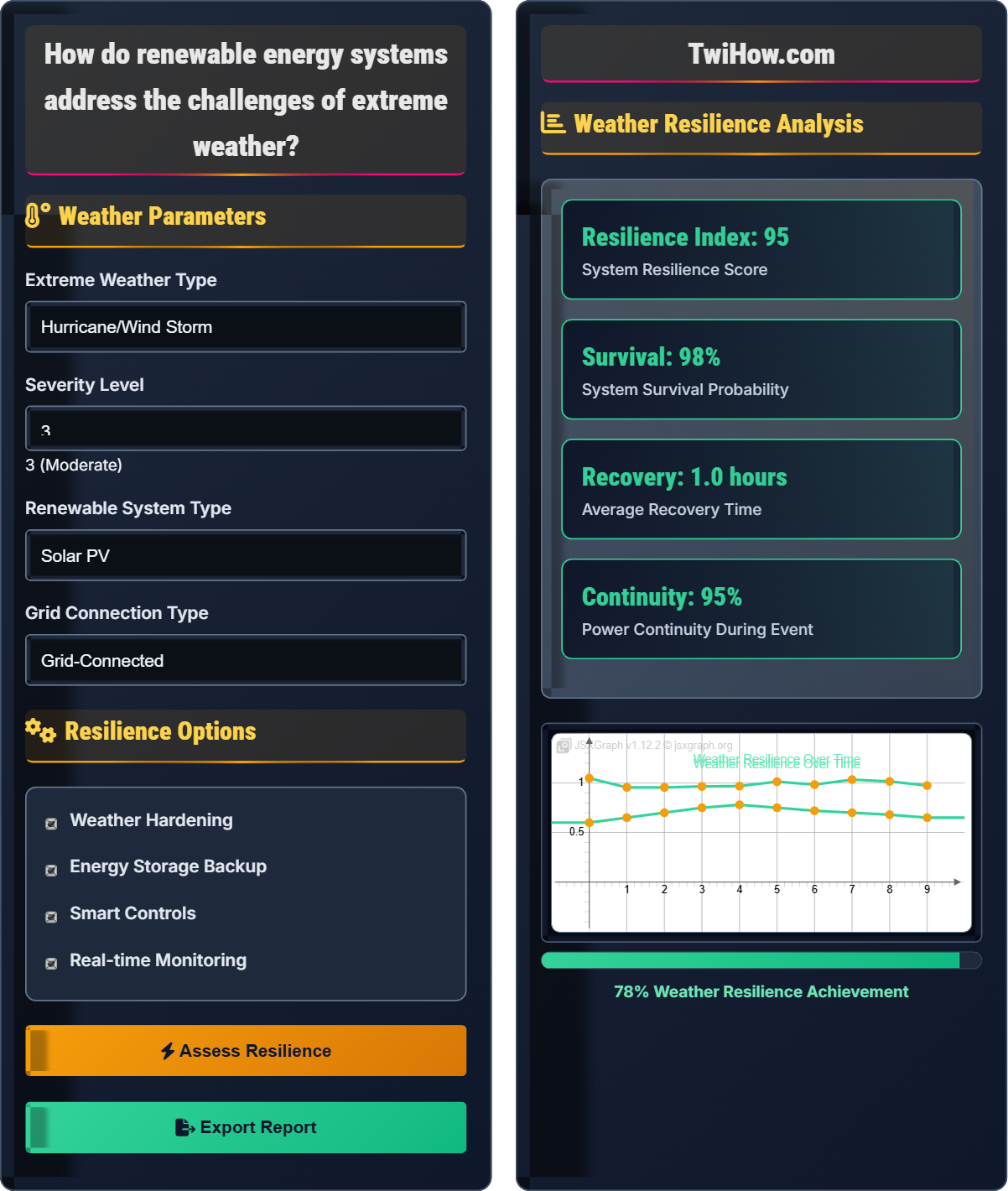
Weather Resilience Analysis
| Resilience Factor | Score | Impact | Improvement |
|---|---|---|---|
| Structural Integrity | 85 | High | Weather-resistant design |
| Operational Continuity | 72 | Medium | Smart controls |
| Recovery Speed | 75 | Medium | Modular design |
| Energy Storage | 88 | High | Battery backup |
| Grid Independence | 70 | Medium | Microgrid capability |
Extreme Weather Visualization
Weather Response Flow
Extreme Weather Resilience Explained
Weather resilience refers to the ability of renewable energy systems to maintain operation, withstand damage, and recover quickly from extreme weather events. This includes resistance to physical damage, operational continuity during adverse conditions, and rapid recovery after events.
Resilience is evaluated through multiple dimensions:
Dimensions include:
- Robustness: Ability to withstand extreme conditions
- Redundancy: Multiple pathways for continued operation
- Resourcefulness: Ability to adapt and respond effectively
- Recovery: Speed and completeness of restoration
- Flexibility: Ability to operate under various conditions
Key challenges by weather type:
- Hurricanes: High winds, flying debris, storm surge
- Ice Storms: Ice accumulation, structural loading, power line damage
- Heat Waves: Thermal stress, reduced efficiency, equipment overheating
- Flooding: Water damage, electrical hazards, foundation issues
- Tornadoes: Extreme winds, debris impact, rapid pressure changes
- Reliability: Continued operation during extreme events
- Reduced Damage: Lower repair and replacement costs
- Energy Security: Maintained power supply during crises
- Grid Stability: Support during grid stress events
- Economic Benefits: Avoided outage costs and faster recovery
Resilience Metrics & Weather Assessment
- Design for local weather extremes and historical patterns
- Implement redundant systems for critical operations
- Use weather-resistant materials and mounting systems
- Deploy energy storage for continuity during outages
Technology-Specific Resilience Profiles
Weather Resilience Quiz
What is the primary design consideration for solar PV systems in hurricane-prone areas?
In hurricane-prone areas, the primary design consideration is wind load resistance. Solar panels must be mounted securely to withstand extreme wind forces that can exceed 150 mph. This includes using appropriate mounting hardware, structural reinforcement, and wind-rated equipment.
The answer is B) Wind load resistance.
Hurricanes create extreme wind loads that can lift, tear, or completely destroy inadequately secured solar installations. The mounting system must be designed to transfer these loads to the structure safely. Wind load calculations consider factors like wind speed, exposure category, and building height.
Wind Load: Force exerted by wind on a structure
Uplift Resistance: Ability to resist upward wind forces
Wind Rating: Maximum wind speed a system can withstand
• Mounting systems must exceed local wind codes
• Secure all components against uplift forces
• Use hurricane straps and reinforcement
• Follow local building codes for wind zones
• Use certified mounting systems
• Regular inspection after storms
• Underestimating wind loads
• Using inadequate mounting hardware
• Not securing racking system properly
Explain how renewable energy systems respond to ice storm conditions and describe protective measures for different technologies.
Ice Storm Challenges: Ice accumulation creates excessive weight loads, reduces structural integrity, and can cause equipment failure.
Solar PV Response: Ice accumulation blocks sunlight and adds weight. Systems may automatically shut down if loads exceed design limits. Anti-icing treatments and heated surfaces can prevent ice formation.
Wind Turbine Response: Most turbines have ice detection systems that automatically shut down when icing conditions are detected to prevent ice throw hazards and structural damage.
Protective Measures: Use ice-resistant materials, implement de-icing systems, and design for ice loading requirements.
Ice storms create unique challenges because ice accumulation can exceed the structural capacity of renewable energy systems. The weight of ice can be many times greater than the equipment itself, requiring special design considerations and automatic protective measures.
Ice Loading: Structural loads caused by ice accumulation
Ice Throw: Dangerous projection of ice from rotating equipment
De-icing Systems: Equipment to remove ice accumulation
• Design for maximum ice loading in area
• Implement automatic shutdown for safety
• Prevent ice throw hazards
• Use ice-resistant mounting systems
• Install ice detection sensors
• Design for easy de-icing access
• Not accounting for ice loading in design
• Failing to implement safety shutdowns
• Ignoring ice throw hazards
A 5 MW solar farm is located in an area experiencing a 5-day heat wave with temperatures reaching 115°F (46°C). Calculate the expected power output reduction and recovery time if the system has heat-resistant components rated for 125°F and cooling systems that maintain 90% efficiency during extreme heat. The normal output is 5 MW, and heat typically reduces output by 0.4% per degree above 77°F.
Temperature Difference:
115°F - 77°F = 38°F difference
Output Reduction:
38°F × 0.4% = 15.2% reduction
Expected Output:
5 MW × (1 - 0.152) = 4.24 MW
With Cooling Systems:
4.24 MW × 90% = 3.82 MW
Recovery Time: With heat-resistant components and cooling, recovery is immediate once temperatures drop to normal levels (within 24 hours).
Heat waves reduce solar panel efficiency due to the negative temperature coefficient of photovoltaic cells. However, proper thermal management and heat-resistant components can maintain operation during extreme temperatures, demonstrating the importance of weather-resilient design.
Temperature Coefficient: Rate of efficiency change with temperature
Heat Resistance: Ability to operate at high temperatures
Thermal Management: Systems to control equipment temperature
• Panels lose efficiency in extreme heat
• Proper ventilation reduces thermal stress
• Heat-resistant components extend operation
• Use panels with low temperature coefficients
• Ensure proper ventilation
• Implement thermal management systems
• Not accounting for temperature effects
• Poor ventilation design
• Using components not rated for local climate
You're designing a renewable energy system for a flood-prone area that experiences 100-year flood events. Identify the key flood resilience measures for different renewable technologies and explain how they would maintain operation during flooding.
Solar PV Measures:
• Elevate panels above projected flood levels
• Use waterproof junction boxes and connections
• Install ground fault protection systems
Wind Turbine Measures:
• Locate turbines outside flood plains
• Elevate electrical equipment above flood levels
• Use submersible electrical components
Energy Storage Measures:
• Seal battery enclosures against water ingress
• Install in elevated, flood-resistant locations
• Implement automatic shutdown protocols
Operation During Flooding: Systems may operate normally if properly elevated and sealed, with energy storage providing backup during grid outages.
Flooding presents electrical hazards and physical damage risks to renewable energy systems. The key is elevating equipment above flood levels and sealing electrical components to prevent water damage. Proper siting is critical for flood resilience.
Flood Plain: Area subject to flooding
IP Rating: Ingress protection rating for water resistance
Ground Fault Protection: Electrical safety system
• Site equipment above flood levels
• Seal all electrical connections
• Implement safety shutdown protocols
• Consult flood maps for siting
• Use IP67 or higher rated equipment
• Install backup power systems
• Improper siting in flood-prone areas
• Not sealing electrical components
• Inadequate grounding systems
Which of the following is the most critical lightning protection measure for renewable energy systems?
Proper grounding and surge protection is the most critical lightning protection measure. Lightning strikes can cause catastrophic damage to electrical systems without proper grounding and surge protection devices that safely conduct lightning energy to ground.
The answer is B) Proper grounding and surge protection.
Lightning protection systems create a path of least resistance for lightning energy to safely reach ground, preventing it from damaging sensitive electronic equipment. Proper grounding connects all equipment to a common ground system, while surge protection devices clamp voltage spikes.
Grounding: Electrical connection to earth
Surge Protection: Devices that limit voltage spikes
Lightning Rod: Device to attract lightning safely
• All equipment must be properly grounded
• Surge protection at all electrical interfaces
• Regular inspection of grounding systems
• Use lightning rods for tall structures
• Install surge protectors at entry points
• Test grounding resistance regularly
• Inadequate grounding connections
• Missing surge protection devices
• Poor grounding conductor sizing
FAQ
Q: How do renewable energy systems compare to conventional power plants in extreme weather resilience?
A: Renewable systems offer both advantages and disadvantages:
Advantages:
• Distributed generation reduces single points of failure
• No fuel supply chain dependencies during disruptions
• Modular design allows partial operation during damage
Disadvantages:
• Weather-dependent output during extreme conditions
• Some technologies vulnerable to specific weather
• May require additional energy storage for continuity
Overall, renewables can provide superior resilience when properly designed and integrated with storage systems.
Q: Can home solar systems provide power during extreme weather events?
A: Home solar systems can provide power during extreme weather depending on configuration:
Grid-Tied Systems: Typically shut down during outages for safety (anti-islanding protection)
Systems with Storage: Can continue operating and provide backup power
Hybrid Systems: Switch to battery backup during outages
Off-Grid Systems: Continue operation independently but limited by battery capacity
For reliable power during extreme weather, systems should include battery storage and be designed for islanding capability.