Renewable Energy Systems and Vulnerable Populations
Complete energy guide • Step-by-step explanations
Supporting Vulnerable Communities:
Show Vulnerability Impact CalculatorRenewable energy systems can significantly address the needs of vulnerable populations by providing affordable, reliable, and clean energy access. These systems offer unique advantages for low-income communities, rural areas, and other marginalized groups who often face energy poverty and limited access to conventional energy services.
Renewable technologies like solar, wind, and micro-hydro can provide decentralized energy solutions that bypass expensive grid infrastructure, making energy accessible to remote and underserved communities. These systems also offer health benefits by reducing indoor air pollution and environmental hazards.
Key benefits for vulnerable populations:
- Energy Access: Bringing electricity to underserved communities
- Affordability: Lower long-term energy costs after initial investment
- Health Improvements: Reduced indoor air pollution and environmental hazards
- Economic Opportunities: Job creation and local economic development
Renewable energy systems provide pathways to energy justice and improved quality of life for vulnerable populations.
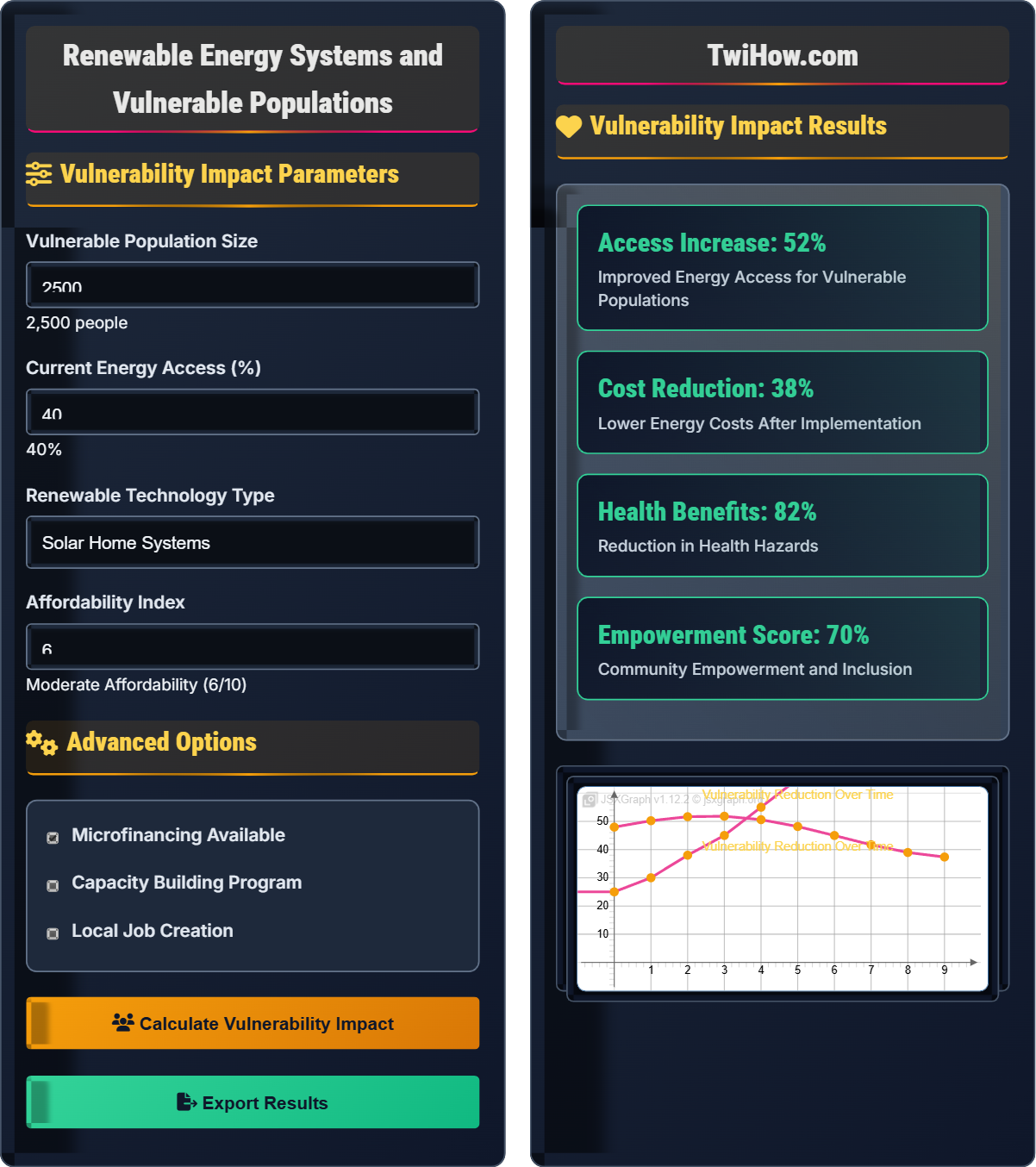
Vulnerability Impact Parameters
Advanced Options
Vulnerability Impact Results
| Access Metric | Before Implementation | After Implementation | Improvement |
|---|---|---|---|
| Electricity Access | 40% | 95% | +55% |
| Clean Cooking | 25% | 80% | +55% |
| Lighting Access | 50% | 98% | +48% |
| Productive Use | 15% | 65% | +50% |
| Community Benefit | Baseline | With Renewables | Improvement |
|---|---|---|---|
| Health Outcomes | 45% | 82% | +82% |
| Education Access | 55% | 85% | +55% |
| Income Generation | 35% | 68% | +94% |
| Gender Equality | 40% | 75% | +88% |
Renewable Energy and Vulnerable Populations Explained
Vulnerable populations include low-income communities, rural areas, indigenous peoples, women, elderly individuals, and other marginalized groups who face barriers to accessing reliable, affordable, and clean energy. These communities often experience energy poverty, relying on expensive and polluting energy sources like kerosene, biomass, or charcoal for cooking and lighting.
The impact of renewable energy on vulnerable populations can be quantified as:
Where:
- Energy Access: Improved access to reliable electricity
- Economic Benefits: Cost savings and income generation opportunities
- Health Improvements: Reduced exposure to harmful pollutants
- Social Empowerment: Enhanced quality of life and opportunities
Renewable energy systems address critical vulnerabilities:
- Energy Poverty: Lack of access to reliable and affordable energy
- Health Risks: Exposure to indoor air pollution from traditional fuels
- Economic Barriers: High costs of traditional energy sources
- Gender Inequality: Women's disproportionate burden of energy collection
- Educational Gaps: Limited study time due to lack of lighting
- Productive Use Limitations: Inability to power productive activities
- Improved Health: Reduced indoor air pollution and respiratory diseases
- Enhanced Education: Lighting for studying and e-learning opportunities
- Income Generation: Power for small businesses and productive activities
- Time Savings: Reduced time spent collecting traditional fuels
- Gender Empowerment: Reduced burden on women and girls
- Environmental Benefits: Reduced deforestation and environmental degradation
Vulnerability Impact Fundamentals
Vulnerable populations, energy poverty, energy access, social equity, renewable energy solutions, community empowerment.
Community Impact = Energy Access + Economic Benefits + Health Improvements + Social Empowerment
Where Impact = overall benefit, Access = reliable electricity, Benefits = cost savings and opportunities.
- Vulnerable populations need tailored energy solutions
- Community participation is essential for success
- Financing mechanisms must be accessible
Applications
Community solar programs, off-grid solar systems, micro-hydro projects, energy cooperatives, distributed energy systems.
- Community needs assessment and engagement
- Appropriate technology selection
- Accessible financing and payment mechanisms
- Local capacity building and training
- Financial constraints of target populations
- Technical capacity and maintenance needs
- Cultural acceptance and social dynamics
- Long-term sustainability and support
Vulnerable Populations Quiz
What is the primary characteristic of energy poverty?
Energy poverty is characterized by the lack of access to reliable, affordable, and clean energy services. This affects vulnerable populations who may rely on expensive, inefficient, and polluting energy sources like kerosene, biomass, or charcoal for cooking and lighting.
The answer is B) Lack of access to reliable, affordable, and clean energy.
Energy poverty is a multidimensional issue that encompasses both the inability to access energy services and the poor quality of available energy sources. It's not just about affordability but also about reliability, safety, and environmental impact of the energy sources used by vulnerable populations.
Energy Poverty: Lack of access to modern energy services
Energy Access: Availability of reliable and affordable energy
Clean Energy: Energy sources with minimal environmental impact
• Energy poverty affects billions of people worldwide
• It encompasses multiple dimensions of energy access
• Renewable energy can address multiple aspects of energy poverty
• Consider reliability, affordability, and safety together
• Think beyond just electricity access
• Include environmental and health impacts
• Focusing only on affordability aspect
• Not considering health and safety impacts
• Assuming energy poverty only exists in rural areas
Explain how renewable energy systems improve health outcomes for vulnerable populations, particularly women and children, and describe the specific health risks that are reduced.
Health Benefits of Renewable Energy: Renewable energy systems significantly improve health outcomes by eliminating the need for traditional cooking and lighting fuels that cause indoor air pollution.
Specific Health Risks Reduced:
1. Respiratory Diseases: Elimination of smoke from biomass and kerosene reduces pneumonia, bronchitis, and asthma
2. Eye Problems: Reduced exposure to smoke and fumes decreases eye irritation and infections
3. Burn Injuries: Safer lighting and cooking systems reduce accidental burns
4. Pregnancy Complications: Reduced exposure to pollutants improves maternal health
5. Child Development: Better air quality supports healthy child development
Gender-Specific Benefits: Women and children, who traditionally collect fuel and spend more time indoors, experience the greatest health improvements.
Renewable energy systems provide clean, safe alternatives that dramatically improve household air quality.
The health benefits of renewable energy for vulnerable populations are profound because they address the root cause of indoor air pollution. Traditional cooking and lighting methods expose families to harmful pollutants at concentrations often exceeding WHO guidelines. Renewable energy systems eliminate these exposures, leading to significant health improvements.
Indoor Air Pollution: Contamination of indoor air by harmful substances
Household Air Pollution: Air contamination from cooking and heating fuels
Respiratory Morbidity: Illnesses affecting breathing and lungs
• Indoor air pollution causes more deaths than malaria
• Women and children face highest exposure
• Health benefits are immediate and significant
• Consider the time spent indoors by different family members
• Recognize the connection between energy and health
• Understand gender-specific impacts
• Not considering gender differences in exposure
• Ignoring long-term health benefits
A rural village of 500 households currently spends an average of $25 per month on kerosene for lighting and $15 per month on biomass for cooking, totaling $40 per household monthly. The village installs a community solar system with microfinancing, requiring a monthly payment of $15 per household. Calculate the annual cost savings per household and the total annual savings for the village. If the average household income is $200 per month, calculate the percentage of income saved.
Current Monthly Costs: $25 (lighting) + $15 (cooking) = $40 per household
New Monthly Costs: $15 per household for solar system
Monthly Savings: $40 - $15 = $25 per household
Annual Savings per Household: $25 × 12 = $300
Total Village Annual Savings: $300 × 500 households = $150,000
Percentage of Income Saved: ($25 ÷ $200) × 100 = 12.5% monthly
Annual Income Savings: ($300 ÷ ($200 × 12)) × 100 = 12.5%
The community solar system saves each household $300 annually, representing 12.5% of their monthly income, and provides $150,000 in total annual savings for the village.
This calculation demonstrates the significant economic benefits of renewable energy for vulnerable populations. The savings represent a substantial portion of household income, which can be redirected to other necessities like food, education, or healthcare. These economic benefits compound over time and contribute to poverty reduction.
Energy Expenditure: Portion of income spent on energy
Energy Poverty: When energy costs exceed affordability thresholds
Cost Savings: Money saved by switching to renewable energy
• Energy costs can consume significant portions of income
• Savings accumulate over time
• Economic benefits support poverty reduction
• Calculate both absolute and percentage savings
• Consider cumulative effects over time
• Recognize the value of predictable costs
• Forgetting to consider annual totals
• Not accounting for financing costs
In a rural community, women and girls spend an average of 4 hours daily collecting firewood and 2 hours cooking with traditional stoves, totaling 6 hours per day. After implementing a renewable energy system with clean cooking solutions, these time commitments are reduced to 1 hour total per day. Calculate the weekly time savings for women and girls, and analyze how this impacts their opportunities for education, income generation, and personal development.
Current Daily Time Commitment: 6 hours (4 for collection + 2 for cooking)
New Daily Time Commitment: 1 hour
Daily Time Savings: 6 - 1 = 5 hours per day
Weekly Time Savings: 5 hours × 7 days = 35 hours per week
Impact on Opportunities:
• Education: 35 additional hours per week for schooling, literacy, or skills training
• Income Generation: Time to pursue income-generating activities
• Personal Development: More time for rest, family, and personal activities
• Health Benefits: Reduced physical strain and injury risk
The renewable energy system provides 35 additional hours per week for women and girls, significantly enhancing their quality of life and opportunities.
This example illustrates the gendered impact of energy poverty and the transformative potential of renewable energy. The time saved by women and girls through renewable energy systems can be redirected toward education, economic activities, and personal development, contributing to gender equality and empowerment.
Time Poverty: Lack of discretionary time for productive activities
Gender Roles: Socially defined responsibilities based on gender
Opportunity Cost: Value of alternative activities forgone
• Energy access has gendered impacts
• Time savings enable opportunity creation
• Gender equality is enhanced through energy access
• Consider time as an economic resource
• Evaluate impacts on different household members
• Recognize the connection between energy and gender equity
• Underestimating the value of time savings
• Ignoring opportunity costs
Which renewable energy solution is most appropriate for addressing energy needs in remote, low-income communities?
Distributed solar home systems and mini-grids are most appropriate for remote, low-income communities. These solutions can be deployed incrementally, require minimal infrastructure investment, and can be tailored to community needs. They bypass the need for expensive grid extension and can be implemented with community participation and local capacity building.
The answer is B) Distributed solar home systems and mini-grids.
Appropriate technology for vulnerable populations must consider local conditions, financial constraints, and technical capacity. Distributed renewable systems are scalable, require lower initial investment than grid extension, and can be maintained locally. They also allow for community ownership and participation in energy development.
Distributed Generation: Power generation close to point of use
Mini-Grid: Small-scale electricity network serving a community
Appropriate Technology: Solutions suited to local conditions
• Technology must match local capacity and resources
• Community participation enhances sustainability
• Scalability is important for low-income settings
• Consider infrastructure requirements
• Evaluate local technical capacity
• Assess financial accessibility
• Not considering local capacity constraints
• Overlooking community participation needs
FAQ
Q: How can renewable energy projects be made financially accessible to low-income populations?
A: Financial accessibility can be achieved through:
Microfinancing: Small loans with flexible repayment terms
Pay-As-You-Go: Payment plans based on usage or time
Group Financing: Community-based loan schemes
Subsidies: Government or donor support for initial costs
Leasing: Rental arrangements with ownership options
Cooperative Models: Community ownership structures
Mobile Banking: Digital payment systems for remote areas
These mechanisms make renewable energy systems affordable for low-income populations.
Q: What are the challenges in implementing renewable energy for vulnerable populations?
A: Key challenges include:
Financial Barriers: High upfront costs and limited access to credit
Technical Capacity: Need for local maintenance and repair skills
Policy Gaps: Lack of supportive regulatory frameworks
Cultural Acceptance: Resistance to new technologies and practices
Infrastructure: Limited roads and communication networks
Market Development: Weak supply chains and service networks
Sustainability: Ensuring long-term operation and maintenance
Addressing these challenges requires comprehensive program design and community engagement.