How Do Renewable Energy Systems Integrate with Existing Grid Infrastructure?
Complete grid integration guide • Step-by-step explanations
Grid Integration Overview:
Show Integration SimulatorRenewable energy systems integrate with existing grid infrastructure through sophisticated power electronics, control systems, and grid management technologies. The integration process involves converting variable renewable energy sources into grid-compatible electricity, managing intermittency, and ensuring system stability. Modern grid integration relies on advanced inverters, smart grid technologies, energy storage systems, and flexible grid operations.
Key integration challenges include managing the variable and intermittent nature of renewable sources, maintaining grid stability, ensuring power quality, and adapting existing infrastructure to accommodate bidirectional power flows. Successful integration requires coordinated planning, advanced forecasting, real-time control systems, and grid modernization efforts.
Integration components and technologies:
- Power Electronics: Inverters, converters, and conditioning equipment
- Control Systems: SCADA, EMS, and advanced automation platforms
- Grid Infrastructure: Transmission upgrades, smart meters, and sensors
- Energy Storage: Batteries, pumped hydro, and other storage solutions
- Forecasting Tools: Weather prediction and generation forecasting
Effective renewable integration transforms the grid into a more flexible, resilient, and intelligent system capable of handling diverse energy sources while maintaining reliability and power quality.
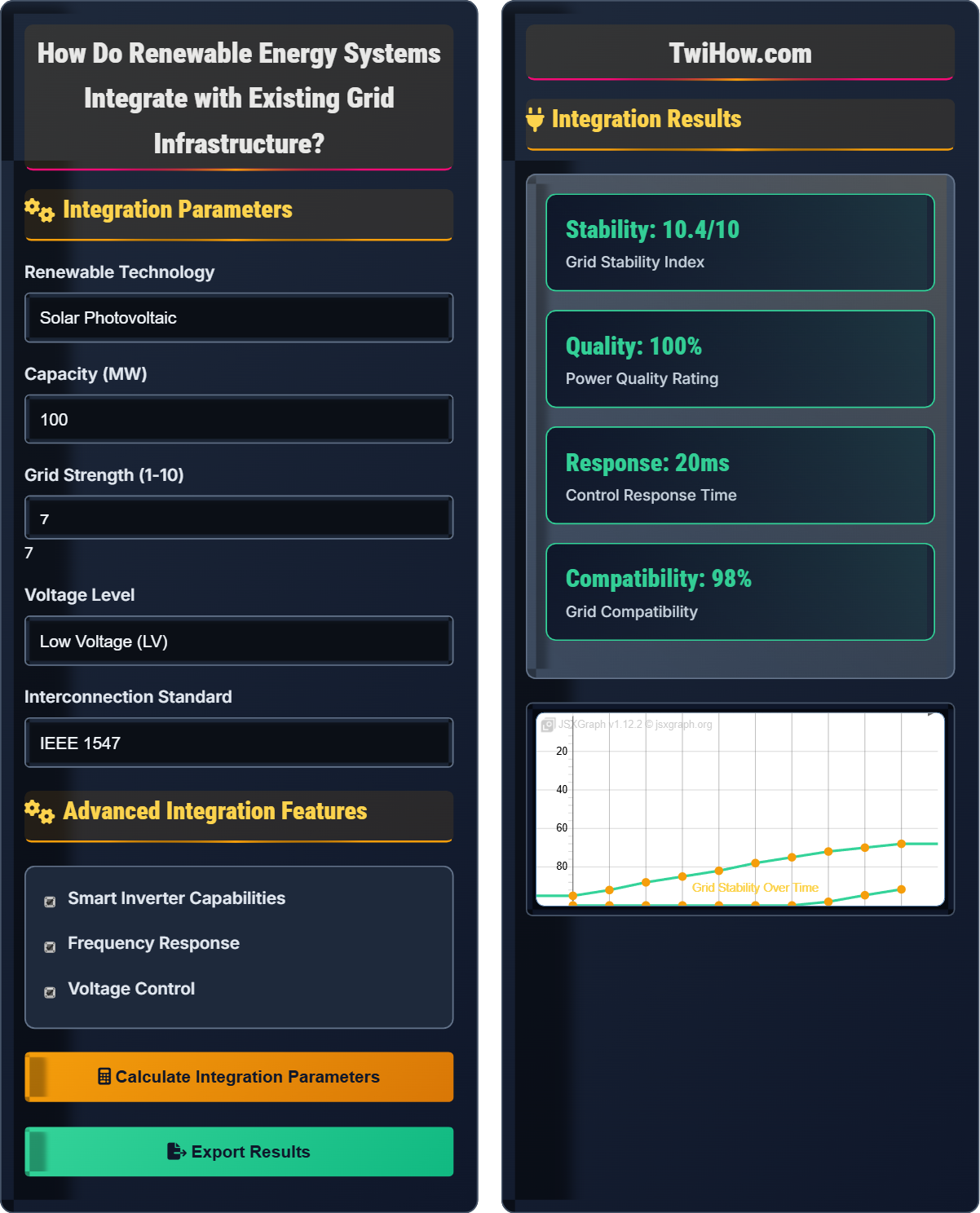
Integration Parameters
Advanced Integration Features
Integration Results
| Parameter | Value | Standard | Status |
|---|---|---|---|
| Voltage Regulation | ±2% | ±5% | Good |
| Frequency Stability | 60.02 Hz | 59.9-60.1 Hz | Excellent |
| Power Factor | 0.98 | 0.95 | Good |
| Harmonic Distortion | 2.1% | 5% | Excellent |
| Islanding Detection | Pass | Required | Compliant |
Grid Integration Explained
Renewable energy integration involves connecting variable energy sources to the electrical grid while maintaining stability, reliability, and power quality. The process requires sophisticated power electronics to convert DC renewable energy to AC grid-compatible electricity, advanced control systems to manage power flows, and grid infrastructure upgrades to accommodate bidirectional power flows.
Key integration calculations:
Where:
- Grid Stability Index: Measure of system stability with renewables
- Short Circuit Capacity: Grid's ability to withstand disturbances
- Harmonic Distortion: Deviation from pure sine wave
Modern grid integration utilizes several key technologies:
- Smart Inverters: Provide grid support functions and advanced control
- Energy Storage: Smooth out renewable variability and provide backup
- Advanced Metering: Real-time monitoring and control capabilities
- SCADA Systems: Supervisory control and data acquisition
- Forecasting Tools: Predict renewable output and grid conditions
- Voltage Regulation: Maintain voltage within acceptable ranges
- Frequency Control: Help stabilize grid frequency
- Reactive Power: Support grid voltage through reactive power
- Islanding Detection: Safely disconnect during grid outages
- Fault Ride-Through: Remain connected during grid faults
Integration Fundamentals
Grid stability, power quality, voltage regulation, frequency control, reactive power, interconnection standards.
Stability Index = (Renewable Capacity / Grid Short Circuit Capacity) × 100
Where Stability Index = system stability measure, Capacity = generation capacity, Short Circuit = grid strength indicator.
- Renewable capacity should be less than 20% of short circuit capacity
- Voltage regulation must stay within ±5% of nominal
- Frequency must remain within 59.9-60.1 Hz
Integration Technologies
Smart inverters provide advanced grid support functions beyond basic DC-to-AC conversion. They can regulate voltage, provide reactive power, respond to grid conditions, and participate in grid stability services. These devices are essential for high-penetration renewable integration.
- VAR Control: Regulate reactive power output
- Voltage-Watt: Reduce output when voltage rises
- Frequency-Watt: Adjust output based on frequency
- Soft Start: Gradual power increase to prevent surges
- Grid Following: Synchronize with grid voltage and frequency
- Grid infrastructure must handle bidirectional flows
- Protection systems need modification
- Monitoring and control systems must be upgraded
- Standards compliance is mandatory
Grid Integration Quiz
What is the primary concern when integrating high levels of renewable energy into the grid?
The primary concern with high renewable penetration is grid stability and frequency control. Traditional synchronous generators provide inertia that helps maintain grid stability, while renewable sources like solar and wind are typically connected through power electronics that don't inherently provide the same stabilizing characteristics. This requires new approaches to grid management and control.
The answer is B) Grid stability and frequency control.
Grid stability is fundamental to reliable electricity supply. The transition from synchronous generation to inverter-based renewable generation changes the grid's dynamic characteristics. Understanding these stability challenges is crucial for designing appropriate integration solutions and maintaining reliable service.
Grid Stability: Ability to maintain steady voltage and frequency
Inertia: Physical property that resists frequency changes
Synchronous Generator: Traditional generator synchronized with grid
• Renewable sources have different stability characteristics
• Grid stability requires new management approaches
• Frequency control is critical for grid operation
• Consider virtual inertia solutions
• Plan for frequency regulation services
• Design appropriate control systems
• Assuming renewable integration doesn't affect stability
• Not considering dynamic grid characteristics
• Ignoring frequency control requirements
Explain how renewable energy systems affect power quality and describe the measures taken to maintain acceptable power quality levels.
Power Quality Effects: Renewable energy systems connected through power electronics can introduce harmonic distortion, voltage fluctuations, and flicker. The variable nature of renewable sources can cause rapid power changes that affect voltage stability.
Mitigation Measures:
1. Harmonic Filtering: Install passive or active filters to reduce harmonic distortion
2. Power Electronics Design: Use advanced inverters with low harmonic output
3. Voltage Regulation: Implement automatic voltage regulators and tap changers
4. Energy Storage: Use batteries to smooth out power fluctuations
5. Control Systems: Implement sophisticated control algorithms to manage power flows
6. Monitoring Equipment: Install power quality monitoring devices to track compliance
These measures ensure that renewable integration maintains power quality within acceptable standards.
Power quality is essential for reliable electricity supply and equipment protection. Renewable systems introduce new challenges because they use power electronics that can create electrical disturbances. Proper design and mitigation measures are essential to maintain high power quality while integrating renewable energy.
Power Quality: Characteristics of electrical power supply
Harmonic Distortion: Deviation from pure sine wave
Flicker: Rapid voltage fluctuations
• Harmonic distortion must stay below 5%
• Voltage fluctuations should be minimized
• Power quality standards must be met
• Use high-quality power electronics
• Install appropriate filtering
• Monitor power quality continuously
• Not considering power quality impacts
• Inadequate harmonic filtering
• Ignoring voltage regulation needs
A 50MW solar farm is planned for a distribution feeder with 100MW of existing load and 200MVA short circuit capacity. The grid operator requires that renewable capacity not exceed 20% of short circuit capacity for stable operation. Calculate whether the proposed solar farm meets this requirement and explain the implications.
Calculation:
Maximum allowable renewable capacity = 20% of short circuit capacity
Maximum capacity = 0.20 × 200MVA = 40MW
Proposed solar capacity = 50MW
50MW > 40MW, so the proposed solar farm exceeds the stability limit.
Implications:
1. Grid Stability: Higher renewable penetration may compromise stability
2. Infrastructure Upgrades: May require grid strengthening measures
3. Alternative Solutions: Consider smaller installations or distributed deployment
4. Control Systems: Advanced control systems may allow higher penetration
5. Energy Storage: Storage could help manage intermittency effects
The project would need to be redesigned or the grid strengthened to accommodate the proposed capacity.
This example demonstrates the importance of grid strength in determining renewable integration capacity. The short circuit capacity represents the grid's ability to handle disturbances and maintain stability. Understanding these limits is crucial for successful renewable integration planning.
Short Circuit Capacity: Grid's ability to handle fault conditions
Grid Strength: Measure of grid's stability characteristics
Interconnection Study: Technical analysis of grid impacts
• Renewable capacity should be less than 20% of SCC
• Stability limits must be respected
• Conduct thorough grid studies early
• Consider grid strengthening options
• Plan for distributed deployment
• Not considering grid strength limits
• Assuming any amount of renewables can be accommodated
• Ignoring stability requirements
A utility is integrating 200MW of wind power into a transmission system. The system currently lacks adequate monitoring and control capabilities for variable generation. Propose a smart grid upgrade plan to safely accommodate the wind integration while maintaining reliability.
Smart Grid Upgrade Plan:
1. Advanced Metering Infrastructure: Install smart meters and sensors throughout the system
2. SCADA System Enhancement: Upgrade supervisory control and data acquisition
3. Real-Time Monitoring: Implement phasor measurement units (PMUs) for grid visibility
4. Forecasting Systems: Deploy weather and generation forecasting tools
5. Automated Controls: Implement automatic generation control and voltage regulation
6. Communication Networks: Upgrade to secure, high-speed communications
7. Energy Storage: Deploy storage systems for renewable smoothing
8. Grid Flexibility: Enhance system flexibility through demand response
This comprehensive upgrade would enable safe and reliable integration of the wind power while maintaining system reliability.
Smart grid technologies are essential for managing variable renewable energy. The integration of advanced monitoring, control, and communication systems enables utilities to maintain reliability while accommodating high levels of renewable generation. This represents the evolution of the grid to handle modern energy systems.
SCADA: Supervisory Control and Data Acquisition
PMU: Phasor Measurement Unit for grid monitoring
Smart Grid: Modernized grid with advanced technologies
• Visibility is essential for control
• Communication systems must be reliable
• Automation improves response time
• Plan upgrades systematically
• Consider cybersecurity requirements
• Ensure interoperability
• Not upgrading monitoring systems
• Ignoring communication requirements
• Failing to consider cybersecurity
Which of the following is NOT a critical standard for renewable energy grid integration?
While ISO 9001 is an important quality management standard, it is not specifically related to grid integration requirements. IEEE 1547 defines interconnection requirements, UL 1741 specifies safety requirements for inverters, and IEC 61850 provides communication protocols for grid automation - all critical for renewable integration. ISO 9001 is a general quality standard that doesn't address grid-specific technical requirements.
The answer is D) ISO 9001 (Quality Management).
Grid integration requires compliance with specific technical standards that address electrical safety, grid stability, and communication requirements. While general quality standards are important for business operations, they don't address the technical requirements for safe and reliable grid connection.
IEEE 1547: Interconnection requirements for distributed resources
UL 1741: Safety standard for power conversion equipment
IEC 61850: Communication standard for substation automation
• Grid integration requires specific technical standards
• Safety standards are mandatory
• Communication standards enable control
• Familiarize with relevant standards
• Ensure compliance during design
• Stay updated on standard changes
• Confusing general standards with technical requirements
• Not understanding specific grid standards
• Assuming all standards are equally relevant
FAQ
Q: How do smart inverters help with grid integration?
A: Smart inverters provide advanced grid support functions:
Voltage Regulation: Automatically adjust reactive power output to maintain voltage within limits
Frequency Response: Adjust active power output based on grid frequency deviations
Soft Start: Gradually increase power output to prevent grid disturbances
Islanding Detection: Safely disconnect when grid is no longer present
Fault Ride-Through: Remain connected during grid faults within specified limits
Power Factor Control: Maintain desired power factor for grid support
Smart inverters enable higher renewable penetration while maintaining grid stability and power quality.
Q: What infrastructure upgrades are typically needed for renewable integration?
A: Common infrastructure upgrades for renewable integration:
Transmission Lines: Upgrade capacity to handle increased power flows
Substations: Install new equipment for monitoring and control
Protection Systems: Modify relay settings for bidirectional flows
SCADA Systems: Enhance monitoring and control capabilities
Metering: Deploy advanced metering infrastructure
Communications: Upgrade networks for real-time data exchange
Energy Storage: Install storage for renewable smoothing
The specific upgrades depend on the amount and type of renewable generation being integrated.