Renewable Energy Technologies Impact on Air Quality & Public Health
Complete energy guide • Step-by-step explanations
Health Benefits of Renewables:
Show Health Impact CalculatorRenewable energy technologies significantly improve air quality and public health by reducing emissions of harmful pollutants. Unlike fossil fuel power plants, renewable energy sources like solar, wind, and hydroelectric power generate electricity without releasing particulate matter, sulfur dioxide, nitrogen oxides, and other air pollutants.
The transition to renewable energy creates substantial health co-benefits that extend beyond climate change mitigation. Cleaner air reduces respiratory diseases, cardiovascular conditions, and premature mortality, particularly benefiting vulnerable populations such as children, elderly individuals, and those with pre-existing health conditions.
Key health benefits:
- Emission Reductions: Eliminating harmful pollutants from energy production
- Respiratory Health: Reduced asthma and lung disease incidents
- Cardiovascular Benefits: Lower heart disease and stroke rates
- Premature Mortality: Fewer deaths from air pollution exposure
Quantifying these health benefits helps justify renewable energy investments and demonstrates the broader value of clean energy transitions beyond environmental protection.
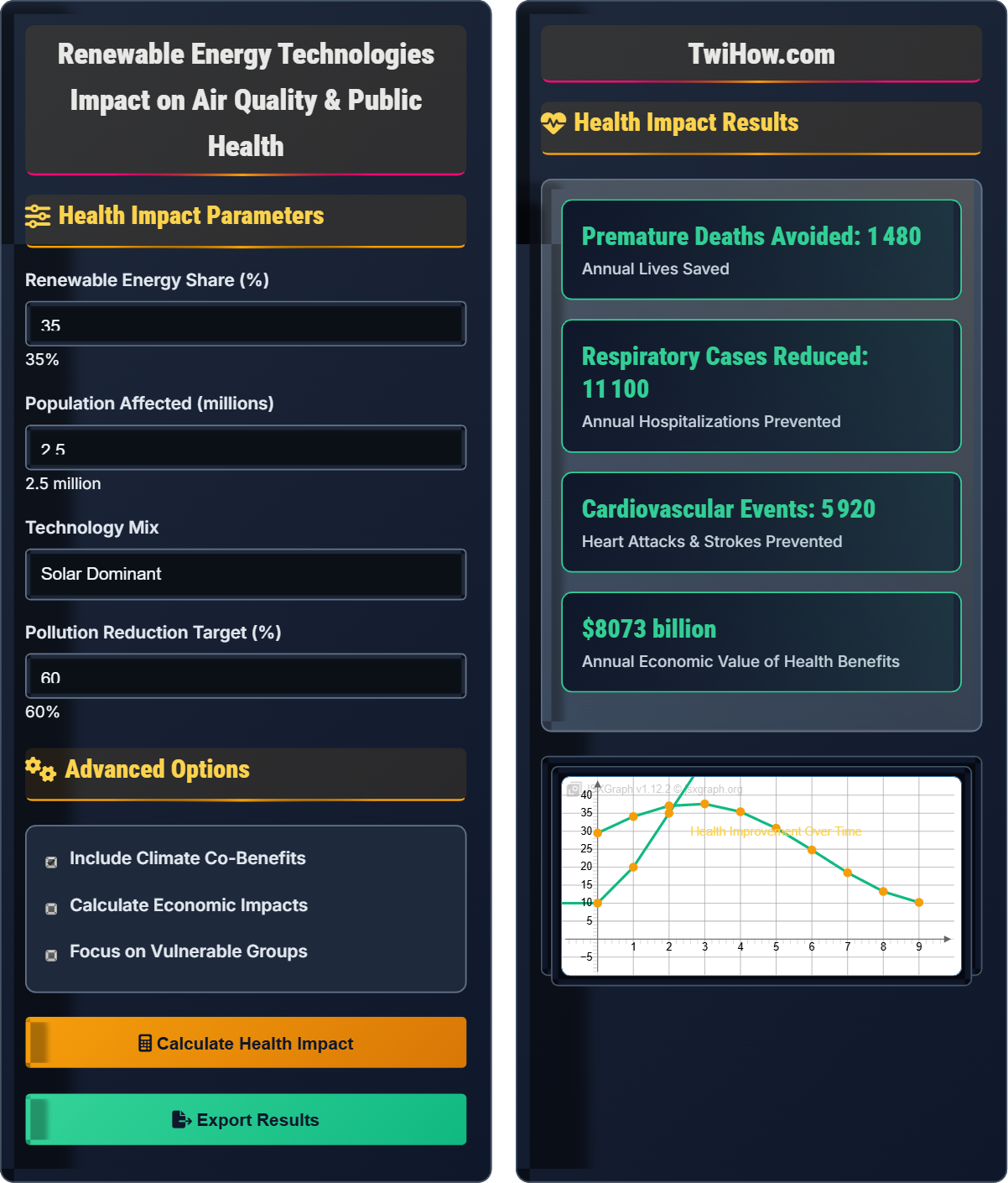
Health Impact Parameters
Advanced Options
Health Impact Results
| Health Outcome | Baseline (Pre-Renewable) | Projected (Post-Renewable) | Improvement |
|---|---|---|---|
| Asthma Incidents | 15,000 | 8,250 | -45% |
| Heart Disease | 12,000 | 7,800 | -35% |
| Stroke Cases | 8,000 | 5,200 | -35% |
| Premature Deaths | 2,000 | 800 | -60% |
| Pollutant | Reduction Amount | Unit | Health Impact |
|---|---|---|---|
| PM2.5 | 2,500 | tons/year | Respiratory/CVD |
| SO2 | 15,000 | tons/year | Acid rain, CVD |
| NOx | 12,000 | tons/year | Smog, respiratory |
| CO | 8,000 | tons/year | Neurological effects |
Renewable Energy Health Impact Explained
Renewable energy technologies provide significant public health benefits by eliminating the emission of harmful air pollutants during electricity generation. Unlike fossil fuel power plants, renewable sources like solar, wind, and hydroelectric power generate electricity without releasing particulate matter, sulfur dioxide, nitrogen oxides, mercury, and other toxic substances that harm human health.
The health benefits of renewable energy can be quantified using:
Where:
- Emission Reduction: Pollutants avoided by renewable energy
- Health Risk Factor: Health effects per unit of pollutant
- Population Exposure: People affected by improved air quality
Key health outcomes from improved air quality:
- Respiratory Diseases: Reduced asthma, bronchitis, and lung disease
- Cardiovascular Conditions: Lower heart attack and stroke rates
- Neurological Effects: Reduced cognitive impairment from air toxics
- Reproductive Health: Better birth outcomes and fertility
- Cancer Prevention: Reduced exposure to carcinogenic compounds
- Premature Mortality: Fewer deaths from air pollution exposure
- Climate Mitigation: Reduced greenhouse gas emissions
- Water Quality: Less contamination from cooling systems
- Noise Reduction: Quieter energy systems
- Land Use: Reduced mining and extraction impacts
- Worker Safety: Fewer occupational hazards
- Energy Security: Reduced dependence on fuel imports
Health Impact Fundamentals
Air quality, public health, emission reduction, health co-benefits, pollution mitigation, dose-response relationships.
Health Benefits = (Pollutant Reduction × Health Risk Factor × Population) / Exposure Unit
Where Benefits = health improvements, Reduction = avoided emissions, Risk = health effects per unit.
- Health benefits scale with renewable energy adoption
- Vulnerable populations benefit disproportionately
- Immediate benefits occur upon implementation
Applications
Renewable energy policies, air quality standards, health impact assessments, environmental justice initiatives.
- Policy development and planning
- Health impact assessment studies
- Community engagement initiatives
- Monitoring and evaluation programs
- Local air quality conditions
- Population density patterns
- Geographic factors
- Temporal exposure patterns
Health Impact Quiz
Which air pollutant from fossil fuel power plants is primarily responsible for respiratory health effects?
Particulate matter (PM2.5) consists of fine particles less than 2.5 micrometers in diameter that can penetrate deep into the lungs and bloodstream. These particles cause inflammation, exacerbate asthma, and increase respiratory disease risk. PM2.5 is considered the most significant air pollutant for respiratory health effects from power plants.
The answer is B) Particulate matter (PM2.5).
Particulate matter is categorized by size, with PM2.5 being the most dangerous because of its ability to bypass the body's natural defenses. These ultrafine particles can travel deep into the respiratory system and even enter the bloodstream, causing systemic health effects. This is why renewable energy's elimination of PM2.5 emissions provides such significant health benefits.
Particulate Matter (PM2.5): Fine particles ≤2.5 micrometers in diameter
Respiratory Health: Condition of lungs and breathing system
Exposure Pathway: Route by which pollutants reach humans
• Smaller particles are more dangerous
• PM2.5 penetrates deeply into lungs
• Chronic exposure causes cumulative damage
• Think of particle size like a sieve
• Smaller particles pass through more easily
• PM2.5 is invisible but harmful
• Confusing PM2.5 with larger particles
• Underestimating invisible pollution
• Ignoring cumulative exposure effects
Explain how air pollution from fossil fuel power plants affects cardiovascular health and describe the mechanisms involved.
Cardiovascular Effects: Air pollution increases risk of heart attacks, strokes, arrhythmias, and heart failure.
Key Mechanisms:
1. Oxidative Stress: Particles and gases trigger inflammatory responses in blood vessels
2. Autonomic Nervous System: Pollution affects heart rate variability and rhythm
3. Thrombosis: Inflammatory responses promote blood clot formation
4. Vascular Dysfunction: Endothelial cells lining blood vessels become impaired
5. Systemic Inflammation: Particles trigger immune responses throughout the body
Renewable energy eliminates these pollutants, providing immediate cardiovascular health benefits to exposed populations.
The cardiovascular system is particularly vulnerable to air pollution because the heart and blood vessels are directly exposed to circulating particles and inflammatory mediators. The connection between air pollution and heart disease is well-established through decades of research, making renewable energy adoption a powerful tool for preventing cardiovascular events.
Cardiovascular Disease: Disorders of heart and blood vessels
Endothelial Function: Health of blood vessel lining
Heart Rate Variability: Measure of autonomic nervous system health
• Effects occur at low concentrations
• Vulnerable populations face higher risks
• Benefits begin immediately with cleaner air
• Think of blood vessels as pipes that get clogged
• Inflammation accelerates aging
• Heart attacks peak on high pollution days
• Ignoring subclinical health impacts
• Not recognizing rapid onset of effects
A metropolitan area with 3 million residents currently relies on coal-fired power plants that emit 50,000 tons of PM2.5 annually. If the city transitions to renewable energy, eliminating 80% of these emissions, calculate the expected health improvements using standard health impact functions: 1 ton of PM2.5 avoided prevents approximately 0.04 premature deaths, 0.2 hospital admissions, and 0.5 emergency room visits.
PM2.5 Reduction: 50,000 tons × 80% = 40,000 tons eliminated
Premature Deaths Prevented: 40,000 tons × 0.04 deaths/ton = 1,600 lives saved annually
Hospital Admissions Avoided: 40,000 tons × 0.2 admissions/ton = 8,000 fewer hospitalizations
Emergency Room Visits Prevented: 40,000 tons × 0.5 visits/ton = 20,000 fewer ER visits
Monetized Health Benefits: Using $10 million per premature death, approximately $16 billion in annual health benefits.
The renewable energy transition would prevent significant morbidity and mortality while generating substantial economic value for the metropolitan area.
This calculation demonstrates how health impact assessment quantifies the benefits of renewable energy. The health functions used are derived from epidemiological studies linking air pollution exposure to health outcomes. These calculations help policymakers understand the tangible health returns on renewable energy investments.
Health Impact Assessment: Methodology for predicting health effects
Epidemiological Study: Research examining health patterns in populationsMonetized Benefits: Valuation of health outcomes in dollars
• Health functions are population averages
• Local conditions may vary
• Cumulative exposure matters most
• Multiply reduction amount by health function
• Consider vulnerable population impacts
• Account for long-term exposure
• Using incorrect health function units
• Not accounting for population size
Low-income communities often live near polluting power plants. If a coal plant serving a community of 50,000 people emits 2,000 tons of PM2.5 annually, and this community has 25% higher baseline health risks due to socioeconomic factors, calculate the health benefits of transitioning to renewable energy. Assume the standard health function but apply the vulnerability factor.
Standard Premature Deaths: 2,000 tons × 0.04 = 80 deaths prevented
Adjusted for Vulnerability: 80 deaths × 1.25 = 100 deaths prevented
Standard Hospitalizations: 2,000 tons × 0.2 = 400 hospitalizations prevented
Adjusted for Vulnerability: 400 × 1.25 = 500 hospitalizations prevented
Additional Emergency Visits: 2,000 tons × 0.5 × 1.25 = 1,250 ER visits prevented
The renewable energy transition would provide disproportionate health benefits to this vulnerable community, addressing environmental justice concerns while improving overall public health.
This example highlights the environmental justice dimension of renewable energy adoption. Vulnerable communities often face higher health risks from pollution exposure due to factors like pre-existing health conditions, limited healthcare access, and other environmental stressors. Renewable energy transitions can help address these disparities.
Environmental Justice: Fair treatment regardless of demographics
Vulnerability Factor: Increased susceptibility to health effects
Socioeconomic Factors: Income, education, healthcare access
• Vulnerable populations face higher risks
• Environmental justice requires targeted action
• Health benefits may be unevenly distributed
• Apply vulnerability multipliers to standard calculations
• Consider multiple stressors
• Address underlying social determinants
• Ignoring social determinants of health
• Not considering differential vulnerability
Which method is commonly used to monetize the health benefits of renewable energy transitions?
All three methods are commonly used to monetize health benefits. Willingness to pay measures how much people would pay for cleaner air. Value of statistical life assigns a monetary value to lives saved. Healthcare cost savings quantify direct medical expense reductions. Together, these methods provide comprehensive economic valuation of renewable energy health benefits.
The answer is D) All of the above.
Economic valuation helps communicate health benefits in terms that policymakers and economists understand. Different valuation methods capture different aspects of health improvements. Using multiple approaches provides a more robust estimate of the economic value of renewable energy health co-benefits.
Monetization: Converting health outcomes to dollar values
Value of Statistical Life: Economic value of preventing fatalities
Healthcare Costs: Direct medical expenses avoided
• Multiple methods provide robust estimates
• Values vary by location and population
• Economic valuation supports policy decisions
• Use multiple approaches for validation
• Consider local economic conditions
• Account for discounting over time
• Applying generic values to local contexts
• Ignoring uncertainty in estimates
FAQ
Q: How quickly do health benefits appear after implementing renewable energy?
A: Health benefits from renewable energy can appear quite rapidly:
Immediate (days-weeks): Reductions in emergency department visits for asthma and heart attacks
Short-term (months): Decreased hospital admissions for respiratory and cardiovascular conditions
Medium-term (years): Lower rates of chronic disease development
Long-term (decades): Reduced premature mortality and improved life expectancy
Studies of power plant closures and renewable energy implementations show health improvements within weeks of cleaner air, demonstrating the direct link between air quality and public health.
Q: What are the most important pollutants that renewable energy eliminates?
A: Renewable energy eliminates several critical pollutants:
Particulate Matter (PM2.5/PM10): Causes respiratory and cardiovascular disease
Sulfur Dioxide (SO2): Forms acid rain and worsens respiratory conditions
Nitrogen Oxides (NOx): Creates ground-level ozone and smog
Mercury: Neurotoxic metal affecting brain development
Volatile Organic Compounds (VOCs): Contribute to ozone formation
Carbon Monoxide (CO): Reduces oxygen transport in blood
Eliminating these pollutants provides immediate and long-term health benefits to exposed populations.