How do renewable energy technologies impact aviation and radar systems?
Complete aviation safety guide • Radar & aviation impacts
Aviation & Radar Impact Assessment:
Show Impact SimulatorRenewable energy technologies, particularly wind turbines, can significantly impact aviation and radar systems through electromagnetic interference, physical obstruction, and signal reflection. Understanding these impacts is crucial for safe coexistence of renewable energy and aviation infrastructure.
Key impact areas include radar clutter from rotating turbine blades, electromagnetic emissions from power electronics, and physical obstruction to flight paths. Mitigation strategies involve proper siting, advanced radar systems, and collaborative planning.
Impact categories:
- Radar Clutter: Reflection of radar signals from turbine blades
- Electromagnetic Interference: Emissions from power electronics
- Physical Obstruction: Flight path interference
- Visual Impact: Pilot visibility concerns
Successful integration requires comprehensive assessment, mitigation planning, and ongoing monitoring to ensure both renewable energy development and aviation safety.
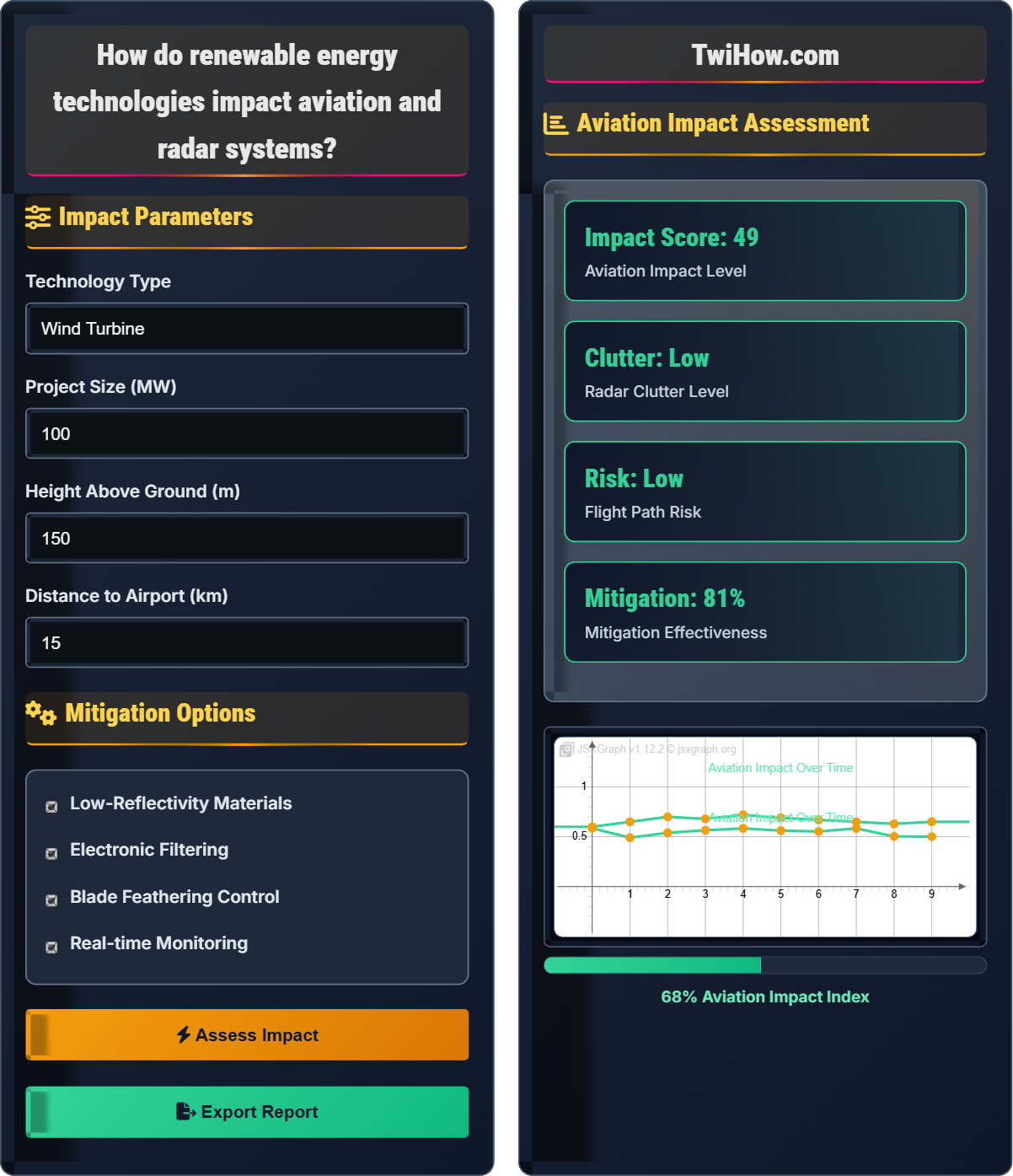
Impact Parameters
Mitigation Options
Aviation Impact Assessment
| Impact Type | Severity | Range | Duration |
|---|---|---|---|
| Radar Clutter | Medium | 5 km | Continuous |
| Electromagnetic Interference | Low | 2 km | Intermittent |
| Physical Obstruction | Low | Line of sight | Permanent |
| Visual Impact | Low | 10 km | Daylight |
| Flight Path Interference | Medium | Approach corridors | As installed |
Radar Scan Visualization
Radar Signal Flow
Aviation & Radar Impact Assessment Explained
Aviation and radar impacts refer to the effects that renewable energy installations, particularly wind turbines, have on aircraft operations, radar systems, and flight safety. These impacts arise from physical obstruction, electromagnetic emissions, and signal reflection that can interfere with aviation operations.
Impact assessment follows a systematic approach:
Framework components include:
- Radar Clutter Assessment: Evaluation of signal reflection and interference
- Flight Path Analysis: Assessment of physical obstruction to aircraft
- Electromagnetic Compatibility: Evaluation of EMI emissions
- Visual Impact Study: Assessment of pilot visibility concerns
- Operational Impact: Effects on air traffic control operations
Impacts vary significantly by technology:
- Wind Turbines: Primary concern is radar clutter and physical obstruction
- Solar Farms: Glare and reflection concerns, minimal electromagnetic impact
- Hydroelectric: Minimal aviation impact, primarily physical presence
- Battery Storage: Low impact, mainly electromagnetic emissions
- Aviation Safety: Ensures safe flight operations and radar functionality
- Regulatory Compliance: Meets aviation authority requirements
- Project Success: Avoids costly delays and relocations
- Industry Cooperation: Maintains positive relationships
- Public Trust: Demonstrates responsible development
Impact Metrics & Aviation Assessment
- Conduct thorough pre-installation assessments
- Implement appropriate mitigation measures
- Maintain ongoing monitoring and reporting
- Coordinate with aviation authorities
Technology-Specific Impact Profiles
Aviation & Radar Impact Quiz
What causes radar clutter from wind turbines?
Radar clutter from wind turbines is primarily caused by the rotating blades that create moving target signatures. The Doppler effect causes frequency shifts that make the blades appear as moving objects on radar screens, potentially masking real aircraft signals.
The answer is B) Moving blade reflection with Doppler shift.
Wind turbine blades create unique radar signatures because they rotate at consistent speeds, creating predictable Doppler shifts. This differs from static objects which create constant reflections. The movement makes radar systems interpret the turbines as moving aircraft, causing clutter that can mask real targets.
Radar Clutter: Unwanted echoes from objects other than targets
Doppler Effect: Frequency shift from moving objects
Rotating Blade Signature: Unique radar pattern from spinning turbines
• Rotating blades create moving target signatures
• Doppler shift affects radar frequency
• Clutter can mask real aircraft
• Blades appear as moving targets on radar
• Frequency shifts create unique signatures
• Advanced filtering can reduce clutter
• Assuming static reflection is primary issue
• Not accounting for Doppler effects
• Underestimating blade rotation impact
Explain how solar farms can impact aviation operations through glare and describe mitigation strategies.
Glare Impact: Solar panels can reflect intense sunlight that temporarily blinds pilots during critical flight phases like takeoff and landing. The reflection angle depends on sun position and panel orientation.
Mitigation Strategies:
• Orientation Planning: Position panels to minimize reflection toward airports
• Anti-reflective Coatings: Apply coatings that reduce surface reflectivity
• Screening Vegetation: Plant trees or install barriers to block reflection
• Flight Path Analysis: Assess critical approach/departure corridors
• Seasonal Assessment: Evaluate year-round sun angles and reflection patterns
Solar glare occurs when sunlight reflects off panel surfaces at angles that intersect flight paths. The intensity depends on the sun's position, panel tilt, and atmospheric conditions. Critical periods are during sunrise/sunset when the sun is low on the horizon.
Solar Glare: Intense reflected light that impairs vision
Critical Flight Phases: Takeoff, landing, and approach
Reflection Angle: Angle at which light bounces off surfaces
• Assess reflection during critical flight phases
• Consider seasonal sun angle variations
• Evaluate approach and departure corridors
• Use computer modeling for reflection analysis
• Consider anti-reflective surface treatments
• Plan panel orientation carefully
• Not considering seasonal sun angles
• Ignoring critical flight corridors
• Underestimating glare intensity
A wind farm with 50 turbines, each 150m tall, is planned 12km from an airport. Each turbine creates a radar cross-section equivalent to a small aircraft. Calculate the expected radar clutter density if the airport's radar has a detection range of 100km and the turbines are concentrated in a 2km² area. Assume each turbine creates clutter equivalent to 10% of its physical cross-section.
Clutter Density Calculation:
Radar coverage area: π × (100km)² = 31,416 km²
Number of clutter sources: 50 turbines
Effective clutter per turbine: 10% of cross-section = 0.10
Total clutter units: 50 × 0.10 = 5 clutter units
Clutter density: 5 / 31,416 = 0.00016 clutter units/km²
Localized Impact: In the 2km² concentration area: 5 / 2 = 2.5 clutter units/km²
This represents a significant local increase in radar clutter density near the airport approach corridor.
This calculation shows how concentrated turbine installations create localized areas of high clutter density, even when the overall radar coverage area is large. The concentration effect can significantly impact specific radar sectors and flight corridors.
Radar Cross-Section: Measure of how detectable an object is by radar
Clutter Density: Number of unwanted echoes per unit area
Concentration Effect: Localized increase in clutter from grouped sources
• Concentrated installations create local hotspots
• Clutter density varies by area
• Approach corridors are most critical
• Distribute turbines to reduce concentration
• Consider radar sector impacts
• Assess approach corridor density
• Not accounting for concentration effects
• Assuming uniform clutter distribution
• Ignoring sector-specific impacts
You're designing a wind farm near an airport with sensitive radar systems. Identify the key mitigation measures and explain how they would be implemented to minimize aviation impacts.
Key Mitigation Measures:
• Advanced Radar Systems: Install newer radars with better clutter rejection capabilities
• Blade Feathering: Temporarily stop turbine rotation during critical flight operations
• Low-RCS Design: Use radar-absorbing materials and blade shaping to reduce reflections
• Electronic Filtering: Implement digital signal processing to filter out turbine signatures
• Coordinated Operations: Establish communication protocols with air traffic control
Implementation: Combine multiple approaches for layered protection, with real-time monitoring to verify effectiveness.
Effective mitigation requires a multi-layered approach combining technological solutions, operational procedures, and monitoring systems. No single measure provides complete protection, so combinations are necessary for high-risk installations.
RCS Reduction: Minimizing radar cross-section of objects
Clutter Rejection: Filtering unwanted radar returns
Operational Coordination: Collaborative management procedures
• Use multiple mitigation layers
• Verify effectiveness through monitoring
• Maintain communication with aviation authorities
• Start with siting and design
• Implement operational procedures
• Use advanced technology solutions
• Relying on single mitigation measures
• Not verifying effectiveness
• Poor communication with authorities
Which renewable energy technology typically has the highest electromagnetic interference potential?
Solar PV systems typically have the highest electromagnetic interference potential due to the large number of power electronic converters (inverters) required to convert DC power to AC. These switching devices can generate wideband electromagnetic emissions across multiple frequency bands.
The answer is A) Solar PV systems.
Solar installations require numerous power electronic devices (inverters, DC-DC converters) that operate by rapidly switching currents on and off. This switching action generates electromagnetic noise across a wide frequency spectrum, potentially interfering with radio and radar systems.
Electromagnetic Interference: Unwanted electrical signals
Power Electronics: Devices that convert electrical power
Switching Noise: EMI generated by rapid switching
• Power electronics are primary EMI sources
• Solar systems have many converter units
• EMI varies by switching frequency
• Use filters on power electronics
• Shield sensitive components
• Maintain distance from critical systems
• Focusing only on radar clutter
• Ignoring power electronics emissions
• Not considering cumulative effects
FAQ
Q: How do wind turbines affect flight safety during low visibility conditions?
A: Wind turbines affect flight safety during low visibility in several ways:
Physical Obstruction: Turbines are obstacles that may not be visible in fog, rain, or darkness
Lighting Systems: Aviation lighting can create visual distractions during approach phases
Radar Interference: Clutter can mask other aircraft and terrain features
Navigation Aids: May interfere with radio navigation signals
Regulations require proper marking and lighting of turbines to enhance visibility during low visibility conditions.
Q: What are the most effective technologies for mitigating wind turbine radar interference?
A: Effective mitigation technologies include:
Phased Array Radars: Can electronically steer beams and filter clutter more effectively
Digital Signal Processing: Advanced algorithms to distinguish real targets from turbine clutter
Multi-static Systems: Use multiple transmitter/receiver sites to improve detection
Passive Radar: Uses existing transmitters to detect targets without interference
Adaptive Beamforming: Dynamically adjusts radar beams to minimize interference
Combining these technologies provides the most effective mitigation strategy.