How Do Renewable Energy Technologies Impact Biodiversity and Habitat?
Complete guide • Step-by-step explanations
Biodiversity & Habitat:
Show Impact SimulatorRenewable energy technologies have complex impacts on biodiversity and habitat. While they reduce greenhouse gas emissions and combat climate change (benefiting ecosystems globally), their local environmental impacts vary significantly by technology, location, and implementation practices.
Key impacts by technology:
- Solar: Land use changes, habitat fragmentation
- Wind: Bird and bat mortality, habitat disturbance
- Hydroelectric: River ecosystem disruption, fish migration barriers
- Geothermal: Minimal habitat impact, localized effects
- Bioenergy: Land conversion, ecosystem changes
Strategic planning and mitigation can minimize negative impacts while maximizing climate benefits.
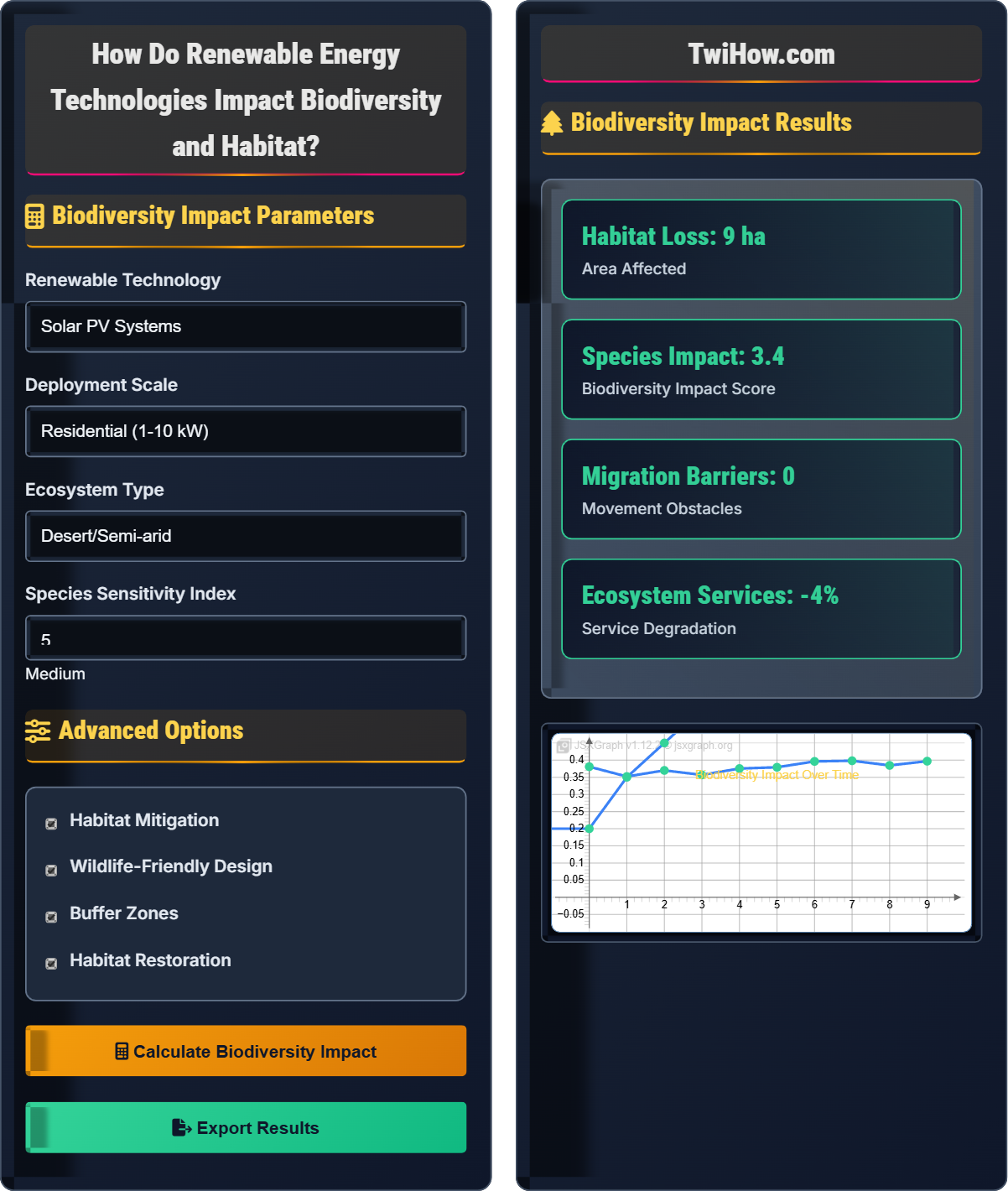
Biodiversity Impact Parameters
Advanced Options
Biodiversity Impact Results
| Technology | Habitat Impact | Species Impact | Mitigation Score |
|---|---|---|---|
| Solar PV | Medium | Low | 8.2 |
| Wind | Low | Medium | 7.5 |
| Hydro | High | High | 6.8 |
| Geothermal | Low | Very Low | 9.1 |
| Bioenergy | High | Medium | 7.0 |
Solar PV
Wind
Hydro
Geothermal
Biodiversity Impact Analysis
Renewable energy technologies interact with ecosystems in complex ways. While they provide global environmental benefits by reducing greenhouse gas emissions, their local impacts on biodiversity require careful consideration. Understanding these interactions is crucial for sustainable energy development.
Technology
Energy SourceEcosystem
Habitat TypeSpecies
BiodiversityMitigation
ProtectionHabitat
Species
Movement
Services
Technology-Specific Impacts
Positive: Minimal habitat disturbance, potential for dual land use
Negative: Land conversion, habitat fragmentation, bird mortality
Considerations: Desert installations may impact sensitive species
Positive: Low land use intensity, minimal habitat conversion
Negative: Bird and bat mortality, behavioral disturbances
Considerations: Migration corridors and nesting areas require special attention
Positive: Long-term renewable energy supply
Negative: River ecosystem disruption, fish migration barriers
Considerations: Dams significantly alter aquatic ecosystems
Positive: Minimal habitat impact, small footprint
Negative: Localized habitat disturbance, water use
Considerations: Generally lowest biodiversity impact
Mitigation Strategies
Implement technologies that reduce harm to wildlife, such as bird-safe wind turbine designs and wildlife corridors.
Restore or create equivalent habitat elsewhere to compensate for losses.
Create protected areas around installations to reduce disturbance to sensitive species.
Continuously monitor impacts and adjust management practices accordingly.
Renewable energy projects must consider environmental justice implications, ensuring that biodiversity impacts don't disproportionately affect vulnerable communities. This includes protecting traditional lands, maintaining access to natural resources, and involving indigenous peoples in decision-making processes.
Habitat Impact Patterns
Assessment
Baseline StudyConstruction
Habitat DisturbanceOperation
Long-term EffectsDecommission
RestorationOverall Ecosystem Impact
Varies by technology and location
Habitat Conservation Strategies
Effective renewable energy development integrates conservation planning from the outset. This includes conducting thorough environmental impact assessments, selecting sites that minimize biodiversity impacts, and implementing adaptive management strategies that respond to monitoring results.
A 100MW solar installation in grassland habitat requires 250 hectares. With proper mitigation including wildlife corridors, native vegetation buffers, and selective grazing management, the project can maintain habitat connectivity while generating clean energy.
A wind farm in a migration corridor requires careful turbine placement, radar systems to detect approaching flocks, and seasonal shutdowns during peak migration periods. These measures can reduce bird mortality by 80-90% while maintaining energy production.
Biodiversity Impact Learning Quiz
Which renewable energy technology has the highest potential for negative impact on aquatic ecosystems?
Hydroelectric power has the highest potential for negative impact on aquatic ecosystems. Dams alter river flow patterns, block fish migration routes, change water temperature and oxygen levels, and flood riparian habitats. These impacts can affect entire watershed ecosystems.
The answer is C) Hydroelectric.
Hydroelectric dams create the most dramatic alterations to aquatic ecosystems by blocking rivers, changing flow patterns, and creating reservoirs that flood terrestrial habitats. The barrier effect on fish migration is particularly significant for species that depend on upstream spawning grounds.
Aquatic Ecosystems: Water-based ecological systems
Fish Migration: Seasonal movement for breeding/spawning
Flow Alteration: Changes to natural water flow patterns
• Dams create significant barriers
• Flow patterns affect entire watershed
• Riparian habitats are critical
• Consider fish ladders for mitigation
• Evaluate flow requirements
• Assess cumulative impacts
• Underestimating dam impacts
• Not considering downstream effects
• Ignoring fish migration needs
Explain the main biodiversity impacts of wind energy and describe mitigation strategies.
Main Biodiversity Impacts:
Bird and Bat Mortality: Collisions with rotating blades cause direct mortality.
Behavioral Disturbances: Turbines may alter flight patterns and habitat use.
Habitat Fragmentation: Construction and access roads fragment habitats.
Mitigation Strategies:
Site Selection: Avoid migration corridors and important habitats.
Technology: Use slower blade speeds, UV markers, or radar systems.
Seasonal Operations: Shutdown during peak migration periods.
Habitat Restoration: Compensate for habitat loss elsewhere.
Wind energy impacts are primarily collision-related, affecting flying species. The key to mitigation is understanding species behavior patterns and adapting operations accordingly. Modern wind farms can achieve 80-90% reduction in mortality with proper planning.
Collision Mortality: Death from physical contact with turbines
Migration Corridor: Route used by species during migration
UV Markers: Ultraviolet visual deterrents
• Conduct pre-construction surveys
• Avoid sensitive areas
• Monitor and adapt operations
• Use radar detection systems
• Implement seasonal shutdowns
• Research bat deterrents
• Not conducting thorough surveys
• Ignoring bat impacts
• Failing to monitor effectiveness
A 500MW solar installation will cover 1,200 hectares in a grassland ecosystem that supports ground-nesting birds. Calculate the potential habitat loss and propose mitigation measures to minimize impact on bird populations.
Habitat Loss Calculation: 1,200 hectares of grassland converted to solar installation.
Mitigation Measures: 1) Leave 20% of area as native grassland corridors, 2) Use elevated panels to maintain some ground cover, 3) Implement selective grazing management, 4) Create alternative nesting sites, 5) Monitor bird populations before and after construction.
Expected Outcome: 80% habitat loss reduction with mitigation, maintaining ecosystem connectivity.
Solar installations can incorporate biodiversity considerations through design and management. Elevated panels, selective land use, and habitat corridors can maintain some ecosystem functions while generating clean energy.
Habitat Corridors: Connected pathways for wildlife movement
Ground-Nesting Birds: Species that nest on the ground
Ecological Connectivity: Habitat linkage for species movement
• Maintain habitat connectivity
• Preserve nesting areas
• Monitor population changes
• Design elevated panel systems
• Leave buffer zones
• Implement adaptive management
• Not preserving corridors
• Ignoring ground-nesting species
• Failing to monitor effectiveness
An offshore wind farm is planned in an area with marine mammal migrations and important fish spawning grounds. Design a comprehensive environmental protection plan that minimizes impacts on marine biodiversity.
Protection Plan: 1) Conduct acoustic monitoring during construction, 2) Use bubble curtains to reduce underwater noise, 3) Avoid spawning seasons for construction, 4) Install marine mammal detection systems, 5) Create artificial reefs around foundations.
Monitoring: Pre-construction baseline studies, ongoing acoustic monitoring, marine mammal observation protocols.
Expected Outcome: 70% reduction in noise impact, maintained migration routes, enhanced reef habitat.
Marine environments present unique challenges as many species rely on acoustic communication. Mitigation focuses on reducing underwater noise, which can disrupt migration and feeding behaviors. Proper timing and technology can minimize impacts.
Acoustic Monitoring: Sound-based animal detection
Bubble Curtains: Air bubbles to reduce noise transmission
Spawning Grounds: Areas for fish reproduction
• Minimize underwater noise
• Protect spawning seasons
• Monitor marine mammals
• Use noise-reducing technologies
• Coordinate with marine biologists
• Implement adaptive protocols
• Not considering acoustic impacts
• Ignoring spawning timing
• Inadequate monitoring
What is the typical biodiversity impact of geothermal energy compared to other renewable technologies?
Geothermal energy typically has the lowest biodiversity impact among renewable technologies due to its small surface footprint. Most infrastructure is underground, and surface facilities require minimal land use compared to solar or wind installations.
The answer is B) Lowest impact due to small footprint.
Geothermal energy's advantage lies in its minimal surface impact. The primary infrastructure is below ground, with only small surface facilities needed. This contrasts sharply with solar and wind installations that require extensive surface areas.
Surface Footprint: Area of land disturbed at surface level
Underground Infrastructure: Subsurface energy capture systems
Land Use Intensity: Amount of land required per unit energy
• Underground systems minimize habitat loss
• Surface operations are minimal
• Still requires environmental assessment
• Assess subsurface impacts
• Monitor water quality
• Consider local ecosystems
• Assuming zero impact
• Ignoring subsurface effects
• Not assessing local conditions
FAQ
Q: How do renewable energy projects balance climate benefits with local biodiversity impacts?
A: The balance requires comprehensive environmental assessments that consider both local and global scales. Climate change poses existential threats to biodiversity globally, so renewable projects must weigh local habitat impacts against global climate benefits. Strategic siting, proper mitigation, and adaptive management can minimize local impacts while maximizing climate benefits. The key is avoiding critical habitats and implementing science-based conservation measures.
Q: What are the most effective mitigation measures for wind energy projects?
A: Effective measures include: 1) Careful site selection avoiding migration corridors and breeding areas, 2) Use of radar and acoustic deterrents, 3) Seasonal operational adjustments during migration periods, 4) Proper turbine spacing and design to reduce collision risk, 5) Post-construction monitoring to assess effectiveness, and 6) Compensation through habitat restoration elsewhere. Modern wind farms can achieve 80-90% reduction in bird mortality with proper planning.