Renewable Energy Technologies and Cultural Heritage Impact
Complete energy guide • Step-by-step explanations
Cultural Heritage & Renewables:
Show Heritage Impact SimulatorRenewable energy technologies can have both positive and negative impacts on cultural and historic resources. While these technologies advance sustainability goals, they may affect archaeological sites, historic buildings, cultural landscapes, and traditional practices. Careful planning and consultation are essential to preserve heritage while advancing clean energy.
The intersection of renewable energy and cultural heritage requires balanced approaches that respect traditional values while addressing climate change. This involves comprehensive impact assessments, stakeholder engagement, and adaptive management strategies.
Key heritage considerations:
- Archaeological Sites: Protection of buried or surface cultural resources
- Historic Buildings: Preservation of architectural integrity
- Cultural Landscapes: Maintaining scenic and symbolic values
- Traditional Practices: Safeguarding cultural and spiritual activities
Successful renewable energy development requires respecting cultural heritage while achieving environmental objectives.
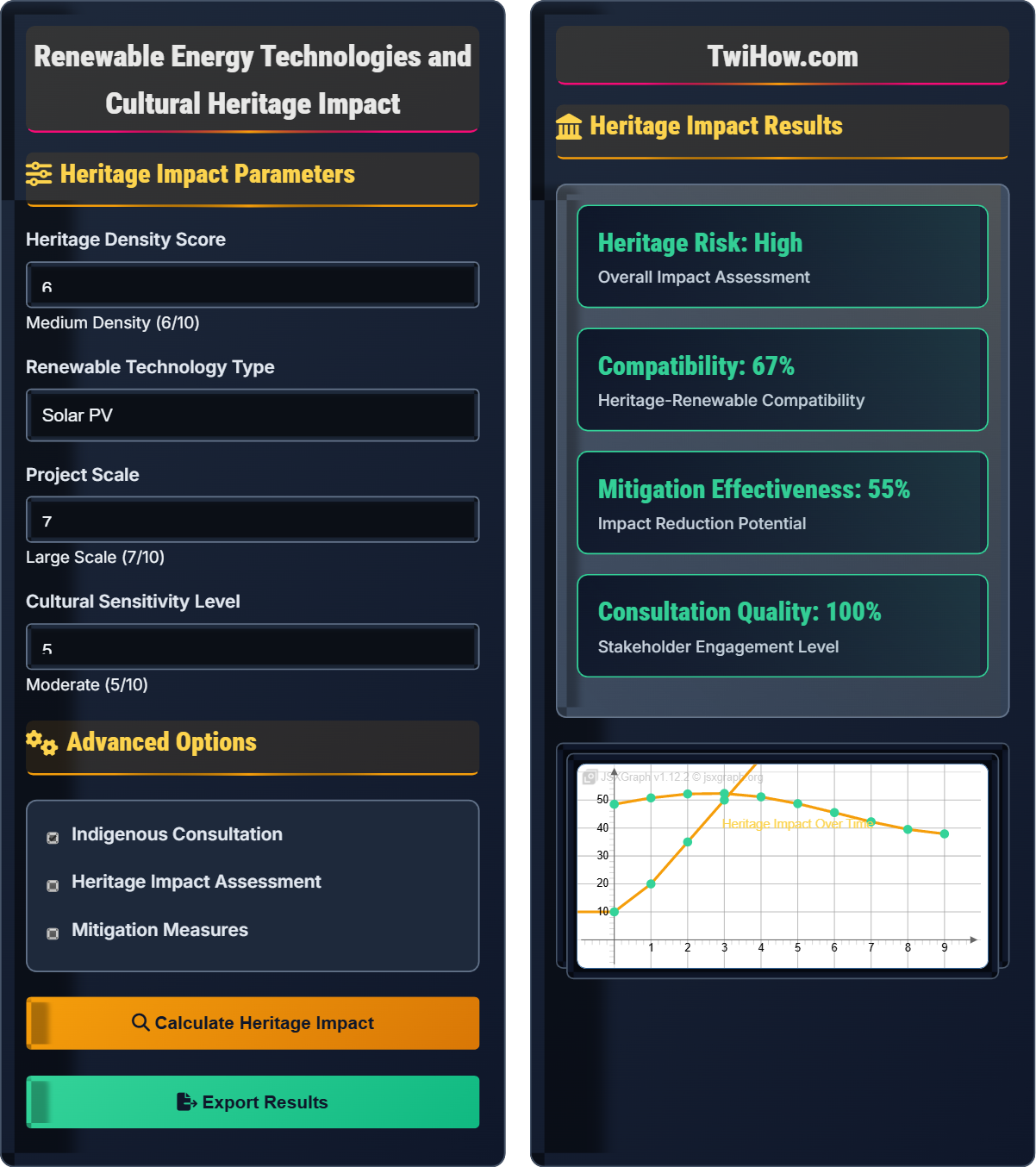
Heritage Impact Parameters
Advanced Options
Heritage Impact Results
| Heritage Category | Risk Level | Impact Severity | Recommendation |
|---|---|---|---|
| Archaeological Sites | Medium | Moderate | Survey Required |
| Historic Buildings | Low | Minor | Visual Assessment |
| Cultural Landscapes | High | Significant | Stakeholder Consultation |
| Traditional Practices | Medium | Moderate | Indigenous Consultation |
| Mitigation Strategy | Effectiveness | Cost Level | Implementation |
|---|---|---|---|
| Site Avoidance | 90% | Low | Feasible |
| Design Modification | 75% | Medium | Feasible |
| Heritage Surveys | 85% | Medium | Recommended |
| Stakeholder Engagement | 80% | Low | Essential |
Renewable Energy and Cultural Heritage Impact Explained
Renewable energy projects can affect cultural and historic resources in various ways. These impacts range from direct physical effects on archaeological sites to visual impacts on historic landscapes and symbolic disruptions to cultural practices. Understanding these potential impacts is essential for sustainable development that respects heritage values.
The assessment of heritage impacts follows a systematic approach:
Where:
- Heritage Value: Significance and importance of cultural resources
- Project Intensity: Scale and nature of renewable energy development
- Vulnerability Factor: Susceptibility of heritage to impacts
Types of cultural and historic resources affected by renewable energy:
- Archaeological Sites: Buried or surface cultural deposits and artifacts
- Historic Buildings: Architecturally or historically significant structures
- Cultural Landscapes: Areas with historic, cultural, or scenic significance
- Traditional Practices: Cultural, spiritual, or ceremonial activities
- Indigenous Territories: Lands with traditional use and occupation
- Visual Resources: Scenic views and aesthetic values
- Site Avoidance: Locate projects away from sensitive heritage areas
- Design Modification: Adjust project configurations to minimize impacts
- Heritage Surveys: Conduct thorough archaeological and historical assessments
- Stakeholder Engagement: Involve communities in planning and decision-making
- Heritage Enhancement: Create opportunities to highlight and protect heritage
- Compensation Measures: Provide alternative resources when impacts are unavoidable
Heritage Impact Fundamentals
Heritage impact, cultural resources, archaeological sites, historic preservation, stakeholder consultation, mitigation strategies.
Heritage Impact = Heritage Value × Project Intensity × Vulnerability Factor
Where Impact = potential harm, Value = significance, Intensity = project scale.
- Heritage values must be identified before project planning
- Stakeholder consultation is essential for indigenous sites
- Mitigation should follow avoidance-first principles
Applications
Wind farm visual impact studies, solar installation heritage assessments, hydroelectric cultural landscape reviews, transmission line cultural corridor planning.
- Comprehensive heritage surveys and mapping
- Meaningful stakeholder consultation processes
- Integrated project design and heritage planning
- Ongoing monitoring and adaptive management
- Legal protections for heritage resources
- Indigenous rights and consultation requirements
- Public interest in heritage preservation
- Technical feasibility of mitigation measures
Heritage Impact Quiz
Which of the following is NOT typically considered a cultural or historic resource that could be impacted by renewable energy development?
Wildlife migration corridors are environmental resources rather than cultural or historic ones. While they may have cultural significance to some communities, they are primarily ecological features. Cultural and historic resources include archaeological sites, historic buildings, cultural landscapes, traditional practices, and indigenous territories.
The answer is D) Wildlife migration corridors.
It's important to distinguish between cultural/historic resources and environmental resources. While there may be overlap in some cases, the legal and planning frameworks for each type of resource differ. Cultural resources relate to human heritage and history, while environmental resources relate to natural systems and ecosystems.
Cultural Resources: Human-made or culturally significant features
Historic Resources: Sites with historical significance
Environmental Resources: Natural ecological systems
• Cultural and historic resources relate to human heritage
• Environmental resources relate to natural systems
• Different legal frameworks apply to each
• Consider human history and culture for cultural resources
• Look for legal protections under heritage laws
• Distinguish from environmental impact assessments
• Confusing cultural resources with environmental ones
• Not distinguishing between different legal frameworks
• Overlooking traditional cultural practices
Explain why stakeholder consultation is critical in renewable energy projects that may impact cultural and historic resources, and describe the key steps in an effective consultation process.
Importance of Stakeholder Consultation: Stakeholder consultation is critical because cultural and historic resources often hold deep significance to local communities, indigenous peoples, and other interested parties. These groups may have traditional knowledge, spiritual connections, or legal rights related to the resources in question.
Key Steps in Effective Consultation:
1. Identify Stakeholders: Map all potentially affected parties including indigenous communities, local residents, historical societies, and government agencies.
2. Early Engagement: Begin consultation early in the planning process, before irreversible decisions are made.
3. Culturally Appropriate Methods: Use communication methods respectful of cultural norms and languages.
4. Meaningful Dialogue: Ensure consultation allows for genuine input and feedback that influences decisions.
5. Documentation: Record all consultation activities and incorporate feedback into project planning.
6. Ongoing Engagement: Continue dialogue throughout project development and implementation.
Effective consultation builds trust, identifies concerns early, and helps develop acceptable solutions.
Consultation goes beyond simple notification - it requires meaningful engagement that allows stakeholders to influence outcomes. This is particularly important for indigenous communities who may have legal rights to consultation under treaties or constitutional provisions. The goal is to ensure that affected parties have a voice in decisions that impact their cultural heritage.
Stakeholder Consultation: Process of engaging affected parties in decision-making
Free, Prior and Informed Consent: Right of indigenous peoples to approve projects
Meaningful Engagement: Consultation that influences project decisions
• Consultation must be meaningful, not just procedural
• Allocate sufficient time and resources for consultation
• Use culturally appropriate communication methods
• Document all consultation activities
• Not engaging early enough in planning
• Failing to incorporate stakeholder feedback
A 200 MW wind farm is proposed in an area containing 3 archaeological sites, 2 historic buildings, and a culturally significant landscape. The project requires 50 turbines, access roads, and a substation covering 1,500 acres. If each turbine has a 100-foot radius and requires 0.5 acres of disturbed land, and the substation requires 10 acres, calculate the percentage of the total project area that will be physically disturbed. Based on this, assess the potential impact on the archaeological sites and recommend mitigation measures.
Turbine Disturbance: 50 turbines × 0.5 acres = 25 acres
Substation Area: 10 acres
Access Roads: Typically 20% of total disturbed area = 7 acres
Total Disturbed Area: 25 + 10 + 7 = 42 acres
Percentage Disturbance: (42 ÷ 1,500) × 100 = 2.8%
Archaeological Impact Assessment: Although the total disturbance is small (2.8%), the linear nature of access roads and concentrated impact of turbine foundations and substations could intersect with archaeological sites. Even small disturbances can significantly impact buried cultural deposits.
Recommended Mitigation: Conduct comprehensive archaeological surveys along road corridors and around turbine locations, implement avoidance measures where possible, and develop salvage excavation protocols if significant finds are discovered.
This example demonstrates that even relatively small percentages of land disturbance can have significant heritage impacts. Archaeological sites can be extremely sensitive to ground disturbance, and the linear infrastructure of renewable projects can intersect with cultural resources in unexpected ways. The spatial configuration of impacts matters as much as the total area affected.
Archaeological Survey: Systematic search for cultural deposits
Salvage Excavation: Recovery of information from threatened sites
Ground Disturbance: Physical alteration of soil layers
• Small disturbance can have large heritage impact
• Linear infrastructure can intersect with sites unexpectedly
• Surveys must be comprehensive before construction
• Map archaeological sites before planning infrastructure routes
• Consider seasonal restrictions for field work
• Plan for potential discoveries and delays
• Not surveying linear infrastructure corridors
• Not planning for significant archaeological finds
A 150 MW solar installation is planned on a hillside overlooking a historic district. The solar panels will be 15 feet tall and cover 1,000 acres. The historic district is located 2 miles away at a lower elevation. Calculate the visual impact considering the panel height, distance, and viewing angle. Describe how this might affect the cultural landscape and recommend mitigation measures to preserve the historic viewshed.
Visual Impact Assessment: At 2 miles (10,560 feet) distance, a 15-foot object subtends an angle of approximately 0.08 degrees. While this seems small, the large scale of the solar installation (covering 1,000 acres) means it will be highly visible across a wide area.
Effect on Cultural Landscape: The solar installation could significantly alter the character of the historic viewshed, affecting the visual integrity of the historic district. This could impact tourism, property values, and the cultural significance of the area.
Mitigation Recommendations: Consider placing panels behind natural ridgelines where possible, using screening vegetation or berms, orienting panels to minimize reflection towards sensitive views, and implementing setback requirements from the historic district boundary. Alternative locations or smaller distributed installations could also be considered.
Visual impacts on historic districts require careful consideration of cumulative effects and long-term preservation values.
Visual impacts are often the most significant heritage concern with renewable energy projects. Even distant installations can alter the character of cultural landscapes. Viewsheds are protected in many jurisdictions, and changes to historic skylines can have lasting impacts on cultural identity and tourism. The cumulative visual impact of multiple installations must also be considered.
Viewshed: Area visible from a particular location
Visual Impact: Alteration to scenic or aesthetic values
Cultural Landscape: Environment modified by human activity
• Visual impacts can be permanent and irreversible
• Historic districts often have special protections
• Cumulative visual effects must be considered
• Conduct photomontages from sensitive viewpoints
• Consider seasonal variations in visibility
• Evaluate alternative locations with less visual impact
• Not considering cumulative effects
• Failing to engage with historic preservation authorities
What is the most important consideration when renewable energy projects may impact indigenous cultural sites?
Obtaining free, prior and informed consent from indigenous communities is the most important consideration. This principle, recognized internationally and in many national laws, acknowledges indigenous peoples' rights to their traditional territories and cultural sites. It requires meaningful consultation and the right to approve or reject projects that affect their lands and resources.
The answer is B) Obtaining free, prior and informed consent.
Free, prior and informed consent is a fundamental principle of indigenous rights that goes beyond standard consultation. It recognizes indigenous peoples' sovereignty over their traditional territories and their right to make decisions about development on their lands. This principle is enshrined in international law and many national constitutions.
Free, Prior and Informed Consent: Indigenous right to approve projects
Traditional Territory: Lands used and occupied by indigenous peoples
Sacred Sites: Culturally and spiritually significant locations
• Indigenous rights take precedence over development interests
• Consent must be obtained before project initiation
• Process must be culturally appropriate
• Engage with indigenous governments and traditional leaders
• Allow adequate time for community discussion
• Respect cultural protocols and decision-making processes
• Not engaging with proper indigenous representatives
• Proceeding without proper consent
FAQ
Q: How can renewable energy projects be designed to avoid impacting archaeological sites?
A: Archaeological site avoidance requires:
Comprehensive Surveys: Conduct thorough archaeological assessments before final design
Buffer Zones: Establish protective areas around known sites
Alternative Siting: Select locations away from sensitive areas
Route Optimization: Design access roads and transmission lines to avoid sites
Subsurface Investigation: Use geophysical methods to identify buried sites
Consultation: Engage with tribal and local communities for traditional knowledge
Monitoring: Implement protocols for unexpected discoveries during construction
Prevention is always preferred over mitigation for archaeological resources.
Q: What are the legal requirements for heritage impact assessments?
A: Legal requirements vary by jurisdiction but typically include:
National Laws: National Historic Preservation Act (US), similar laws elsewhere
State/Provincial: Heritage conservation acts and regulations
Indigenous Rights: Consultation requirements under constitutional law
International: UNDRIP, ILO Convention 169 for indigenous rights
Permitting: Environmental and heritage permits for project approval
Documentation: Comprehensive record-keeping and reporting
Enforcement: Penalties for non-compliance with heritage laws
Non-compliance can result in project delays, legal challenges, or forced modifications.