How Do Renewable Energy Technologies Impact Manufacturing and Supply Chains?
Complete guide • Step-by-step explanations
Manufacturing & Supply Chains:
Show Supply Chain SimulatorRenewable energy technologies create significant impacts on global manufacturing and supply chains. From raw material extraction to component manufacturing and final assembly, these technologies reshape industrial processes and logistics networks worldwide.
Key impacts:
- Raw Materials: Increased demand for lithium, cobalt, rare earth elements, and silicon
- Manufacturing: New production facilities and processes for solar panels, wind turbines, and batteries
- Geography: Shifts in manufacturing hubs and supply chain routes
- Logistics: Specialized transportation and storage requirements
- Workforce: New skills and job opportunities in green manufacturing
Understanding these impacts is crucial for sustainable development and resilient supply chains.
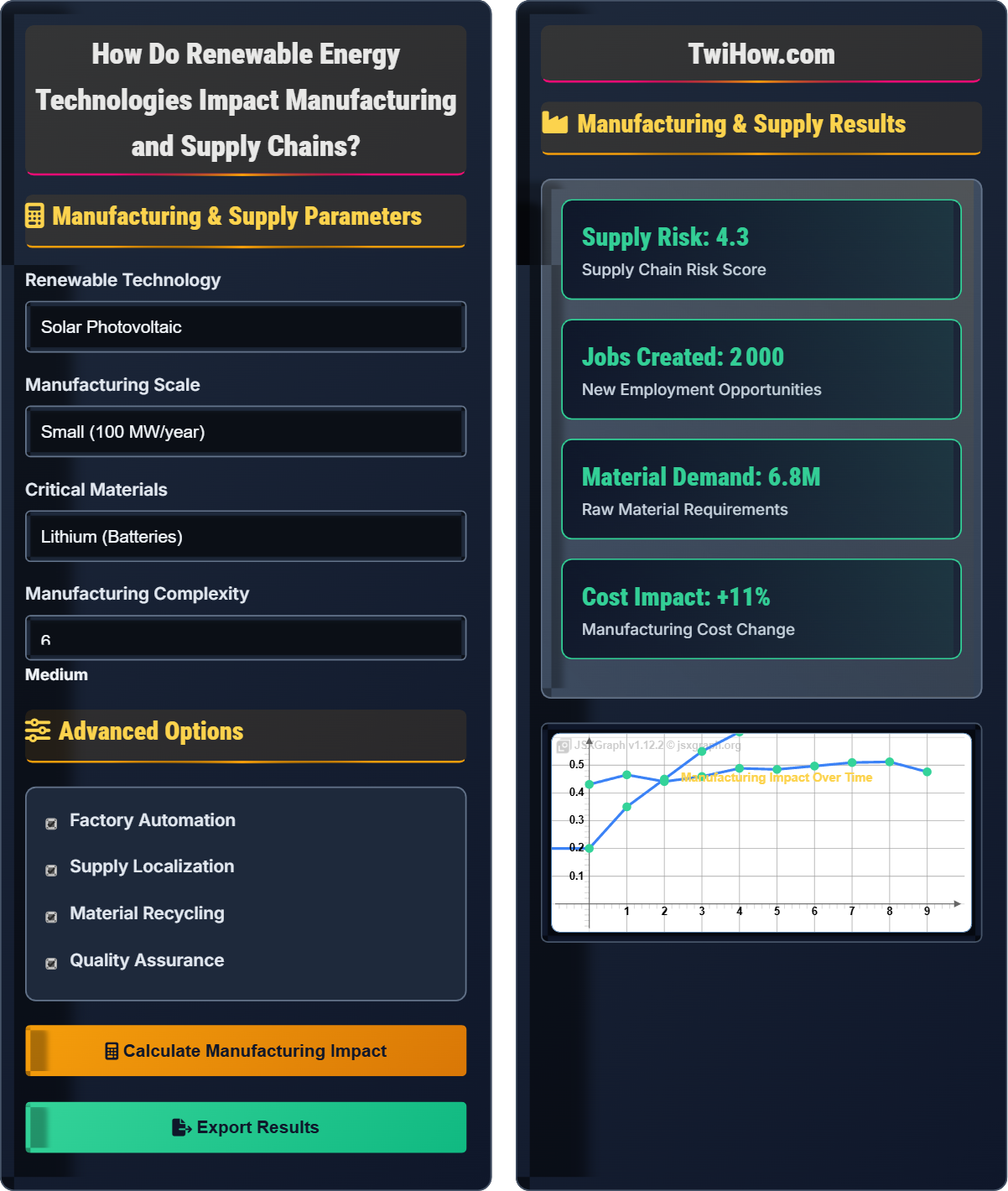
Manufacturing & Supply Parameters
Advanced Options
Manufacturing & Supply Results
| Technology | Supply Risk | Material Demand | Job Creation |
|---|---|---|---|
| Solar PV | Medium | High | 2,500 |
| Wind | Low | Very High | 1,800 |
| Batteries | High | Very High | 3,200 |
| Hydrogen | Medium | Medium | 1,500 |
| Power Electronics | Medium | Medium | 1,200 |
Solar PV
Wind
Batteries
Hydrogen
Manufacturing & Supply Chain Impact Analysis
Renewable energy technologies are fundamentally reshaping global supply chains. Traditional energy sectors relied on established supply routes for oil, gas, and coal, while renewables create demand for new materials like lithium, cobalt, and rare earth elements. This shift creates both opportunities and challenges for manufacturers and logistics providers.
Raw Materials
ExtractionManufacturing
ProductionLogistics
TransportationInstallation
DeploymentLithium
Silicon
Cobalt
Steel
Technology-Specific Manufacturing Analysis
Process: Silicon purification, wafer production, cell fabrication, module assembly
Materials: Silicon, silver, aluminum, glass, polymers
Challenges: Price volatility of silver, silicon purity requirements
Process: Steel forging, blade molding, generator assembly, nacelle integration
Materials: Steel, concrete, rare earth magnets, copper
Challenges: Transportation of large components, material fatigue
Process: Cell chemistry formulation, electrode coating, cell assembly, pack integration
Materials: Lithium, cobalt, nickel, graphite
Challenges: Critical material supply, recycling complexity
Process: Electrolyzer manufacturing, catalyst production, system integration
Materials: Platinum, iridium, steel, polymers
Challenges: Rare metal dependency, high energy requirements
Supply Chain Strategies
Design products for reuse, remanufacturing, and recycling to reduce raw material dependency and waste.
Source materials from multiple suppliers and regions to reduce single points of failure and geopolitical risks.
Implement robotic manufacturing and AI-driven logistics to improve efficiency and reduce labor costs.
Optimize inventory management to reduce storage costs and improve cash flow.
Renewable energy manufacturing is increasingly adopting circular economy principles to reduce waste and material dependency. This includes designing for durability, implementing take-back programs, and developing efficient recycling processes for end-of-life components.
Critical Materials Flow
Extraction
Mining & RefiningProcessing
Chemical TreatmentManufacturing
Component AssemblyUse Phase
Energy GenerationRecycling
Material RecoverySupply Chain Risk
Geopolitical tensions and material scarcity
Critical Raw Materials
Renewable energy technologies depend on critical raw materials with concentrated supply chains. For example, China dominates rare earth element production, while Chile and Australia control lithium supplies. This concentration creates supply risks that require strategic planning and diversification.
A large battery manufacturing facility requires 100 tons of lithium, 50 tons of cobalt, and 200 tons of nickel annually. Supply chain disruptions in any of these materials could halt production. Strategies include supplier diversification, inventory buffering, and alternative chemistry development.
Solar panel production requires high-purity silicon, silver paste, and aluminum frames. Price volatility in silver markets can significantly impact manufacturing costs. Automation and process optimization help manage these challenges while maintaining quality standards.
Manufacturing & Supply Chain Learning Quiz
Which critical material is most concentrated in its global supply chain for renewable energy technologies?
Rare earth elements are the most concentrated in their global supply chain, with China controlling approximately 85% of global production. This concentration creates significant supply chain risks for renewable energy technologies that rely on rare earth magnets for wind turbines and electric motors.
The answer is B) Rare Earth Elements.
Supply chain concentration occurs when a single country or region dominates the production of critical materials. Rare earth elements have the highest concentration due to geological deposits and processing expertise, making diversification strategies particularly important for supply security.
Supply Chain Concentration: Dominance by few suppliers/regions
Rare Earth Elements: 17 chemically similar elements used in magnets
Supply Security: Reliable access to materials
• Monitor supplier concentration ratios
• Diversify sourcing where possible
• Develop alternative materials
• Track geopolitical developments
• Invest in recycling technologies
• Support domestic production
• Underestimating supply concentration risks
• Not planning for price volatility
• Ignoring alternative materials
Explain the key manufacturing challenges for renewable energy technologies and how they differ from traditional energy sector manufacturing.
Key Manufacturing Challenges:
Material Complexity: Renewable technologies require specialized materials like high-purity silicon, rare earth elements, and lithium, which have complex extraction and processing requirements.
Scale Requirements: Rapid scaling from pilot to mass production creates bottlenecks in supply chains and manufacturing capacity.
Quality Standards: Performance and safety requirements demand precise manufacturing processes and extensive quality control.
Geographic Dispersal: Manufacturing often occurs in different locations than raw material sources, creating complex logistics.
Differences from Traditional Energy: Unlike oil refineries or coal plants with established processes, renewable manufacturing requires new production lines, specialized equipment, and different workforce skills.
Renewable energy manufacturing differs from traditional energy in that it requires more diverse and specialized materials, faster scaling requirements, and more complex international supply chains. Traditional energy manufacturing was often centralized around resource locations, while renewables require global coordination of materials, manufacturing, and deployment.
Material Complexity: Specialized processing requirements
Quality Control: Performance and safety verification
Supply Chain Coordination: International logistics management
• Plan for rapid scaling requirements
• Invest in quality assurance
• Diversify supplier base
• Develop vertical integration strategies
• Implement lean manufacturing
• Invest in automation technologies
• Underestimating scaling complexity
• Not investing in quality systems
• Over-relying on single suppliers
A solar panel manufacturer relies on silicon wafers from a single supplier in Southeast Asia. A factory fire disrupts supply for 3 months. The manufacturer has 30-day inventory and produces 100 MW of panels monthly. Calculate the production shortfall and propose mitigation strategies.
Production Shortfall Calculation:
Available inventory: 30 days (1 month) = 100 MW
Disruption duration: 3 months
Normal production capacity: 100 MW/month
Shortfall: (3 months - 1 month) × 100 MW/month = 200 MW
Mitigation Strategies: 1) Develop multiple suppliers in different regions, 2) Increase safety stock to 60-90 days, 3) Implement supplier risk assessments, 4) Diversify supply geography, 5) Negotiate backup supply agreements, 6) Develop alternative material sources.
This scenario demonstrates the critical importance of supply chain resilience in renewable energy manufacturing. Single-source dependencies create significant risks that can impact production schedules and customer commitments. Diversification and risk management are essential strategies.
Safety Stock: Extra inventory for supply disruptions
Supply Chain Resilience: Ability to withstand disruptions
Single Source Risk: Dependency on one supplier
• Never rely on single suppliers
• Maintain adequate safety stock
• Regular supplier assessments
• Map entire supply chain
• Monitor supplier financials
• Develop contingency plans
• Not diversifying suppliers
• Inadequate safety stock
• Not monitoring supplier risks
A battery manufacturer needs 50 tons of lithium, 20 tons of cobalt, and 80 tons of nickel monthly. Current suppliers are located in Australia, DR Congo, and Indonesia respectively. Design a supply chain strategy to ensure continuity while managing geopolitical and environmental risks.
Supply Chain Strategy: 1) Diversify suppliers across 3-4 regions for each material, 2) Develop long-term contracts with multiple suppliers, 3) Invest in recycling capabilities to reduce virgin material demand, 4) Monitor geopolitical developments in supplier countries, 5) Implement environmental and social compliance standards.
Geopolitical Risk Management: Maintain 2-3 months of inventory for each critical material and develop alternative suppliers in politically stable regions.
Expected Outcome: 95% supply continuity with reduced risk exposure.
This example shows how critical material supply chains require sophisticated risk management due to their geographic concentration and associated political and environmental challenges. Strategic diversification and recycling integration are key mitigation approaches.
Supply Diversification: Multiple suppliers across regions
Recycling Integration: Material recovery programs
Risk Mitigation: Strategies to reduce exposure
• Diversify critical material sources
• Invest in recycling capabilities
• Monitor supplier compliance
• Develop local recycling facilities
• Support alternative material research
• Build strategic reserves
• Not diversifying enough suppliers
• Ignoring environmental risks
• Not planning for recycling
Which renewable energy manufacturing process is most amenable to automation?
Solar cell production is most amenable to automation because it involves standardized, repetitive processes like wafer handling, chemical treatments, and electrical connections that can be precisely controlled by robots and automated systems. This has already led to significant cost reductions in solar manufacturing.
The answer is B) Solar cell production.
Manufacturing automation potential depends on process standardization, repetition, and precision requirements. Solar cell production benefits from these characteristics, allowing for high-speed, consistent manufacturing that reduces costs and improves quality.
Manufacturing Automation: Robot and system integration
Process Standardization: Consistent, repeatable operations
Quality Control: Automated inspection systems
• Automate standardized processes
• Invest in precision equipment
• Maintain quality standards
• Start with high-volume processes
• Implement quality monitoring
• Train operators for new systems
• Automating complex processes too soon
• Not training workers properly
• Underestimating maintenance needs
FAQ
Q: How can manufacturers prepare for the rapid scaling requirements of renewable energy technologies?
A: Manufacturers should: 1) Design scalable production lines with modular equipment, 2) Develop supplier partnerships early and secure long-term contracts, 3) Invest in workforce training and recruitment pipelines, 4) Implement flexible manufacturing systems that can adapt to changing product specifications, 5) Establish quality control systems that scale with production, and 6) Maintain adequate cash reserves for rapid capacity expansion. The key is building flexibility and agility into all aspects of the manufacturing process.
Q: What are the biggest supply chain risks in renewable energy manufacturing and how can they be mitigated?
A: Major risks include: 1) Critical material shortages (lithium, rare earths), 2) Geopolitical disruptions, 3) Transportation bottlenecks, 4) Quality control issues at scale, and 5) Supplier financial instability. Mitigation strategies include supplier diversification, strategic inventory management, vertical integration where appropriate, development of recycling capabilities, and investment in alternative material technologies. Geographic diversification is particularly important for critical materials.