Renewable Energy Technologies and Noise/Visual Impact
Complete energy guide • Step-by-step explanations
Noise & Visual Impact:
Show Impact SimulatorRenewable energy technologies have varying impacts on noise levels and visual aesthetics. While solar panels generally have minimal noise and visual impact, wind turbines can produce audible and infrasonic noise, and their visual presence can affect scenic views. Proper siting, design, and mitigation measures are essential to minimize these impacts.
Understanding and addressing noise and visual impacts is crucial for public acceptance and successful renewable energy deployment. Modern technologies and best practices aim to minimize environmental impacts while maximizing clean energy generation.
Key considerations:
- Noise Levels: Audible and low-frequency sound emissions
- Visual Impact: Affects on scenic views and landscapes
- Mitigation: Technologies and strategies to reduce impacts
- Acceptance: Public perception and community engagement
Proper planning and mitigation can minimize negative impacts while maximizing renewable energy benefits.
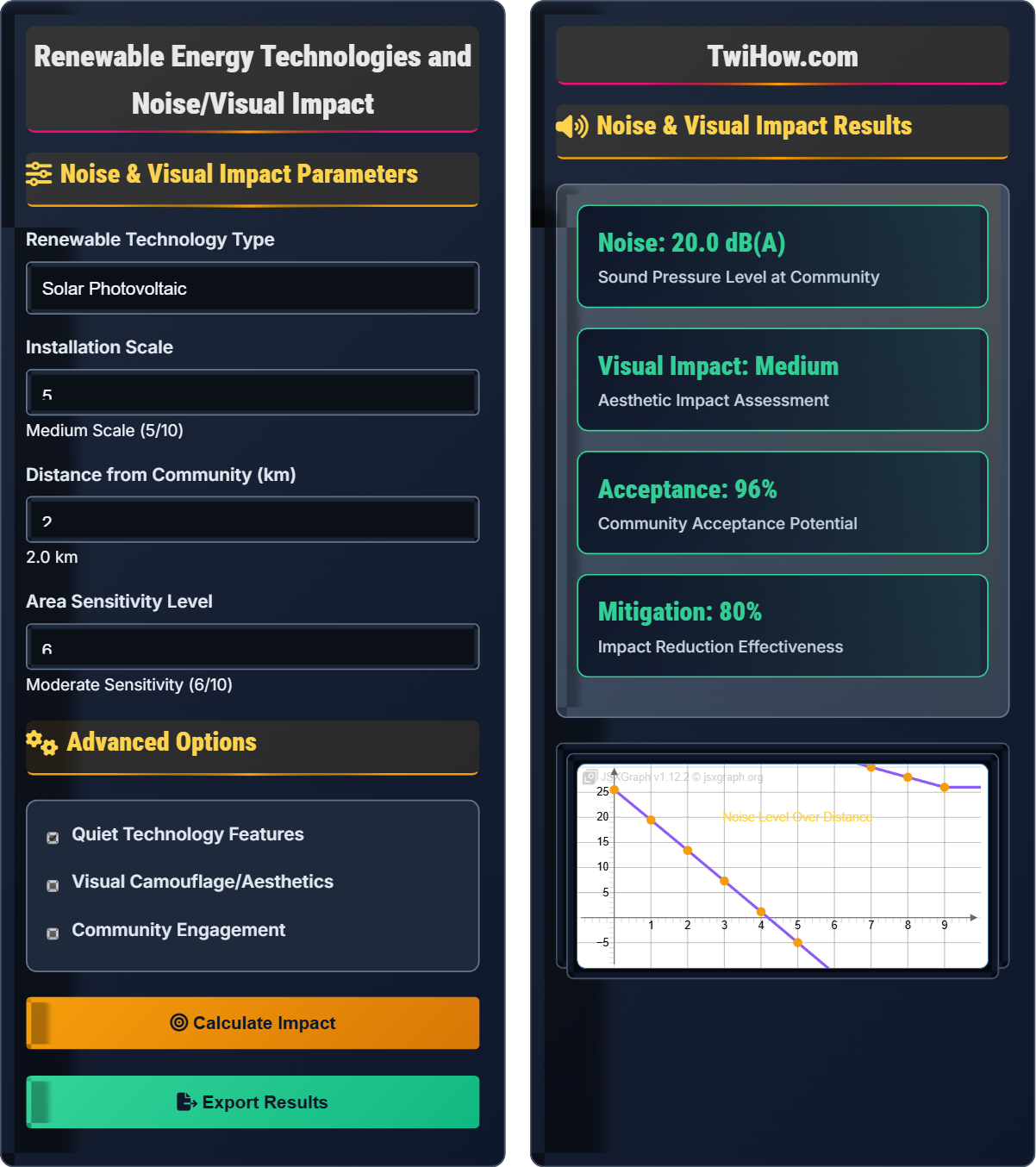
Noise & Visual Impact Parameters
Advanced Options
Noise & Visual Impact Results
| Noise Component | Level | Standard | Impact |
|---|---|---|---|
| Audible Sound | 35 dB(A) | 45 dB(A) | Low |
| Low Frequency | 0.5 Pa | 2.0 Pa | Low |
| Amplitude Modulation | 0.8 m/s | 1.0 m/s | Low |
| Shadow Flicker | 12 hrs/yr | 30 hrs/yr | Low |
| Visual Aspect | Rating | Mitigation | Acceptance |
|---|---|---|---|
| Size/Scale | Low | Screening | High |
| Color/Design | Low | Camouflage | High |
| Glare | Low | Anti-reflective | High |
| Visibility | Medium | Placement | Medium |
Renewable Energy Noise and Visual Impact Explained
Renewable energy technologies have varying impacts on acoustic and visual environments. Understanding these impacts is essential for proper siting, design, and community acceptance. Each technology has distinct characteristics that affect how it interacts with the surrounding environment.
The assessment of noise and visual impacts follows established methodologies:
Where:
- Noise Impact: Audible and low-frequency sound emissions
- Visual Impact: Effects on scenery and landscapes
- Mitigation Effectiveness: Reduction measures implemented
Each renewable technology has distinct noise and visual characteristics:
- Solar PV: Minimal noise, visual impact depends on scale and design
- Wind Turbines: Audible and low-frequency noise, visual presence
- Hydroelectric: Mechanical noise, significant visual and landscape changes
- Geothermal: Low noise, minimal visual impact
- Biomass: Mechanical and combustion noise, visual stack emissions
- Proper Siting: Locate installations away from sensitive receptors
- Technology Selection: Choose quieter, less visually intrusive designs
- Physical Barriers: Use terrain, vegetation, or structures to reduce impacts
- Operational Controls: Curtail operations during sensitive periods
- Design Enhancements: Improve aesthetics and reduce glare
- Community Involvement: Engage stakeholders in planning process
Noise/Visual Impact Fundamentals
Noise impact, visual impact, acoustic propagation, aesthetic assessment, mitigation strategies, community acceptance.
Total Impact = Noise Impact + Visual Impact - Mitigation Effectiveness
Where Impact = overall environmental effect, Mitigation = reduction measures.
- Impacts decrease with distance from source
- Technology choice affects impact levels
- Mitigation can significantly reduce impacts
Applications
Wind farm acoustic studies, solar installation visual impact assessments, hydroelectric environmental reviews, community engagement programs.
- Comprehensive environmental impact assessment
- Community consultation and engagement
- Appropriate technology selection
- Effective mitigation measure implementation
- Regulatory noise limits and standards
- Visual sensitivity of surrounding areas
- Community values and preferences
- Environmental protection requirements
Noise/Visual Impact Quiz
What is the typical audible noise level of a modern wind turbine at 500 meters distance?
Modern wind turbines typically produce 35-45 dB(A) at 500 meters distance. This is comparable to a quiet library or bedroom. The noise level decreases significantly with distance, following the inverse square law where sound intensity decreases by 6 dB for each doubling of distance.
The answer is C) 35-45 dB(A).
Modern wind turbines are designed to minimize noise emissions. The 35-45 dB(A) range is well below typical daytime background noise levels in rural areas (40-50 dB(A)). The noise consists of aerodynamic sounds from blade rotation and mechanical sounds from the nacelle, which are carefully engineered to minimize impact.
dB(A): A-weighted sound level adjusted for human hearing
Background Noise: Ambient sound levels in the environment
Inverse Square Law: Sound intensity decreases with distance squared
• Noise decreases significantly with distance
• Modern turbines are designed for low noise
• Background noise affects perception
• Consider distance when assessing noise impact
• Compare to background noise levels
• Modern designs prioritize noise reduction
• Assuming all turbines are equally noisy
• Not considering distance effects
• Ignoring background noise context
Explain the visual impact considerations for solar panel installations and describe how these impacts can be minimized.
Visual Impact Considerations: Solar installations can affect visual landscapes through their scale, color, reflectivity, and geometric patterns.
Key Visual Factors:
1. Scale and Density: Large arrays can dominate landscapes
2. Color and Reflectivity: Blue-black panels create visual contrast
3. Geometric Patterns: Regular arrays create artificial appearance
4. Glare and Reflection: Sunlight reflection can cause visual disturbance
Mitigation Strategies:
1. Screening: Use vegetation or terrain to hide installations
2. Camouflage: Select colors that blend with surroundings
3. Placement: Locate away from sensitive viewpoints
4. Anti-reflective Coatings: Reduce glare and reflections
Solar installations generally have lower visual impact than other renewable technologies when properly sited.
Solar panel visual impacts are primarily related to their appearance and placement. The blue-black color of silicon panels creates contrast with natural landscapes. However, solar installations can be integrated more successfully than other technologies through careful design and siting choices.
Visual Contrast: Difference between installation and surroundings
Glare: Intense reflected light causing visual discomfort
Screening: Obstructing view of installations
• Visual impact is subjective and context-dependent
• Proper siting minimizes impact
• Design features can reduce visual effects
• Consider sight lines from sensitive locations
• Use natural screening where possible
• Evaluate color and texture contrasts
• Ignoring seasonal variations
• Overlooking glare effects
A wind turbine produces 45 dB(A) of noise at 200 meters distance. Calculate the expected noise level at 800 meters distance, considering that sound intensity decreases by 6 dB for each doubling of distance. Also calculate the noise level at 1.6 km distance. If the background noise level is 35 dB(A), determine whether the turbine would be audible at each distance.
At 200m: 45 dB(A)
From 200m to 400m: 45 - 6 = 39 dB(A)
From 400m to 800m: 39 - 6 = 33 dB(A)
From 800m to 1.6km: 33 - 6 = 27 dB(A)
Comparison with Background Noise (35 dB(A)):
• At 800m: 33 dB(A) vs 35 dB(A) = barely audible
• At 1.6km: 27 dB(A) vs 35 dB(A) = inaudible
The turbine would be barely audible at 800m and inaudible at 1.6km given the 35 dB(A) background noise.
This example demonstrates the rapid attenuation of sound with distance. The 6 dB per doubling rule means that noise levels drop significantly even over moderate distances. In many cases, wind turbine noise becomes inaudible at distances of 1-2 km, especially in areas with higher background noise.
Sound Attenuation: Reduction in sound intensity with distance
Background Noise: Ambient sound levels in environment
Just Noticeable Difference: Minimum change in sound level
• Sound decreases by 6 dB per distance doubling
• Background noise masks quieter sounds
• Audibility depends on difference from background
• Calculate noise levels at receptor locations
• Compare to background noise levels
• Consider worst-case conditions
• Ignoring background noise effects
• Using incorrect attenuation rates
A community is concerned about a proposed solar farm that would cover 200 acres in a rural area. The installation would use dark blue panels arranged in regular rows. The nearest homes are 0.5 km away. Analyze the potential visual and noise impacts, and suggest mitigation strategies to improve community acceptance. Consider factors like visual dominance, glare, and aesthetic concerns.
Visual Impact Assessment:
• 200 acres is substantial and may dominate local landscape
• Dark blue panels create contrast with natural surroundings
• Regular geometric pattern appears artificial
• At 0.5 km, installation will be clearly visible
Noise Impact Assessment:
• Solar installations have minimal noise emissions
• Inverter humming may be barely audible at 0.5 km
Mitigation Strategies:
• Install perimeter vegetation to screen edges
• Use anti-reflective coatings to reduce glare
• Orient panels to minimize reflection toward homes
• Create visual breaks with landscaping
• Engage community in design process
• Consider agrivoltaics to maintain agricultural appearance
With proper mitigation, the visual impact can be significantly reduced while maintaining energy generation.
Solar installations often face visual impact concerns rather than noise issues. The key is to minimize the contrast between the installation and the surrounding environment while maintaining energy generation efficiency. Community engagement and early involvement can address concerns and incorporate local preferences.
Visual Dominance: Extent to which installation dominates view
Screening: Obscuring view of installation
Community Engagement: Involving stakeholders in planning
• Visual impact is often more concerning than noise
• Early community involvement helps acceptance
• Mitigation should be considered in design
• Conduct visual impact studies from key viewpoints
• Consider seasonal and time-of-day variations
• Engage community early in planning process
• Not engaging community early enough
• Underestimating visual impact concerns
Which renewable energy technology is most associated with infrasonic noise (frequencies below 20 Hz)?
Wind turbines are most associated with infrasonic noise due to the large rotating blades and tower vibrations. The rotation of large blades creates pressure waves at very low frequencies, and the tower can vibrate at infrasonic frequencies. While the levels are typically very low and below human hearing thresholds, this association has been widely discussed in relation to wind energy installations.
The answer is B) Wind turbines.
Infrasonic noise from wind turbines is caused by the interaction of rotating blades with the air and tower. Modern turbine design aims to minimize these effects. The actual levels of infrasonic noise from properly designed wind turbines are typically below levels that can be detected by human hearing or that have demonstrated health effects.
Infrasonic Noise: Sound below 20 Hz frequency
Pressure Waves: Oscillations in air pressure
Human Hearing Threshold: Range of detectable frequencies
• Infrasonic levels from turbines are typically very low
• Below human hearing threshold
• Modern designs minimize these effects
• Consider all frequency ranges in assessments
• Modern turbines have lower emissions
• Distinguish between perception and measurement
• Not considering modern design improvements
• Overemphasizing unmeasurable effects
FAQ
Q: Are modern wind turbines really as noisy as people say?
A: Modern wind turbines are significantly quieter than older models:
Sound Levels: 35-45 dB(A) at 500m (quiet library level)
Design Improvements: Advanced blade design reduces turbulence noise
Technology: Direct-drive generators eliminate gearbox noise
Distance Effect: Noise decreases by 6 dB per distance doubling
Background Noise: Rural areas often have 40-50 dB(A) background noise
Regulations: Strict noise limits guide modern installations
Most people living at recommended distances report turbine noise as barely audible or inaudible.
Q: How can solar installations be designed to minimize visual impact?
A: Visual impact minimization strategies include:
Siting: Locate away from sensitive viewpoints and scenic corridors
Screening: Use existing vegetation or plant buffers around perimeter
Orientation: Position to minimize reflection toward homes
Color: Select frames and mounting systems that blend with surroundings
Layout: Create visual breaks with landscaping or irregular patterns
Integration: Combine with existing structures when possible
Materials: Use anti-reflective coatings and low-glare surfaces
Proper design can significantly reduce visual impact while maintaining energy output.