How do renewable energy technologies impact soil and geology?
Complete renewable energy environmental guide • Soil & geology impacts
Soil & Geology Impact Assessment:
Show Impact SimulatorRenewable energy technologies interact with soil and geological systems in various ways, affecting land use patterns, soil composition, hydrology, and geological stability. Understanding these impacts is crucial for sustainable energy development and environmental stewardship.
Key impact categories include physical disturbance during construction, changes in land use patterns, alterations to water infiltration and runoff, and effects on soil chemistry. Different technologies have varying impact profiles and scales.
Impact categories by technology:
- Solar PV: Minimal soil disturbance, potential for dual land use
- Wind: Moderate infrastructure footprint, minimal soil impact
- Geothermal: Significant subsurface impact, minimal surface footprint
- Hydroelectric: Major geological and soil modifications
Effective impact management requires careful site selection, appropriate mitigation measures, and post-construction monitoring to ensure sustainable development practices.
Impact Parameters
Impact Mitigation
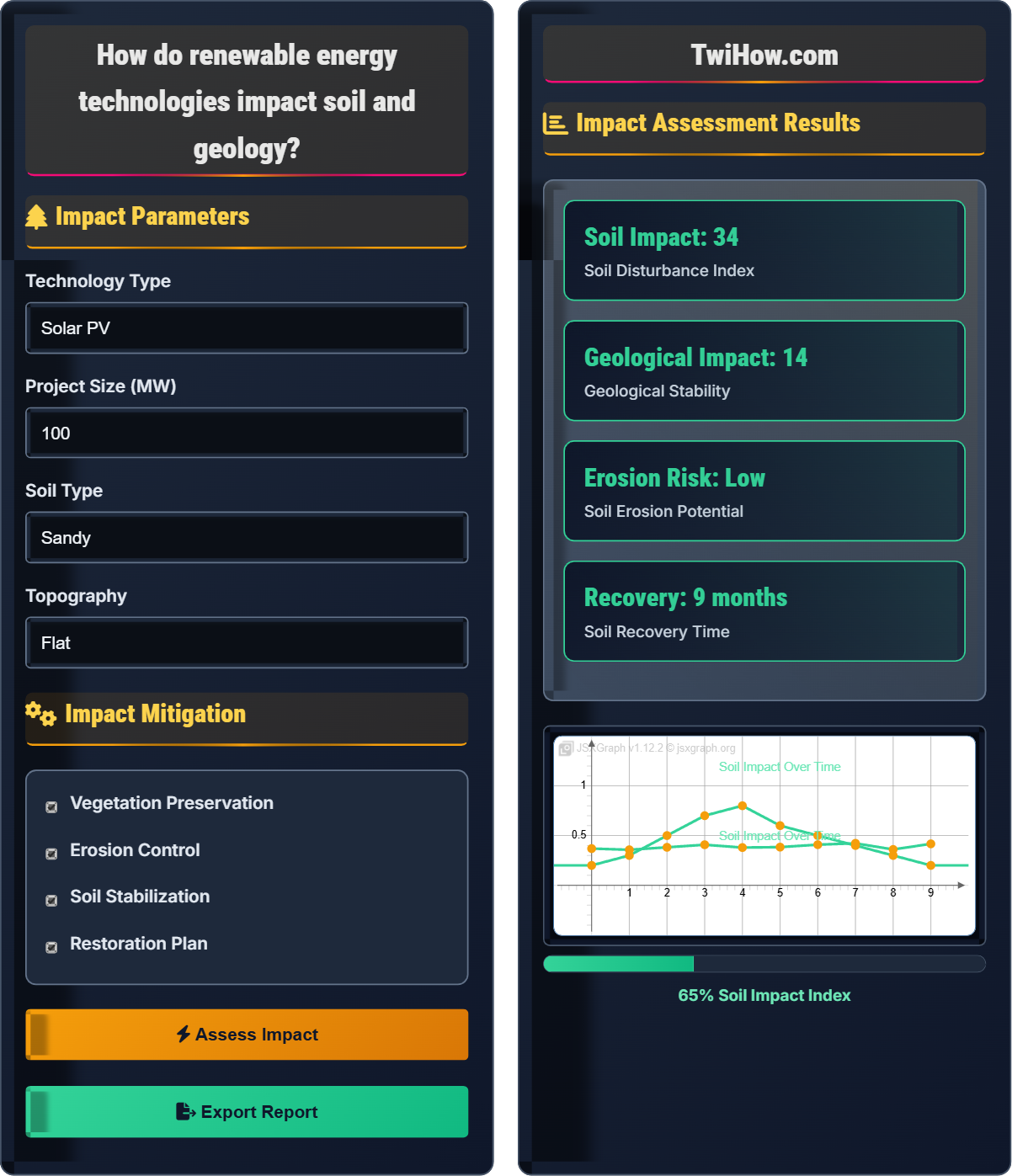
Impact Assessment Results
| Impact Type | Severity | Duration | Mitigation |
|---|---|---|---|
| Physical Disturbance | High | Short-term | Construction practices |
| Water Infiltration | Medium | Long-term | Drainage design |
| Soil Compaction | Medium | Medium-term | Equipment management |
| Chemical Changes | Low | Long-term | Material selection |
| Hydrology | Medium | Long-term | Stormwater management |
Geological Structure
Soil & Geology Impact Assessment Explained
Soil and geology impact assessment evaluates how renewable energy installations affect the physical environment beneath and around energy infrastructure. This includes changes to soil structure, composition, drainage patterns, and geological stability.
Assessment follows a systematic framework:
Framework components:
- Pre-Construction: Baseline soil and geology characterization
- Construction: Monitoring of soil disturbance and compaction
- Operation: Assessment of ongoing impacts
- Decommissioning: Soil restoration and rehabilitation
Impacts vary significantly by technology:
- Solar PV: Minimal soil disturbance, potential for beneficial land use (agrivoltaics)
- Wind: Moderate infrastructure footprint, minimal soil impact with proper construction
- Geothermal: Significant subsurface impact, minimal surface footprint
- Hydroelectric: Major geological and soil modifications, reservoir creation
- Biomass: Land use changes affecting soil organic matter and structure
- Environmental Protection: Preserves soil health and geological stability
- Regulatory Compliance: Meets environmental permitting requirements
- Long-term Viability: Maintains land productivity for future use
- Community Relations: Demonstrates environmental stewardship
- Project Success: Avoids costly delays and remediation
Impact Metrics & Soil Assessment
- Conduct thorough pre-construction soil surveys
- Implement erosion control measures during construction
- Minimize soil compaction through equipment management
- Restore vegetation cover for long-term stability
Technology-Specific Impact Profiles
Renewable Energy Soil & Geology Quiz
Which renewable energy technology typically has the highest soil and geological impact?
Hydroelectric projects typically have the highest soil and geological impact due to the massive scale of construction required. Dams, reservoirs, and associated infrastructure fundamentally alter geological structures and flood large areas, changing soil composition and drainage patterns permanently.
The answer is C) Hydroelectric.
Hydroelectric projects require extensive excavation, dam construction, and reservoir creation that permanently alters geological structures. The scale of earth-moving required is orders of magnitude larger than other renewable technologies, creating lasting changes to soil composition and drainage patterns across large areas.
Hydroelectric Impact: Major geological modification through dam construction
Soil Alteration: Permanent changes to soil composition and structure
Geological Change: Modification of natural geological formations
• Hydroelectric has largest soil/geological impact
• Scale of construction determines impact level
• Permanent changes require extensive planning
• Consider scale when evaluating impacts
• Hydroelectric changes are largely irreversible
• Smaller technologies have more manageable impacts
• Underestimating hydroelectric impact scale
• Assuming all renewables have minimal impact
• Not considering cumulative effects
Explain the causes and consequences of soil compaction during renewable energy construction and describe mitigation strategies.
Causes: Heavy construction equipment, repeated vehicle traffic, and improper handling of soil during foundation work create soil compaction.
Consequences: Reduced water infiltration, decreased root penetration, impaired gas exchange, and altered soil structure affecting long-term productivity.
Mitigation Strategies:
• Limit heavy equipment use to designated areas
• Use appropriate equipment for soil conditions
• Install temporary access mats to distribute weight
• Restore soil structure through subsoiling after construction
• Implement erosion control measures immediately
Soil compaction occurs when pressure from heavy machinery compresses soil particles, reducing pore space essential for water infiltration, air circulation, and root growth. This can persist for years, affecting vegetation recovery and water management. Prevention is more effective than remediation.
Soil Compaction: Compression of soil particles reducing pore space
Pore Space: Air and water spaces between soil particles
Subsoiling: Deep tillage to break up compacted layers
• Prevention is better than remediation
• Heavy equipment causes most compaction
• Pore space is essential for soil health
• Plan equipment routes carefully
• Restore soil structure post-construction
• Not planning for equipment movement
• Using inappropriate equipment for soil type
• Ignoring post-construction soil restoration
A 200 MW solar farm is planned on 800 acres of loamy soil with gentle slopes. Construction will require clearing vegetation on 600 acres and installing concrete foundations for tracking systems. Calculate the soil impact index using the formula: Impact Index = (Area Disturbed × Soil Sensitivity × Duration Factor) / Mitigation Effectiveness. Assume Area Disturbed = 600 acres, Soil Sensitivity = 0.7 (loamy soil), Duration Factor = 1.2 (2-year construction), Mitigation Effectiveness = 0.8 (good planning).
Calculation:
Impact Index = (Area Disturbed × Soil Sensitivity × Duration Factor) / Mitigation Effectiveness
Impact Index = (600 × 0.7 × 1.2) / 0.8
Impact Index = 504 / 0.8 = 630
Interpretation: With an impact index of 630, this project would have a high soil impact rating. The large area disturbed combined with the sensitivity of loamy soil and moderate duration creates significant impact, partially offset by good mitigation planning.
The impact index formula helps quantify environmental effects by combining multiple factors. In this case, the large area and soil sensitivity contribute significantly to the impact score, while mitigation efforts help reduce the overall rating. This quantitative approach enables comparison between different project alternatives.
Impact Index: Quantitative measure of environmental impact
Soil Sensitivity: Susceptibility to damage from disturbance
Mitigation Effectiveness: Degree to which impacts are reduced
• Higher index indicates greater impact
• Mitigation reduces overall impact
• Multiple factors influence total impact
• Use index for project comparison
• Focus on highest impact factors
• Maximize mitigation effectiveness
• Ignoring multiple impact factors
• Overestimating mitigation effectiveness
• Not considering soil-specific factors
You're designing a wind farm on steep, clay soil terrain. Identify the key soil and geological risks and propose specific mitigation measures for each risk.
Key Risks:
• Erosion on steep slopes during construction
• Foundation instability in clay soils
• Drainage issues due to clay permeability
• Equipment access on steep terrain
Mitigation Measures:
• Install terracing and retaining walls for slope stabilization
• Use deep pile foundations to bypass unstable clay layers
• Design comprehensive stormwater management system
• Create temporary access roads with proper drainage
• Implement immediate revegetation of disturbed areas
Steep clay terrain presents unique challenges requiring specialized mitigation approaches. Clay soils expand and contract with moisture, potentially destabilizing foundations. Steep slopes are prone to erosion, requiring engineering solutions like terracing and proper drainage. The key is addressing each risk with appropriate technical solutions.
Clay Soil Properties: High plasticity, low permeability
Slope Stability: Resistance to erosion and landslides
Deep Foundations: Extending below unstable soil layers
• Address each risk individually
• Use appropriate engineering solutions
• Consider soil-specific properties
• Engage geotechnical engineers early
• Conduct detailed soil testing
• Plan construction sequence carefully
• Using generic solutions for specific conditions
• Not considering clay soil expansion
• Inadequate slope stabilization
Which restoration technique is most effective for recovering soil productivity after renewable energy construction?
Adding organic matter and establishing native vegetation is the most effective approach for restoring soil productivity. Organic matter improves soil structure, water retention, and nutrient content, while native plants provide sustainable ground cover and enhance soil biology.
The answer is C) Organic matter addition and native vegetation establishment.
Soil restoration is a biological process that requires rebuilding the complex ecosystem of microorganisms, nutrients, and organic matter that support plant growth. Adding organic matter (compost, mulch) and establishing native vegetation creates a self-sustaining system that gradually restores soil productivity over time.
Soil Productivity: Ability to support plant growth
Organic Matter: Decomposed plant and animal material
Native Vegetation: Plants adapted to local conditions
• Biological restoration is most effective
• Native species support ecosystem health
• Organic matter improves soil structure
• Use compost and organic amendments
• Select native plant species
• Allow time for natural recovery
• Relying solely on topsoil replacement
• Using non-native plant species
• Expecting immediate recovery
FAQ
Q: How do renewable energy projects compare to fossil fuel extraction in terms of soil and geological impact?
A: Renewable energy projects generally have significantly lower soil and geological impacts compared to fossil fuel extraction:
Renewables: Temporary or localized disturbance, often with restoration potential. Solar/wind have minimal permanent changes. Geothermal has subsurface impact but small surface footprint.
Fossil Fuels: Mining creates massive geological disturbances, oil/gas extraction can cause subsidence, fracking affects underground formations.
However, large-scale hydroelectric projects can have comparable or greater impacts to some fossil fuel operations, particularly regarding land flooding and geological modifications.
Q: Can agricultural land be used for solar installations without impacting soil productivity?
A: Yes, agricultural land can be used for solar installations with minimal soil impact through agrivoltaics:
Benefits: Solar panels can reduce soil erosion, retain moisture, and provide shade that benefits certain crops. Panel cleaning can provide irrigation water.
Considerations: Panel spacing must allow adequate sunlight and equipment access. Some crops perform better than others under panels.
Best Practices: Use elevated mounting systems, maintain soil access for farming, and select compatible crops. Studies show some soil improvements with proper design.