How Do Renewable Energy Technologies Impact Water Resources and Usage?
Complete guide • Step-by-step explanations
Water-Energy Nexus:
Show Water Impact CalculatorThe water-energy nexus describes the critical relationship between water and energy systems. Renewable energy technologies have diverse impacts on water resources, ranging from minimal usage in wind and solar PV to significant consumption in concentrated solar power and hydropower. Understanding these impacts is crucial for sustainable energy planning.
Key water impacts by technology:
- Solar PV: Minimal water usage, primarily for panel cleaning
- Wind Power: Negligible water consumption
- Concentrated Solar Power: Significant cooling water requirements
- Hydropower: Alters water flow and quality
- Geothermal: Moderate water usage for cooling
Sustainable renewable energy deployment must balance energy needs with water conservation and ecosystem protection.
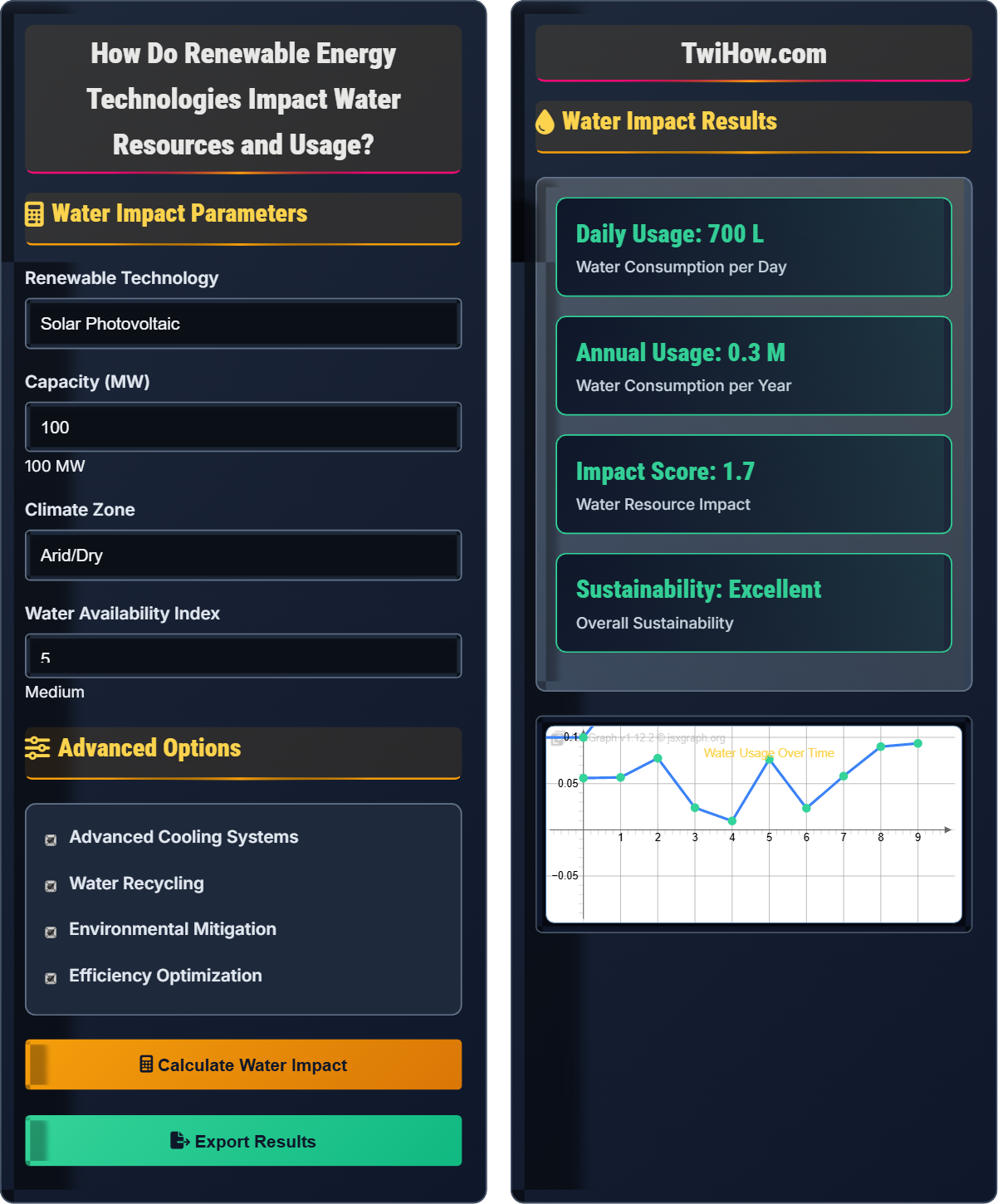
Water Impact Parameters
Advanced Options
Water Impact Results
| Technology | Daily Usage (L/MW) | Annual Usage (M) | Impact Level |
|---|---|---|---|
| Solar PV | 10 | 0.4 | Low |
| Wind | 0.5 | 0.02 | Minimal |
| CSP | 1,200 | 43.8 | High |
| Hydro | 0 | 0 | None |
| Geothermal | 25 | 0.9 | Low |
Solar PV
Wind
CSP
Hydro
Water-Impact Analysis of Renewable Technologies
The water-energy nexus describes the interdependent relationship between water and energy systems. Energy is required to pump, treat, and transport water, while water is essential for energy production. Renewable energy technologies have varying impacts on water resources, making careful selection crucial for water-stressed regions.
Solar PV
10 L/MW/dayWind
0.5 L/MW/dayCSP
1,200 L/MW/dayHydro
0 L/MW/daySolar PV
Wind
CSP
Coal
Technology Impact Analysis
Water Usage: Minimal (panel cleaning only)
Impact: Positive - reduces strain on water resources
Considerations: Cleaning frequency depends on dust accumulation and local climate
Water Usage: Negligible
Impact: Highly positive - no operational water consumption
Considerations: Manufacturing requires some water for component production
Water Usage: High (cooling requirements)
Impact: Negative in water-scarce regions
Considerations: Dry cooling systems available but less efficient
Water Usage: None consumed
Impact: Mixed - alters natural flow patterns
Considerations: Affects downstream ecosystems and water availability
Water Conservation Strategies
Reduce water usage in CSP plants by up to 90% compared to wet cooling systems, though with some efficiency trade-offs.
Implement closed-loop cooling systems that reuse water multiple times before discharge.
Collect and store rainwater for cleaning solar panels and other operational needs.
Use floating covers or other technologies to reduce evaporation losses in reservoirs.
Climate change exacerbates water scarcity in many regions, making water-efficient renewable technologies increasingly important. As temperatures rise and precipitation patterns shift, the water requirements of energy systems become a critical planning factor. Renewable technologies that minimize water usage will be essential for resilient energy systems in water-stressed regions.
Water Cycle & Renewable Energy
Solar Heating
EvaporationCondensation
Cloud FormationPrecipitation
Rain/SnowCollection
Rivers/LakesHydropower Impact
Alters sediment flow and temperature
Regional Scenarios
In arid regions, water-efficient technologies like wind and solar PV are preferred over CSP due to high water requirements. Implementation of dry cooling systems and water recycling becomes critical for CSP deployment.
In water-abundant regions, CSP with wet cooling and hydropower can be viable options, allowing for maximum energy generation while managing environmental impacts.
Industrial facilities can integrate renewable energy systems with existing water infrastructure, utilizing waste heat recovery and closed-loop cooling systems for enhanced efficiency.
Water-Energy Nexus Learning Quiz
Which renewable energy technology has the highest water consumption per unit of electricity generated?
Concentrated Solar Power (CSP) has the highest water consumption among renewable technologies, typically using 2-3 liters of water per kWh for cooling. This is significantly higher than other renewables due to the steam turbine cooling requirements in CSP systems.
The answer is C) Concentrated Solar Power.
While CSP is a renewable technology, it requires significant water for cooling purposes similar to conventional thermal power plants. This makes CSP less suitable for deployment in water-scarce regions unless dry cooling systems are implemented, which reduces efficiency but dramatically cuts water usage.
Water Consumption: Water that is evaporated or incorporated into products
Cooling Systems: Methods to dissipate waste heat from power generation
Water Footprint: Total volume of freshwater used to produce goods/services
• CSP requires cooling water for steam turbines
• Solar PV needs minimal water for cleaning
• Wind power consumes virtually no water
• Consider dry cooling for CSP in water-scarce regions
• Solar PV is ideal for desert installations
• Water availability should drive technology choice
• Assuming all solar technologies have low water usage
• Ignoring cooling requirements in CSP
• Overlooking regional water availability
Explain how hydropower impacts water resources differently from other renewable technologies. What are the main concerns?
Hydropower Water Impact: Unlike other renewables, hydropower doesn't consume water but significantly alters its natural flow patterns. The main concerns include:
Flow Alteration: Dams change seasonal flow patterns, affecting downstream ecosystems.
Sediment Trapping: Reservoirs trap sediments, reducing nutrient flow downstream.
Temperature Changes: Water released from deep reservoir layers is often colder.
Habitat Fragmentation: Dams block fish migration routes and fragment aquatic habitats.
These impacts differ fundamentally from consumption-based impacts of CSP or minimal impacts of wind/solar PV.
Hydropower represents a unique case in the water-energy nexus. While it doesn't consume water, it profoundly modifies the water cycle in affected watersheds. This illustrates the complexity of renewable energy impacts beyond simple consumption metrics.
Water Consumption: Permanent removal from the water cycle
Water Modification: Changes to flow, temperature, or quality
Watershed: Area drained by a river system
• Hydropower doesn't consume water
• Flow modification is the primary impact
• Downstream effects must be considered
• Consider environmental flow requirements
• Evaluate cumulative watershed impacts
• Implement fish passage systems
• Confusing consumption with modification
• Underestimating ecosystem impacts
• Ignoring downstream communities
A country in the Middle East with limited water resources wants to deploy 5 GW of renewable capacity. The region has abundant sunshine and wind resources. Compare the water implications of deploying all solar PV versus a mix of 50% CSP and 50% wind. Which strategy is more sustainable?
All Solar PV Strategy: 5 GW of solar PV would consume approximately 18,250 m³ of water annually for cleaning, representing minimal impact.
Mixed CSP-Wind Strategy: 2.5 GW of CSP would consume approximately 23,725,000 m³ annually for cooling, while 2.5 GW of wind would consume virtually nothing.
The all-solar PV strategy is significantly more sustainable for water-scarce regions, consuming less than 0.1% of the water required by the CSP portion of the mixed strategy.
This example demonstrates how regional characteristics should drive technology selection. In water-scarce regions, the water implications of renewable technologies become as important as energy efficiency considerations.
Water-Scarce Region: Areas with less than 1,000m³ per person annually
Technology Selection: Choosing appropriate technologies for local conditions
Sustainability: Long-term viability considering all resource constraints
• Match technology to local resources
• Consider cumulative water impacts
• Evaluate long-term sustainability
• Prioritize low-water technologies in arid regions
• Consider dry cooling for CSP where necessary
• Plan for water recycling and efficiency
• Ignoring regional water constraints
• Assuming all renewables are equal
• Focusing only on energy output
A CSP plant in California is facing drought restrictions limiting cooling water usage. Propose three technological solutions to maintain operations while reducing water consumption by 80%.
Solution 1: Dry Cooling Systems - Replace wet cooling towers with air-cooled condensers, reducing water usage by 90% but with 5-10% efficiency penalty.
Solution 2: Hybrid Cooling - Combine wet and dry cooling with smart controls to optimize water usage based on ambient conditions.
Solution 3: Wastewater Utilization - Use treated municipal wastewater for cooling, reducing freshwater demand while providing beneficial reuse.
These solutions can achieve the 80% reduction target while maintaining acceptable operational efficiency.
This scenario illustrates how engineering innovation can address sustainability challenges. Technological solutions can often bridge the gap between energy needs and environmental constraints, though trade-offs must be carefully evaluated.
Dry Cooling: Heat rejection using air instead of water
Hybrid Cooling: Combination of wet and dry cooling systems
Wastewater Reuse: Beneficial use of treated effluent
• Balance efficiency with water savings
• Consider total cost of solutions
• Evaluate environmental trade-offs
• Implement predictive controls for hybrid systems
• Consider seasonal variations in water availability
• Evaluate multiple solutions simultaneously
• Focusing only on one solution
• Ignoring efficiency penalties
• Not considering maintenance requirements
Which renewable energy technology has the greatest potential to negatively impact water quality?
Hydropower has the greatest potential to negatively impact water quality through altered flow patterns, temperature changes, and sediment trapping. While it doesn't consume water, it significantly modifies water characteristics and ecosystem functions in affected watersheds.
The answer is C) Hydropower.
Water quality impacts extend beyond consumption to include temperature, flow rate, sediment transport, and ecosystem disruption. Hydropower's flow regulation and reservoir formation can significantly alter downstream water quality and aquatic ecosystems.
Water Quality: Physical, chemical, and biological characteristics
Flow Regulation: Control of natural flow patterns
Sediment Transport: Movement of particles in water systems
• Quality impacts differ from quantity impacts
• Flow modification affects ecosystems
• Temperature changes matter for aquatic life
• Consider environmental flow releases
• Evaluate cumulative watershed impacts
• Monitor downstream water quality
• Focusing only on water consumption
• Ignoring ecosystem impacts
• Not considering downstream effects
FAQ
Q: How do renewable energy water impacts compare to fossil fuel alternatives?
A: Renewable energy technologies generally have lower water impacts than fossil fuel alternatives. Coal power plants use 1.8-2.2 liters/kWh, natural gas uses 0.7-1.0 liters/kWh, while most renewables use significantly less. Solar PV and wind use virtually no water during operation. CSP uses more water than other renewables but still less than coal. Hydropower doesn't consume water but modifies flow patterns. Overall, transitioning to renewables provides substantial water savings compared to traditional thermal power generation.
Q: What are the most promising water-saving innovations in renewable energy?
A: Key innovations include: 1) Advanced dry cooling systems for CSP that reduce water usage by 90% with minimal efficiency loss, 2) Atmospheric water generation integrated with renewable systems, 3) Smart irrigation systems powered by solar for agricultural applications, 4) Floating solar panels that reduce reservoir evaporation while generating electricity, 5) Hybrid renewable systems that optimize water usage across multiple technologies, and 6) Advanced materials for more efficient water heating and cooling. These innovations are making renewable energy increasingly compatible with water-scarce environments.