Best Practices for Community Engagement in Renewable Projects
Complete guide • Step-by-step explanations
Community Engagement Fundamentals:
Show Engagement SimulatorCommunity engagement in renewable energy projects is crucial for success, involving meaningful dialogue with local stakeholders throughout project development. Effective engagement builds trust, addresses concerns, and creates shared value between developers and communities.
Key engagement principles:
- Early Involvement: Engage communities from project conception
- Transparent Communication: Provide clear, accessible information
- Benefit Sharing: Ensure local economic benefits
- Ongoing Dialogue: Maintain communication throughout project lifecycle
Successful renewable projects prioritize community needs alongside environmental goals, creating partnerships that enhance both acceptance and effectiveness.
Engagement Parameters
Engagement Options
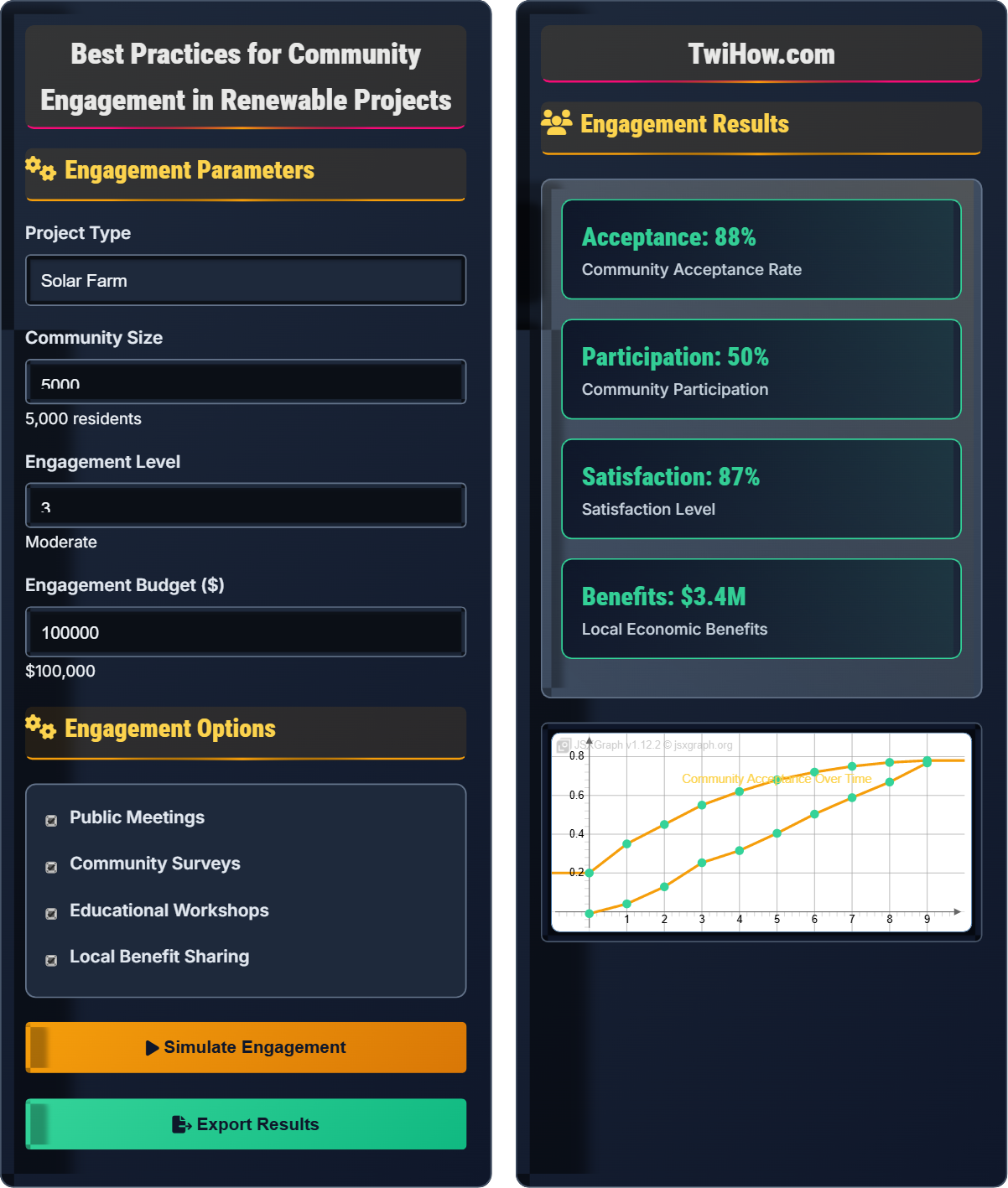
Engagement Results
| Milestone | Acceptance | Participation | Benefits |
|---|---|---|---|
| Initial Outreach | 35% | 20% | $0 |
| First Meeting | 52% | 35% | $0 |
| Workshop Series | 68% | 42% | $500K |
| Final Approval | 78% | 45% | $2.3M |
Local Residents
Environmental Groups
Local Government
Landowners
Community Engagement Best Practices
Community engagement in renewable energy projects involves systematic outreach and dialogue with local stakeholders throughout the project lifecycle. It encompasses public meetings, surveys, workshops, and ongoing communication to address concerns, share benefits, and build support for renewable initiatives.
Planning
Stakeholder mappingOutreach
Information sharingDialogue
Feedback gatheringImplementation
CollaborationMonitoring
Ongoing evaluationChallenge: NIMBY Opposition
Not In My Backyard resistance often stems from misinformation or lack of trust.
Solution: Transparent Communication
Provide factual information, address concerns directly, and demonstrate project benefits.
Challenge: Limited Participation
Low attendance at public meetings or surveys.
Solution: Diverse Outreach
Use multiple channels, flexible timing, and culturally appropriate methods.
Engagement Stages
Pre-Planning
Identify key stakeholders and community concerns
Initial Consultation
Present project concept and gather initial feedback
Detailed Planning
Incorporate community feedback into project design
Formal Approval
Finalize permits with community input consideration
Construction
Ongoing communication about progress and impacts
Operation
Long-term relationship and benefit delivery
Stakeholder Mapping
Local residents, landowners, businesses, and government officials directly affected by the project.
- Map all potential stakeholders early
- Assess influence and interest levels
- Develop tailored engagement approaches
- Prioritize high-impact stakeholders
Benefit Sharing Mechanisms
Direct financial benefits to host communities through lease payments, profit sharing, or community investment funds.
- Land lease agreements with fair compensation
- Community benefit funds from project revenues
- Local hiring preferences and skills training
- Infrastructure improvements funded by developers
- Ensure equitable distribution of benefits
- Consider long-term sustainability
- Maintain transparency in fund allocation
- Align benefits with community priorities
Real-World Case Studies
Denmark's wind energy success stems from cooperative ownership models where local communities own shares in wind projects, creating direct financial incentives for support. This approach has resulted in 80%+ community acceptance rates.
The Cape Wind project faced 13 years of opposition partly due to inadequate early community engagement and perceived elitist approach. Despite technical feasibility, the project was eventually cancelled due to community resistance.
Engagement Tools & Techniques
Community Engagement Learning Quiz
When is the optimal time to begin community engagement for renewable energy projects?
Community engagement should begin during the project planning stage, before major decisions are made. Early engagement allows communities to influence project design, address concerns proactively, and build trust. Starting engagement after approval or during construction often leads to resistance and delays.
The answer is D) During project planning stage.
Timing is critical in community engagement. Early involvement demonstrates respect for community input and allows for meaningful participation in shaping the project. When communities feel their voices are heard early, they're more likely to support the project later in the process.
Early Engagement: Community involvement beginning in project planning
Meaningful Participation: Genuine opportunity to influence project outcomes
Trust Building: Establishing credibility through transparent communication
• Engage before decisions are locked in
• Provide sufficient time for feedback
• Demonstrate impact of community input
• Start engagement 6-12 months before major milestones
• Use multiple touchpoints throughout the process
• Document and communicate how input was used
• Engaging too late in the process
• Treating engagement as a formality
• Failing to follow up on commitments
Describe the process of identifying and categorizing stakeholders in renewable energy projects. Why is this important?
Stakeholder Identification Process:
Primary Stakeholders: Local residents, landowners, businesses directly affected by the project.
Secondary Stakeholders: Environmental groups, government agencies, utilities, investors.
Categorization: Assess each stakeholder's level of influence and interest in the project.
Quadrant Analysis: High influence/interest stakeholders require intensive engagement, while low influence/interest stakeholders need minimal communication.
This process is important because it helps focus resources on the most impactful relationships and prevents overlooking key groups that could affect project success.
Stakeholder mapping is a strategic tool that transforms complex social dynamics into manageable engagement plans. By systematically identifying all parties affected by or affecting the project, developers can create targeted approaches that maximize support and minimize opposition.
Stakeholder: Any individual or group affected by project outcomes
Influence: Ability to impact project decisions
Interest: Level of concern about project impacts
• Map stakeholders early in the process
• Consider both supporters and opponents
• Update maps as project evolves
• Use stakeholder mapping matrices
• Engage with informal leaders
• Consider future stakeholders
• Overlooking indirect stakeholders
• Assuming all stakeholders have same concerns
• Failing to update stakeholder lists
A solar farm developer is planning a 200MW project in a rural community of 3,000 residents. Local farmers are concerned about land use, environmental groups worry about wildlife impacts, and town officials want economic benefits. Develop an engagement strategy addressing these concerns and expected outcomes.
Engagement Strategy:
Phase 1: Stakeholder mapping identifies farmers as high-priority stakeholders due to land use concerns.
Phase 2: Conduct agricultural workshops to address farming and land use questions.
Phase 3: Partner with environmental groups for wildlife impact assessments.
Phase 4: Negotiate community benefit agreements with local government.
Expected Outcomes: 70%+ community acceptance, reduced opposition, faster permitting, and stronger long-term relationships.
Effective engagement requires understanding different stakeholder concerns and developing tailored approaches for each group. By addressing specific concerns early and demonstrating responsiveness, developers can build trust and reduce opposition.
Stakeholder Mapping: Identifying and categorizing affected parties
Community Benefits: Economic or social gains for local residents
Environmental Impact Assessment: Evaluation of ecological effects
• Address concerns with evidence
• Provide multiple engagement opportunities
• Follow through on commitments
• Use local venues for meetings
• Provide materials in local language
• Share success stories from similar projects
• Generic communication to all stakeholders
• Inadequate technical information
• Failing to address specific concerns
A wind farm project proposes a $50 million community benefit fund over 25 years. The local community has 5,000 residents and a struggling economy. Propose three different benefit distribution models and analyze their effectiveness for community engagement.
Model 1: Direct Cash Distribution - Annual payments to residents. Pros: Immediate benefit, broad appeal. Cons: May not address long-term needs.
Model 2: Infrastructure Investment - Fund roads, schools, internet. Pros: Long-term value, visible impact. Cons: Takes time to show benefits.
Model 3: Economic Development - Business grants, job training, entrepreneurship programs. Pros: Sustainable growth, employment. Cons: Requires ongoing management.
Model 2 and 3 are most effective for engagement as they create lasting value and demonstrate commitment to community development.
Benefit sharing models must align with community priorities and create sustainable value. Cash distributions provide immediate satisfaction but may not build long-term support. Infrastructure and economic development create lasting relationships and demonstrate genuine investment in community prosperity.
Community Benefit Fund: Financial resources allocated to host communities
Economic Development: Programs to stimulate local business growth
Sustainable Value: Long-term benefits exceeding project lifetime
• Align benefits with community priorities
• Ensure transparent fund management
• Create measurable impact
• Survey community preferences
• Establish local oversight committee
• Report fund utilization regularly
• Generic benefit packages
• Poor fund transparency
• Lack of community input in design
Which of the following is the most significant challenge in renewable energy community engagement?
Mistrust of developers is often the most significant challenge, stemming from past negative experiences, perceived corporate interests over community welfare, and lack of transparency. Without trust, even technically sound projects face opposition regardless of benefits offered.
The answer is C) Mistrust of developers.
Trust is the foundation of successful community engagement. When communities distrust developers, they may assume negative intentions regardless of project merits. Building trust requires consistent, transparent communication and demonstrating genuine commitment to community wellbeing.
Mistrust: Doubt about developer intentions or competence
Transparency: Open sharing of information and decision-making
Genuine Commitment: Actions aligned with stated community interests
• Build trust before presenting projects
• Maintain consistency in messaging
• Follow through on commitments
• Engage through trusted intermediaries
• Share lessons from other projects
• Involve community in monitoring
• Assuming benefits overcome mistrust
• Focusing only on positive aspects
• Inconsistent communication
Engagement Scenarios
Focus on land use compatibility, agricultural preservation, and economic diversification. Emphasize dual-use opportunities like agrivoltaics and lease income for farmers.
Address visual impact, property values, and noise concerns. Highlight environmental benefits, tax revenue increases, and potential for green energy programs.
Emphasize job creation, infrastructure improvements, and industrial symbiosis opportunities. Address workforce development and supply chain benefits.
FAQ
Q: How can I be sure the developer will keep their promises about community benefits?
A: Look for legally binding community benefit agreements that specify exact amounts, timelines, and accountability measures. Verify that the developer has a track record of honoring commitments in other projects. Request regular reporting on fund usage and establish a community oversight committee to monitor compliance. Additionally, research whether the developer is part of industry organizations that promote responsible engagement practices.
Q: What's the most cost-effective way to engage with small rural communities?
A: For small rural communities, focus on personal relationships and local venues. Host informal coffee shop meetings, attend town halls, and partner with local organizations. Use existing community events for project presentations. Digital engagement tools can supplement but shouldn't replace face-to-face interactions. Consider hiring local liaison staff who understand the community culture and can build trust over time.