What Are the Best Practices for End-of-Life Management of Renewable Energy Equipment?
Complete guide • Step-by-step explanations
End-of-Life Management:
Show EOL SimulatorAs renewable energy installations age, proper end-of-life management becomes critical for sustainability. Best practices include design for recyclability, take-back programs, material recovery, and circular economy principles that maximize resource value while minimizing environmental impact.
Key considerations:
- Design Phase: Design for disassembly and recyclability
- Collection: Take-back programs and logistics
- Processing: Efficient dismantling and separation
- Recovery: Material and component reuse
- Regulation: Compliance with waste management laws
Proactive EOL management ensures renewable energy systems remain truly sustainable throughout their entire lifecycle.
EOL Management Parameters
Advanced Options
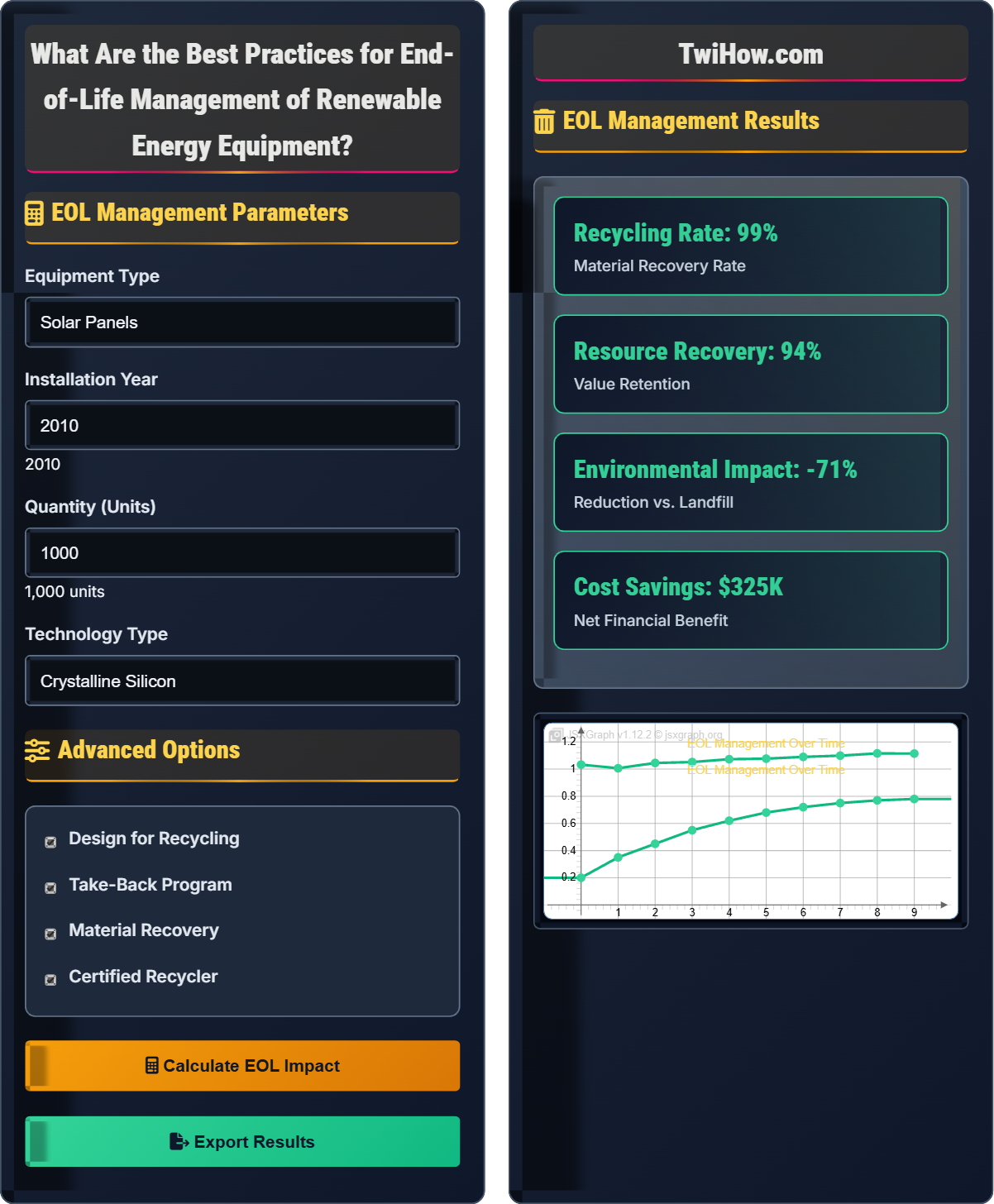
EOL Management Results
| Material | Recovery Rate | Value | Application |
|---|---|---|---|
| Silver | 95% | $150K | Electronics |
| Silicon | 90% | $80K | New Panels |
| Aluminum | 98% | $45K | Structural |
| Gold | 99% | $25K | Electronics |
| Copper | 96% | $35K | Electrical |
Recycling
Recovery
Impact
Cost
End-of-Life Management Analysis
End-of-life management for renewable energy equipment involves systematic approaches to dismantle, process, and recover valuable materials while minimizing environmental impact. As the first wave of renewable installations reaches end-of-life, proper management becomes critical for sustainability.
Collection
Equipment RetrievalDismantling
SeparationProcessing
Material RecoveryReuse
Value RecoveryRecycling
Value
Impact
CO2
Equipment-Specific Management
Recovery: Silver, silicon, aluminum, glass, and copper can be recovered with high efficiency.
Process: Mechanical separation followed by thermal and chemical processes.
Best Practice: Design for easy disassembly and material separation.
Recovery: Steel, copper, rare earth magnets, and composite materials.
Process: Cutting, shredding, and magnetic separation.
Best Practice: Plan for decommissioning from installation.
Recovery: Lithium, cobalt, nickel, and other valuable metals.
Process: Pyrometallurgy, hydrometallurgy, or direct recycling.
Best Practice: Second-life applications before recycling.
Recovery: Precious metals like gold, silver, and palladium.
Process: Circuit board separation and precious metal recovery.
Opportunity: High-value material recovery.
Best Practices
Design equipment with end-of-life considerations from the beginning, including easy disassembly and material separation.
Establish systems for collecting end-of-life equipment from customers, often as part of extended producer responsibility.
Partner with certified recyclers who meet environmental and safety standards for processing.
Conduct comprehensive LCA to optimize design and processing for environmental benefits.
End-of-life management is a critical component of circular economy principles for renewable energy. By recovering valuable materials and reintroducing them into the production cycle, we can reduce the need for virgin materials and minimize environmental impacts while maintaining the sustainability benefits of renewable energy.
Equipment Lifecycle Management
Design
EOL ConsiderationsInstall
DeploymentOperate
ServiceRetire
DecommissionRecycle
RecoveryWaste Reduction
Proper EOL management prevents hazardous materials from entering waste stream
Equipment-Specific Strategies
Different renewable energy equipment requires specific management approaches based on material composition, design complexity, and environmental considerations. Solar panels, wind turbines, and batteries each present unique challenges and opportunities for end-of-life management.
A 10MW solar installation installed in 2010 will reach end-of-life around 2030. Proper EOL management includes take-back programs, certified processing, and material recovery of silver, silicon, and aluminum. With 92% recycling rate, approximately 85% of material value can be recovered while avoiding landfill disposal.
Lithium-ion battery systems have shorter lifespans (10-15 years) than solar panels, requiring earlier EOL management. First-life applications (grid storage) can be followed by second-life applications (backup power) before recycling. This approach maximizes value retention while preparing for responsible material recovery.
EOL Management Learning Quiz
What is the primary valuable material recovered from crystalline silicon solar panels?
Silver is the primary valuable material recovered from crystalline silicon solar panels, used in the conductive grid lines on the front surface. While silicon is the semiconductor material, silver has the highest economic value due to its rarity and use in electronics applications.
The answer is B) Silver.
Solar panels contain multiple valuable materials, but silver stands out due to its high economic value and critical use in the electrical connections. Understanding material composition helps optimize recovery processes and economic returns.
Material Recovery: Extraction of valuable components
Crystalline Silicon: High-efficiency solar cell technology
Conductive Grid Lines: Silver tracks for current collection
• Identify valuable materials early
• Optimize recovery processes
• Consider material market values
• Research material composition
• Monitor commodity prices
• Optimize separation processes
• Not identifying valuable materials
• Inefficient separation processes
• Ignoring market value fluctuations
Explain the importance of take-back programs for renewable energy equipment end-of-life management.
Take-Back Programs Importance:
Producer Responsibility: Manufacturers retain responsibility for equipment throughout its lifecycle.
Collection Efficiency: Centralized collection systems ensure proper handling and processing.
Material Recovery: Maximizes recovery of valuable materials and components.
Environmental Protection: Prevents improper disposal and environmental contamination.
Regulatory Compliance: Meets extended producer responsibility requirements.
Customer Relations: Builds trust and loyalty through comprehensive service.
Take-back programs shift the responsibility for end-of-life management from consumers to producers, ensuring that equipment is handled properly and valuable materials are recovered. This approach aligns with circular economy principles and environmental regulations.
Take-Back Program: Manufacturer collects end-of-life products
Extended Producer Responsibility: Manufacturer liability for entire lifecycle
Circular Economy: Resource recovery and reuse
• Plan for take-back from design
• Establish collection networks
• Partner with certified processors
• Integrate with warranty programs
• Use reverse logistics
• Track material flows
• Not planning for take-back
• Inadequate collection systems
• Poor processor selection
A solar farm installed in 2015 with 10,000 panels is expected to reach end-of-life in 2035. Calculate the material recovery potential and plan for EOL management. Each panel weighs 20kg and contains 2g of silver.
Material Recovery Calculation:
Total weight: 10,000 panels × 20kg = 200,000kg
Silver content: 10,000 panels × 2g = 20,000g = 20kg
At current silver prices (~$25/g), silver value = 20kg × 1000 × $25 = $500,000
EOL Plan: 1) Establish take-back program with certified recycler, 2) Plan collection logistics 2-3 years before retirement, 3) Process panels for 92% material recovery rate, 4) Track material flows and environmental benefits.
This example demonstrates the significant value potential in end-of-life renewable equipment. Proper planning can turn EOL management from a cost center into a revenue opportunity while ensuring environmental protection.
Material Recovery: Extraction of valuable components
Take-Back Program: Manufacturer collection system
Life Cycle Planning: Forward-thinking EOL preparation
• Plan EOL from installation
• Calculate material value
• Establish collection systems
• Monitor commodity prices
• Partner with recyclers early
• Track environmental benefits
• Not planning for EOL
• Ignoring material value
• Delaying collection planning
A grid-scale battery installation has 1,000 lithium-ion battery packs with 15-year lifespans. Design an EOL management strategy that maximizes value recovery while ensuring environmental protection.
Strategy: 1) First-life applications until 80% capacity retention, 2) Second-life applications for backup power, 3) Certified pyrometallurgical processing, 4) Material recovery tracking.
Implementation: Partner with certified recyclers specializing in lithium-ion batteries, establish collection logistics, track material flows and environmental benefits.
Expected Outcome: 90% material recovery rate, $2M value recovery, environmental protection.
Battery EOL management benefits from second-life applications that extend useful life before recycling. This approach maximizes value while preparing for responsible material recovery.
Second-Life Applications: Continued use after first-life
Pyrometallurgical: High-temperature metal recovery
Capacity Retention: Remaining storage capacity
• Maximize first-life applications
• Plan for second-life uses
• Use certified processors
• Monitor battery health
• Identify second-life markets
• Track material recovery
• Not considering second-life
• Using uncertified processors
• Not tracking material flows
What is the primary environmental concern for wind turbine blade disposal?
The primary environmental concern for wind turbine blade disposal is composite material disposal. Blades are made of fiberglass and carbon fiber composites that are difficult to recycle and can persist in landfills indefinitely. New recycling technologies are being developed to address this challenge.
The answer is B) Composite material disposal.
Wind turbine blades present unique EOL challenges due to their composite construction. Unlike metals that can be melted down, composite materials require specialized processing technologies that are still being developed and scaled.
Composite Materials: Fiber-reinforced plastics
Fiberglass: Glass fiber reinforcement
Carbon Fiber: High-strength fiber reinforcement
• Plan for composite disposal
• Research recycling technologies
• Consider material alternatives
• Monitor recycling developments
• Consider recyclable materials
• Plan for long-term disposal
• Not planning for composite disposal
• Ignoring recycling limitations
• Not researching alternatives
FAQ
Q: How can installers contribute to end-of-life management during installation?
A: Installers can contribute by: 1) Recording serial numbers and installation details for future tracking, 2) Installing with EOL access in mind (avoiding permanent adhesives), 3) Providing customers with EOL management information, 4) Partnering with manufacturers for take-back programs, and 5) Following proper disposal guidelines for installation waste. Documentation and planning during installation can significantly simplify end-of-life processes.
Q: What are the economic benefits of proper end-of-life management?
A: Economic benefits include: 1) Recovery of valuable materials (silver, rare earths, lithium), 2) Reduced disposal costs compared to landfilling, 3) Potential revenue from recycled materials, 4) Compliance with regulations avoiding penalties, 5) Enhanced brand reputation, and 6) Reduced need for virgin materials. Proper EOL management can convert costs into revenue opportunities while ensuring regulatory compliance.