Renewable Energy Project Financing & Risk Management Best Practices
Complete energy guide • Step-by-step explanations
Financing & Risk Management:
Show Financing Risk CalculatorRenewable energy project financing requires sophisticated strategies to manage the unique risks associated with clean energy investments. Successful projects combine multiple funding sources, implement comprehensive risk mitigation measures, and utilize specialized financial instruments designed for the renewable sector.
Best practices include diversifying funding sources, conducting thorough due diligence, structuring appropriate contracts, and implementing robust risk management frameworks. These approaches help reduce financial uncertainties and attract investment capital at competitive rates.
Key financing strategies:
- Capital Structure: Optimal mix of debt and equity financing
- Risk Allocation: Proper assignment of risks to capable parties
- Contract Design: Comprehensive agreements with performance guarantees
- Insurance Coverage: Protection against various operational risks
Effective risk management ensures project viability and investor confidence while enabling the scale of investment needed for the energy transition.
Financing & Risk Parameters
Advanced Options
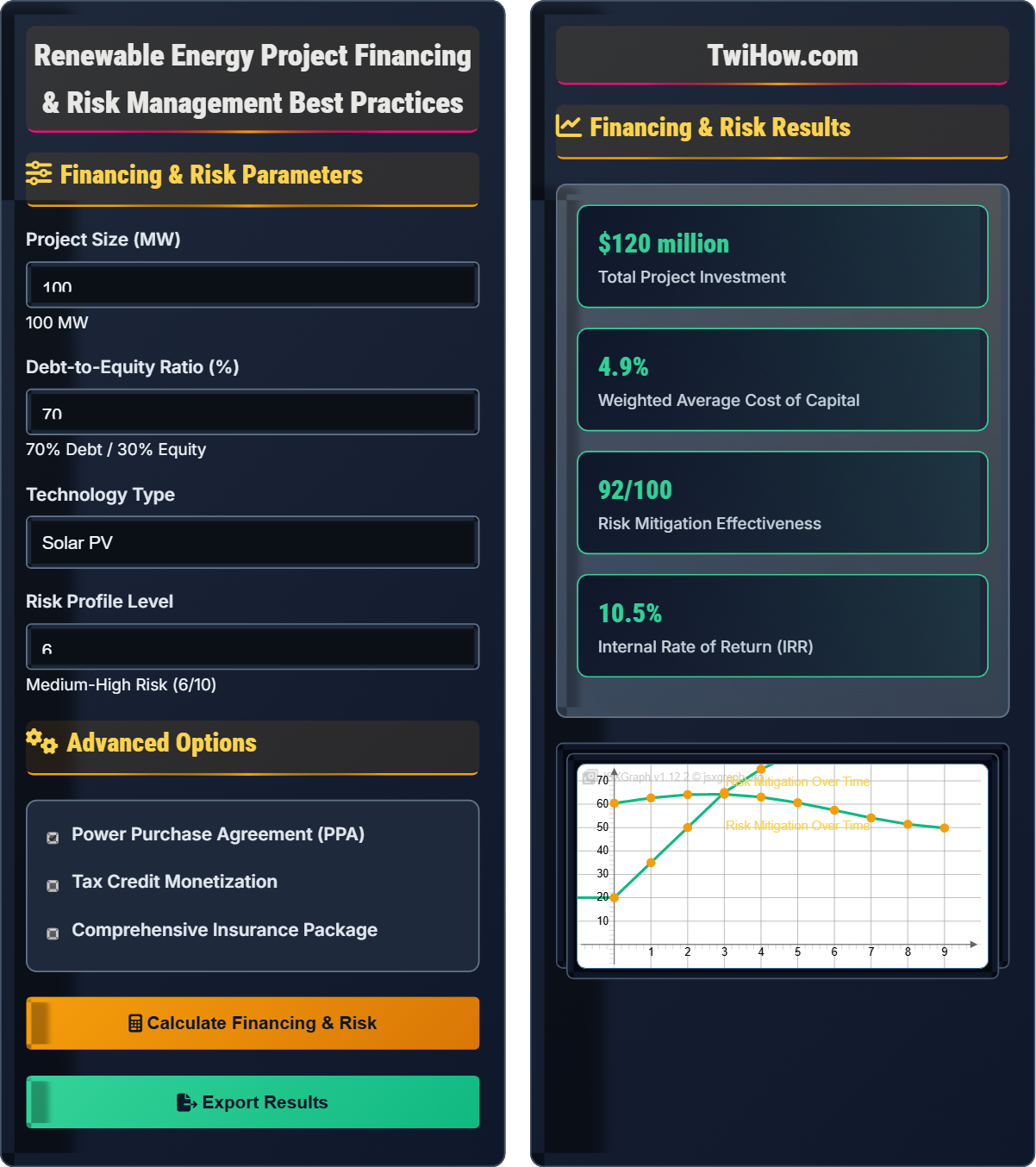
Financing & Risk Results
| Financing Source | Amount ($M) | Interest Rate | Term (Years) |
|---|---|---|---|
| Senior Debt | 60 | 4.5% | 15 |
| Subordinated Debt | 24 | 6.2% | 12 |
| Equity Investment | 36 | - | 20 |
| Tax Equity | 18 | - | 7 |
| Risk Category | Probability | Impact | Mitigation |
|---|---|---|---|
| Weather | Medium | High | Insurance |
| Market | Low | Medium | PPA |
| Construction | Low | High | Guarantees |
| Policy | Medium | Medium | Diversification |
Renewable Energy Project Financing & Risk Management Explained
Renewable energy project financing involves structuring capital to fund clean energy developments while managing inherent risks. Unlike corporate financing, project financing relies on the project's cash flows for debt repayment rather than the sponsor's balance sheet. This approach allows for larger projects and risk isolation.
The optimal capital structure balances costs and risks:
Where:
- WACC: Weighted Average Cost of Capital
- E/V: Equity to total value ratio
- D/V: Debt to total value ratio
- R_e: Cost of equity
- R_d: Cost of debt
- T_c: Corporate tax rate
Key risk categories in renewable energy projects:
- Resource Risk: Variability in wind, solar, or water resources
- Market Risk: Price volatility and demand fluctuations
- Construction Risk: Delays, cost overruns, and technical issues
- Policy Risk: Regulatory changes and incentive modifications
- Technology Risk: Equipment performance and warranty issues
- Counterparty Risk: Default by offtakers or contractors
- Contractual Protection: Long-term PPAs and EPC contracts
- Insurance Coverage: Comprehensive policies for various risks
- Performance Guarantees: Contractor warranties and insurance
- Financial Hedging: Derivatives to manage market risks
- Diversification: Geographic and technology portfolio mix
- Government Support: Guarantees and policy stability
Financing & Risk Fundamentals
Project financing, risk management, debt-equity structure, WACC, cash flow modeling, risk mitigation.
WACC = (E/V × Re) + (D/V × Rd × (1-Tc))
Where WACC = weighted average cost, E/V = equity proportion, D/V = debt proportion.
- Project cash flows must service debt obligations
- Risks should be assigned to capable parties
- Debt typically finances 70-80% of project cost
Applications
Solar farms, wind projects, energy storage systems, hybrid renewable installations, distributed generation.
- Comprehensive due diligence and risk assessment
- Structured financing with appropriate covenants
- Robust contract frameworks and guarantees
- Continuous monitoring and risk management
- Market conditions and interest rates
- Regulatory environment stability
- Technology maturity and performance
- Counterparty creditworthiness
Financing & Risk Management Quiz
What is the typical debt-to-equity ratio in renewable energy project financing?
Renewable energy projects typically have a debt-to-equity ratio of 70-80% debt and 20-30% equity. This high debt ratio is possible because renewable projects have predictable, long-term cash flows from power purchase agreements, making them attractive to lenders who can rely on steady revenue streams to service debt obligations.
The answer is C) 70-80% debt / 20-30% equity.
The high debt ratio in renewable projects reflects the industry's understanding that these assets generate stable, predictable cash flows. Lenders are willing to provide substantial debt financing because they have confidence in the revenue streams from long-term power purchase agreements. This allows sponsors to maximize their returns on equity investments.
Debt-to-Equity Ratio: Proportion of debt to equity financing
Power Purchase Agreement (PPA): Contract for electricity sale
Cash Flow Predictability: Consistency of revenue streams
• Higher debt ratios increase returns on equity
• Predictable cash flows enable high leverage
• Risk allocation affects financing terms
• Longer PPAs enable higher debt ratios
• Stable offtaker credit is crucial
• Technology risk affects financing terms
• Assuming all projects can achieve high leverage
• Not considering counterparty credit risk
• Ignoring construction risk impact
Explain the key risk categories in renewable energy projects and describe how each risk can be mitigated.
Key Risk Categories and Mitigation:
1. Resource Risk: Variability in renewable resources (sunlight, wind) - Mitigated through long-term meteorological data, insurance, and performance guarantees.
2. Market Risk: Electricity price volatility - Managed through long-term PPAs, hedging instruments, and revenue diversification.
3. Construction Risk: Delays and cost overruns - Addressed with fixed-price EPC contracts, completion guarantees, and delay insurance.
4. Policy Risk: Regulatory changes affecting incentives - Mitigated through policy stability agreements, diversified portfolios, and political risk insurance.
5. Technology Risk: Equipment performance issues - Handled with manufacturer warranties, O&M contracts, and performance insurance.
6. Counterparty Risk: Default by offtakers or contractors - Managed through credit enhancement, parent guarantees, and collateral requirements.
Effective risk management allocates each risk to the party best able to manage it.
Risk management in renewable projects involves identifying, quantifying, and allocating risks appropriately. The goal is to assign each risk to the party that can most efficiently manage it, whether that's through expertise, insurance, or financial capacity. This approach minimizes the overall cost of risk to the project.
EPC Contract: Engineering, procurement, and construction agreement
Performance Guarantee: Assurance of minimum output levels
Risk Allocation: Assignment of risks to capable parties
• Risks should be allocated to capable parties
• Multiple mitigation strategies strengthen protection
• Continuous monitoring is essential
• Use insurance to transfer pure risks
• Employ contracts to manage commercial risks
• Diversify to reduce concentration risk
• Failing to properly allocate risks
• Not monitoring risk mitigation effectiveness
A 150 MW solar project costs $200 million to build and has a 20-year PPA at $45/MWh. Annual operating expenses are $1.5 million. The project is financed with 75% debt at 4.2% interest and 25% equity. Calculate the unlevered IRR (ignoring debt) and determine if the project meets a 10% return threshold. Assume the plant operates at 90% capacity factor and sells all generated electricity.
Annual Energy Production: 150 MW × 8,760 hours × 90% = 1,182,600 MWh
Annual Revenue: 1,182,600 MWh × $45/MWh = $53,217,000
Annual Operating Expenses: $1,500,000
Annual Cash Flow: $53,217,000 - $1,500,000 = $51,717,000
Initial Investment: $200,000,000
Unlevered IRR Calculation: Solving for IRR in NPV equation with 20 years of $51.717M cash flows and $200M initial investment
Unlevered IRR ≈ 25.1%
The project significantly exceeds the 10% return threshold, demonstrating strong financial viability even before considering the leverage effect of debt financing.
This calculation demonstrates the fundamental profitability of renewable projects. The high IRR reflects the long-term nature of renewable assets with stable cash flows. The unlevered IRR provides a baseline measure of project economics before considering financing effects. With debt financing at lower rates than the unlevered return, the equity IRR would be even higher.
Unlevered IRR: Return excluding financing effects
Capacity Factor: Actual output vs. maximum possible output
Power Purchase Agreement (PPA): Long-term electricity sales contract
• Capacity factors reflect actual performance
• Use conservative capacity factor assumptions
• Account for inflation in operating expenses
• Consider degradation in energy output over time
• Not accounting for equipment degradation
• Ignoring inflation in operating costs
A wind project qualifies for $30 million in production tax credits over 10 years. The developer needs to monetize these credits to reduce upfront equity requirements. Describe how tax equity financing works in this context and calculate the approximate equity reduction if tax equity investors provide 15% of the project cost in exchange for tax benefits.
Tax Equity Financing Structure: A tax equity investor contributes capital in exchange for tax benefits (ITC, PTC, depreciation). The investor receives tax allocations for a specified period (often 7 years) then sells the project back to the developer.
Project Cost Assumption: $200 million total project cost
Tax Equity Investment: 15% × $200 million = $30 million
Original Equity Requirement: 25% × $200 million = $50 million
New Equity Requirement: $50 million - $30 million = $20 million
Equity Reduction: $30 million or 60% reduction in equity requirement
Tax equity financing allows developers to significantly reduce their upfront equity investment while monetizing tax benefits efficiently.
Tax equity financing is a specialized structure that allows entities with tax appetite to monetize renewable energy tax incentives. Financial institutions often serve as tax equity investors, providing capital in exchange for tax benefits they can use to offset their own tax obligations. This structure optimizes the use of tax incentives across the economy.
Tax Equity: Investment in exchange for tax benefits
Production Tax Credit (PTC): Federal tax credit for renewable electricity
Tax Appetite: Ability to use tax benefits effectively
• Tax equity investors need tax appetite
• Structures must comply with safe harbor rules
• Developer typically retains operational control
• Match tax equity investors with project timing
• Ensure compliance with IRS safe harbors
• Maintain operational control agreements
• Violating safe harbor requirements
• Misaligning investment timing with tax credits
Which type of insurance is most critical for renewable energy projects during the construction phase?
Contractor's all-risk insurance is most critical during the construction phase. This comprehensive policy covers physical loss or damage to the project during construction, including equipment, materials, and work in progress. It protects against risks like fire, theft, weather damage, and construction accidents that could cause significant delays and cost overruns.
The answer is B) Contractor's all-risk insurance.
Construction phase insurance is crucial because projects face maximum exposure during this period. The contractor's all-risk policy provides comprehensive coverage for the unique risks associated with large-scale construction activities. This insurance is typically required by lenders and provides financial protection against events that could threaten project completion.
Contractor's All-Risk: Comprehensive construction insurance
Completion Risk: Risk of project not finishing
Cost Overrun: Expenses exceeding budget
• Construction insurance is mandatory for lenders
• Coverage must match project value
• Policy terms must satisfy debt covenants
• Ensure coverage includes all project components
• Verify policy limits are adequate
• Confirm lender requirements are met
• Not covering all construction phases
• Failing to meet lender requirements
FAQ
Q: How do renewable energy tax incentives affect project financing?
A: Renewable tax incentives significantly impact financing:
Cost Reduction: Investment Tax Credits (ITC) and Production Tax Credits (PTC) reduce project costs
Capital Efficiency: Tax equity structures allow monetization of benefits
IRR Enhancement: Tax benefits increase project returns
Financing Terms: Higher returns enable better debt pricing
Risk Mitigation: Stable tax benefits provide predictable cash flows
Investor Attraction: Tax incentives attract specialized investors
These incentives make renewable projects financially attractive and enable innovative financing structures.
Q: What are the main challenges in renewable energy project financing?
A: Major challenges include:
Policy Uncertainty: Changing regulations and incentive structures
Technology Risk: Equipment performance and warranty issues
Market Volatility: Power price fluctuations and demand changes
Construction Delays: Permitting, supply chain, and logistics issues
Grid Connection: Transmission capacity and interconnection costs
Financing Costs: Interest rate fluctuations and credit spreads
Success requires comprehensive risk management and experienced teams.