What Are the Best Practices for Siting and Permitting Renewable Energy Projects?
Complete siting & permitting guide • Step-by-step explanations
Siting & Permitting Best Practices:
Show Siting AnalyzerSiting and permitting renewable energy projects requires careful consideration of environmental, social, and regulatory factors. Success depends on early stakeholder engagement, comprehensive environmental assessments, and adherence to complex regulatory frameworks. Best practices include identifying suitable sites with minimal environmental impact, engaging local communities early in the process, and developing robust mitigation strategies.
The permitting process involves multiple agencies at federal, state, and local levels, each with specific requirements and review periods. Environmental impact assessments evaluate potential effects on wildlife, ecosystems, cultural resources, and community concerns. Proper planning and documentation significantly reduce project delays and costs.
Key considerations for successful siting and permitting:
- Environmental Assessment: Evaluate impacts on wildlife, habitats, and ecosystems
- Stakeholder Engagement: Involve communities, tribes, and interested parties
- Regulatory Compliance: Navigate federal, state, and local requirements
- Community Relations: Address local concerns and economic impacts
Effective siting and permitting practices balance renewable energy development with environmental protection and community interests to ensure long-term project success and social acceptance.
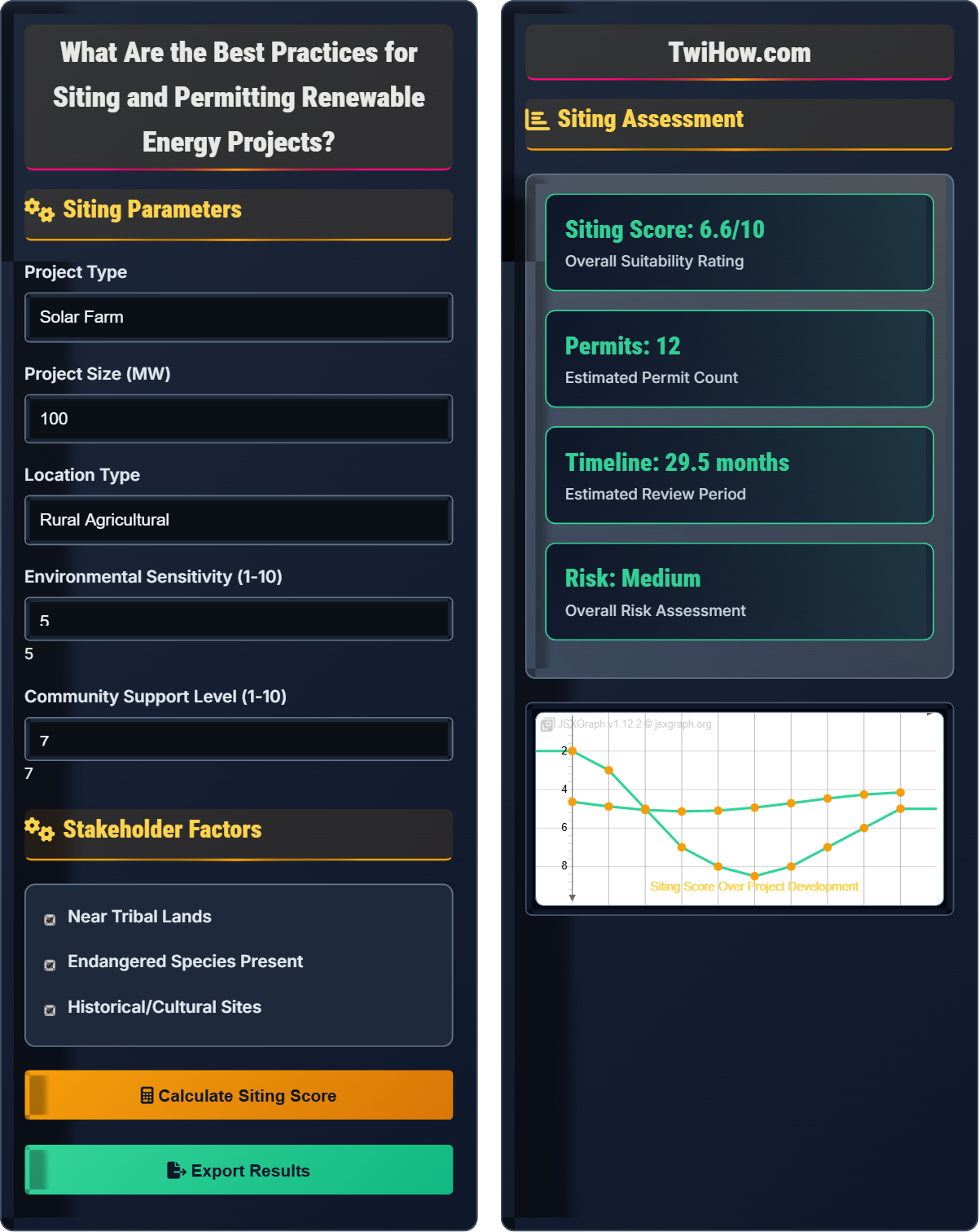
Siting Parameters
Stakeholder Factors
Siting Assessment
| Agency | Permit Type | Timeline | Complexity |
|---|---|---|---|
| Federal | NEPA Review | 12 months | High |
| State | Environmental | 6 months | Medium |
| Local | Zoning | 3 months | Low |
| Federal | ESA Consultation | 9 months | High |
| State | Water Quality | 4 months | Medium |
Siting & Permitting Best Practices Explained
Proper site selection is critical for renewable energy project success. Key factors include resource availability, environmental sensitivity, community acceptance, and infrastructure access. The ideal site maximizes energy production while minimizing environmental and social impacts. Early identification of suitable sites reduces project risks and accelerates the permitting process.
Site suitability assessment formula:
Where:
- Resource Quality: Energy yield potential
- Environmental Impact: Ecological and habitat effects
- Community Acceptance: Public support level
- Infrastructure Access: Grid connection and transportation
Siting and permitting involve multiple regulatory levels:
- Federal: NEPA, ESA, Clean Water Act, FAA requirements
- State: Environmental reviews, zoning, utility regulations
- Local: Zoning, building permits, noise ordinances
- Tribal: Consultation requirements for tribal lands
- Early Engagement: Involve stakeholders from project inception
- Comprehensive Studies: Conduct thorough environmental assessments
- Transparency: Provide clear information and regular updates
- Mitigation Planning: Develop robust impact mitigation strategies
- Regulatory Coordination: Align with agency requirements early
Siting & Permitting Fundamentals
Environmental impact assessment, stakeholder engagement, regulatory compliance, site suitability, community relations.
Siting Score = (Resource Quality + Environmental Impact + Community Acceptance + Infrastructure Access) / Total Weighted Factors
Where Siting Score = suitability rating, Resource Quality = energy potential, Environmental Impact = ecological effects.
- Early stakeholder engagement prevents conflicts
- Environmental assessments are mandatory
- Community support accelerates approval
Regulatory Requirements
The National Environmental Policy Act (NEPA) requires federal agencies to assess environmental impacts of proposed actions. The Endangered Species Act (ESA) mandates consultation for threatened species. The Clean Water Act governs water quality impacts. The National Historic Preservation Act addresses cultural resources.
- Environmental Reviews: State environmental policies
- Zoning Permits: Local land use regulations
- Building Permits: Construction and safety requirements
- Utility Interconnection: Grid connection agreements
- Multiple agencies may have jurisdiction
- Review periods vary by project type
- Appeals processes extend timelines
- Requirements may overlap or conflict
Siting & Permitting Best Practices Quiz
What is the primary purpose of the National Environmental Policy Act (NEPA) review in renewable energy project permitting?
NEPA requires federal agencies to assess the environmental effects of their proposed actions before making decisions. The law establishes a national framework for environmental policy, requiring agencies to consider environmental impacts in their planning and decision-making processes. NEPA does not mandate specific outcomes but ensures that environmental information is available to public officials and citizens before decisions are made.
The answer is B) To assess environmental impacts and inform decision-making.
NEPA is a procedural law that requires agencies to consider environmental impacts but does not prohibit projects with negative environmental effects. The law ensures that decision-makers have comprehensive information about environmental consequences and that the public has access to this information. Understanding NEPA's role is crucial for renewable energy developers as it affects nearly every project that requires federal action or funding.
NEPA: National Environmental Policy Act of 1969
EIS: Environmental Impact Statement (detailed study)
EA: Environmental Assessment (less detailed study)
• NEPA requires disclosure of environmental impacts
• Public comment is mandatory during review
• Agencies must consider alternatives
• Start NEPA process early in project planning
• Engage stakeholders during scoping
• Consider all reasonable alternatives
• Assuming NEPA prohibits projects with impacts
• Not engaging stakeholders during scoping
• Failing to consider reasonable alternatives
Explain the importance of stakeholder engagement in renewable energy project siting and describe effective strategies for community involvement.
Importance of Stakeholder Engagement: Early and meaningful engagement with stakeholders builds trust, identifies concerns, and can prevent costly delays. Communities, landowners, environmental groups, and tribal nations all have legitimate interests in renewable energy projects.
Effective Strategies:
1. Early Engagement: Begin outreach during initial site identification phase
2. Transparent Communication: Provide clear, accessible information about the project
3. Multiple Formats: Use public meetings, online resources, and one-on-one discussions
4. Address Concerns: Respond to feedback with meaningful modifications when possible
5. Local Benefits: Propose economic benefits to host communities
6. Ongoing Communication: Maintain dialogue throughout project lifecycle
Successful engagement often requires significant investment in time and resources but pays dividends in community support and streamlined permitting.
Stakeholder engagement is both a regulatory requirement and a business necessity for renewable energy projects. Regulatory agencies often require evidence of community consultation, while community opposition can significantly delay or even stop projects. Effective engagement transforms potential opponents into supporters and helps identify legitimate concerns that can be addressed through project modifications.
Stakeholders: Individuals or groups affected by or interested in a project
Meaningful Engagement: Genuine two-way communication and consideration of input
Community Benefits: Economic or other advantages provided to host communities
• Engagement must begin early in project development
• Information must be accessible to general public
• Responses to concerns must be meaningful
• Hire local community liaisons
• Use multiple communication channels
• Provide economic benefits to host communities
• Treating engagement as a regulatory checkbox
• Providing information only when requested
• Failing to address legitimate concerns
A 200MW wind farm is proposed in an area known to have golden eagle habitat and migration corridors. The project site is also near a tribal reservation. Outline the environmental and cultural considerations that must be addressed in the permitting process and propose mitigation strategies.
Environmental Considerations:
1. Bird and Bat Studies: Conduct pre-construction monitoring of raptor flight patterns
2. Habitat Assessment: Evaluate breeding and nesting areas
3. Mortality Modeling: Estimate potential bird fatalities
4. Acoustic Impact: Assess effects on wildlife behavior
Cultural Considerations:
1. Tribal Consultation: Formal consultation with tribal governments
2. Cultural Resources: Survey for archaeological and sacred sites
3. Traditional Uses: Consider impacts on hunting and gathering areas
Mitigation Strategies:
• Implement curtailment protocols during peak migration periods
• Design turbine placement to avoid sensitive areas
• Establish habitat conservation areas
• Collaborate with tribal nations on monitoring
• Provide funding for eagle conservation programs
These measures help minimize impacts while ensuring regulatory compliance.
Environmental and cultural assessments are critical components of renewable energy permitting that require specialized expertise and significant time investment. Projects involving endangered species or tribal lands face additional regulatory requirements and consultation processes. Proactive identification and mitigation of impacts can prevent significant delays and legal challenges later in the process.
Section 7 Consultation: ESA requirement for federal agencies
Reasonable and Prudent Alternative: Mitigation measure to avoid jeopardy
Tribal Consultation: Government-to-government relationship requirement
• Formal consultation required for listed species
• Mitigation must be effective and enforceable
• Conduct studies during appropriate seasons
• Engage tribal nations early in process
• Use proven mitigation technologies
• Inadequate pre-construction studies
• Not engaging tribal nations properly
• Proposing unproven mitigation measures
A solar project faces a 30-month permitting timeline with multiple agencies involved. Propose strategies to reduce the timeline while maintaining regulatory compliance and suggest ways to coordinate agency reviews effectively.
Timeline Reduction Strategies:
1. Early Coordination: Request pre-application meetings with all agencies
2. Parallel Processing: Submit applications to multiple agencies simultaneously
3. Scoping Alignment: Ensure all agencies request similar information
4. Quality Submittals: Provide complete, accurate applications
5. Electronic Systems: Use digital filing systems where available
Coordination Strategies:
• Establish lead agency coordination
• Schedule joint meetings and field visits
• Create shared databases for information
• Develop coordinated review schedules
• Implement concurrent review processes
• Use standardized forms and templates
These strategies can reduce permitting timelines by 20-30% while ensuring comprehensive review.
Permitting coordination among multiple agencies is often the most challenging aspect of renewable energy development. Agencies may have different requirements, review periods, and priorities. Effective coordination requires proactive communication and alignment of processes. Many states have begun implementing "one-stop" permitting systems to streamline multi-agency reviews.
Lead Agency: Primary coordinator of multi-agency reviews
Concurrent Review: Simultaneous review by multiple agencies
Scoping: Process to determine scope of environmental review
• Each agency has independent authority to approve
• Statutory deadlines may limit acceleration
• Quality reviews cannot be sacrificed for speed
• Build relationships with agency staff
• Prepare draft documents early
• Use experienced environmental consultants
• Not coordinating agency requirements
• Submitting incomplete applications
• Failing to engage agencies early
Which of the following is NOT typically an effective strategy for gaining community support for renewable energy projects?
Mandating community ownership requirements can be counterproductive as it may create financial burdens for communities that lack resources or expertise. Voluntary community participation is more effective than mandatory requirements. Other strategies like lease payments, tax revenue, and infrastructure improvements provide tangible benefits that communities can appreciate.
The answer is C) Imposing mandatory community ownership requirements.
Community benefits should be voluntary and tailored to local needs and preferences. While community ownership can be valuable in some contexts, it should not be mandated as it may create financial burdens or management challenges for communities. Effective community benefit packages consider local economic conditions, governance capacity, and community priorities.
Community Benefits: Tangible advantages provided to host communities
Revenue Sharing: Distribution of project revenues to local communities
Voluntary Participation: Community involvement by choice, not requirement
• Community benefits should be voluntary
• Benefits must align with local priorities
• Long-term commitments must be sustainable
• Survey community priorities before proposing benefits
• Offer multiple benefit options
• Include long-term benefit commitments
• Assuming all communities want ownership
• Not involving communities in benefit design
• Making unsustainable long-term commitments
FAQ
Q: How can renewable energy developers effectively navigate complex multi-agency permitting processes?
A: Effective navigation of multi-agency permitting requires:
Early Coordination: Request pre-application meetings with all involved agencies to understand requirements and align expectations
Lead Agency Identification: Determine which agency will coordinate the process and ensure all others are informed
Parallel Processing: Submit applications to multiple agencies simultaneously rather than sequentially
Standardized Documentation: Use common formats and data to satisfy multiple agency requirements
Regular Communication: Maintain ongoing dialogue with agency staff throughout the process
Experienced Counsel: Work with consultants familiar with specific agency processes and requirements
Many jurisdictions are moving toward coordinated permitting systems that streamline multi-agency reviews.
Q: What rights do local communities have in renewable energy project siting decisions?
A: Local communities have several important rights in renewable energy siting:
Public Participation: Right to comment during environmental review processes and public hearings
Zoning Authority: Local governments often control land use through zoning ordinances
Legal Standing: Right to challenge permits in court if proper procedures weren't followed
Property Rights: Protection from involuntary taking without just compensation
Due Process: Right to fair and transparent decision-making procedures
Information Access: Right to access relevant environmental and technical information
However, state and federal authorities may override local decisions in certain circumstances, particularly for major energy infrastructure projects.