Renewable Energy in Industrial & Commercial Applications
Complete energy guide • Step-by-step explanations
Industrial & Commercial Renewables:
Show ROI CalculatorRenewable energy systems in industrial and commercial applications offer significant opportunities for cost reduction, sustainability, and operational efficiency. These systems can include solar installations, wind turbines, energy storage, and hybrid systems tailored to specific industrial and commercial needs.
Industrial and commercial applications require careful consideration of energy demands, load profiles, grid integration, and return on investment. The implementation of renewable energy systems can provide long-term cost savings, energy security, and environmental benefits.
Key considerations:
- Energy Demand: Matching renewable capacity to industrial/commercial load
- Cost Analysis: Evaluating long-term savings and payback periods
- Grid Integration: Connecting to existing electrical infrastructure
- Regulatory Compliance: Meeting local and national requirements
Strategic implementation of renewable energy systems can significantly benefit industrial and commercial operations.
Industrial/Commercial Parameters
Advanced Options
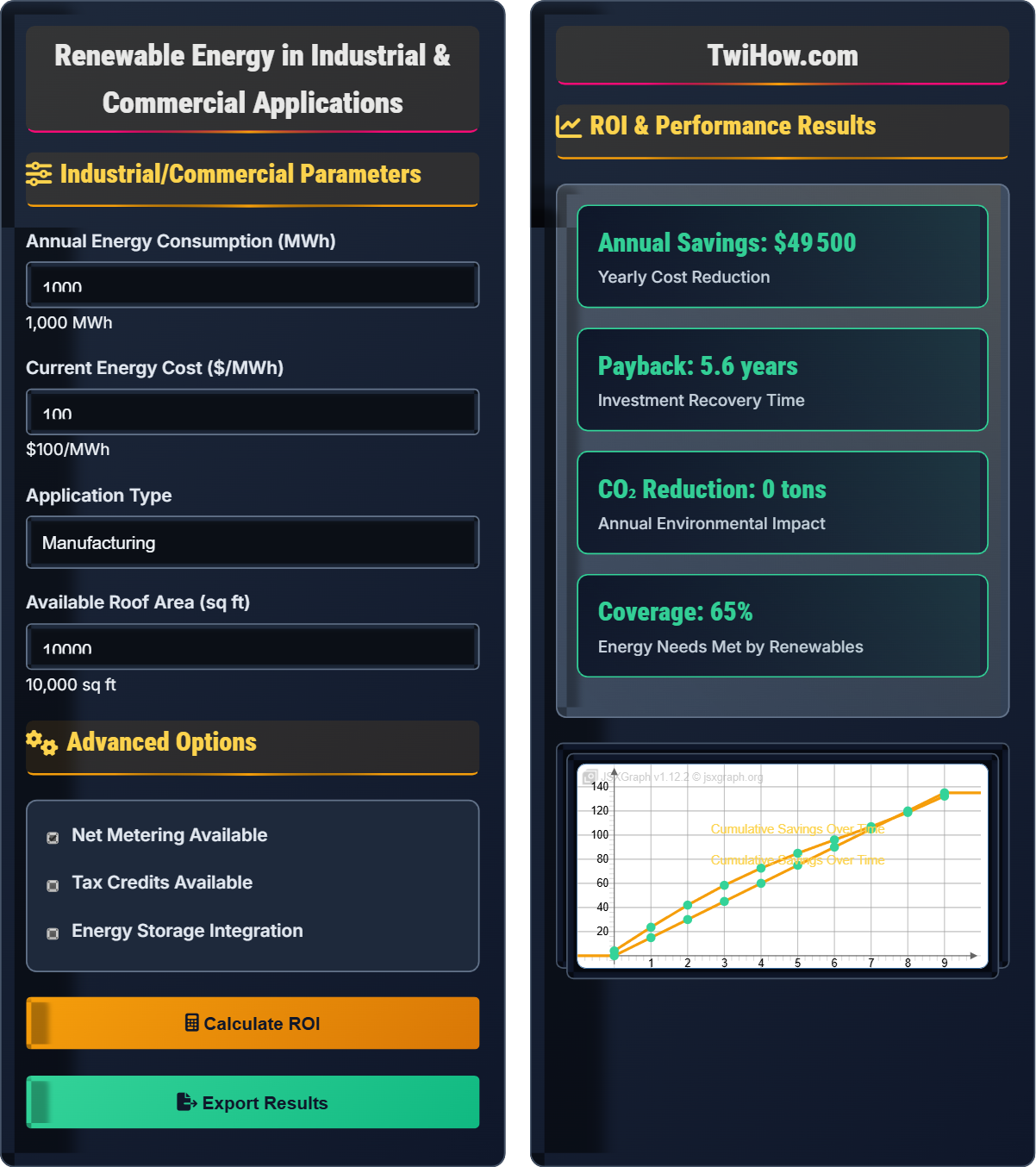
ROI & Performance Results
| Financial Metric | Value | Annual Change |
|---|---|---|
| Energy Cost Reduction | $45,000 | -45% |
| Maintenance Savings | $5,000 | -15% |
| Carbon Credits | $2,500 | +100% |
| Total Annual Benefit | $52,500 | - |
| Technical Specification | Requirement | Proposed Solution |
|---|---|---|
| Solar Capacity | 650 kW | 650 kW Solar Array |
| Roof Space | 8,500 sq ft | 10,000 sq ft Available |
| Energy Storage | 200 kWh | 200 kWh Battery System |
| Grid Integration | 208V/480V | Compatible Inverters |
Renewable Energy in Industrial & Commercial Applications Explained
Industrial and commercial applications of renewable energy systems require specialized considerations due to the scale, reliability requirements, and operational demands of these facilities. These applications can include manufacturing plants, warehouses, office complexes, retail stores, hospitals, and other commercial enterprises.
The return on investment for renewable energy in industrial and commercial applications can be calculated as:
Where:
- NPV: Net Present Value
- Cash Flow_t: Annual savings and benefits in year t
- r: Discount rate
- n: Project lifetime
Important factors for industrial and commercial applications:
- Load Profile: Matching renewable generation to consumption patterns
- Space Requirements: Adequate roof or ground space for installations
- Grid Integration: Connecting to existing electrical infrastructure
- Reliability: Maintaining operational continuity
- Financial Viability: Achieving positive ROI and payback
- Regulatory Compliance: Meeting local and national requirements
- Cost Reduction: Lower energy bills and operational costs
- Energy Security: Reduced dependence on grid electricity
- Brand Value: Enhanced reputation and customer loyalty
- Regulatory Compliance: Meeting environmental standards
- Tax Benefits: Available incentives and credits
- Long-term Stability: Fixed energy costs over system lifetime
Industrial/Commercial Applications Fundamentals
Industrial applications, commercial applications, ROI, energy efficiency, grid integration, renewable energy systems.
NPV = Σ(Cash Flow_t / (1+r)^t) - Initial Investment
Where NPV = net present value, r = discount rate, t = time period.
- Match renewable capacity to energy demand
- Consider operational reliability requirements
- Evaluate financial returns carefully
Applications
Manufacturing plants, warehouses, office buildings, retail stores, hospitals, hotels, data centers, schools.
- Energy audit and consumption analysis
- Site assessment and resource evaluation
- Technology selection and system design
- Financial analysis and ROI calculation
- Operational continuity requirements
- Space and structural constraints
- Regulatory and permit requirements
- Grid interconnection procedures
Industrial/Commercial Applications Quiz
What is the most important factor to consider when sizing a renewable energy system for an industrial facility?
The most important factor is matching the renewable energy system capacity to the facility's energy demand profile. This ensures optimal utilization of the renewable system, maximizes cost savings, and avoids over-investment in unnecessary capacity. Understanding the load profile is crucial for sizing the system appropriately.
The answer is B) Matching system capacity to facility's energy demand profile.
Energy demand matching is fundamental to successful renewable energy implementation. Industrial and commercial facilities have specific energy consumption patterns that vary throughout the day and year. The renewable system should be sized to meet these demands efficiently while considering peak loads and seasonal variations.
Energy Demand Profile: Pattern of energy consumption over time
Load Matching: Aligning generation with consumption
Capacity Factor: Ratio of actual output to maximum possible output
• Match generation to consumption patterns
• Consider peak and average loads
• Account for seasonal variations
• Analyze 12 months of energy bills
• Identify peak usage times
• Consider future expansion needs
• Oversizing systems without load analysis
• Not considering demand variations
• Focusing only on peak capacity
Explain the grid integration considerations for renewable energy systems in commercial applications and describe the technical requirements for connecting to the electrical grid.
Grid Integration Considerations: Commercial applications must consider voltage compatibility, grid stability, and interconnection requirements.
Technical Requirements:
1. Voltage Matching: Ensuring renewable system output matches grid voltage levels
2. Power Quality: Maintaining voltage stability and power factor
3. Safety Systems: Installing disconnect switches and protective devices
4. Metering: Installing bi-directional meters for net metering
5. Compliance: Meeting IEEE 1547 and UL 1741 standards
6. Permitting: Obtaining electrical and building permits
Successful grid integration requires coordination with utility providers and adherence to technical standards.
Grid integration is critical for commercial renewable energy systems as it ensures safe and reliable operation. The technical requirements are designed to protect both the customer's equipment and the utility grid. Compliance with standards ensures system safety and grid stability.
Grid Integration: Connecting renewable systems to electrical grid
Net Metering: Billing arrangement for excess energy
IEEE 1547: Standard for interconnecting distributed resources
• Follow utility interconnection procedures
• Meet technical standards and codes
• Obtain necessary permits
• Engage utility early in planning
• Use certified equipment and installers
• Plan for inspection and commissioning
• Using non-certified equipment
• Skipping required inspections
A commercial building consumes 800,000 kWh annually at an average cost of $0.12/kWh. A solar installation would cost $1,200,000 and generate 600,000 kWh annually. Calculate the annual savings, payback period, and 20-year NPV assuming a 5% discount rate and no escalation in energy costs. If the building owner requires a 7-year payback, is this project financially viable?
Current Annual Cost: 800,000 kWh × $0.12/kWh = $96,000
Energy Savings: 600,000 kWh (generated) × $0.12/kWh = $72,000
Annual Savings: $72,000 (assuming all generated energy is consumed)
Payback Period: $1,200,000 ÷ $72,000 = 16.67 years
NPV Calculation: Using NPV formula with 20 years of $72,000 annual savings:
NPV = $72,000 × [(1 - (1 + 0.05)^-20) / 0.05] - $1,200,000
NPV = $72,000 × 12.462 - $1,200,000 = $897,264 - $1,200,000 = -$302,736
Viability Assessment: The payback period (16.67 years) exceeds the required 7 years, and NPV is negative. This project would not meet the owner's financial criteria.
This calculation demonstrates the importance of financial analysis in renewable energy projects. The project has a long payback period and negative NPV, indicating it wouldn't meet the owner's financial requirements. Factors like tax credits, incentives, or energy cost escalation could improve the financial viability.
Payback Period: Time to recover initial investment
Net Present Value: Present value of future cash flows minus investment
Discount Rate: Rate used to calculate present value
• Calculate both payback and NPV
• Consider all financial factors
• Compare to required thresholds
• Include all costs and benefits
• Consider tax incentives
• Account for energy cost escalation
• Not considering all costs
• Ignoring time value of money
A manufacturing facility operates 24/7 with a constant load of 2 MW and peak loads of 3 MW during production cycles. The facility has 50,000 sq ft of flat roof space and wants to install solar panels. Calculate the maximum solar capacity possible (assuming 5 sq ft per kW), determine what percentage of energy needs this would cover, and analyze the challenges of implementing renewable energy in a continuous operation facility.
Maximum Solar Capacity: 50,000 sq ft ÷ 5 sq ft/kW = 10,000 kW = 10 MW
Facility Load: 2 MW average, 3 MW peak
Solar Capacity vs Load: 10 MW solar vs 3 MW peak = 333% of peak load
Energy Coverage: With 1,500 full sun hours annually: 10 MW × 1,500 = 15,000 MWh
Annual Consumption: 2 MW × 8,760 hours = 17,520 MWh
Coverage: 15,000 ÷ 17,520 = 86% of annual needs
Challenges: 1) Excess generation during low production periods, 2) Need for energy storage or export, 3) Operational continuity requirements, 4) Structural load considerations.
The facility could install 10 MW of solar, covering 86% of annual energy needs, but would need to address excess generation and storage challenges.
This example illustrates the complexities of renewable energy in continuous operations. The manufacturing facility has enough roof space for solar that exceeds its needs, creating challenges with excess generation. Energy storage or export mechanisms would be needed to handle the surplus, and operational continuity must be maintained during all phases of implementation.
Full Sun Hours: Equivalent hours of peak solar radiation
Continuous Operation: 24/7 facility operation
Load Factor: Ratio of average to peak load
• Consider operational continuity
• Address excess generation
• Plan for structural requirements
• Evaluate load patterns carefully
• Consider energy storage solutions
• Plan for operational disruptions
• Ignoring excess generation issues
• Underestimating structural requirements
Which of the following is NOT a common tax benefit for commercial renewable energy installations?
While Investment Tax Credit (ITC), MACRS depreciation, and Production Tax Credit (PTC) are common tax benefits for commercial renewable energy installations, sales tax exemption is not typically available as a federal benefit. Sales tax exemptions vary by state and are not universal across all jurisdictions.
The answer is D) Sales Tax Exemption.
Understanding the various tax benefits available for commercial renewable energy projects is crucial for financial analysis. Federal tax benefits like ITC and PTC are standardized, while state and local benefits vary by jurisdiction. Sales tax treatment differs significantly between states.
Investment Tax Credit: Credit based on system cost
MACRS: Accelerated depreciation schedule
Production Tax Credit: Credit based on energy production
• Tax benefits vary by jurisdiction
• Federal and state benefits differ
• Tax credits affect project economics
• Research federal and state benefits
• Consider expiration dates
• Include in financial analysis
• Not considering expiration dates
• Ignoring state-specific benefits
FAQ
Q: What is the typical payback period for commercial solar installations?
A: Typical payback periods for commercial solar installations range from 5-8 years, depending on:
Energy Costs: Higher electricity rates lead to shorter payback
Solar Resource: Better solar irradiance improves economics
System Size: Larger systems often have better economics
Tax Benefits: ITC and depreciation accelerate payback
Financing: Purchase vs. lease affects cash flow
Electricity Rate Escalation: Rising rates improve returns
Many commercial installations now achieve paybacks of 5-7 years with current incentives.
Q: What are the technical challenges of integrating renewable energy into existing industrial facilities?
A: Technical challenges include:
Harmonics: Inverter-generated harmonics affecting equipment
Voltage Regulation: Maintaining stable voltage levels
Power Quality: Ensuring consistent power factor
Grid Interaction: Managing bidirectional power flow
Protection Coordination: Integrating with existing protection systems
Structural Loads: Ensuring roof can support solar arrays
Operational Continuity: Maintaining critical processes
Proper design and engineering address these challenges effectively.