What Are the Considerations for Renewable Energy in Rural and Remote Areas?
Complete guide • Step-by-step explanations
Rural & Remote Energy:
Show Rural Deployment CalculatorRenewable energy deployment in rural and remote areas presents unique opportunities and challenges. These locations often have excellent renewable resources but face logistical, economic, and technical constraints that require specialized approaches.
Key considerations:
- Resource Availability: Abundant solar, wind, and hydro resources
- Grid Connectivity: Off-grid and mini-grid solutions
- Logistics: Transportation and installation challenges
- Economics: Higher per-unit costs but potential for energy independence
- Community Needs: Local energy requirements and capacity building
Strategic deployment can provide reliable, sustainable energy access while supporting rural economic development.
Rural Deployment Parameters
Advanced Options
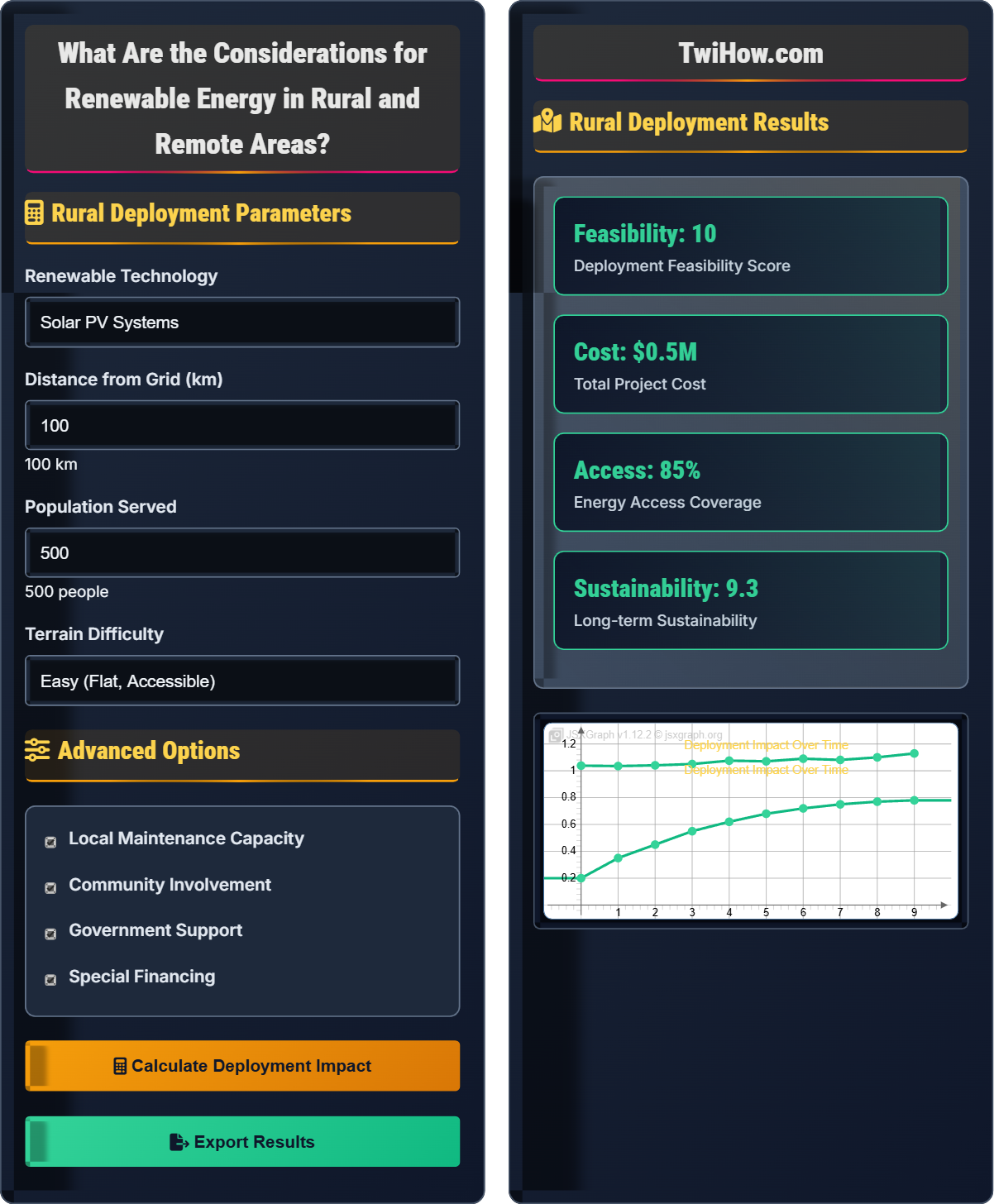
Rural Deployment Results
| Technology | Feasibility | Cost Factor | Access Impact |
|---|---|---|---|
| Solar PV | High | Medium | 85% |
| Wind | Medium | High | 70% |
| Small Hydro | High | Low | 90% |
| Microgrids | Very High | Medium | 95% |
| Hybrid | Very High | High | 98% |
Solar PV
Wind
Hydro
Hybrid
Rural & Remote Energy Deployment Analysis
Rural and remote areas face unique challenges in accessing reliable electricity. Grid extension costs are often prohibitive, making renewable energy solutions particularly attractive. However, these locations also present logistical, economic, and technical challenges that require specialized approaches.
Remote Village
Energy IndependenceRenewable Sources
Solar/Wind/HydroEnergy Storage
Battery SystemsManagement
Local ControlAccess Rate
Cost Savings
Local Jobs
Reliability
Technology Suitability Analysis
Advantages: Abundant sunlight in many rural areas, modular design, minimal maintenance
Challenges: Intermittency, storage requirements, initial capital costs
Best For: Locations with good solar irradiance and limited grid access
Advantages: High capacity factors in windy areas, proven technology
Challenges: Higher initial costs, maintenance complexity, noise concerns
Best For: Areas with consistent wind resources and open terrain
Advantages: Consistent power generation, long lifespan, low operating costs
Challenges: Site-specific requirements, environmental regulations
Best For: Locations with suitable water resources and flow
Advantages: Integrated management, reliability, scalability
Challenges: Complexity, control systems, coordination requirements
Best For: Communities seeking comprehensive energy solutions
Implementation Strategies
Coordinate equipment transport, temporary storage, and installation schedules to minimize costs and maximize efficiency in remote locations.
Train local technicians and operators to ensure long-term system sustainability and reduce dependence on external support.
Involve local communities in planning, ownership, and decision-making to ensure acceptance and long-term success.
Develop sustainable financing mechanisms including grants, microfinance, and pay-as-you-go models for rural populations.
Successful rural renewable energy deployment requires community-centered approaches that respect local customs, involve local leadership, and ensure that benefits flow back to the community. This includes local ownership models, training programs, and sustainable maintenance arrangements.
Rural Deployment Logistics
Equipment
TransportationInstallation
Site PreparationMaintenance
Ongoing SupportOperations
Energy DeliveryLogistics Complexity
Transportation and installation challenges
Off-Grid Solutions
Off-grid renewable systems offer energy independence for remote areas but require careful planning for storage, backup, and reliability. Grid-connected systems can provide backup power but depend on distant infrastructure that may be unreliable in rural areas.
In a remote mountain village with 500 residents, a hybrid solar-wind-battery system can provide 24/7 electricity access. The solution requires helicopter transport for equipment, local technician training, and community ownership for sustainability.
A forest community with access to a small river can utilize micro-hydro combined with solar panels for consistent power generation. The solution leverages natural resources while minimizing environmental impact and creating local employment opportunities.
Rural Renewable Energy Learning Quiz
Which renewable technology is most suitable for a remote island community with high wind speeds but limited space?
Wind turbines are most suitable for a remote island with high wind speeds and limited space because they have a smaller footprint per unit of power generated compared to solar installations, and they take advantage of the abundant wind resource. Wind energy is also well-suited for island environments.
The answer is B) Wind turbines.
Technology selection for rural and remote areas must consider local resources, space constraints, and logistics. Wind turbines are particularly advantageous in areas with consistent wind resources and limited land availability, making them ideal for remote islands with favorable wind conditions.
Space Efficiency: Power output per unit area of land
Resource Matching: Aligning technology with local resources
Footprint: Physical space required for installation
• Match technology to local resources
• Consider space constraints
• Evaluate logistics requirements
• Assess wind resource quality
• Consider transportation logistics
• Plan for salt corrosion protection
• Ignoring local resource conditions
• Not considering environmental factors
• Overlooking maintenance challenges
Why is community engagement crucial for successful renewable energy deployment in rural areas, and what strategies ensure effective engagement?
Importance of Community Engagement: Rural communities often have strong cultural ties, traditional practices, and local governance structures that must be respected. Successful renewable projects require community acceptance, local ownership, and sustained operation.
Effective Strategies:
Early Involvement: Include community members in planning and decision-making from the beginning.
Capacity Building: Train local technicians and operators to ensure long-term sustainability.
Benefit Sharing: Ensure economic benefits flow back to the community through employment and ownership.
Cultural Sensitivity: Respect local customs and traditions in project design and implementation.
Community engagement in rural areas goes beyond simple consultation—it requires building trust, understanding local dynamics, and creating sustainable relationships. Projects that ignore community needs often fail regardless of technical merit.
Community Acceptance: Local support for the project
Local Ownership: Community involvement in project control
Capacity Building: Training for local skills development
• Engage before making decisions
• Include all community segments
• Share benefits equitably
• Use local meeting places and languages
• Identify community leaders early
• Provide regular updates and feedback
• Top-down decision making
• Excluding certain community groups
• Not addressing long-term sustainability
A remote mining town of 2,000 people is 300km from the nearest grid connection. The town relies on expensive diesel generators for electricity. The area has good solar irradiance and moderate wind speeds. Design a renewable energy solution that provides reliable power while minimizing costs.
Recommended Solution: Hybrid solar-wind-battery system with diesel backup.
System Components: 1.5MW solar array, 500kW wind turbines, 2MWh battery storage, existing diesel generators as backup.
Implementation: Phased approach starting with solar, adding wind and storage as financing allows.
Expected Outcomes: 80% reduction in diesel consumption, 15-year payback period, local employment in maintenance.
Challenges: Equipment transport to remote location, harsh environmental conditions, skilled labor availability.
This scenario demonstrates the importance of hybrid solutions in remote areas, where multiple renewable sources can complement each other to provide reliable power. The phased approach allows for gradual implementation as resources become available.
Hybrid System: Multiple renewable technologies combined
Phased Implementation: Gradual deployment over timePayback Period: Time to recover investment costs
• Assess multiple renewable resources
• Plan for system integration
• Consider backup power needs
• Use existing infrastructure when possible
• Plan for extreme weather resilience
• Establish local maintenance protocols
• Not considering backup power
• Underestimating logistics costs
• Ignoring maintenance requirements
An agricultural community of 800 farmers lacks reliable electricity for irrigation pumps and food processing. The area has abundant sunlight but faces seasonal weather variations. Design a renewable energy system that supports both daily operations and seasonal activities.
System Design: 2MW solar installation with 3MWh battery storage and smart irrigation scheduling.
Seasonal Adaptation: Energy management system that prioritizes irrigation during growing seasons and food processing during harvest.
Integration: Smart grid technology to optimize energy use during peak agricultural activities.
Benefits: Reduced energy costs, improved irrigation efficiency, enhanced food processing capabilities, and increased crop yields.
Expected outcome: 60% energy cost reduction and improved agricultural productivity.
This example shows how renewable energy systems can be tailored to support specific economic activities in rural areas. The integration of energy management with agricultural operations creates synergistic benefits that enhance overall productivity.
Energy Management: Optimizing energy use patterns
Smart Grid: Intelligent energy distribution system
Productivity Enhancement: Improved output efficiency
• Align energy with economic activities
• Consider seasonal variations
• Optimize system sizing
• Integrate with existing agricultural systems
• Plan for peak demand periods
• Consider water-energy nexus
• Not matching energy to activity cycles
• Ignoring water pumping needs
• Oversimplifying agricultural demands
What is the most significant logistics challenge for renewable energy deployment in remote areas?
Transportation to remote sites is often the most significant logistics challenge, as large renewable energy equipment (wind turbine blades, solar panels, batteries) must be transported over long distances on potentially poor road infrastructure. This can significantly increase costs and complicate installation schedules.
The answer is B) Transportation to site.
Transportation logistics can make or break rural renewable projects. The cost of moving heavy equipment over long distances on poor roads often exceeds the cost of the equipment itself. This challenge requires careful planning and sometimes specialized transport solutions.
Transportation Logistics: Moving equipment to remote sites
Infrastructure Limitations: Road and access constraints
Specialized Transport: Heavy haul or helicopter delivery
• Plan transport routes early
• Consider seasonal access
• Budget for logistics costs
• Use modular designs for easier transport
• Consider temporary storage facilities
• Plan for weather delays
• Underestimating transport costs
• Not considering seasonal access
• Ignoring road condition changes
FAQ
Q: How can we ensure long-term maintenance of renewable systems in remote areas where technical expertise is limited?
A: Long-term maintenance in remote areas requires: 1) Comprehensive local training programs for community members, 2) Simple, robust system designs that minimize maintenance needs, 3) Remote monitoring capabilities for predictive maintenance, 4) Partnerships with nearby technical institutions, 5) Maintenance contracts with regional service providers, and 6) Community ownership models that incentivize proper care. The key is building local capacity while maintaining connections to external support when needed.
Q: What financial models work best for rural renewable energy projects when residents have limited income?
A: Effective financial models include: 1) Pay-as-you-go systems where users pay for energy as consumed, 2) Community ownership models that spread costs across members, 3) Government subsidies and grants for initial capital, 4) Microfinance options with extended repayment periods, 5) Income-generating applications that provide returns to justify investment, and 6) Leasing arrangements with local organizations. Success requires flexible payment structures that align with local income patterns.