Renewable Energy in Transportation & Electrification
Complete energy guide • Step-by-step explanations
Transportation Electrification:
Show Charging Impact SimulatorTransportation electrification represents a critical pathway for reducing greenhouse gas emissions and integrating renewable energy into the broader energy system. Electric vehicles (EVs) can serve as mobile energy storage units, supporting grid stability while consuming clean energy from renewable sources.
Successful electrification requires careful consideration of charging infrastructure, grid impacts, renewable energy integration, and policy frameworks. The timing and location of EV charging significantly affect grid operations and renewable energy utilization.
Key considerations:
- Charging Infrastructure: Strategic placement of charging stations
- Grid Impact: Managing increased electricity demand
- Renewable Integration: Aligning charging with renewable generation
- Smart Charging: Optimizing charging schedules for grid benefits
Transportation electrification offers opportunities to create synergies between transportation and energy systems, supporting both decarbonization goals and grid stability.
Transportation Electrification Parameters
Advanced Options
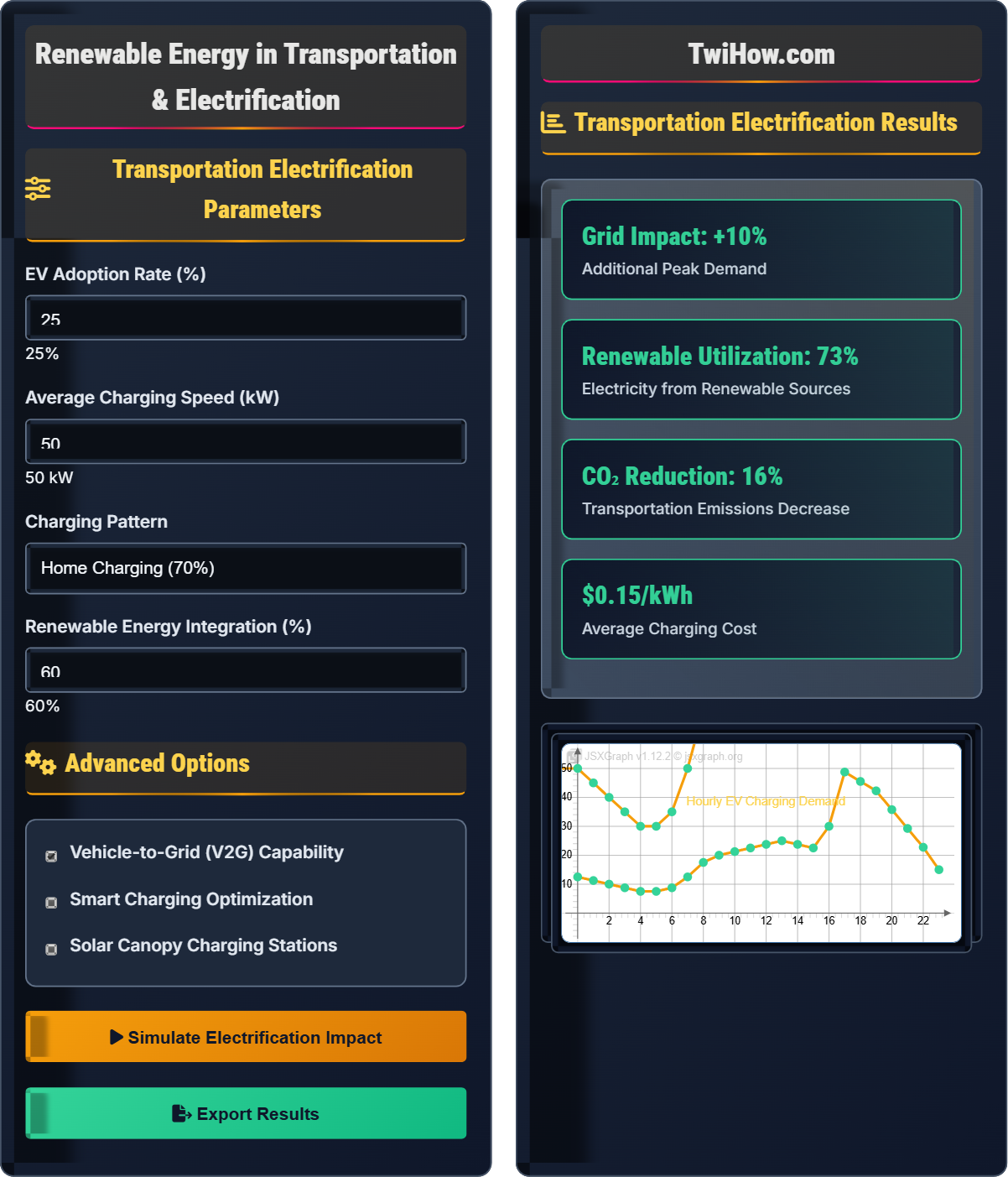
Transportation Electrification Results
| Infrastructure | Quantity | Capacity | Renewable Share |
|---|---|---|---|
| Fast Chargers | 1,200 | 150 kW | 45% |
| Level 2 Chargers | 8,500 | 7.2 kW | 75% |
| Solar Canopies | 300 | 50 kW | 100% |
| Grid Upgrades | 150 | 10 MW | 80% |
| Metric | Before Electrification | After Electrification | Improvement |
|---|---|---|---|
| CO₂ Emissions (tons/year) | 1,200,000 | 816,000 | -32% |
| Energy Consumption (TWh) | 0 | 25 | +100% |
| Renewable Energy Used (TWh) | 0 | 19.5 | +∞ |
| Air Quality Index | 65 | 78 | +20% |
Renewable Energy in Transportation Electrification Explained
Transportation electrification involves replacing internal combustion engines with electric motors powered by electricity from the grid. When this electricity comes from renewable sources, transportation becomes a significant contributor to emission reduction goals. The integration of renewable energy with transportation requires coordinated planning across multiple sectors.
The impact of EV charging on the grid depends on several factors:
Where:
- Total EV Load: Combined power demand from all EVs
- Peak Factor: Concentration of charging during peak hours
- Grid Capacity: Available electrical capacity
- Renewable Fraction: Proportion of electricity from renewable sources
Critical factors for successful renewable energy integration in transportation:
- Charging Infrastructure: Strategic placement of stations with renewable integration
- Grid Capacity: Upgrading distribution systems to handle increased demand
- Smart Charging: Optimizing charging schedules to align with renewable generation
- Vehicle-to-Grid (V2G): Using EV batteries for grid services
- Policy Framework: Supportive regulations and incentives
- Consumer Behavior: Understanding charging preferences and patterns
- Decarbonization: Significant reduction in transportation emissions
- Energy Security: Reduced dependence on oil imports
- Grid Services: EVs can provide ancillary services
- Cost Savings: Lower operating costs for consumers
- Resilience: Distributed energy storage enhances grid stability
- Co-Benefits: Improved air quality and reduced noise pollution
Transportation Electrification Fundamentals
Transportation electrification, EV charging, renewable integration, grid impact, smart charging, V2G.
Grid Impact = (EV Load × Peak Factor) / (Grid Capacity × Renewable Fraction)
Where Impact = system stress, Load = charging demand, Fraction = renewable availability.
- Charging patterns affect grid stability
- Smart charging optimizes renewable utilization
- Infrastructure planning is critical for success
Applications
EV charging networks, solar-powered stations, workplace charging, public transit electrification.
- Infrastructure development planning
- Renewable energy procurement
- Smart charging deployment
- Grid modernization initiatives
- Grid capacity requirements
- Consumer adoption patterns
- Technology interoperability
- Regulatory frameworks
Transportation Electrification Quiz
What is the primary concern regarding the impact of widespread EV adoption on electrical grids?
The primary concern with widespread EV adoption is the potential increase in peak electrical demand. If many EV owners charge their vehicles simultaneously during peak hours, it could overload local distribution transformers and transmission lines not designed for such additional loads.
The answer is B) Increased peak demand and potential overloading.
Traditional grid planning assumes predictable load patterns. EV charging introduces a new, potentially variable load that can significantly impact local distribution systems. Without proper planning and smart charging technologies, simultaneous EV charging could create new peak demand periods that strain existing infrastructure.
Peak Demand: Highest electrical load during a specified period
Distribution Transformers: Equipment stepping down voltage for local use
Load Factor: Ratio of average to peak demand
• Electrical infrastructure has finite capacity
• Peak loads drive infrastructure requirements
• Smart charging can flatten load curves
• Think of the grid as a highway system
• Congestion occurs when everyone travels at once
• Smart charging spreads the load over time
• Assuming the grid can handle unlimited additional load
• Ignoring local distribution constraints
• Not considering transformer capacity limits
Explain how smart charging technologies can optimize the integration of renewable energy with EV charging and describe three specific benefits of this approach.
Smart Charging Integration: Smart charging systems use real-time data on renewable generation, grid conditions, and user preferences to optimize charging schedules.
Three Specific Benefits:
1. Renewable Energy Utilization: Charging is scheduled when renewable generation is high, maximizing clean energy use and reducing carbon intensity.
2. Grid Stability: Load is distributed to avoid peak demand periods and can provide grid services like frequency regulation.
3. Cost Optimization: Charging occurs during low-price periods, saving money for consumers and utilities.
Smart charging transforms EVs from potential grid stressors into grid assets that support renewable integration and system efficiency.
Smart charging represents a shift from dumb, immediate charging to intelligent, optimized charging. By connecting EV charging to grid conditions and renewable generation forecasts, smart systems can turn transportation electrification into a tool for grid management rather than a burden.
Smart Charging: Intelligent EV charging with optimization algorithms
Time-of-Use Pricing: Variable electricity rates based on time
Load Shifting: Moving electricity usage to different times
• Optimization requires real-time data
• User preferences must be respected
• Grid constraints must be monitored
• Smart charging can be programmed overnight
• Weather forecasts inform renewable availability
• V2G capabilities enhance grid services
• Ignoring the timing of renewable generation
• Not considering consumer convenience
A city with 100,000 households expects 40% EV adoption by 2030. Each EV requires an average of 0.8 charging sessions per day with 30 kWh per session. If 70% of charging occurs at home, calculate the total additional residential electricity demand and determine how many 50 kW fast chargers would be needed to handle the remaining 30% of public charging demand if each charger serves 10 vehicles per day.
EV Population: 100,000 households × 40% = 40,000 EVs
Total Daily Charging: 40,000 EVs × 0.8 sessions/day × 30 kWh/session = 960,000 kWh/day
Home Charging Demand: 960,000 kWh × 70% = 672,000 kWh/day
Public Charging Demand: 960,000 kWh × 30% = 288,000 kWh/day
Public Charger Requirement: 40,000 EVs × 0.8 × 30% = 9,600 daily public charging sessions
Number of Fast Chargers Needed: 9,600 sessions ÷ 10 sessions per charger = 960 fast chargers
The city would need 960 fast chargers to handle public charging demand, plus infrastructure to support 672 MWh/day of home charging.
This calculation demonstrates the scale of infrastructure needed for transportation electrification. The problem shows how to break down aggregate demand into specific infrastructure requirements, considering both home and public charging patterns. Understanding these calculations is essential for utility and municipal planning.
Charging Session: Single charging event for an EV
Fast Charger: High-power charging station (typically 50kW+)
Level 2 Charger: Moderate-power charging (typically 7.2kW)
• Charging patterns vary by location and time
• Infrastructure must account for peak demand
• Utilization rates affect sizing requirements
• Multiply adoption rate by total population
• Consider utilization factors for equipment
• Plan for growth beyond initial estimates
• Not considering different charging speeds
• Ignoring peak demand impacts
A commercial fleet of 500 electric delivery trucks has 100 kWh battery capacity each. If the fleet participates in a V2G program, returning 60% of their stored energy back to the grid during peak demand periods for 2 hours each day, calculate the total power capacity available for grid services and the energy returned to the grid. Assume batteries maintain 80% state of charge before discharging.
Total Fleet Battery Capacity: 500 trucks × 100 kWh = 50,000 kWh
Usable Capacity for V2G: 50,000 kWh × 80% = 40,000 kWh (at 80% SoC)
Energy Available for Discharge: 40,000 kWh × 60% = 24,000 kWh
Power Capacity (2-hour discharge): 24,000 kWh ÷ 2 hours = 12,000 kW or 12 MW
Energy Returned to Grid: 24,000 kWh per day during peak periods
The fleet can provide 12 MW of power capacity and return 24 MWh of energy to the grid daily during peak demand, supporting grid stability and renewable integration.
This example demonstrates the potential of V2G technology to transform transportation assets into grid resources. Commercial fleets are particularly suitable for V2G because they have predictable schedules and large battery capacities. The calculation shows how vehicle batteries can provide valuable grid services while maintaining sufficient charge for transportation needs.
V2G (Vehicle-to-Grid): Technology enabling bidirectional power flow
State of Charge (SoC): Percentage of battery capacity available
Grid Services: Support functions like frequency regulation
• Battery degradation must be considered
• Transportation needs take priority
• Grid services must be economically viable
• V2G is most effective with predictable schedules
• Consider round-trip efficiency losses
• Account for battery degradation over time
• Not accounting for transportation priorities
• Ignoring battery degradation effects
Which of the following is the most effective strategy for maximizing renewable energy utilization in EV charging?
Time-of-use pricing aligned with renewable generation is the most effective strategy. This approach incentivizes EV charging during periods of high renewable output, maximizing clean energy utilization without requiring location-specific installations or limiting EV adoption.
The answer is B) Implementing time-of-use pricing aligned with renewable generation.
Time-of-use pricing creates market signals that align consumer behavior with renewable generation patterns. When electricity is cheaper during sunny or windy periods, EV owners naturally charge during those times, increasing renewable energy utilization. This approach scales effectively and doesn't require infrastructure changes at every charging location.
Time-of-Use Pricing: Variable rates based on grid conditions
Price Signals: Economic incentives guiding behavior
Renewable Curtailment: Wasted renewable energy due to constraints
• Market mechanisms can align behavior with grid needs
• Scalable solutions work better than site-specific
• Economic incentives drive adoption
• Price signals are more effective than mandates
• Align incentives with renewable patterns
• Consider consumer price sensitivity
• Not considering consumer behavior
• Ignoring economic drivers
FAQ
Q: How should cities plan for EV charging infrastructure to maximize renewable energy integration?
A: Cities should adopt a strategic approach to EV infrastructure planning:
1. Location Analysis: Prioritize areas with high renewable potential and grid capacity
2. Smart Grid Integration: Install smart charging stations with grid communication capabilities
3. Solar Integration: Deploy solar canopies at parking areas and charging stations
4. Multi-Modal Hubs: Integrate charging with public transit and bike-sharing
5. Equity Considerations: Ensure access in all neighborhoods regardless of income
6. Future-Proofing: Design infrastructure to accommodate growing demand
This integrated approach maximizes renewable energy utilization while supporting equitable access to electric transportation.
Q: What technical considerations are important for renewable energy integration with EV charging?
A: Critical technical considerations include:
Power Quality: Maintaining voltage stability and power factor during high charging loads
Protection Coordination: Ensuring safety systems work properly with bidirectional power flow
Communication Protocols: Standardized interfaces for smart charging and grid communication
Load Forecasting: Predicting EV charging patterns and renewable generation
Energy Management: Optimizing the dispatch of renewable generation and storage
Cybersecurity: Protecting communication networks from cyber threats
These technical elements must work together to create a reliable, efficient, and secure integrated system.