What Are the Considerations for Renewable Energy Workforce Development?
Complete workforce development guide • Step-by-step explanations
Workforce Development Overview:
Show Workforce PlannerRenewable energy workforce development involves comprehensive planning to meet the growing demand for skilled workers in solar, wind, hydroelectric, geothermal, and energy storage sectors. The industry requires diverse skill sets ranging from technical installation and maintenance to engineering and project management. Key considerations include education and training pathways, skills transfer from traditional energy sectors, certification requirements, and regional workforce needs.
The renewable energy sector is experiencing rapid growth, creating millions of new jobs globally. However, this growth presents challenges in matching available skills with industry needs, ensuring adequate training programs, and preparing workers for evolving technologies. Success requires coordinated efforts between educational institutions, employers, and government agencies.
Workforce development considerations include:
- Skills Mapping: Identifying current and future skill requirements
- Training Programs: Developing appropriate educational pathways
- Certification: Ensuring proper credentials and standards
- Job Placement: Connecting workers with employment opportunities
- Continuing Education: Supporting ongoing skill development
Effective workforce development strategies ensure the renewable energy industry has the skilled workers needed to meet climate goals while providing good-paying jobs for workers transitioning from traditional energy sectors.
Workforce Parameters
Training & Certification
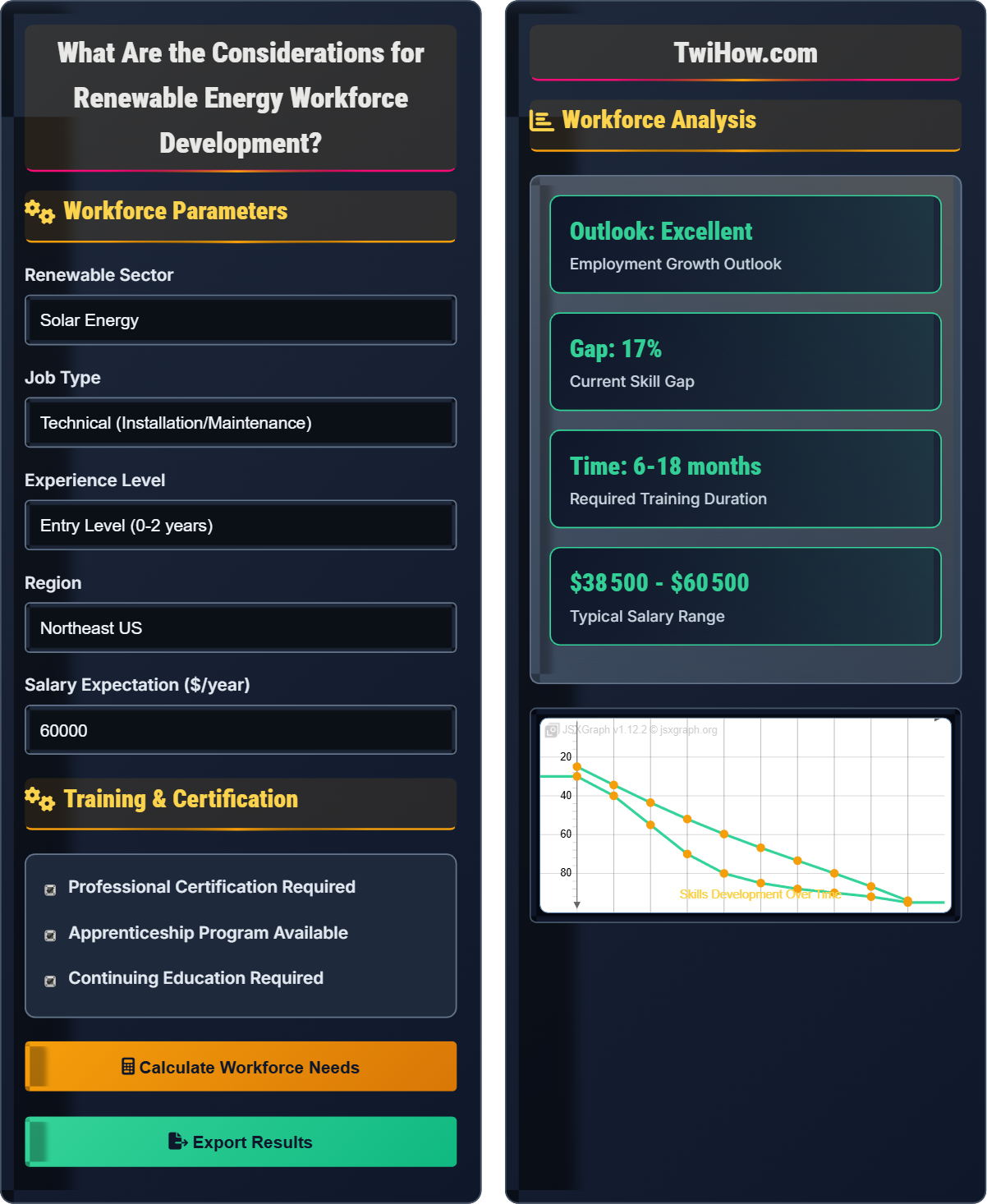
Workforce Analysis
| Skill Area | Required Level | Training Source | Development Time |
|---|---|---|---|
| Electrical Systems | High | Trade School | 6 months |
| Power Electronics | Medium | Technical College | 1 year |
| Safety Protocols | High | Company Training | 2 weeks |
| Software Systems | Medium | Online Courses | 3 months |
| Project Management | Medium | University | 1-2 years |
Workforce Development Explained
Renewable energy workforce development involves multiple interconnected factors that must be carefully coordinated to ensure adequate skilled workers. The process includes identifying current and future skill needs, developing appropriate training programs, establishing certification standards, and creating pathways for career advancement. Success requires collaboration between educational institutions, employers, and government agencies.
Workforce demand calculation:
Where:
- Market Growth Rate: Expected industry expansion
- Jobs per MW: Employment intensity by technology
- Training Capacity: Available educational resources
Different renewable energy technologies require distinct skill sets:
- Solar: Electrical systems, panel installation, software monitoring
- Wind: Mechanical systems, tower climbing, gearbox maintenance
- Hydro: Water systems, turbines, civil construction
- Storage: Battery systems, power electronics, safety protocols
- Grid Integration: Power systems, SCADA, communication protocols
- Apprenticeships: Hands-on training with experienced workers
- Trade Schools: Focused technical education programs
- Community Colleges: Associate degrees and certificate programs
- University Programs: Engineering and management degrees
- Online Training: Flexible learning options
Workforce Development Fundamentals
Skill mapping, certification standards, apprenticeships, continuing education, career pathways, job placement.
Workforce Demand = (Technology Growth Rate × Jobs per MW) / Training Capacity
Where Demand = required workers, Growth Rate = market expansion, Capacity = training availability.
- Skills must match industry needs
- Certification ensures quality standards
- Training must keep pace with technology
Career Pathways
Entry-level positions in renewable energy typically include solar installer, wind technician, energy auditor, and field service technician. These roles often require technical school certificates or associate degrees and provide pathways to more advanced positions through experience and continuing education.
- Entry Level: Technician, installer, or field service
- Mid Level: Supervisor, specialist, or project coordinator
- Senior Level: Manager, engineer, or project manager
- Executive Level: Director, VP, or CEO positions
- Continuing education is essential
- Professional certifications enhance career prospects
- Experience in multiple technologies is valuable
- Leadership skills become increasingly important
Workforce Development Quiz
What is the primary challenge facing renewable energy workforce development?
The primary challenge is the skills gap between industry needs and worker capabilities. As the renewable energy sector grows rapidly, there is often a shortage of workers with the specific technical skills required. Educational institutions may not be keeping pace with technological changes, and traditional energy workers may need retraining to transition to renewable technologies.
The answer is B) Skills gap between industry needs and worker capabilities.
Skills gaps are common in rapidly growing industries. The renewable energy sector is expanding faster than the educational system can prepare workers, creating opportunities for those who acquire the right skills. Understanding this dynamic helps workers and educators focus on high-demand skills and career paths.
Skills Gap: Difference between required and available skills
Workforce Development: Process of building worker capabilities
Career Transition: Movement from one industry to another
• Industry needs evolve faster than education systems
• Workers must continuously update their skills
• Focus on high-demand skills
• Pursue relevant certifications
• Consider apprenticeships for hands-on experience
• Assuming traditional energy skills transfer directly
• Not staying updated on technology changes
• Ignoring certification requirements
Explain the different types of training programs available for renewable energy careers and their respective advantages.
Training Program Types:
Trade Schools: Focused technical training lasting 6 months to 2 years. Advantages include specialized skills, hands-on experience, and quick entry into the workforce.
Community Colleges: Associate degree programs and certificates lasting 1-2 years. Advantages include comprehensive education, transferable credits, and industry partnerships.
Apprenticeships: Paid training programs combining classroom and on-the-job learning. Advantages include earning while learning, mentorship, and guaranteed employment.
University Programs: Bachelor's and master's degrees in engineering and related fields. Advantages include theoretical foundation, research opportunities, and management preparation.
Online Training: Flexible learning options for continuing education. Advantages include convenience, self-paced learning, and accessibility.
Corporate Training: Employer-provided specialized training. Advantages include job-specific skills and career advancement opportunities.
Each type serves different career goals and learning preferences.
Multiple training pathways exist to accommodate different learning styles, career goals, and life circumstances. The choice of training program depends on factors like career objectives, time availability, financial resources, and preferred learning environment. A combination of programs often provides the most comprehensive preparation.
Apprenticeship: Structured training combining work and education
Certificate Program: Focused credential for specific skills
Associate Degree: Two-year post-secondary degree
• Choose training aligned with career goals
• Consider time and financial investment
• Verify program accreditation and reputation
• Research job market requirements
• Talk to industry professionals
• Consider hybrid approaches combining programs
• Choosing programs without researching job prospects
• Not verifying accreditation
• Ignoring industry recommendations
A 45-year-old electrician with 20 years of experience in traditional electrical work wants to transition to solar installation. The local solar industry is growing at 15% annually and requires specialized training in photovoltaic systems. Calculate the career transition strategy and describe the steps needed for success.
Transition Strategy:
1. Leverage Existing Skills: Use electrical background as foundation
2. Specialized Training: Enroll in NABCEP solar certification program
3. Hands-On Experience: Seek apprenticeship or entry-level installer position
4. Professional Certification: Obtain PV installer certification
5. Networking: Join industry associations and attend events
6. Continuing Education: Stay updated on technology changes
Timeline:
• Training Program: 6-12 months
• Certification: 3-6 months
• Job Search: 1-3 months
• Career Advancement: 2-5 years
With 20 years of electrical experience and a 15% growth industry, this transition offers excellent prospects for career continuation with higher earning potential.
This example demonstrates how workers can leverage existing skills while acquiring new ones for career transitions. The electrical background provides a strong foundation, but specialized training in renewable technologies is essential for success in the new field.
NABCEP: North American Board of Certified Energy Practitioners
PV Systems: Photovoltaic solar power systems
Career Transition: Moving from one profession to another
• Transferable skills provide a foundation
• Specialized training is still required
• Certifications enhance credibility
• Highlight transferable skills in applications
• Consider part-time training while working
• Network with professionals in the new field
• Underestimating the need for specialized training
• Not obtaining proper certifications
• Failing to network with industry professionals
A state with 5,000 MW of planned renewable capacity over the next 5 years needs to develop a workforce plan. The region currently has 200 qualified technicians but needs 1,000 by the target date. Propose a comprehensive workforce development strategy to meet this need.
Workforce Development Strategy:
1. Immediate Recruitment: Hire 100 workers from neighboring states
2. Training Programs: Partner with 5 community colleges to train 400 workers
3. Apprenticeships: Establish 200 apprenticeship positions with local companies
4. Career Transition: Retrain 200 fossil fuel workers
5. University Partnerships: Develop internship programs with 3 universities
6. Outreach Programs: Promote renewable careers to students
7. Certification Centers: Establish 2 local certification facilities
8. Retention Programs: Develop career advancement opportunities
This comprehensive approach leverages multiple recruitment and training strategies to meet the 800-worker gap over 5 years while building long-term workforce capacity.
Large-scale workforce needs require multiple strategies working together. A comprehensive approach addresses immediate needs while building long-term capacity. Success depends on coordination between educational institutions, employers, and government agencies.
Workforce Planning: Strategic approach to meeting labor needs
Capacity Building: Developing long-term workforce capability
Stakeholder Coordination: Collaboration between organizations
• Multiple strategies are more effective than single approaches
• Long-term planning is essential for capacity building
• Stakeholder coordination ensures success
• Start planning early for large workforce needs
• Leverage existing educational infrastructure
• Build partnerships with multiple organizations
• Relying on a single recruitment strategy
• Not starting planning early enough
• Failing to coordinate between stakeholders
Why is continuing education particularly important in renewable energy careers?
Continuing education is crucial in renewable energy because of rapidly evolving technology and standards. The industry experiences constant innovation in materials, systems, and installation techniques. Additionally, safety standards, regulations, and best practices evolve regularly. Workers must stay current to maintain competitiveness and ensure safe, effective work practices.
The answer is B) Due to rapidly evolving technology and standards.
Renewable energy is a high-technology field with rapid innovation cycles. Workers who don't continue learning risk becoming obsolete. This contrasts with more traditional fields where technology changes more slowly. The dynamic nature of the industry makes lifelong learning essential for career success.
Continuing Education: Ongoing learning after initial training
Professional Development: Career-enhancing learning activities
Technology Evolution: Ongoing improvements in systems and methods
• Technology evolves rapidly in renewable energy
• Standards and regulations change frequently
• Continuing education maintains professional competency
• Subscribe to industry publications
• Attend conferences and workshops
• Join professional associations
• Assuming initial training is sufficient
• Not keeping up with certification requirements
• Ignoring technological advances
FAQ
Q: What education do I need to get started in renewable energy?
A: Entry into renewable energy can begin with various educational backgrounds:
Technical Positions: High school diploma plus trade school certification or apprenticeship
Installation Roles: Certificate programs (6-18 months) at community colleges
Engineering Roles: Bachelor's degree in engineering or related field
Management Roles: Bachelor's degree plus relevant experience
Essential Skills: Basic electrical knowledge, mechanical aptitude, safety awareness, and computer literacy
Many positions offer on-the-job training and advancement opportunities. Start with entry-level positions and pursue continuing education to advance your career.
Q: How should educational institutions adapt to renewable energy workforce needs?
A: Educational institutions should adapt through:
Curriculum Development: Integrate renewable energy topics into existing programs
Partnerships: Collaborate with industry employers and trade associations
Facility Upgrades: Install demonstration systems and modern equipment
Faculty Training: Ensure instructors have current industry knowledge
Flexible Delivery: Offer online, hybrid, and part-time options
Certification Programs: Provide industry-recognized credentials
Apprenticeships: Develop work-study programs with local employers
Institutions that proactively adapt to industry needs will best serve students and employers while ensuring program sustainability.