What are the emerging trends in renewable energy and grid technology for 2026?
Complete technology trends guide • 2026 innovations
2026 Technology Trends:
Show Trend SimulatorThe renewable energy and grid technology landscape for 2026 is characterized by rapid innovation in energy storage, grid digitization, and next-generation renewable technologies. These trends promise to revolutionize how we generate, store, and distribute clean energy.
Key developments include advanced battery technologies, artificial intelligence integration, grid-edge devices, and breakthrough renewable generation methods. These innovations are converging to create more resilient, efficient, and sustainable energy systems.
Emerging trends for 2026:
- Advanced Storage: Solid-state batteries and long-duration storage
- AI Integration: Machine learning for grid optimization
- Grid Modernization: Digital infrastructure and smart controls
- Next-Gen Renewables: Perovskite solar cells and advanced wind
These technologies will significantly enhance renewable energy adoption and grid reliability.
Trend Parameters
Technology Options
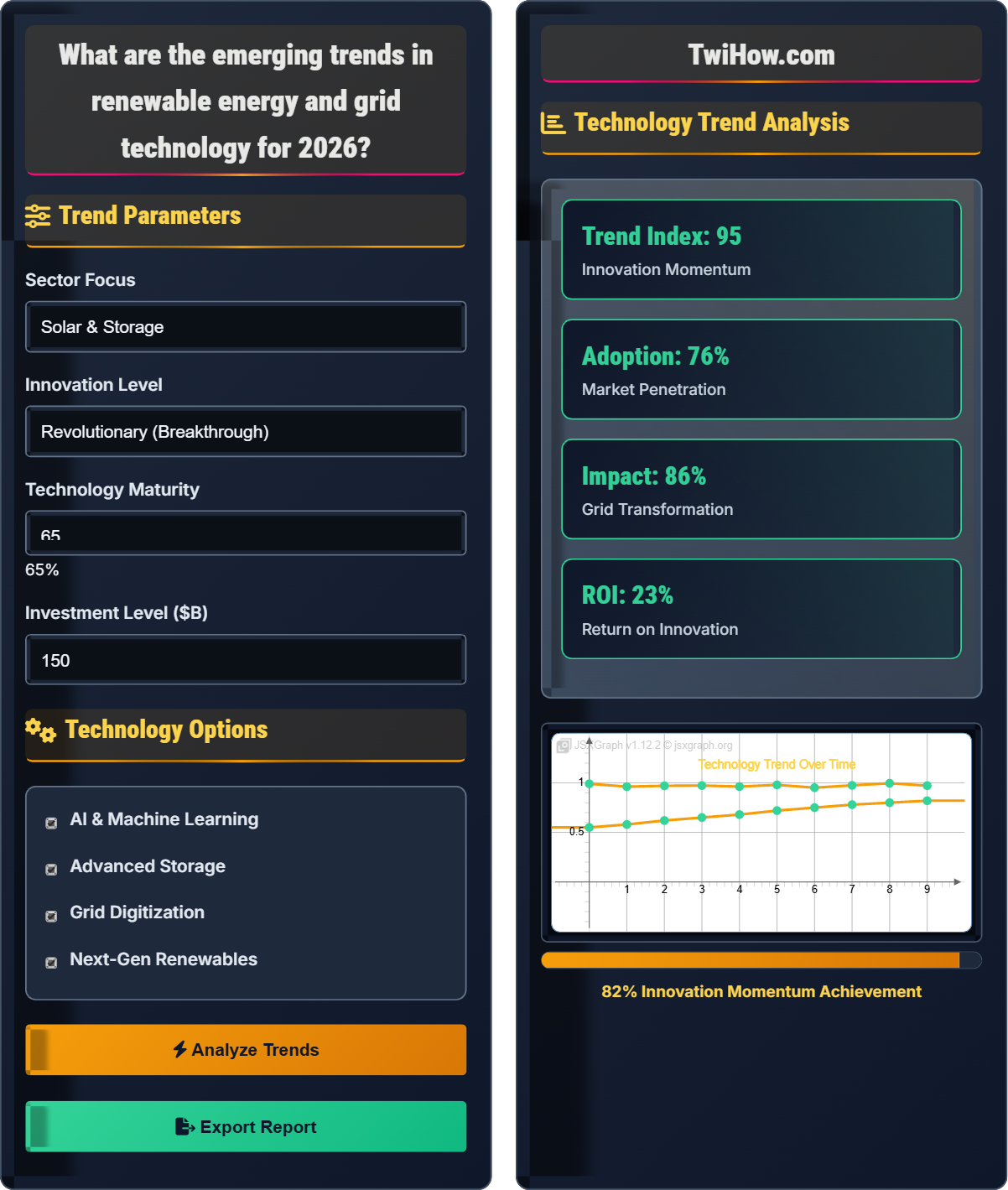
Technology Trend Analysis
| Technology | Readiness | Impact | Timeline |
|---|---|---|---|
| Perovskite Solar Cells | High | 85% | 2026-2028 |
| Solid-State Batteries | High | 90% | 2026-2027 |
| AI Grid Management | High | 75% | 2026-2025 |
| Long-Duration Storage | Medium | 80% | 2026-2029 |
| Advanced Wind Turbines | High | 70% | 2026-2027 |
Innovation Momentum Visualization
Technology Flow
Emerging Technology Trends Explained
Emerging trends in renewable energy and grid technology represent cutting-edge innovations that are expected to transform the energy sector by 2026. These trends encompass breakthrough technologies, novel applications, and revolutionary approaches to energy generation, storage, and distribution.
Trend analysis follows a systematic approach:
Framework components include:
- Technology Readiness: Maturity and deployment feasibility
- Market Potential: Commercial viability and adoption prospects
- Impact Assessment: Transformation potential for energy systems
- Investment Flows: Capital allocation and R&D funding
- Regulatory Support: Policy frameworks enabling innovation
Primary trends shaping the energy sector:
- Advanced Energy Storage: Solid-state batteries, long-duration storage
- AI-Driven Grid Management: Machine learning for optimization
- Next-Gen Solar: Perovskite cells, tandem technologies
- Grid Edge Technologies: Distributed energy resources
- Hybrid Systems: Integrated renewable-storage solutions
- Enhanced Efficiency: Higher conversion and storage efficiency
- Grid Stability: Improved reliability and resilience
- Cost Reduction: Lower technology costs through innovation
- Scalability: Better integration of distributed resources
- Environmental Impact: Reduced carbon footprint and waste
Trend Metrics & Technology Assessment
- Focus on scalable and commercially viable technologies
- Consider integration challenges and grid impacts
- Assess market readiness and adoption drivers
- Monitor regulatory and policy support
Technology Trend Profiles
Technology Trends Quiz
What is the expected efficiency potential of perovskite solar cells by 2026?
Perovskite solar cells are expected to achieve 25-30% efficiency by 2026, representing a significant leap from current silicon cell efficiencies. Tandem configurations combining perovskite and silicon could push this even higher, potentially exceeding 30%.
The answer is C) 25-30%.
Perovskite solar cells represent a breakthrough technology due to their potential for high efficiency at lower manufacturing costs. Their unique crystal structure allows for efficient light absorption and charge transport, making them promising for next-generation photovoltaic applications.
Perovskite Solar Cell: Photovoltaic cell using perovskite-structured material
Efficiency: Percentage of sunlight converted to electricity
Tandem Configuration: Multiple cell layers stacked together
• Perovskites offer high efficiency potential
• Manufacturing costs could be lower than silicon
• Stability improvements are ongoing
• Watch for stability improvements
• Monitor manufacturing scalability
• Consider tandem cell configurations
• Underestimating efficiency potential
• Not considering stability challenges
• Ignoring manufacturing scalability
Explain the advantages of solid-state batteries over conventional lithium-ion batteries and describe their expected impact on grid storage applications.
Advantages of Solid-State Batteries:
• Higher Energy Density: Up to 50% more energy storage in same volume
• Improved Safety: Non-flammable solid electrolyte eliminates fire risk
• Faster Charging: Higher power density enables rapid charging
• Longer Lifespan: Fewer degradation mechanisms extend cycle life
• Wider Temperature Range: Operates effectively in extreme conditions
Grid Storage Impact:
• More compact storage facilities with higher capacity
• Enhanced safety for urban and industrial installations
• Improved grid stability through better performance
• Reduced maintenance and replacement costs
Solid-state batteries replace the liquid electrolyte in conventional batteries with a solid ceramic or polymer electrolyte. This fundamental change eliminates many safety concerns while enabling higher energy densities and faster charging, making them ideal for grid-scale storage applications.
Solid Electrolyte: Non-liquid conductor separating battery electrodes
Energy Density: Amount of energy stored per unit volume
Grid Storage: Large-scale energy storage for power grids
• Solid electrolytes eliminate safety concerns
• Higher energy density enables compact systems
• Longer lifespan reduces operational costs
• Monitor manufacturing cost reductions
• Consider temperature performance
• Evaluate scalability for grid applications
• Not considering manufacturing challenges
• Ignoring cost implications
• Overlooking temperature limitations
A utility company plans to implement AI-driven grid management systems by 2026. Current grid inefficiencies result in 8% energy losses. AI systems are expected to reduce these losses by 60% while improving renewable integration by 40%. Calculate the net efficiency improvement and estimate the annual savings for a utility with 100 GWh annual energy throughput.
Current Losses:
100 GWh × 8% = 8 GWh lost annually
AI-Reduced Losses:
8 GWh × (1 - 0.60) = 3.2 GWh lost
Efficiency Improvement:
8 GWh - 3.2 GWh = 4.8 GWh saved
Renewable Integration Benefit:
40% improvement in renewable integration efficiency
Total Annual Savings:
4.8 GWh at typical value of $50/MWh = $240,000 annually
The AI system would save approximately 4.8 GWh annually with additional renewable integration benefits.
AI grid management systems optimize power flow, predict demand patterns, and coordinate distributed energy resources. Even small percentage improvements in efficiency translate to significant energy and cost savings when applied to large utility systems.
Grid Efficiency: Percentage of energy delivered versus generated
AI Optimization: Machine learning for system performance
Energy Losses: Power lost during transmission and distribution
• Small efficiency improvements have large impacts
• AI enables predictive grid management
• Renewable integration requires advanced controls
• Consider compound effects of efficiency gains
• Factor in renewable integration benefits
• Monitor AI system performance
• Underestimating cumulative savings
• Not accounting for renewable benefits
• Ignoring implementation costs
You're planning a grid modernization project for 2026. Identify the three most impactful technologies to implement and explain the implementation strategy for each.
Most Impactful Technologies:
• AI Grid Management: Implement through phased rollout of predictive analytics and automated control systems
• Advanced Energy Storage: Deploy grid-scale battery systems with smart inverters for grid services
• Smart Grid Infrastructure: Upgrade to digital substations and advanced metering infrastructure
Implementation Strategy:
1. Pilot Phase: Test technologies in controlled environments
2. Scalable Rollout: Deploy in phases to minimize disruption
3. Integration: Ensure systems work together seamlessly
4. Monitoring: Track performance and optimize continuously
Successful grid modernization requires a strategic approach that considers technology maturity, integration complexity, and operational impact. The most impactful technologies often work synergistically, creating multiplicative benefits when properly integrated.
Grid Modernization: Upgrading infrastructure with advanced technologies
Phased Implementation: Gradual deployment strategy
System Integration: Connecting different technologies
• Prioritize technologies with highest impact
• Consider integration complexity
• Plan for phased implementation
• Start with pilot projects
• Focus on interoperability
• Plan for future upgrades
• Implementing too many technologies simultaneously
• Not considering integration challenges
• Failing to plan for scalability
Which technology is expected to provide the most cost-effective long-duration energy storage (>8 hours) by 2026?
Flow batteries and compressed air energy storage are expected to provide the most cost-effective long-duration storage by 2026. These technologies can discharge for 8+ hours while maintaining cost competitiveness, making them ideal for grid-scale applications.
The answer is C) Flow batteries and compressed air.
Long-duration storage technologies differ from short-term batteries in their design and economics. Flow batteries use liquid electrolytes that can be scaled independently of power output, while compressed air systems store energy in pressurized vessels, both offering cost advantages for extended discharge durations.
Long-Duration Storage: Energy storage for 8+ hours
Flow Battery: Battery using liquid electrolytes
Compressed Air Storage: Energy stored as pressurized air
• Different technologies excel at different durations
• Cost per kWh varies with discharge time
• Scalability is key for grid applications
• Match technology to duration requirements
• Consider total cost of ownership
• Evaluate scalability for grid needs
• Using lithium-ion for long-duration needs
• Not considering location constraints
• Ignoring total cost of ownership
FAQ
Q: How will AI integration affect grid stability and reliability?
A: AI integration will significantly enhance grid stability and reliability:
Predictive Analytics: AI predicts equipment failures before they occur
Real-Time Optimization: Continuous adjustment of grid parameters for optimal performance
Demand Response: Intelligent load management during peak periods
Renewable Integration: Accurate forecasting of variable renewable output
Automated Control: Faster response to grid disturbances than human operators
AI systems can process vast amounts of data in real-time to maintain grid balance.
Q: Which emerging technologies offer the best investment opportunities for 2026?
A: Top investment opportunities for 2026 include:
Advanced Battery Technologies: Solid-state and flow batteries for grid storage
AI Software Platforms: Grid management and optimization systems
Smart Grid Hardware: Advanced sensors, inverters, and controls
Perovskite Solar Companies: Next-generation photovoltaic technology
Grid Integration Services: Companies specializing in DER management
Focus on technologies addressing grid stability and renewable integration.