What is the Impact of Renewable Energy on Energy Access and Equity?
Complete guide • Step-by-step explanations
Energy Access & Equity:
Show Equity Impact CalculatorRenewable energy technologies have transformative potential for improving energy access and equity worldwide. Through distributed generation, off-grid solutions, and community ownership models, renewables can bridge the energy access gap and reduce disparities in energy services.
Key impacts by technology:
- Solar Home Systems: Provide electricity to remote areas without grid infrastructure
- Mini-grids: Enable community-level energy access in underserved regions
- Wind Power: Creates local jobs and economic opportunities
- Community Solar: Makes renewable energy accessible to renters and low-income households
- Energy Storage: Ensures reliable power in areas with intermittent supply
Strategic deployment of renewable technologies can democratize energy access while promoting social and economic equity.
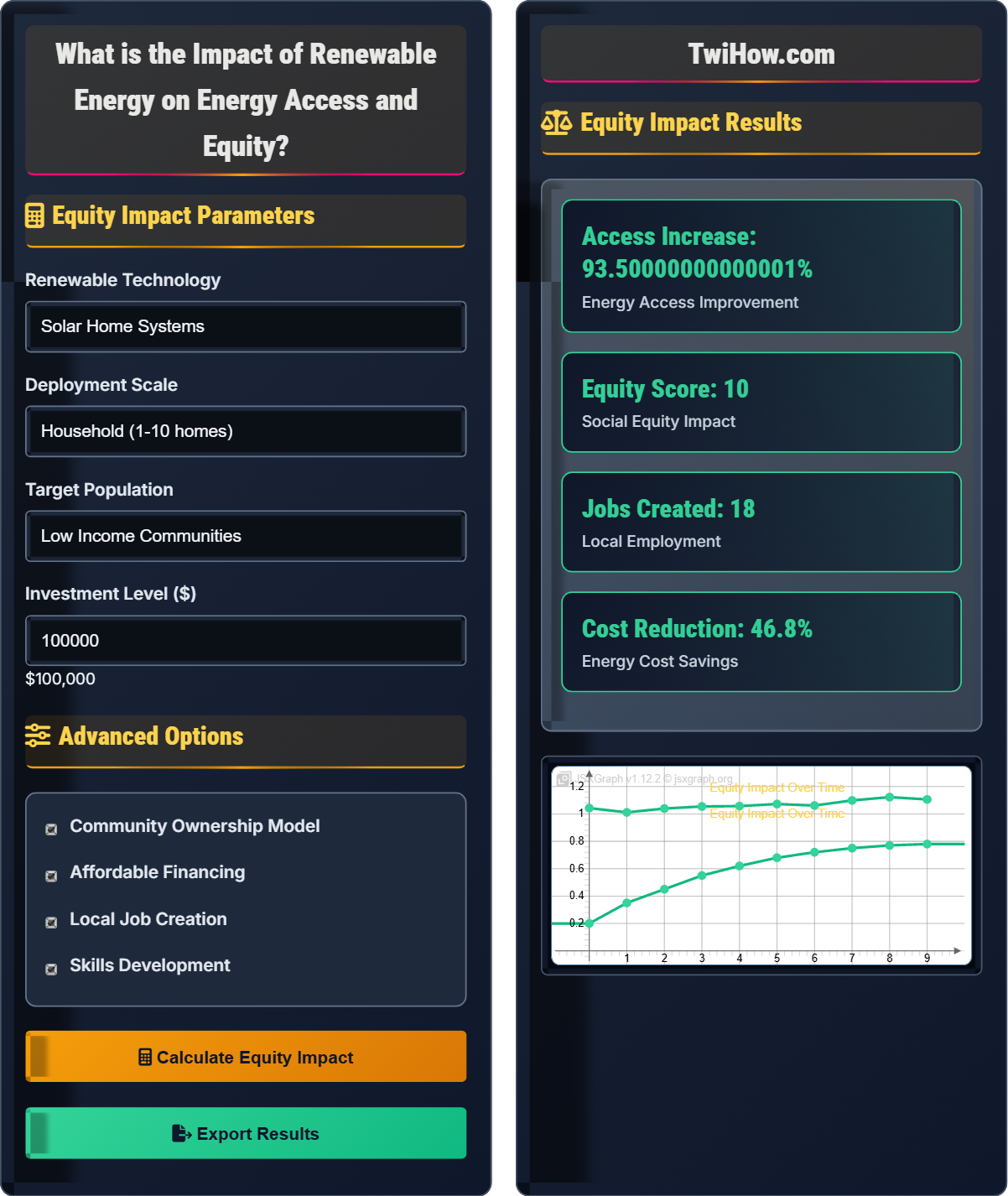
Equity Impact Parameters
Advanced Options
Equity Impact Results
| Technology | Access Impact | Equity Score | Jobs Created |
|---|---|---|---|
| Solar Home Systems | High | 8.5 | 5 |
| Mini-grids | Very High | 9.2 | 15 |
| Community Solar | Medium | 7.0 | 8 |
| Wind Power | Medium | 6.5 | 20 |
| Hybrid Systems | Very High | 9.0 | 25 |
Solar Home
Mini-grid
Community Solar
Hybrid
Energy Access & Equity Impact Analysis
Approximately 759 million people worldwide lack access to electricity, with the majority living in sub-Saharan Africa and rural areas of developing countries. Energy equity refers to fair distribution of energy services, costs, and benefits across different socioeconomic groups. Renewable energy technologies offer unique opportunities to address both access and equity challenges simultaneously.
Household Access
Solar Home SystemsCommunity Access
Mini-grid SystemsSystem Access
Grid IntegrationAccess Rate
Cost Savings
Job Creation
Gender Equity
Technology Impact Analysis
Access Impact: High (immediate household access)
Equity Benefit: Significant for remote populations
Considerations: Scalable, affordable financing models needed
Access Impact: Very High (community-level access)
Equity Benefit: Democratic energy distribution
Considerations: Community ownership models promote equity
Access Impact: Medium (shared access model)
Equity Benefit: Inclusive for renters and low-income
Considerations: Subscription models reduce barriers
Access Impact: Indirect (grid strengthening)
Equity Benefit: Mixed - may not reach underserved
Considerations: Requires complementary access programs
Equity Enhancement Strategies
Microfinance, pay-as-you-go models, and subsidized loans make renewable energy accessible to low-income households.
Cooperative models ensure local control and equitable distribution of benefits from renewable energy projects.
Training programs create local employment and ensure sustainable maintenance of renewable systems.
Prioritizing underserved communities ensures renewable investments address existing inequities.
Energy Access Cycle
Energy Access
Electricity ConnectionAffordability
Cost-Effective ServiceReliability
Consistent SupplyQuality
Power QualityGlobal Energy Gap
759M people lack electricity access
Community Ownership Models
Community-owned renewable energy projects ensure local control, equitable benefit distribution, and democratic governance. Members have voting rights in project decisions and receive dividends from energy sales. This model promotes energy democracy and economic development in underserved communities.
In remote rural areas, mini-grid systems owned by cooperatives can provide reliable electricity while keeping economic benefits within the community. Local technicians trained in system maintenance create sustainable employment opportunities.
Community solar gardens allow urban residents to access renewable energy without rooftop installation, reducing energy costs for low-income households while building local economic resilience.
Energy Access & Equity Learning Quiz
Which renewable energy technology is most effective for providing electricity access to remote, off-grid communities?
Solar home systems are most effective for remote, off-grid communities because they can be deployed at the household level without requiring extensive transmission infrastructure. They provide immediate access to electricity for lighting, phone charging, and small appliances.
The answer is B) Solar home systems.
For remote communities, centralized power generation is often impractical due to transmission costs and infrastructure challenges. Distributed renewable technologies like solar home systems bypass these barriers by generating power at the point of use.
Off-grid: Not connected to national electrical grid
Distributed Generation: Power generation near point of use
Energy Access: Reliable, affordable electricity supply
• Remote areas need decentralized solutions
• Infrastructure costs limit grid extension
• Solar is most practical for household use
• Consider pay-as-you-go models for affordability
• Include battery storage for reliability
• Train local technicians for maintenance
• Assuming grid extension is always possible
• Ignoring local capacity for maintenance
• Not considering cultural acceptance
Define energy equity and explain how renewable energy technologies can promote greater equity in energy access and services.
Energy Equity: Fair distribution of energy services, costs, and benefits across different socioeconomic groups, ensuring that marginalized communities have equal access to reliable, affordable, and clean energy.
Renewable Promotion of Equity:
Accessibility: Distributed renewables like solar home systems can serve remote and underserved areas not reached by grid infrastructure.
Affordability: Declining renewable costs and innovative financing models reduce barriers to access for low-income households.
Community Ownership: Cooperative models ensure local control and benefit retention within communities.
Job Creation: Renewable deployment creates local employment opportunities in manufacturing, installation, and maintenance.
Energy equity addresses systemic inequalities in energy access that disproportionately affect low-income communities and marginalized populations. Renewable technologies offer unique advantages through their distributed nature and declining costs, making them powerful tools for achieving energy justice.
Energy Poverty: Inability to afford adequate energy services
Energy Democracy: Community control over energy systems
Procedural Justice: Inclusive decision-making processes
• Equity requires targeted interventions
• Community involvement is essential
• Economic benefits should remain local
• Engage communities in planning processes
• Develop local ownership models
• Create training and employment pathways
• Assuming technology alone solves equity
• Excluding communities from planning
• Not addressing structural barriers
A remote village of 200 households currently lacks electricity access. The nearest grid connection is 50km away, making extension prohibitively expensive. Propose a renewable energy strategy that maximizes access and equity for this community.
Recommended Strategy: A hybrid renewable mini-grid system combining solar PV, battery storage, and potentially micro-hydro if water resources exist.
Implementation: 100kW solar array with 200kWh battery storage serving 200 households through a community-owned mini-grid.
Equity Measures: Community cooperative ownership model with tiered pricing for different income levels, local technician training program, and community fund from excess energy sales.
Expected Outcomes: 100% household access, 5-10 local jobs, 50% reduction in energy costs compared to kerosene, and retained economic benefits within the community.
This scenario demonstrates how renewable technologies can provide comprehensive solutions in areas where traditional grid extension is not feasible. The community ownership model ensures that economic benefits remain local while building social capital and local capacity.
Mini-grid: Local electricity network serving a community
Community Cooperative: Member-owned organizationEnergy Security: Reliable access to affordable energy
• Assess local resources and needs
• Engage community in planning
• Build local capacity
• Start with productive uses to generate revenue
• Implement gradual capacity expansion
• Establish maintenance protocols
• Ignoring community preferences
• Not planning for maintenance
• Assuming uniform energy needs
An urban neighborhood with 1,000 low-income households pays 40% more for electricity than wealthier areas due to older infrastructure and lack of renewable options. Design a renewable energy program that addresses this equity gap.
Community Solar Program: Develop a 2MW community solar garden that allows residents to subscribe without upfront costs, providing 20-25% bill reductions.
Energy Efficiency: Combine solar with weatherization and LED programs to maximize savings.
Local Hiring: Require local hiring for installation and maintenance jobs, prioritizing residents.
Community Control: Establish resident-led advisory board to oversee program implementation and ensure community needs are met.
Expected outcome: 25% average bill reduction, 20 local jobs, improved infrastructure, and community empowerment.
Urban energy equity challenges often stem from systemic disinvestment and discriminatory practices. Community-based renewable programs can address these disparities while building local economic capacity and community resilience.
Energy Burden: Percentage of income spent on energy
Energy Democracy: Community control over energy systems
Just Transition: Fair shift to clean energy
• Address structural inequities
• Include community in governance
• Create local economic benefits
• Partner with community organizations
• Provide multilingual resources
• Implement sliding scale fees
• Top-down program design
• Not addressing affordability
• Excluding community voices
How do renewable energy technologies specifically impact gender equity in energy access?
Renewable energy technologies significantly benefit gender equity by reducing women's time burden (less time collecting fuel), providing safer lighting for evening activities, and creating economic opportunities through energy access for income-generating activities. Community renewable projects also provide leadership opportunities for women.
The answer is C) Reduce women's time burden and create opportunities.
Energy access has gendered impacts because women traditionally bear responsibility for household energy needs. Renewable technologies can reduce drudgery, improve health outcomes from indoor air pollution, and enable economic empowerment through access to electricity for business activities.
Gendered Energy Burden: Disproportionate energy responsibilities
Energy Justice: Equitable energy access across genders
Women's Empowerment: Increased autonomy and opportunities
• Energy access affects gender roles
• Women should participate in planning
• Programs should address gender needs
• Include women in project planning
• Consider gender-specific needs
• Create leadership opportunities
• Excluding women from decision-making
• Not considering gendered impacts
• Assuming uniform benefits
FAQ
Q: How can governments ensure renewable energy investments promote equity?
A: Governments can ensure equitable renewable investments through: 1) Mandating community benefit requirements for renewable projects, 2) Prioritizing funding for underserved communities, 3) Requiring community consultation and consent processes, 4) Supporting community ownership models, 5) Implementing targeted programs for low-income households, and 6) Creating local hiring and training requirements. These policies ensure that renewable investments address existing inequities rather than simply following market logic.
Q: What steps should communities take to ensure renewable projects benefit residents?
A: Communities should: 1) Form energy committees to assess local needs and priorities, 2) Demand community ownership or benefit-sharing agreements, 3) Negotiate local hiring and training commitments, 4) Advocate for energy affordability programs, 5) Participate in planning processes and regulatory proceedings, and 6) Build partnerships with other communities and advocacy organizations. Strong community organization is essential to ensure renewable projects serve community interests rather than external developers.