Renewable Energy Impact on Energy Independence & Security
Complete energy guide • Step-by-step explanations
Energy Independence & Security:
Show Security Impact CalculatorRenewable energy significantly enhances energy independence and security by reducing dependence on imported fossil fuels and diversifying energy sources. Unlike fossil fuels that require extraction, transportation, and importation, renewable resources like sunlight, wind, and water are abundant and available domestically.
The transition to renewable energy systems strengthens national energy security by reducing exposure to volatile international markets, geopolitical risks, and supply disruptions. Renewable energy provides price stability and long-term predictability for energy costs.
Key security benefits:
- Import Reduction: Decreased reliance on foreign energy sources
- Price Stability: Protection from volatile fuel prices
- Grid Resilience: Distributed generation and storage systems
- Supply Security: Abundant domestic renewable resources
Renewable energy technologies are essential for achieving energy independence and enhancing national security.
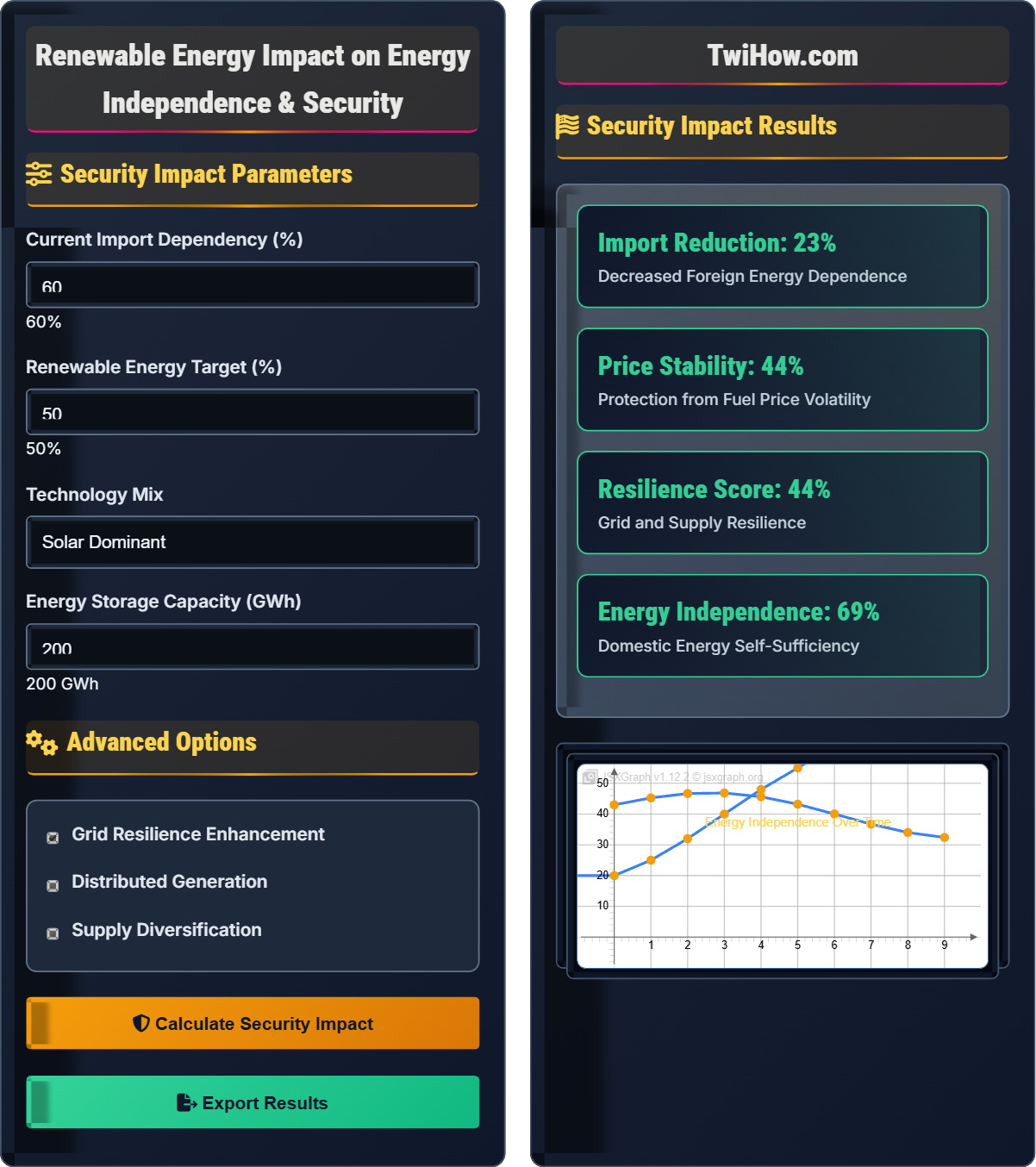
Security Impact Parameters
Advanced Options
Security Impact Results
| Security Metric | Current Value | Projected Value | Improvement |
|---|---|---|---|
| Import Dependency | 60% | 33% | -45% |
| Price Volatility | 85% | 19% | -78% |
| Supply Diversity | 35% | 78% | +123% |
| Energy Security | 40% | 85% | +113% |
| Resilience Factor | Current | With Renewables | Improvement |
|---|---|---|---|
| Grid Stability | 65% | 82% | +26% |
| Supply Reliability | 70% | 88% | +26% |
| Disruption Recovery | 55% | 75% | +36% |
| Supply Security | 60% | 85% | +42% |
Renewable Energy and Energy Security Explained
Energy security encompasses the reliable, affordable, and sustainable supply of energy to meet national needs. Renewable energy enhances security by reducing dependence on imported fuels, diversifying supply sources, and providing price stability. Unlike fossil fuels that are subject to volatile international markets, renewable resources are abundant and available domestically.
The impact of renewable energy on security can be quantified as:
Where:
- Import Independence: Reduction in foreign energy dependence
- Price Stability: Protection from volatile fuel prices
- Supply Diversity: Multiple domestic energy sources
Key dimensions of energy security enhanced by renewables:
- Supply Security: Reliable access to energy sources
- Price Stability: Predictable and affordable energy costs
- Infrastructure Resilience: Robust and secure energy systems
- Geopolitical Independence: Reduced exposure to international conflicts
- Supply Chain Security: Localized and diversified supply chains
- Grid Stability: Balanced and reliable electricity supply
- Reduced Import Bills: Significant savings on foreign energy purchases
- Price Predictability: Stable energy costs over long periods
- Supply Security: Abundant domestic renewable resources
- Grid Resilience: Distributed generation and storage systems
- Geopolitical Stability: Reduced dependence on unstable regions
- Economic Development: Domestic manufacturing and job creation
Security Impact Fundamentals
Energy security, import dependency, price stability, supply diversity, grid resilience, energy independence.
Energy Security = Import Independence + Price Stability + Supply Diversity
Where Security = overall measure, Independence = reduced imports, Stability = predictable costs.
- Renewable resources are abundant and domestic
- Price volatility decreases with renewable adoption
- Diversification reduces systemic risks
Applications
National renewable energy policies, energy security strategies, grid modernization programs, import reduction initiatives.
- Comprehensive energy security assessments
- Renewable resource mapping and planning
- Infrastructure development and modernization
- Policy and regulatory framework establishment
- Transition period and energy security risks
- Technology and infrastructure requirements
- Geopolitical implications of reduced imports
- Grid integration and stability challenges
Energy Security Quiz
How does renewable energy primarily reduce energy import dependency?
Renewable energy reduces import dependency by substituting domestic renewable resources (sunlight, wind, water) for imported fossil fuels. This direct replacement means that energy is generated from sources available within the country rather than relying on foreign energy imports.
The answer is B) By replacing imported fuels with domestic renewable resources.
The fundamental advantage of renewable energy is that it harnesses resources that are freely available within the country. Unlike fossil fuels that must be extracted, processed, and transported from abroad, renewable resources like solar irradiance, wind energy, and water flow are naturally occurring phenomena that can be converted to electricity without any imports.
Import Dependency: Percentage of energy needs met by imports
Domestic Resources: Energy sources available within the country
Substitution Effect: Replacing imports with domestic alternatives
• Renewable resources are naturally occurring and domestic
• Direct substitution reduces import requirements
• Energy independence increases with renewable adoption
• Think of renewables as converting natural resources to energy
• Domestic resources eliminate import dependencies
• Abundance of renewables ensures long-term supply
• Confusing energy efficiency with import reduction
• Assuming renewables still require fuel imports
• Not recognizing the substitution effect
Explain how renewable energy contributes to price stability and energy security, and contrast this with fossil fuel price volatility.
Renewable Energy Price Stability: Once renewable energy infrastructure is built, the "fuel" (sunlight, wind, water) is free and abundant. This eliminates fuel cost volatility and provides long-term price predictability for 20-25 years or more.
Contrast with Fossil Fuels: Fossil fuel prices are subject to market speculation, geopolitical tensions, supply disruptions, and extraction costs. These factors cause significant price volatility that can impact energy costs dramatically.
Security Benefits: Price stability allows for better budgeting, reduces economic uncertainty, and insulates the economy from external energy price shocks. This predictability is crucial for long-term economic planning and industrial competitiveness.
Renewable energy provides energy security through price predictability and protection from volatile international markets.
The fundamental difference lies in the cost structure. Fossil fuel energy has variable fuel costs that can fluctuate dramatically. Renewable energy has high upfront capital costs but zero marginal fuel costs. This means that after the initial investment, the energy produced is essentially free, providing price stability for the lifetime of the equipment.
Price Volatility: Fluctuation in energy costs over time
Fixed Costs: Costs that do not vary with production
Variable Costs: Costs that change with production volume
• Renewable energy has zero marginal fuel costs
• Price predictability enhances economic planning
• Volatility creates economic uncertainty
• Compare cost structures of renewables vs. fossil fuels
• Consider long-term price predictability benefits
• Recognize economic planning advantages
• Overlooking economic planning benefits
• Assuming all energy costs are similar
A country currently imports 80% of its energy needs at an annual cost of $40 billion. The country plans to transition to 60% renewable energy over 15 years. Calculate the projected import reduction and cost savings, assuming renewable energy replaces fossil fuel imports proportionally. Also calculate the cumulative savings over the 15-year transition period, assuming import costs remain constant.
Current Import Cost: $40 billion annually
Import Reduction: 60% of current imports = 60% × 80% = 48% import reduction
New Import Dependency: 80% - 48% = 32%
Annual Cost Savings: 48% × $40 billion = $19.2 billion
Final Import Cost: $40 billion - $19.2 billion = $20.8 billion
Cumulative 15-Year Savings: $19.2 billion × 15 years = $288 billion
The transition to 60% renewable energy would reduce import costs by $19.2 billion annually and save $288 billion over 15 years, significantly enhancing energy security and economic stability.
This calculation demonstrates the substantial economic benefits of renewable energy adoption. The import reduction is proportional to the renewable energy share, and the cost savings accumulate over time. This shows how renewable energy investments pay for themselves through import cost reductions while enhancing security.
Import Reduction: Decrease in foreign energy purchases
Cost Savings: Money saved by reducing importsCumulative Benefits: Total benefits over time period
• Import reduction is proportional to renewable share
• Savings accumulate over time
• Economic benefits enhance security
• Calculate proportional import reduction
• Consider cumulative effects over time
• Factor in cost stability benefits
• Forgetting to consider cumulative benefits
• Ignoring cost stability advantages
A region experiences frequent power outages due to centralized generation and extreme weather events. The region plans to install distributed renewable energy systems with storage, targeting 40% of power from distributed sources. Analyze how this distributed renewable approach enhances energy security compared to centralized fossil fuel generation, considering resilience during natural disasters and supply chain disruptions.
Centralized Fossil Fuel Vulnerabilities: Single points of failure, dependence on fuel supply chains, large-scale outages when disrupted.
Distributed Renewable Advantages: Multiple smaller generation points, no fuel supply chain dependencies, continued operation during fuel disruption.
Resilience Benefits: 40% distributed generation means 40% of power can continue operating even if centralized systems fail. Local renewable systems with storage can provide backup power during emergencies.
Security Enhancement: Distributed systems provide redundancy, reduce vulnerability to single-point failures, and maintain power during supply chain disruptions. Storage systems provide backup power during outages.
Distributed renewable systems significantly enhance grid resilience and energy security during emergencies and disruptions.
Distributed renewable energy systems provide inherent security advantages through decentralization. Rather than relying on a few large power plants, distributed systems spread generation across many locations. This provides redundancy and reduces the risk of complete system failure. Storage systems add another layer of security by providing backup power during outages.
Distributed Generation: Power generation spread across multiple locations
Grid Resilience: Ability to withstand and recover from disruptions
Single Point of Failure: Critical system component whose failure causes total failure
• Distributed systems provide redundancy
• No fuel supply chain dependencies enhance security
• Storage systems provide backup capabilities
• Consider failure modes of different system types
• Evaluate redundancy and backup capabilities
• Assess supply chain dependencies
• Overlooking supply chain vulnerabilities
• Ignoring emergency backup capabilities
How does renewable energy adoption affect a nation's geopolitical security and international relations?
Renewable energy adoption reduces exposure to energy-related geopolitical conflicts by decreasing dependence on imported fossil fuels from politically unstable regions. Nations with abundant renewable resources become less vulnerable to energy embargoes and geopolitical pressures related to fossil fuel supplies.
The answer is B) Reduces exposure to energy-related geopolitical conflicts.
Many geopolitical tensions and conflicts arise from competition for fossil fuel resources and control over energy supply routes. By developing domestic renewable energy sources, nations reduce their exposure to these international energy politics. This energy independence enhances national sovereignty and reduces vulnerability to external pressures.
Geopolitical Security: Protection from international political risks
Energy Diplomacy: Political relationships centered on energy
Energy Independence: Self-sufficiency in energy supply
• Energy independence reduces geopolitical vulnerabilities
• Domestic resources enhance sovereignty
• Reduced import dependence lowers political pressure
• Consider the link between energy and geopolitics
• Evaluate how independence reduces vulnerabilities
• Recognize sovereignty benefits
• Overlooking sovereignty benefits
• Ignoring international pressure reduction
FAQ
Q: How quickly can renewable energy reduce import dependence?
A: Import reduction occurs gradually over 10-20 years depending on:
Deployment Rate: Speed of renewable project development and grid integration
Infrastructure: Grid modernization and storage deployment
Policy Support: Government incentives and regulatory frameworks
Technology Maturity: Availability of cost-effective solutions
Financing: Access to capital for renewable projects
Phasing: Orderly transition to maintain supply security
Typical scenarios show 20-40% import reduction within 10 years and 50-70% within 20 years.
Q: What are the economic security benefits of renewable energy?
A: Economic security benefits include:
Price Stability: Predictable energy costs over 20-25 year lifespans
Import Savings: Billions in reduced foreign energy purchases
Job Creation: Domestic manufacturing and installation jobs
Industrial Competitiveness: Stable energy costs for manufacturers
Balance of Payments: Improved trade deficits
Investment: Domestic capital retention and growth
These benefits enhance economic resilience and reduce exposure to external shocks.