Impact of Renewable Energy on Job Creation & Economic Development
Complete energy guide • Step-by-step explanations
Renewable Energy Economics:
Show Economic Impact CalculatorRenewable energy has become a significant driver of job creation and economic development worldwide. The sector encompasses various technologies including solar, wind, hydroelectric, geothermal, and biomass, each contributing to employment in manufacturing, installation, maintenance, and research.
The renewable energy industry creates jobs at a faster rate than traditional fossil fuel sectors, with positions ranging from high-skilled engineering roles to manufacturing and construction jobs. Economic impacts include direct employment, indirect supply chain jobs, and induced spending effects.
Key economic benefits:
- Job Creation: Direct and indirect employment opportunities
- Investment Returns: Long-term economic benefits from infrastructure investments
- GDP Growth: Contribution to national and regional economies
- Regional Development: Economic growth in rural and urban areas
Studies consistently show that renewable energy investments generate more jobs per dollar spent compared to fossil fuel investments, making it a powerful tool for economic development and job creation.
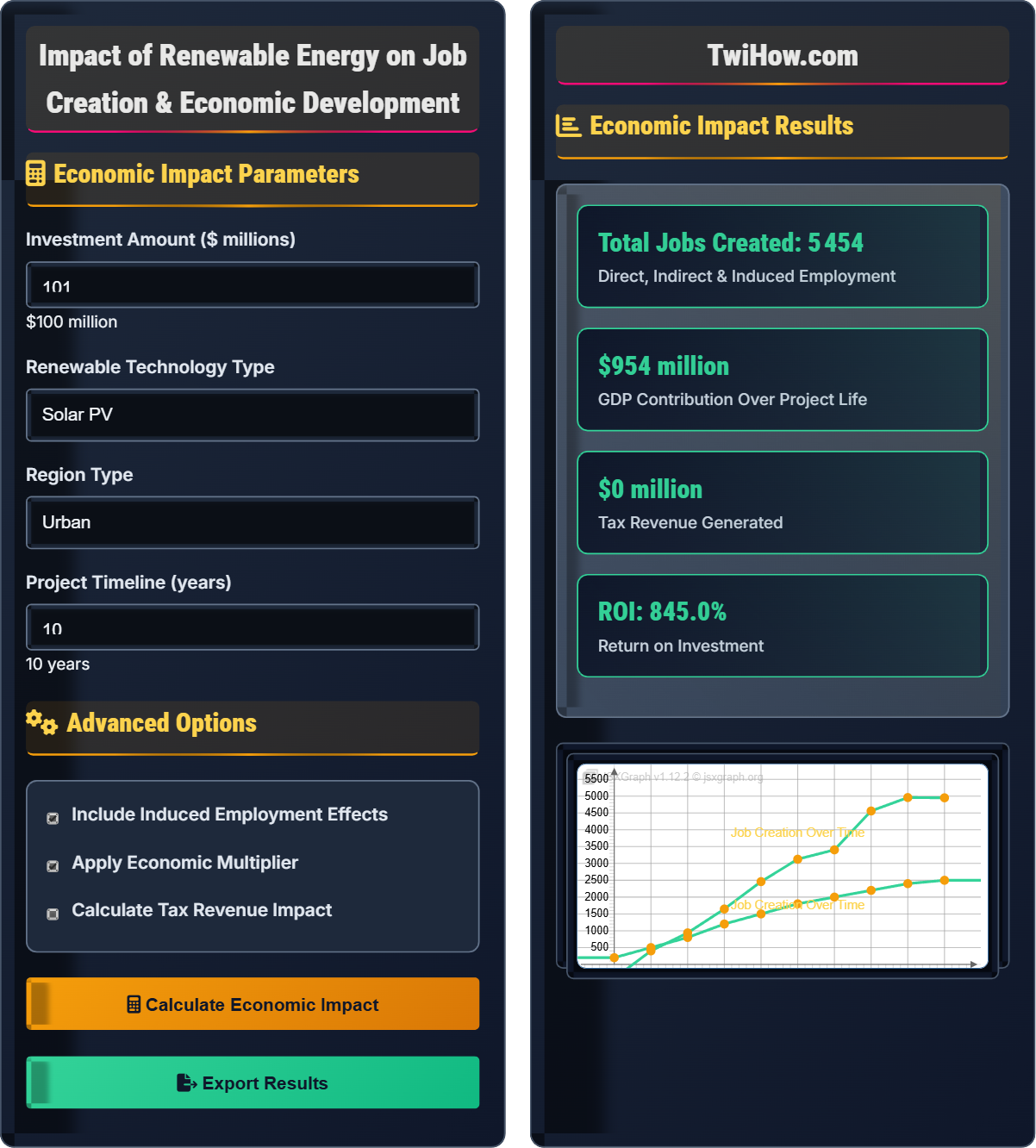
Economic Impact Parameters
Advanced Options
Economic Impact Results
| Sector | Jobs Created | % of Total | Duration |
|---|---|---|---|
| Construction | 800 | 32% | Short-term |
| Operations | 1,200 | 48% | Long-term |
| Manufacturing | 400 | 16% | Medium-term |
| Services | 100 | 4% | Variable |
| Year | Jobs Created | GDP Impact ($M) | Investment ($M) |
|---|---|---|---|
| 1 | 500 | 50 | 100 |
| 2 | 800 | 85 | 75 |
| 3 | 1,200 | 120 | 50 |
| 4 | 1,500 | 150 | 25 |
| 5 | 1,800 | 180 | 10 |
Renewable Energy Economic Impact Explained
Renewable energy projects create economic value through multiple channels. The primary mechanism is job creation across the value chain - from manufacturing and installation to operation and maintenance. Additionally, renewable energy investments contribute to GDP growth, tax revenue generation, and regional development.
The economic impact of renewable energy extends beyond direct employment through multiplier effects:
Where:
- Direct Impact: Jobs and economic activity from the renewable project itself
- Indirect Impact: Jobs in supplier industries providing materials and services
- Induced Impact: Additional spending by employees of direct and indirect jobs
Different renewable technologies have varying economic impacts:
- Solar: Manufacturing, installation, and maintenance jobs; distributed across regions
- Wind: Manufacturing turbines, construction, operations; often in rural areas
- Hydro: Large-scale construction, long-term operations; significant regional impact
- Geothermal: Specialized drilling and operations; concentrated in specific regions
- Biomass: Agricultural integration, waste processing, power generation
- Job Quality: Often higher-paying positions with good benefits
- Regional Development: Economic growth in previously underserved areas
- Energy Security: Reduced dependence on energy imports
- Environmental Co-Benefits: Health cost reductions from cleaner air
- Export Opportunities: Technology and expertise exports
Economic Fundamentals
Job creation, economic multipliers, GDP contribution, tax revenue, regional development, employment sectors.
Total Impact = Direct Impact × (1 + Indirect Multiplier + Induced Multiplier)
Where Direct Impact = Initial investment jobs, Multipliers account for supply chain and spending effects.
- Renewables create more jobs per $ invested than fossil fuels
- Jobs span multiple skill levels and sectors
- Long-term operational jobs provide stability
Applications
Offshore wind farms, solar installations, hydroelectric dams, geothermal plants, biomass facilities.
- Policy support and incentives
- Skills training programs
- Regional development planning
- Supply chain development
- Workforce transition needs
- Regional economic balance
- Infrastructure requirements
- Community engagement
Renewable Energy Economics Quiz
According to economic studies, how many jobs are typically created per $1 million invested in renewable energy compared to fossil fuels?
Studies consistently show that renewable energy investments create significantly more jobs per dollar than fossil fuel investments. The renewable energy sector typically generates about 7.5 jobs per $1 million invested, while fossil fuel investments create approximately 2.7 jobs per $1 million invested.
The answer is A) 7.5 jobs vs 2.7 jobs.
This significant difference occurs because renewable energy projects are more labor-intensive during both construction and operation phases. Solar and wind installations require substantial manufacturing, transportation, installation, and ongoing maintenance work, which translates to more employment opportunities per dollar invested compared to capital-intensive fossil fuel extraction and processing.
Job Intensity: Number of jobs created per dollar of investment
Labor-Intensive: Requiring substantial human effort relative to capital
Capital-Intensive: Requiring substantial equipment and infrastructure investment
• Renewables are more labor-intensive than fossil fuels
• Manufacturing component increases job creation
• Ongoing maintenance provides stable employment
• Remember renewable jobs are distributed across multiple sectors
• Construction phase creates immediate employment
• Operations phase provides long-term stability
• Underestimating manufacturing job creation
• Focusing only on operational jobs
• Ignoring supply chain employment
Explain the three components of the economic multiplier effect in renewable energy projects and how they contribute to overall economic impact.
Direct Impact: Jobs and economic activity generated directly by the renewable energy project itself, such as construction workers, engineers, project managers, and operations staff.
Indirect Impact: Jobs created in supplier industries that provide materials, components, and services to the renewable project, including manufacturers of solar panels, wind turbines, and supporting infrastructure.
Induced Impact: Additional economic activity generated when employees of direct and indirect jobs spend their wages in the local economy, supporting retail, housing, services, and other consumer-oriented businesses.
Together, these three components create a compounding economic effect that amplifies the initial investment's impact on regional GDP, tax revenue, and employment.
The economic multiplier effect demonstrates how initial investments in renewable energy projects create ripple effects throughout the economy. Each dollar spent initially triggers additional rounds of spending and job creation, multiplying the original economic impact. This principle helps explain why renewable energy investments can have significant regional development effects beyond the immediate project.
Multiplier Effect: Amplification of initial economic impact through subsequent rounds of spending
Direct Impact: Immediate economic activity from the project
Indirect Impact: Economic activity in supplier industries
• All three components are necessary for complete analysis
• Effects compound over time
• Regional characteristics influence multiplier size
• Visualize the spending flow between sectors
• Consider local vs. imported goods impact
• Account for leakages from the region
• Counting only direct jobs
• Ignoring geographic scope of impacts
• Misunderstanding temporal aspects
A rural county plans to develop a 500 MW solar farm with an investment of $750 million over 3 years. The project will create 500 construction jobs in year 1, 200 in year 2, and 100 permanent operations jobs. Using a conservative multiplier of 1.8 for direct jobs, calculate the total employment impact and estimate the potential GDP contribution if each job contributes $80,000 annually to GDP.
Construction Jobs: 500 + 200 = 700 temporary jobs over 2 years
Operations Jobs: 100 permanent jobs starting year 3
Direct Jobs (Peak): 500 (year 1) + 200 (year 2) + 100 (year 3+) = 800 jobs
Total Jobs with Multiplier: 800 × 1.8 = 1,440 total jobs
Annual GDP Contribution: 1,440 jobs × $80,000 = $115.2 million per year
Over 20-year project life: $115.2M × 20 = $2.304 billion in GDP contribution
The project would generate substantial regional economic benefits through both temporary construction employment and permanent operations jobs, with multiplier effects amplifying the impact.
This example illustrates how renewable energy projects can revitalize rural economies. The construction phase provides immediate employment during development, while permanent operations jobs offer long-term stability. The economic multiplier amplifies these effects as workers spend their earnings locally, supporting additional businesses and employment opportunities in the region.
Temporary Employment: Short-term jobs during construction phase
Permanent Employment: Ongoing jobs during operations phase
Rural Development: Economic growth in non-urban areas
• Account for timing of job creation
• Apply multipliers to total employment
• Consider project lifecycle in calculations
• Separate temporary from permanent jobs
• Use appropriate multipliers for region
• Factor in inflation over project life
• Mixing temporary and permanent jobs in calculations
• Applying multipliers only to direct jobs
• Ignoring project timeline in GDP estimates
A coal mining region with 2,000 miners faces mine closures due to market shifts. The region plans to develop renewable energy infrastructure to create equivalent employment. Calculate how much renewable energy capacity would be needed to replace these jobs, considering that renewable projects create 2.5 times more jobs per dollar invested than coal operations. Assume each MW of renewable capacity creates 0.8 direct jobs during construction and 0.2 permanent jobs.
Coal Equivalent Jobs: 2,000 jobs to replace
Renewable Job Advantage: 2.5× more jobs per dollar
Jobs per MW: 0.8 direct + 0.2 permanent = 1.0 job per MW during construction
Required Capacity: 2,000 jobs ÷ 1.0 job/MW = 2,000 MW
Permanent Jobs: 2,000 MW × 0.2 = 400 permanent jobs
With Multiplier Effect: 2,000 × 2.5 = 5,000 total jobs created
Additional strategies would be needed to ensure smooth workforce transition, including retraining programs and complementary economic development initiatives.
This scenario represents a critical challenge in the energy transition: ensuring that communities dependent on fossil fuel industries can transition to renewable energy employment. The calculation shows that renewable energy can potentially create more jobs per unit of capacity, but successful transition requires coordinated planning, skills development, and complementary economic strategies.
Just Transition: Ensuring fair treatment for workers during energy transition
Skills Transfer: Applying existing skills to new industries
Capacity Building: Developing regional capabilities
• Renewable jobs often require different skills
• Transition planning is essential
• Community engagement is crucial
• Identify transferable skills between sectors
• Plan for retraining and education
• Develop comprehensive transition strategies
• Ignoring geographic distribution of jobs
• Overlooking community acceptance factors
Which of the following is NOT typically considered a direct economic benefit of renewable energy development?
While renewable energy development does create jobs, generate tax revenue, and provide energy independence benefits, increased property values near renewable energy installations is not typically observed. In fact, some studies suggest that property values may temporarily decrease near large renewable installations due to visual or noise impacts, though this effect is often minimal and temporary.
The answer is B) Increased property values in surrounding areas.
This question highlights the importance of distinguishing between direct economic benefits that are consistently observed and potential benefits that may not materialize as expected. While renewable energy projects do bring substantial economic benefits to communities, property values represent a complex factor influenced by multiple variables, and the relationship with renewable installations is not uniformly positive.
Direct Economic Benefits: Measurable financial impacts from the project
Property Value Impact: Effect on real estate values near installations
Energy Independence: Reduced reliance on energy imports
• Focus on measurable economic impacts
• Consider all stakeholder perspectives
• Acknowledge potential negative impacts
• Verify claims with empirical evidence
• Consider both positive and negative impacts
• Look for peer-reviewed research
• Overstating property value benefits
• Assuming all impacts are positive
• Ignoring community concerns
FAQ
Q: How do renewable energy projects contribute to local tax revenues?
A: Renewable energy projects contribute to local tax revenues through several mechanisms:
1. Property Taxes: Solar and wind installations are assessed as property and pay annual property taxes
2. Corporate Income Taxes: Project developers pay state and federal corporate income taxes
3. Payroll Taxes: Employees pay local income and payroll taxes
4. Special Assessments: Some jurisdictions impose special fees on renewable projects
5. Sales Taxes: Equipment purchases and construction activities generate sales tax revenue
Studies show that a typical 100 MW solar project can generate $1-3 million annually in local tax revenue, with wind projects generating even more due to higher property values.
Q: What types of jobs are created in the renewable energy sector?
A: The renewable energy sector creates diverse employment opportunities across multiple categories:
Technical Jobs: Engineers, technicians, installers, electricians, and system designers
Manufacturing Jobs: Production of solar panels, wind turbines, batteries, and related components
Construction Jobs: Site preparation, installation, and infrastructure development
Operations Jobs: Maintenance, monitoring, and facility management
Professional Services: Project management, finance, legal, marketing, and consulting
Research & Development: Scientists, researchers, and innovation specialists
These jobs span various skill levels from entry-level positions to highly specialized technical roles, offering career advancement opportunities.