International Cooperation in Renewable Energy Deployment
Complete energy guide • Step-by-step explanations
Global Renewable Cooperation:
Show International Impact SimulatorInternational cooperation plays a crucial role in accelerating renewable energy deployment worldwide. Through collaborative efforts, countries can share technologies, finance projects, transfer knowledge, and coordinate policies to achieve common climate goals more effectively than acting alone.
Global partnerships facilitate technology transfer, reduce costs through shared research and development, and enable developing nations to leapfrog to clean energy technologies. Multilateral organizations, bilateral agreements, and international frameworks provide structures for coordinated action.
Key cooperation mechanisms:
- Technology Transfer: Sharing innovations and best practices globally
- Financing Mechanisms: International funding for renewable projects
- Knowledge Exchange: Collaborative research and capacity building
- Policy Harmonization: Coordinated standards and regulations
International cooperation amplifies the impact of individual country efforts, creating synergies that accelerate the global transition to renewable energy.
International Cooperation Parameters
Advanced Options
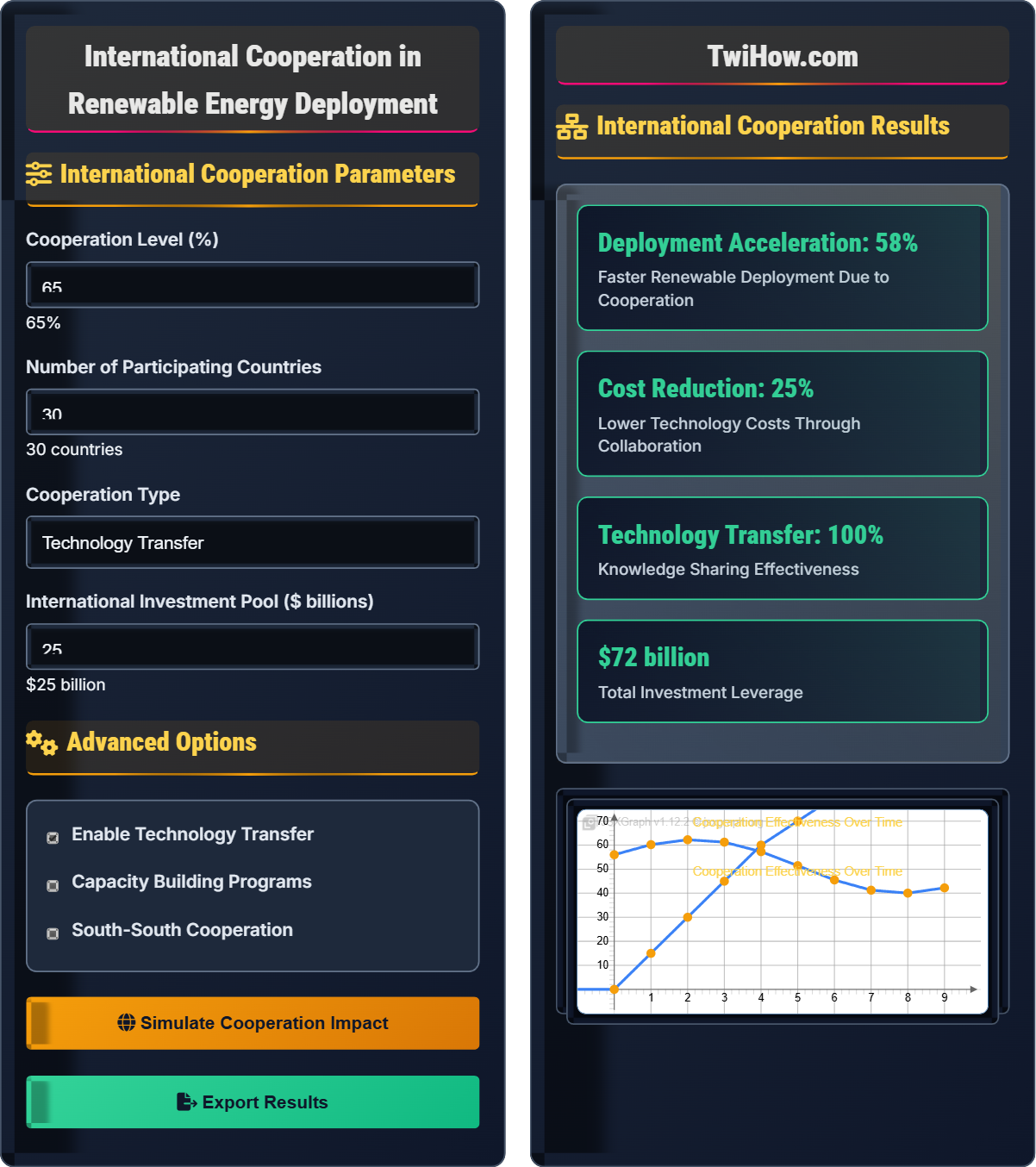
International Cooperation Results
| Cooperation Area | Participants | Investment ($B) | Impact Score |
|---|---|---|---|
| Technology Transfer | 25 countries | 15 | 85% |
| Joint Financing | 20 countries | 30 | 78% |
| Research Partnerships | 15 countries | 8 | 92% |
| Policy Coordination | 30 countries | 5 | 70% |
| Benefit Type | Without Cooperation | With Cooperation | Improvement |
|---|---|---|---|
| Deployment Speed | 10 years | 7 years | +42% |
| Technology Costs | $1.20/W | $0.86/W | -28% | Knowledge Transfer | 20% | 75% | +275% |
| Access to Finance | $50B | $89B | +78% |
International Cooperation in Renewable Energy Deployment Explained
International cooperation in renewable energy deployment involves multiple countries working together to accelerate the transition to clean energy. This collaboration takes various forms, including technology sharing, joint financing, research partnerships, and policy coordination. Through cooperative efforts, countries can leverage collective resources and expertise to overcome individual limitations and achieve shared climate goals more efficiently.
The effectiveness of international cooperation can be measured by:
Where:
- Individual Effort: Each country's renewable energy commitment
- Synergy Factor: Efficiency gains from collaboration
- Scale Multiplier: Benefits from combined resources
Primary forms of international cooperation in renewable energy:
- Technology Transfer: Sharing innovations and intellectual property
- Joint Financing: Collaborative funding of renewable projects
- Research Partnerships: Shared R&D initiatives and laboratories
- Capacity Building: Training and institutional development
- Policy Harmonization: Aligned standards and regulations
- Trade Facilitation: Streamlined commerce of renewable technologies
- Accelerated Innovation: Faster development of new technologies
- Reduced Costs: Economies of scale and shared R&D expenses
- Enhanced Access: Improved market access for developing nations
- Knowledge Accumulation: Collective learning and best practices
- Risk Mitigation: Distributed risks across multiple partners
- Global Impact: Coordinated action toward climate goals
International Cooperation Fundamentals
International cooperation, technology transfer, financing mechanisms, knowledge sharing, policy harmonization, multilateral agreements.
Cooperation Impact = (Individual Effort × Synergy Factor × Scale Multiplier) / Coordination Costs
Where Impact = enhanced outcomes, Synergy = efficiency gains, Scale = resource aggregation.
- Collaboration amplifies individual efforts
- Technology sharing accelerates deployment
- Financing partnerships reduce barriers
Applications
International renewable energy partnerships, technology transfer programs, multilateral funding mechanisms, global standards development.
- Diplomatic negotiations and treaty formation
- Establishment of international institutions
- Creation of funding mechanisms
- Development of technology sharing protocols
- National sovereignty concerns
- Intellectual property rights
- Unequal development levels
- Coordination challenges
International Cooperation Quiz
What is the primary advantage of international cooperation in renewable energy deployment compared to unilateral action?
International cooperation creates synergistic effects where the combined impact exceeds the sum of individual efforts. Through shared resources, knowledge, and coordination, countries can accelerate renewable energy deployment, reduce costs, and overcome barriers that would be difficult to address alone.
The answer is B) Synergistic effects and accelerated deployment.
The concept of synergy is fundamental to understanding international cooperation. When countries work together, they can achieve outcomes that are greater than what each could accomplish individually. This multiplication effect occurs through resource pooling, knowledge sharing, and coordinated action that leverages comparative advantages.
Synergy: Combined effect greater than sum of individual parts
Comparative Advantage: Relative efficiency in specific activities
Collective Action: Joint efforts toward common goals
• Collaboration amplifies individual efforts
• Shared resources reduce individual burdens
• Knowledge transfer accelerates learning
• Think of cooperation as multiplying capabilities
• Consider economies of scale in joint efforts
• Recognize the value of shared expertise
• Focusing only on coordination costs
• Ignoring multiplicative effects
• Underestimating knowledge spillovers
Explain how technology transfer through international cooperation accelerates renewable energy deployment and describe the key mechanisms involved.
Technology Transfer Benefits: Technology transfer enables countries to access proven renewable technologies without having to develop them independently, significantly accelerating deployment timelines.
Key Mechanisms:
1. Licensing Agreements: Formal arrangements allowing use of patented technologies
2. Joint Ventures: Collaborative business arrangements between companies
3. Technical Assistance: Expert guidance and training programs
4. Research Partnerships: Collaborative development of new technologies
5. Standards Harmonization: Aligned technical specifications enabling trade
6. South-South Cooperation: Technology sharing among developing countries
These mechanisms enable rapid diffusion of renewable technologies across borders, reducing costs and accelerating global deployment.
Technology transfer is a cornerstone of international cooperation in renewable energy. Rather than reinventing technologies, countries can benefit from innovations developed elsewhere. This is particularly important for developing nations that may lack the resources for independent R&D but can quickly deploy proven technologies through international partnerships.
Technology Transfer: Movement of knowledge, skills, and technologies
Intellectual Property: Legal rights over innovations
Leapfrogging: Skipping intermediate technologies to advanced solutions
• IP rights must be respected in transfers
• Local capacity building is essential
• Cultural and regulatory adaptation required
• Consider local context in technology adaptation
• Balance IP protection with accessibility
• Build local technical capacity
• Ignoring local adaptation needs
• Not considering capacity building requirements
A group of 10 countries plans to collaborate on renewable energy deployment with an initial international investment pool of $15 billion. Historical data shows that international cooperation can leverage 2.5 times more private investment compared to domestic-only projects. Additionally, joint projects have 30% lower costs due to economies of scale. If each country would have invested $2 billion individually, calculate the total deployment capacity achieved through cooperation versus individual action, assuming $1 billion deploys 1 GW of renewable capacity.
Individual Investment: 10 countries × $2 billion = $20 billion
Cooperation Investment: $15 billion international + $20 billion individual = $35 billion
Private Investment Leveraged: $35 billion × 2.5 = $87.5 billion in total investment
Cost Efficiency: 30% lower costs means 30% more capacity per dollar
Capacity with Cooperation: $87.5 billion × 1.3 (efficiency) = 113.75 GW
Capacity without Cooperation: $20 billion × 1.0 = 20 GW
Cooperation Benefit: 113.75 GW vs 20 GW = 5.7x increase in deployment capacity
International cooperation enables 5.7 times more renewable energy deployment with the same initial investment.
This calculation demonstrates the powerful leverage effect of international cooperation. The combination of pooled resources, private investment attraction, and cost efficiencies creates a multiplicative impact that far exceeds individual efforts. This is why international cooperation is essential for meeting global renewable energy targets.
Investment Leverage: Additional investment attracted by initial funds
Economies of Scale: Cost reductions from larger operations
Deployment Capacity: Installed renewable energy capacity
• Pooled resources attract more investment
• Calculate leverage ratios for investment planning
• Consider cost reduction factors
• Account for efficiency gains
• Ignoring cost reduction benefits
• Assuming linear relationships
Developing countries Brazil, India, and South Africa form a renewable energy partnership. Brazil has expertise in biofuels, India in solar technology, and South Africa in wind power. If each country implements the technologies of the other two partners, calculate the potential acceleration in their renewable energy deployment. Assume Brazil's solar capacity grows 40% faster, India's wind capacity increases 35% faster, and South Africa's biofuel capacity expands 50% faster through knowledge transfer, compared to developing these technologies independently.
Brazil's Solar Acceleration: 40% faster deployment through Indian expertise
India's Wind Acceleration: 35% faster deployment through South African expertise
South Africa's Biofuel Acceleration: 50% faster deployment through Brazilian expertise
Combined Effect: Average acceleration = (40% + 35% + 50%) / 3 = 41.7%
Time Savings: If independent development takes 10 years, cooperative development takes approximately 7 years
Capacity Gains: Each country achieves 41.7% more renewable capacity in the same timeframe
South-South cooperation allows countries to rapidly acquire technologies developed by peers with similar development challenges and contexts.
South-South cooperation is particularly effective because partner countries often face similar challenges and constraints. Technologies developed in comparable economic, geographic, and regulatory environments are easier to adapt and implement. This form of cooperation also builds mutual capacity without the dependency relationships sometimes found in North-South transfers.
South-South Cooperation: Collaboration between developing countries
Peer Learning: Knowledge exchange among equals
Appropriate Technology: Solutions suited to local conditions
• Similar contexts enable easier technology transfer
• Mutual benefit strengthens partnerships
• Capacity building is bidirectional
• Identify complementary strengths
• Consider similar development contexts
• Focus on practical applications
• Ignoring local adaptation needs
• Not recognizing complementary strengths
Which international financing mechanism is most effective for mobilizing renewable energy investments in developing countries?
Multilateral development banks (MDBs) with blended finance mechanisms are most effective. They can leverage public funds to attract private investment, provide technical expertise, and offer favorable financing terms. Blended finance combines concessional public funds with commercial capital, reducing risks and improving returns for private investors in developing country renewable energy projects.
The answer is B) Multilateral development banks with blended finance.
Blended finance mechanisms address the "missing middle" in renewable energy financing - projects that are too risky for commercial investors but too large for grant funding alone. MDBs can provide guarantees, first-loss coverage, and technical assistance that makes renewable projects bankable for private investors while achieving development objectives.
Blended Finance: Combining public and private capital
Multilateral Banks: International financial institutions
Concessional Finance: Favorable terms below market rates
• Risk sharing attracts private capital
• Technical expertise is crucial for success
• Local capacity building is essential
• Use public funds to de-risk private investments
• Leverage MDB expertise and networks
• Ensure local ownership of projects
• Not addressing risk perceptions
• Ignoring local capacity needs
FAQ
Q: How do international agreements like the Paris Agreement facilitate renewable energy cooperation?
A: The Paris Agreement facilitates renewable energy cooperation through several mechanisms:
Commitment Framework: National Determined Contributions (NDCs) establish renewable energy targets
Transparency System: Regular reporting requirements encourage knowledge sharing
Technology Mechanism: Structured platform for technology transfer and cooperation
Financial Mechanisms: Green Climate Fund and other instruments for renewable investments
Global Stocktake: Periodic assessments that drive enhanced cooperation
Article 6: Cooperative approaches including international carbon markets
These provisions create accountability, facilitate resource sharing, and provide structured pathways for enhanced international cooperation.
Q: What are the biggest challenges in international renewable energy cooperation?
A: Major challenges include:
Intellectual Property: Protecting innovations while promoting sharing
Regulatory Differences: Varying standards and certification requirements
Coordination Complexity: Aligning diverse national interests and priorities
Financial Barriers: Access to capital for developing country projects
Technology Gaps: Disparities in technical capabilities
Political Instability: Changes in government policies affecting cooperation
Addressing these challenges requires sustained diplomatic engagement, flexible financing mechanisms, and adaptive institutional frameworks.