What is the role of public engagement and education in renewable energy adoption?
Complete engagement guide • Public education & adoption
Public Engagement & Education:
Show Engagement SimulatorPublic engagement and education play crucial roles in accelerating renewable energy adoption by building awareness, addressing concerns, and fostering community support. Effective programs inform citizens about benefits, dispel myths, and create champions for renewable energy initiatives.
Key engagement strategies include community workshops, educational campaigns, stakeholder consultations, and transparent communication. Success depends on understanding local concerns, cultural contexts, and addressing misinformation through evidence-based education.
Engagement components:
- Information Dissemination: Factsheets, websites, and educational materials
- Community Consultation: Public meetings and feedback sessions
- Stakeholder Involvement: Local leaders and influencers
- Addressing Concerns: Transparent communication and solutions
Successful engagement builds trust, reduces opposition, and accelerates project timelines while ensuring community benefits.
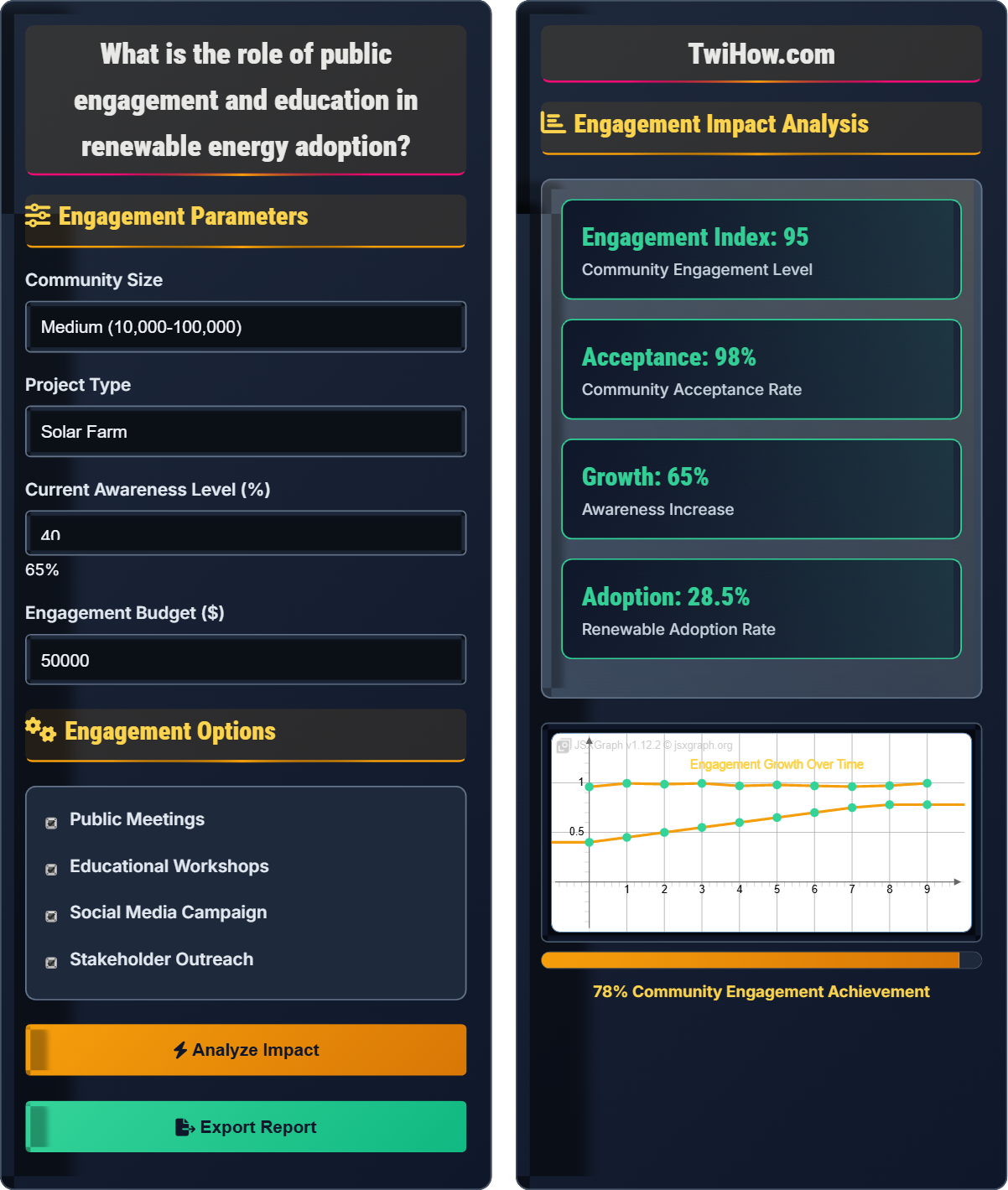
Engagement Parameters
Engagement Options
Engagement Impact Analysis
| Strategy | Reach | Effectiveness | Cost |
|---|---|---|---|
| Public Meetings | High | 85% | Medium |
| Educational Workshops | Medium | 90% | Low |
| Social Media | Very High | 70% | Low |
| Stakeholder Outreach | High | 95% | High |
| Information Campaigns | High | 75% | Medium |
Awareness Growth Visualization
Outreach Flow
Public Engagement & Education Explained
Public engagement in renewable energy refers to the systematic process of involving community members, stakeholders, and citizens in decision-making processes related to renewable energy development. This includes informing, consulting, and collaborating with the public to build support and address concerns.
Effective public engagement follows a structured approach:
Framework components include:
- Information Sharing: Providing clear, accessible information about projects
- Consultation: Gathering input and feedback from stakeholders
- Collaboration: Working together on project design and implementation
- Empowerment: Giving communities control over decisions
- Education: Building knowledge and understanding
Effective strategies by audience type:
- General Public: Information campaigns, social media, community events
- Local Leaders: Direct consultation, formal presentations, partnership opportunities
- Environmental Groups: Technical briefings, environmental impact discussions
- Business Community: Economic impact presentations, business opportunity discussions
- Community Support: Builds local acceptance and advocacy
- Project Success: Reduces opposition and delays
- Trust Building: Establishes credibility with stakeholders
- Improved Design: Incorporates local knowledge and preferences
- Policy Alignment: Ensures community needs are met
Engagement Metrics & Community Assessment
- Start engagement early in project development
- Use clear, jargon-free communication
- Address concerns transparently and honestly
- Provide multiple channels for input
Engagement Strategy Profiles
Public Engagement Quiz
When should public engagement begin in a renewable energy project?
Public engagement should begin during the project development stage, before final design decisions are made. Early engagement allows community input to influence project design and helps build support from the beginning.
The answer is B) During project development stage.
Early engagement is crucial because it allows community concerns to be addressed in the project design phase, rather than trying to modify completed plans. When communities feel heard early, they are more likely to support projects and less likely to oppose them later.
Early Engagement: Community involvement before final project decisions
Stakeholder Input: Feedback from affected parties
Design Influence: Ability to shape project characteristics
• Engage before final decisions are made
• Allow community input to influence design
• Build trust through early transparency
• Start engagement during feasibility studies
• Use iterative feedback loops
• Demonstrate responsiveness to input
• Engaging too late in process
• Not allowing input to influence design
• Treating engagement as formality
Explain how to effectively address public concerns about renewable energy projects and describe best practices for communication.
Effective Concern Addressing:
• Listen Actively: Acknowledge concerns without dismissing them
• Provide Evidence: Use credible data and case studies to address concerns
• Be Transparent: Share both benefits and potential impacts honestly
• Offer Solutions: Propose specific mitigation measures
Best Practices:
• Use clear, jargon-free language
• Provide multiple information formats (written, visual, verbal)
• Engage with trusted community intermediaries
• Follow up consistently on commitments
• Address concerns promptly and respectfully
Public concerns about renewable energy often stem from misinformation, fear of change, or legitimate environmental/social impacts. Effective communication acknowledges these concerns while providing factual information to address them. Building trust through transparency and responsiveness is key to gaining community support.
Community Concerns: Issues raised by affected populations
Transparent Communication: Open sharing of information and decisions
Responsive Engagement: Acting on community feedback
• Acknowledge all concerns seriously
• Provide factual, evidence-based responses
• Follow through on commitments
• Use local intermediaries for communication
• Provide visual aids and demonstrations
• Share success stories from similar projects
• Dismissing concerns as irrational
• Using technical jargon in communication
• Failing to follow through on commitments
A renewable energy project with a $10 million budget allocates $500,000 for public engagement activities. The engagement program increases community support from 40% to 85%, reducing project delays from 18 months to 6 months. Calculate the return on investment (ROI) if each month of delay costs $200,000 in project costs and opportunity costs.
Delay Reduction:
Original delay: 18 months
New delay: 6 months
Reduction: 12 months
Cost Savings:
12 months × $200,000/month = $2,400,000 savings
Engagement Investment:
$500,000
ROI Calculation:
ROI = (Savings - Investment) / Investment × 100
ROI = ($2,400,000 - $500,000) / $500,000 × 100 = 380%
The public engagement program achieved a 380% return on investment by reducing project delays.
This calculation demonstrates the significant financial benefits of public engagement in renewable energy projects. The investment in engagement activities paid dividends by reducing costly delays, showing that public engagement is not just ethically important but financially beneficial.
Return on Investment (ROI): Financial benefit relative to investment cost
Project Delays: Time extensions due to opposition or complications
Opportunity Costs: Lost benefits from delayed implementation
• Engagement investments often have high ROI
• Delays multiply costs significantly
• Early engagement prevents expensive delays
• Budget 5-10% of project for engagement
• Track engagement ROI metrics
• Use case studies to justify investment
• Underestimating engagement costs
• Not tracking delay reduction benefits
• Failing to calculate financial returns
You're developing a wind farm project in a rural community where residents are concerned about noise, property values, and visual impact. Design an engagement strategy that addresses these specific concerns and builds community support.
Concern-Specific Strategy:
• Noise Concerns: Conduct acoustic studies, provide noise level data, invite visits to similar projects
• Property Values: Present independent real estate studies, offer property value guarantees
• Visual Impact: Create visual impact simulations, discuss setback distances, show design options
Multi-Channel Approach:
• Host town halls for direct dialogue
• Organize facility tours to similar projects
• Engage with local realtors and property experts
• Create visual impact simulations and fact sheets
• Establish community advisory committee
Effective engagement strategies must be tailored to address specific community concerns with credible evidence and multiple engagement channels. This approach demonstrates respect for community concerns while providing factual information to address them.
Concern-Specific Engagement: Strategies targeting specific issues
Credible Evidence: Independent, verifiable data
Multi-Channel Approach: Multiple engagement methods
• Address each concern with specific evidence
• Use multiple engagement channels
• Engage with trusted intermediaries
• Use independent experts for credibility
• Provide visual demonstrations
• Offer property value protections
• Generic responses to specific concerns
• Not providing visual evidence
• Failing to address property values
Which communication method is most effective for educating the general public about renewable energy benefits?
Visual aids and interactive demonstrations are most effective for educating the general public about renewable energy benefits. These methods make complex information accessible and memorable, allowing people to understand concepts through direct experience.
The answer is B) Visual aids and interactive demonstrations.
Public education about renewable energy requires communication methods that are accessible to non-technical audiences. Visual aids, models, and hands-on demonstrations help people understand abstract concepts and make information more memorable than text-heavy materials.
Visual Aids: Graphical representations of information
Interactive Demonstrations: Hands-on learning experiences
Accessible Communication: Information understandable by general public
• Use simple, clear language
• Make information visually engaging
• Provide hands-on learning opportunities
• Use infographics and videos
• Create interactive models
• Organize facility tours
• Using technical jargon with public
• Providing only text-based information
• Not making information visually appealing
FAQ
Q: How can renewable energy developers ensure their engagement efforts are meaningful and not just token gestures?
A: Meaningful engagement requires:
Authentic Participation: Genuine consideration of community input in project design
Transparency: Open sharing of information, data, and decision-making processes
Follow-through: Implementation of commitments made during engagement
Continuous Dialogue: Ongoing communication throughout project lifecycle
Accountability: Regular reporting on engagement outcomes and project impacts
Token gestures fail when input doesn't influence decisions or when promises aren't kept.
Q: What role does education play in overcoming resistance to renewable energy projects?
A: Education plays a crucial role in overcoming resistance by:
Addressing Misinformation: Correcting false beliefs with factual information
Building Understanding: Explaining how renewable technologies work
Highlighting Benefits: Demonstrating economic and environmental advantages
Creating Champions: Educated individuals become advocates
Reducing Fear: Familiarity decreases anxiety about new technologies
Education alone isn't sufficient but is essential when combined with meaningful engagement.