What is the Role of Research and Innovation in Advancing Renewable Energy?
Complete guide • Step-by-step explanations
Research & Innovation:
Show Innovation SimulatorResearch and innovation are fundamental drivers of renewable energy advancement, enabling breakthrough technologies, cost reductions, and performance improvements. From fundamental science to commercial deployment, innovation accelerates the transition to clean energy.
Key innovation areas:
- Material Science: Advanced photovoltaics, lightweight materials, energy storage
- Systems Integration: Grid stability, smart controls, forecasting
- Emerging Technologies: Perovskite cells, fusion, advanced storage
- Manufacturing: Process improvements, automation, quality
- Policy & Economics: Market mechanisms, financing models
Continuous innovation is essential for achieving global renewable energy targets and addressing climate change.
Research & Innovation Parameters
Advanced Options
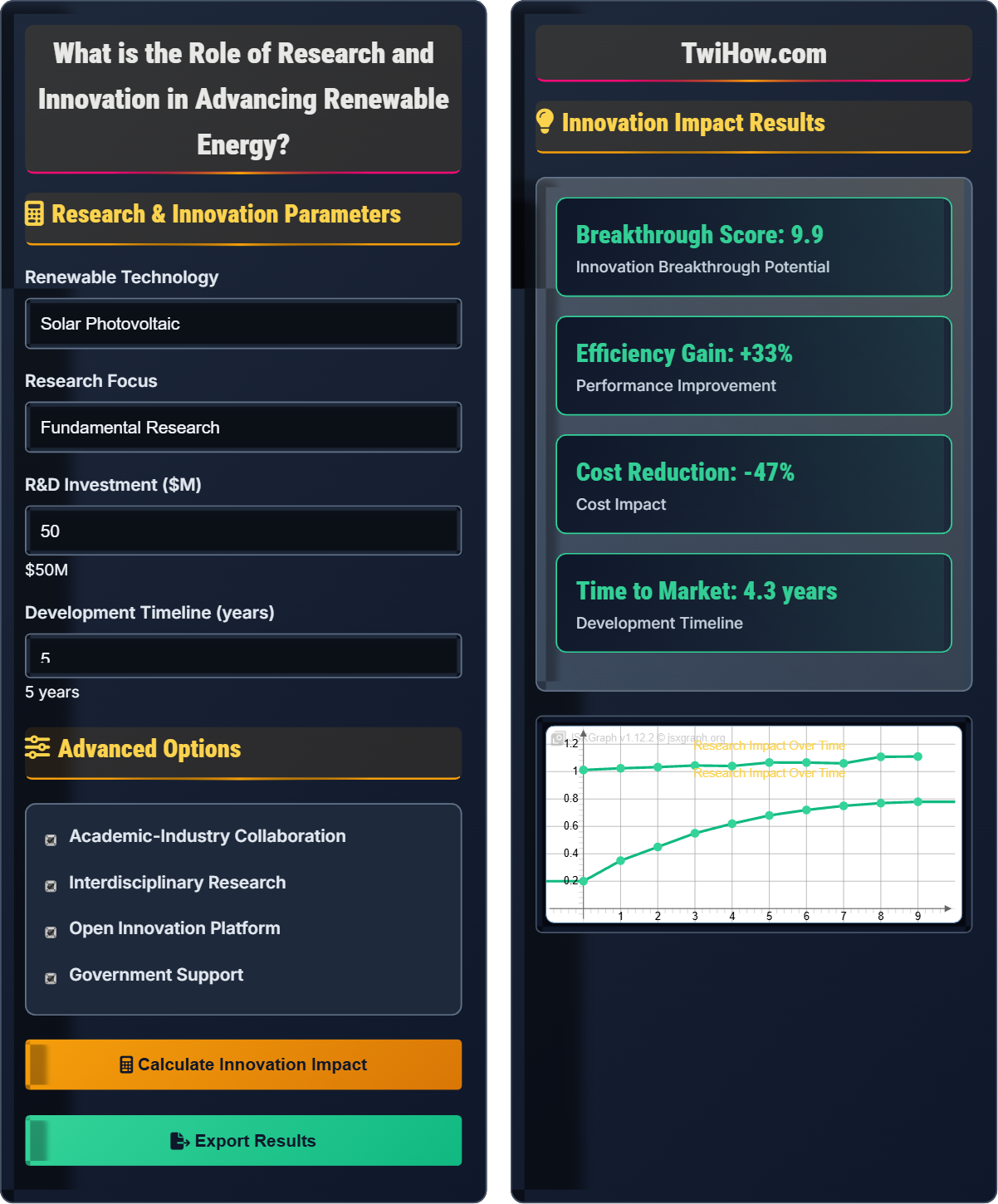
Innovation Impact Results
| Technology | Breakthrough Score | Efficiency Gain | Cost Reduction |
|---|---|---|---|
| Solar PV | 8.5 | +30% | -45% |
| Wind | 7.2 | +15% | -35% |
| Batteries | 9.0 | +40% | -50% |
| Hydrogen | 8.8 | +35% | -42% |
| Grid | 7.8 | +20% | -25% |
Solar PV
Wind
Batteries
Hydrogen
Research & Innovation Impact Analysis
Research and innovation in renewable energy follow a systematic pipeline from fundamental discovery to commercial deployment. Each stage contributes to technological advancement, cost reduction, and performance improvement that drives market adoption and climate impact.
Fundamental Research
Basic ScienceApplied Research
Concept DevelopmentDevelopment
Prototype CreationCommercialization
Market EntryEfficiency
Cost
Timeline
Patents
Technology Innovation Analysis
Breakthroughs: Perovskite cells, heterojunction technology, bifacial panels
Impact: Efficiency gains from 15% to over 30%
Research Focus: Material science, cell architecture, manufacturing processes
Improvements: Larger turbines, advanced materials, smart controls
Impact: Cost reduction of 70% since 2010
Research Focus: Aerodynamics, materials, grid integration
Breakthroughs: Solid-state batteries, flow batteries, novel chemistries
Impact: Cost reduction of 85% since 2010
Research Focus: Electrochemistry, materials, safety
Emerging: Advanced electrolysis, catalysts, system integration
Impact: Potential for industrial decarbonization
Research Focus: Electrolysis efficiency, renewable coupling
Research Strategies
Partner universities, industry, and government labs to accelerate innovation through shared expertise and resources.
Combine physics, chemistry, engineering, and economics to solve complex renewable energy challenges.
Share research findings and collaborate openly to accelerate global progress in renewable energy.
Invest in education and training programs to build the next generation of renewable energy researchers.
Successful renewable energy innovation requires a collaborative ecosystem connecting universities, national laboratories, private companies, and government agencies. This network facilitates knowledge transfer, accelerates commercialization, and ensures research addresses real-world challenges.
Technology Development Pathway
Discovery
Basic ResearchDevelopment
Proof of ConceptScale-up
Pilot ProjectsCommercial
Market DeploymentInnovation Breakthrough
Scientific discoveries leading to technology advances
Emerging Technologies
Research is exploring revolutionary technologies like perovskite-silicon tandem cells, airborne wind energy, advanced nuclear fusion, and synthetic biology approaches to renewable energy. These innovations could transform the energy landscape if successfully commercialized.
Research into perovskite solar cells has achieved laboratory efficiencies exceeding 25%, with potential for low-cost manufacturing. Ongoing research focuses on stability and scalability challenges that must be overcome for commercial deployment.
Research into solid-state batteries promises higher energy density, improved safety, and longer lifespans. Universities and companies worldwide are working to overcome manufacturing challenges and bring these technologies to market.
Research & Innovation Learning Quiz
Which factor has been the primary driver of renewable energy cost reductions over the past decade?
Manufacturing scale economies have been the primary driver of renewable energy cost reductions, with large-scale production facilities achieving lower per-unit costs. This has been enabled by supportive policies and research advances that made mass production feasible.
The answer is B) Manufacturing scale economies.
While research and development enable the underlying technological improvements, it's the scale of manufacturing that translates these advances into cost reductions. The learning curve effect means that as cumulative production doubles, costs decrease by a predictable percentage.
Scale Economies: Cost advantages from increased production volume
Learning Curve: Cost reduction as cumulative experience increases
Manufacturing Scale: Large-volume production facilities
• Research enables manufacturing advances
• Scale reduces per-unit costs
• Policies support market development
• Monitor manufacturing trends
• Track production volumes
• Watch for cost projections
• Attributing cost reductions solely to research
• Ignoring manufacturing scale effects
• Not considering policy impacts
Explain the research and development pipeline for renewable energy technologies from discovery to commercialization.
Research Pipeline Stages:
Fundamental Research: Basic scientific investigation in universities and national labs to understand underlying principles.
Applied Research: Translating discoveries into practical applications and proof-of-concept demonstrations.
Development: Engineering prototypes and testing at laboratory and pilot scales.
Commercialization: Manufacturing scale-up and market deployment with industrial partners.
Each stage requires different resources, expertise, and success metrics, with only a small fraction of discoveries reaching commercial markets.
The innovation pipeline is a systematic process that transforms scientific discoveries into market-ready products. Each stage builds on the previous one, with increasing investment and decreasing success probability as technologies advance toward commercialization.
Fundamental Research: Basic scientific investigation
Applied Research: Practical application development
Commercialization: Market entry and deployment
• Each stage requires different expertise
• Success rates decrease with each stage
• Collaboration accelerates progression
• Support early-stage research
• Bridge research-development gap
• Foster university-industry partnerships
• Skipping development stages
• Not bridging research gaps
• Underfunding early research
A research consortium invests $100 million in solar cell efficiency research. The research team expects to achieve a 5% efficiency gain, which could reduce the levelized cost of electricity by 15%. If current solar costs are $50/MWh, calculate the potential cost reduction and estimate the market impact assuming 100 GW of new solar deployment.
Cost Reduction Calculation:
Current cost: $50/MWh
Projected reduction: 15%
New cost: $50 × (1 - 0.15) = $42.50/MWh
Cost reduction: $7.50/MWh
Market Impact: For 100 GW of new deployment at 25% capacity factor: 100 GW × 8,760 hours × 0.25 = 219 TWh annually
Annual savings: 219 TWh × $7.50/MWh = $1.64 billion annually
Total investment impact: $1.64 billion annual savings for $100 million investment
This example demonstrates the significant economic impact of research investments in renewable energy. Small efficiency improvements can yield substantial cost savings when applied at scale, making research investments highly valuable for the energy transition.
Levelized Cost of Electricity: Average cost over asset lifetime
Capacity Factor: Actual output vs maximum possible
Market Impact: Economic benefits at scale
• Small improvements scale significantly
• Calculate impact at deployment scale
• Consider long-term benefits
• Estimate deployment scale
• Calculate annual benefits
• Consider compound effects
• Not calculating scale effects
• Ignoring deployment timeline
• Underestimating compounding benefits
A national laboratory wants to establish a renewable energy innovation hub focusing on grid integration. Design a research strategy that maximizes innovation outcomes while ensuring practical applications.
Research Strategy: 1) Establish partnerships with utilities and grid operators to identify real-world challenges, 2) Focus on scalable solutions that can be tested on actual grids, 3) Create joint university-industry research teams, 4) Develop rapid prototyping capabilities, 5) Establish testing facilities for grid-scale demonstrations.
Practical Applications: Real-time grid simulation, AI-powered forecasting, advanced inverter controls, virtual power plants, and demand response systems.
Expected Outcome: 5-10 breakthrough technologies with commercial potential within 5 years.
Successful renewable energy research requires close collaboration with industry partners to ensure that innovations address real market needs. Academic-industry partnerships accelerate the transition from research to practical applications.
Grid Integration: Connecting renewables to electrical grids
University-Industry Partnerships: Academic-commercial collaborationsPractical Applications: Real-world implementations
• Partner with industry early
• Focus on scalable solutions
• Test on real systems
• Identify industry pain points
• Create demonstration projects
• Develop commercialization pathways
• Not involving industry partners
• Focusing on theoretical problems
• Not planning for commercialization
Which emerging renewable energy technology has shown the most promising recent research results?
Perovskite solar cells have shown the most promising recent research results, achieving laboratory efficiencies exceeding 25% and demonstrating potential for low-cost manufacturing. While still facing stability challenges, they represent the most advanced emerging solar technology.
The answer is A) Perovskite solar cells.
Emerging technologies vary in their readiness levels and potential for commercialization. Perovskite solar cells have advanced rapidly in recent years, moving from laboratory curiosity to potential commercial application, making them the most promising near-term emerging technology.
Technology Readiness: Commercialization maturity level
Perovskite Cells: Novel solar cell material
Research Results: Laboratory achievements
• Assess commercial readiness
• Consider scalability potential
• Evaluate market timing
• Monitor efficiency records
• Track commercial pilots
• Assess manufacturing feasibility
• Confusing research results with commercial success
• Not considering manufacturing challenges
• Overvaluing early-stage technologies
FAQ
Q: How can research institutions better connect their work to commercial applications?
A: Research institutions should: 1) Establish industry partnerships early in research projects, 2) Create technology transfer offices to facilitate commercialization, 3) Develop proof-of-concept demonstrators, 4) Engage with startups and venture capital, 5) Participate in industry consortia, and 6) Focus on solving real market problems. The key is building bridges between fundamental research and practical applications through structured pathways and industry engagement.
Q: What policies best support renewable energy research and innovation?
A: Effective policies include: 1) Stable long-term research funding, 2) Tax incentives for corporate R&D investment, 3) University-industry partnership programs, 4) Patent and intellectual property protections, 5) Demonstration project support, 6) Early-stage investment programs, and 7) Skilled workforce development initiatives. These policies create an environment where research can translate into commercial innovation while maintaining public support for continued investment.