What is the Role of Standards and Certification in Renewable Energy Quality?
Complete renewable energy guide • Quality assurance & compliance
Renewable Energy Standards:
Show Standards CalculatorStandards and certification play a crucial role in ensuring the quality, safety, and reliability of renewable energy systems. They establish minimum performance requirements, safety protocols, and quality assurance measures that protect consumers and ensure system interoperability.
Key standard-setting organizations include the International Electrotechnical Commission (IEC), Underwriters Laboratories (UL), and various national standards bodies. These standards cover everything from component specifications to installation procedures and grid integration requirements.
Primary benefits of standards and certification:
- Safety Assurance: Ensures equipment meets rigorous safety requirements
- Performance Guarantee: Validates that systems meet specified performance criteria
- Market Confidence: Builds trust among investors and consumers
- Grid Compatibility: Ensures seamless integration with power grids
Standards and certification also facilitate international trade by providing globally recognized benchmarks and reducing technical barriers to market entry.
Certification Parameters
Compliance Options
Compliance Results
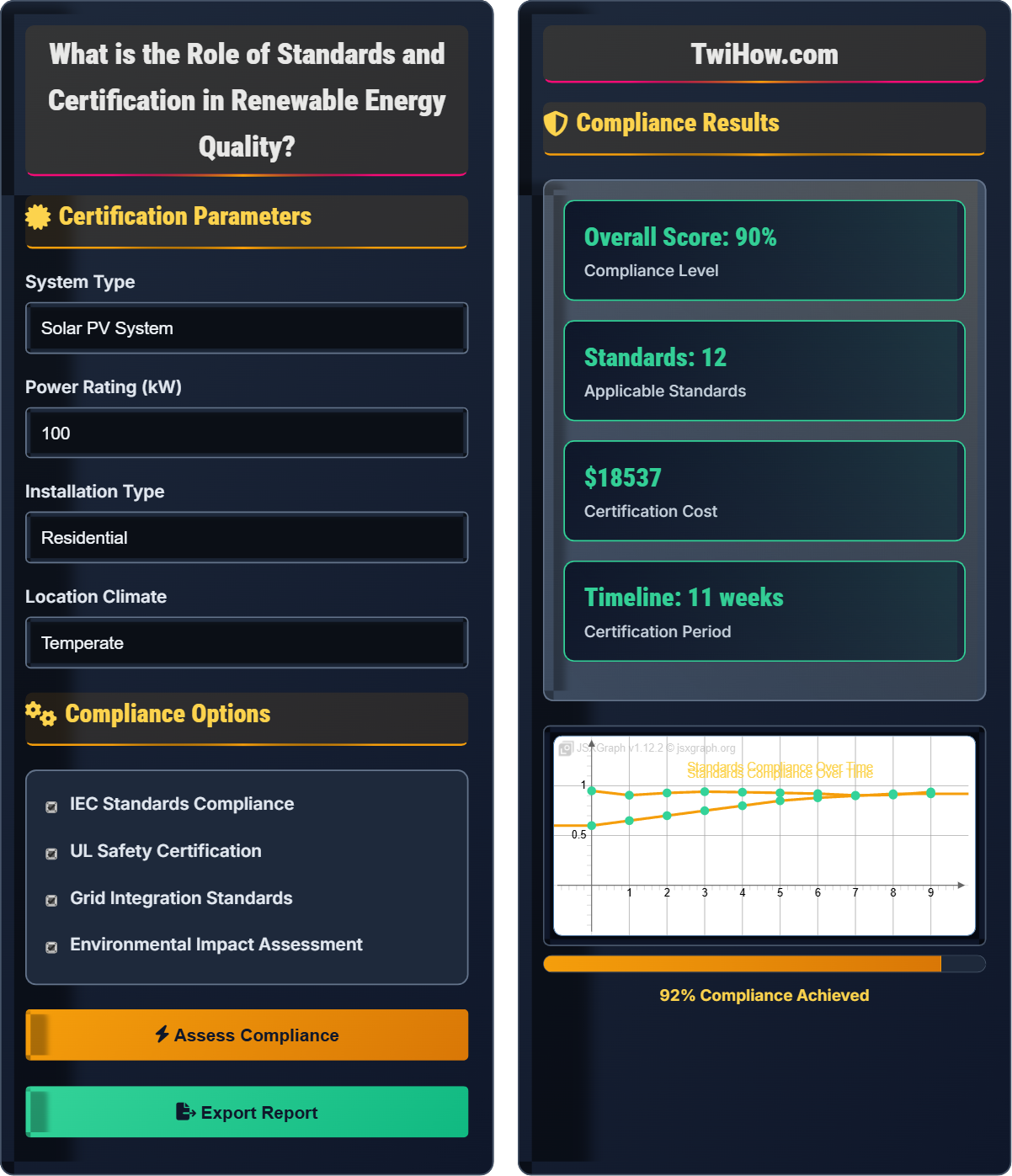
| Standard | Type | Status | Priority |
|---|---|---|---|
| IEC 61215 | Solar Module | Required | High |
| IEC 61730 | Safety | Required | High |
| UL 1703 | Safety | Required | Medium |
| IEC 62109 | Inverter | Required | High |
| IEEE 1547 | Grid | Required | High |
Standards and Certification Explained
Renewable energy standards are technical specifications and guidelines that define minimum requirements for the design, manufacture, installation, operation, and maintenance of renewable energy systems. These standards ensure safety, performance, and compatibility across different systems and manufacturers.
Renewable energy standards fall into several categories:
Categories include:
- Performance Standards: Define minimum efficiency and output requirements
- Safety Standards: Ensure electrical and mechanical safety
- Grid Integration: Specify requirements for connecting to power grids
- Environmental: Address environmental impact and sustainability
- Installation: Provide safe installation procedures and requirements
Key organizations that develop renewable energy standards:
- International Electrotechnical Commission (IEC): Global electrotechnical standards
- Underwriters Laboratories (UL): Safety standards for North America
- International Organization for Standardization (ISO): Quality management standards
- Institute of Electrical and Electronics Engineers (IEEE): Grid integration standards
- National standards bodies: Country-specific requirements and adaptations
- Quality Assurance: Guarantees minimum performance and safety levels
- Investor Confidence: Reduces financial risks for project developers
- Market Access: Enables participation in utility programs and incentives
- Insurance Benefits: Often required for insurance coverage
- Grid Compatibility: Ensures safe and reliable grid integration
Quality Factors & Risk Assessment
- All electrical components must meet UL safety standards
- Grid integration must comply with IEEE 1547 requirements
- Environmental impact assessments required for large projects
- Periodic inspections and maintenance certifications needed
Major Standards Overview
Renewable Energy Standards Quiz
Which IEC standard specifically addresses the safety requirements for photovoltaic systems?
IEC 61730 specifically addresses safety requirements for photovoltaic (PV) modules. It covers both construction requirements and safety qualification tests. IEC 61215 deals with performance requirements, IEC 62109 covers inverter safety, and IEC 61400 relates to wind turbines.
The answer is B) IEC 61730.
Understanding the distinction between performance and safety standards is crucial in renewable energy. While performance standards focus on how well a system operates under various conditions, safety standards prioritize protecting people and property from potential hazards. IEC 61730 is specifically designed to address electrical, mechanical, and fire safety concerns in PV installations.
IEC 61730: International standard for PV module safety requirements
Safety Standards: Regulations ensuring protection against hazards
IEC: International Electrotechnical Commission
• Safety standards are mandatory in most jurisdictions
• Compliance requires third-party certification
• Standards evolve with technology advancements
• Remember: IEC 61730 = Safety, IEC 61215 = Performance
• Safety comes first in renewable energy design
• Regularly update on standard revisions
• Confusing performance with safety standards
• Assuming compliance is one-time only
• Neglecting regional standard variations
Explain the importance of IEEE 1547 in renewable energy grid integration and describe three key requirements it specifies.
Importance: IEEE 1547 is crucial for ensuring that distributed energy resources (DER) like solar panels and wind turbines can safely and reliably connect to the electrical grid without disrupting power quality or grid stability.
Three Key Requirements:
1. Voltage Regulation: Specifies acceptable voltage ranges and response to voltage deviations. DER must disconnect if voltages exceed safe limits.
2. Frequency Response: Defines how DER should respond to frequency variations on the grid. Systems must disconnect if frequency deviates too far from nominal values.
3. Islanding Protection: Requires DER to detect grid outages and disconnect immediately to prevent backfeeding isolated sections of the grid, which poses safety risks to workers.
Grid integration standards like IEEE 1547 are essential because renewable energy sources behave differently from traditional generators. They must be able to respond appropriately to grid conditions while maintaining safety. The standard ensures that when the grid fails, distributed resources don't continue operating and feeding power into disconnected lines, which could endanger utility workers.
IEEE 1547: Standard for interconnecting distributed resources with electric power systems
DER: Distributed Energy Resources
Islanding: Condition where DER continues to power a portion of the grid disconnected from the main network
• IEEE 1547 compliance is required for grid connection
• DER must automatically disconnect during grid outages
• Voltage and frequency parameters must be monitored continuously
• Islanding protection is critical for worker safety
• Modern inverters are designed with IEEE 1547 built-in
• Always verify local utility requirements beyond IEEE 1547
• Assuming IEEE 1547 is the only requirement
• Not accounting for utility-specific requirements
• Installing non-compliant inverters
A solar installer is planning to certify a 500kW commercial solar array. The certification process includes IEC 61215/61730 testing ($15,000), IEEE 1547 compliance verification ($8,000), UL 1703 safety certification ($5,000), and documentation review ($2,000). Calculate the total certification cost and determine the percentage of the total project cost ($400,000) that certification represents.
Calculation:
Total Certification Cost = $15,000 + $8,000 + $5,000 + $2,000 = $30,000
Percentage of Project Cost = ($30,000 ÷ $400,000) × 100 = 7.5%
The certification cost represents 7.5% of the total project cost. This is within the typical range of 5-10% for commercial renewable energy projects.
Understanding certification costs is important for project budgeting. While certification expenses might seem significant, they are essential for ensuring system safety, performance, and eligibility for incentives. The 7.5% cost ratio is typical for commercial installations, though it may vary based on system complexity and required standards.
Project Cost Ratio: Certification cost as percentage of total project cost
Typical Range: 5-10% for commercial renewable projects
Cost Justification: Safety, performance, and incentive eligibility
• Certification costs are necessary project expenses
• Non-certified systems may face penalties
• Certification enables access to incentives
• Budget 5-10% of project cost for certification
• Factor in certification early in planning
• Consider certification as investment in quality
• Underestimating certification costs
• Delaying certification until project end
• Choosing lowest-cost certification providers
A manufacturer is developing a new battery storage system for residential solar applications. Identify the three most important standards they should consider and explain why each is critical for product success.
Three Most Important Standards:
1. IEC 62619: Safety requirements for secondary lithium cells. Critical because battery systems pose fire and chemical hazards that must be properly managed to protect users.
2. UL 1973: Batteries for use in stationary applications. Essential for US market access and insurance requirements. Addresses electrical and environmental safety.
3. IEEE 2030.5: Smart grid communication protocols. Important for system integration, remote monitoring, and utility communication capabilities.
These standards ensure safety, market access, and interoperability—three critical factors for product success in the competitive energy storage market.
For battery storage systems, safety standards take precedence due to the inherent risks of energy storage. IEC 62619 specifically addresses lithium-ion battery safety, which is critical given the potential for thermal runaway. Communication standards like IEEE 2030.5 are increasingly important as smart grid integration becomes standard.
IEC 62619: Safety for secondary lithium cells in industrial applications
UL 1973: Batteries for stationary applications
IEEE 2030.5: Smart grid communication protocols
• Safety standards are mandatory for market access
• Communication standards enable grid integration
• Standards vary by application and region
• Start with safety standards for any energy system
• Research regional requirements early
• Consider future standard updates in design
• Focusing only on performance standards
• Neglecting communication protocol standards
• Assuming one standard fits all markets
Which of the following is NOT a direct benefit of adhering to renewable energy standards and certification?
While renewable energy standards improve system performance, enhance safety, and often lead to insurance premium reductions, they do not directly reduce installation time. In fact, compliance with standards may sometimes increase installation time due to additional safety procedures and verification steps required by the standards.
The answer is B) Reduced installation time.
It's important to understand that standards prioritize safety, performance, and quality over speed. While standards may seem to slow down processes, they ultimately save time by preventing failures, accidents, and costly repairs. The upfront investment in following standards pays dividends in system longevity and reliability.
Quality Standards: Specifications for performance and safety
Process Efficiency: Not always improved by standards
Long-term Benefits: Outweigh short-term delays
• Standards prioritize safety over speed
• Quality benefits outweigh temporary delays
• Compliance reduces long-term costs
• View standards as quality investments
• Plan extra time for compliance activities
• Consider long-term value over short-term costs
• Expecting standards to speed up processes
• Skipping steps to save time
• Undervaluing long-term benefits
FAQ
Q: How do renewable energy standards impact the cost and timeline of a project?
A: Renewable energy standards have both cost and timeline impacts:
Cost Impact: Standards increase upfront costs through required testing, certification, and higher-specification components. However, they reduce long-term costs by ensuring system reliability and avoiding warranty claims.
Timeline Impact: Standards add time for compliance activities like testing and certification. A typical certification process takes 6-12 months, which must be planned into project schedules.
Net Effect: While standards increase initial investment (typically 5-10% of project cost), they provide greater returns through reduced maintenance, extended system life, and eligibility for incentives.
Q: What's the difference between IEC and UL standards, and when do I need each?
A: IEC (International Electrotechnical Commission) and UL (Underwriters Laboratories) serve different purposes:
IEC Standards: International standards developed for global use. Focus on performance, safety, and compatibility. Examples: IEC 61215 for solar modules, IEC 61400 for wind turbines.
UL Standards: US-specific safety standards. Required for products sold in North America. Examples: UL 1703 for PV modules, UL 1995 for air conditioning equipment.
When to Use: For global markets, IEC standards are often sufficient. For US sales, UL certification is typically required. Many manufacturers pursue both to maximize market access.