How to Evaluate In-Game Purchase Value
Smart gaming spending • Cost-benefit analysis
Gaming Economics:
Show Value CalculatorEvaluating in-game purchases requires understanding the cost-benefit relationship between real money spent and value received. Key factors include time savings, gameplay enhancement, aesthetic appeal, and long-term utility.
Smart gaming spending involves calculating cost per hour of entertainment, comparing bundle deals, and identifying psychological triggers that encourage purchases.
Essential evaluation criteria:
- Cost Per Hour: Total cost divided by hours of enjoyment
- Utility Value: Practical benefits provided by the purchase
- Opportunity Cost: Alternative purchases you could make
- Scarcity Factor: Limited-time offers and their true worth
Effective evaluation combines objective metrics with subjective enjoyment to determine if a purchase provides genuine value for your gaming experience.
Purchase Details
Advanced Options
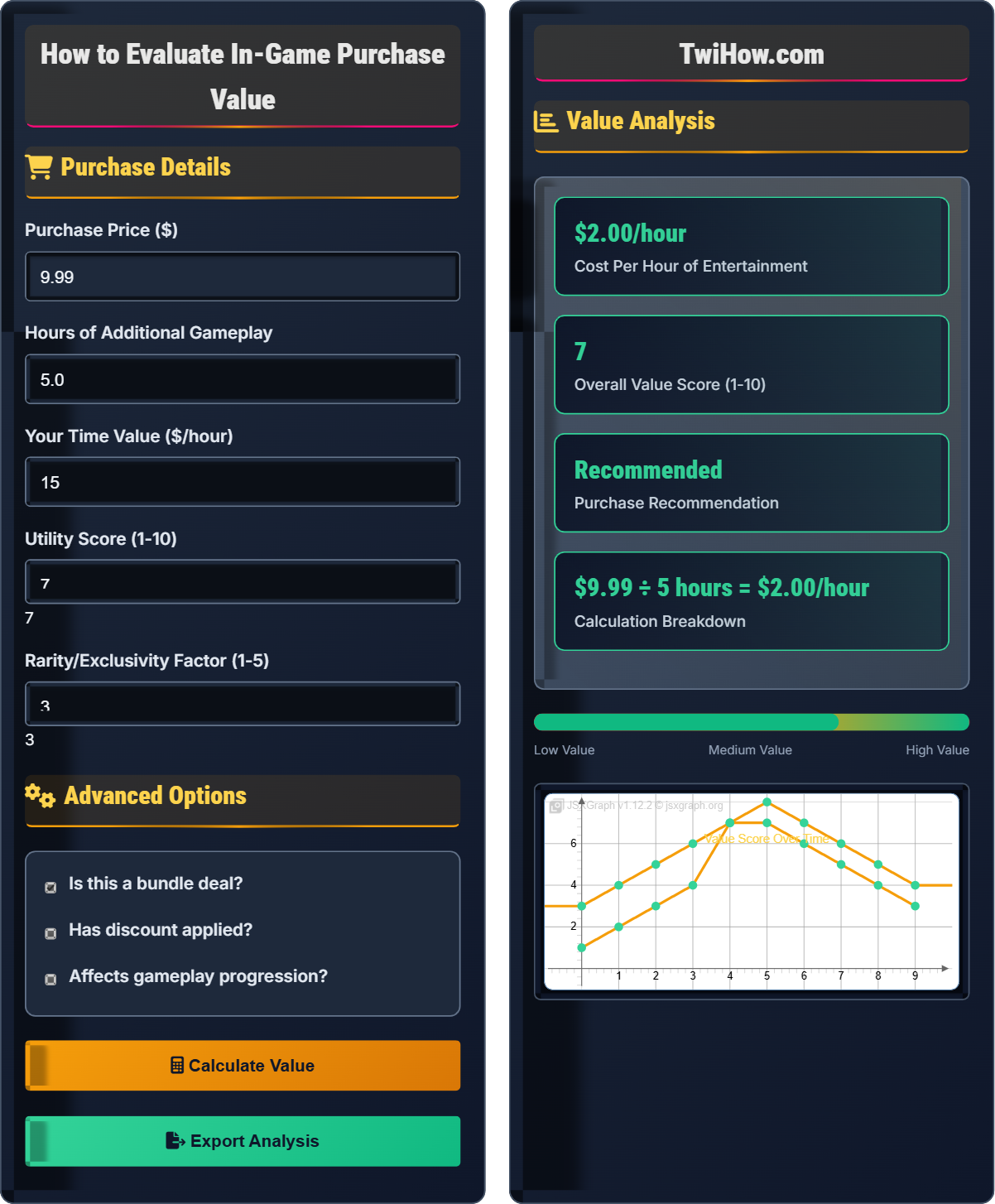
Value Analysis
| Metric | Value | Interpretation |
|---|---|---|
| Cost Per Hour | $1.99 | Good value compared to other entertainment |
| Utility Score | 7/10 | High practical benefit |
| Rarity Factor | 3/5 | Moderate exclusivity |
| Bundle Discount | Yes | Additional savings |
In-Game Purchase Value Evaluation
Value in gaming purchases is determined by multiple factors that interact to create a comprehensive evaluation:
Where:
- Utility Score: Practical benefits (1-10 scale)
- Rarity Factor: Exclusivity and uniqueness (1-5 scale)
- Time Saved: Hours of content unlocked
- Cost Per Hour: Financial efficiency measure
Different types of in-game purchases offer varying value propositions:
- Cosmetic Items: Aesthetic value, no gameplay advantage
- Time-Savers: Reduce grind time, increase convenience
- Progression Boosters: Accelerate character development
- Bundles: Multiple items at discounted rates
- Season Passes: Future content access
- Random Boxes: Uncertain rewards, gambling element
Several psychological elements influence purchase decisions:
- Scarcity Effect: Limited-time offers create urgency
- Social Proof: Seeing others make purchases
- Loss Aversion: Fear of missing out on exclusive items
- Endowment Effect: Valuing items you own more highly
- Just-Noticeable Difference: Small discounts seem larger
Value Assessment Framework
Cost per hour, utility score, rarity factor, opportunity cost.
Value Score = (Utility Score + Rarity Factor + Time Saved) / Cost Per Hour
Where Utility Score = Practical benefits (1-10), Rarity Factor = Exclusivity (1-5).
- Cost per hour under $3 is generally good value
- Utility > 7 indicates high practical benefit
- Random boxes have negative expected value
- Bundles often provide better value ratios
Practical Strategies
Wait for sales, prioritize utility over aesthetics, calculate before purchasing.
- Set monthly gaming budget
- Prioritize purchases by value score
- Wait 24 hours before buying
- Track spending and satisfaction
- Random reward boxes
- Pay-to-win advantages
- Pressure tactics
- Unclear value propositions
Gaming Purchase Value Quiz
A game pack costs $14.99 and provides approximately 8 hours of additional gameplay. What is the cost per hour?
To calculate cost per hour, divide the total cost by the number of hours of gameplay: $14.99 ÷ 8 hours = $1.87/hour. This metric helps compare the value of different in-game purchases.
The answer is A) $1.87/hour.
The cost-per-hour metric is fundamental to evaluating gaming purchases because it standardizes value across different price points and content volumes. A $50 purchase that provides 50 hours of gameplay has the same cost-per-hour ($1) as a $5 purchase that provides 5 hours of gameplay. This allows for apples-to-apples comparisons regardless of the absolute price.
Cost Per Hour: Total cost divided by hours of entertainment value
Value Metric: Standardized measure for comparing purchase options
Standardization: Process of making different options comparable
• Always calculate cost per hour before purchasing
• Compare to other entertainment options ($3-6/hour for movies)
• Consider subjective value alongside cost metrics
• Round up for conservative estimates
• Factor in replay value for games
• Account for social aspects (multiplayer)
• Focusing only on absolute price
• Ignoring time value of money
• Not considering opportunity cost
Explain why bundle deals often provide better value than individual purchases in gaming. Include the mathematical reasoning and psychological factors involved.
Mathematical Reasoning: Bundles typically offer a discount percentage on the combined price of individual items. For example, if three items normally cost $5 each individually (total $15), a bundle might offer all three for $12, providing a 20% discount. The cost per item drops from $5 to $4.
Psychological Factors: Bundles create perceived value through the "bundle premium effect," where consumers feel they're getting more for their money. The packaging suggests a curated experience and creates urgency through limited-time offers.
Value Calculation: Cost per item in bundle = Total bundle price ÷ Number of items. This is usually lower than the average cost of individual items.
Bundle pricing leverages both economic and psychological principles. Economically, companies can afford to offer discounts because they reduce marketing costs per item and guarantee volume sales. Psychologically, consumers often overestimate the value of bundled items because they don't mentally "unbundle" the components. This creates a perception of greater value than the sum of individual parts.
Bundle Discount: Percentage reduction when buying multiple items together
Bundle Premium Effect: Consumer perception of increased value in bundles
Volume Sales: Strategy of selling more items at lower per-unit margins
• Verify you'll use all items in the bundle
• Compare bundle price to individual prices
• Beware of forced consumption
• Calculate per-item cost in bundles
• Assess actual usage likelihood
• Wait for deeper discounts
• Buying bundles for items you won't use
• Assuming all bundles are good deals
• Not comparing to individual prices
A game offers a random reward box for $4.99 containing one of three possible items: Item A (worth $3), Item B (worth $5), or Item C (worth $10). The probabilities are 50% for Item A, 35% for Item B, and 15% for Item C. Calculate the expected value and determine if this is a good purchase.
Expected Value Calculation: Expected Value = (Probability of A × Value of A) + (Probability of B × Value of B) + (Probability of C × Value of C)
Expected Value = (0.50 × $3) + (0.35 × $5) + (0.15 × $10)
Expected Value = $1.50 + $1.75 + $1.50 = $4.75
Analysis: The expected value ($4.75) is less than the cost ($4.99), making this a poor financial decision. The house edge is approximately 4.8%. From a value perspective, this is a losing proposition.
Random reward boxes follow the same principles as gambling. Game developers set the probabilities and payout values to ensure they profit over time. The expected value calculation reveals the true value of these purchases. Understanding this concept helps players make informed decisions about probability-based purchases.
Expected Value: Average outcome if an action is repeated many times
House Edge: Advantage held by the operator over players
Probability Distribution: Set of possible outcomes and their likelihoods
• Expected value < cost means poor value
• Random boxes have negative expected value
• Probability rarely favors the player
• Calculate expected value for random purchases
• Avoid probability-based purchases
• Look for guaranteed value alternatives
• Believing you'll get lucky
• Not calculating expected value
• Falling for "gambler's fallacy"
You're considering a season pass for a game that costs $39.99 and promises 6 months of content releases. You estimate spending 2 hours per week on new content, with your time valued at $20/hour. Additionally, the pass includes exclusive cosmetics worth $15 to you. Calculate the value proposition and decide whether to purchase.
Time Value Calculation: 2 hours/week × 26 weeks = 52 hours of content
Monetary value of time = 52 hours × $20/hour = $1,040
Additional Value: Exclusive cosmetics = $15
Total Value: $1,040 + $15 = $1,055
Cost: $39.99
Value Ratio: $1,055 ÷ $39.99 = 26.4 (extremely high value)
Decision: Excellent value proposition at a cost-per-hour of $0.77.
Season passes often provide exceptional value when you plan to engage with the game regularly. The key is accurately estimating your future engagement, as overestimating can lead to poor value. The calculation must factor in both direct content value and indirect benefits like exclusive items.
Season Pass: Subscription providing ongoing content updates
Time Value: Monetary equivalent of your leisure time
Engagement Estimation: Predicting future playtime commitment
• Estimate engagement conservatively
• Factor in exclusive content value
• Consider time decay in enthusiasm
• Compare to individual DLC purchases
• Overestimating future engagement
• Ignoring opportunity cost
• Not accounting for time value
Which of the following is the most effective psychological pricing trigger used in gaming to encourage purchases?
While all options are effective psychological triggers, scarcity (limited time offers) is particularly powerful in gaming because it creates immediate urgency. The fear of missing out (FOMO) combined with the emotional investment in a game creates a compelling purchase motivation. Games often use "limited time only" or "exclusive items" to drive quick decisions.
The answer is B) Scarcity (limited time offers).
Scarcity is a powerful psychological trigger because it exploits our loss aversion tendency - we feel losses more strongly than equivalent gains. In gaming contexts, this is amplified by our emotional attachment to characters and virtual possessions. The combination of time pressure and emotional investment reduces rational decision-making.
Scarcity Principle: People assign more value to scarce items
Fear of Missing Out (FOMO): Anxiety about missing opportunities
Loss Aversion: Stronger reaction to losses than gains
• Scarcity creates urgency
• Emotional decisions bypass rational thinking
• Take time to evaluate urgent offers
• Ignore time pressure in purchase decisions
• Calculate value without urgency
• Remember most "limited" items return
• Making decisions under time pressure
• Assuming limited items never return
• Letting emotions override value calculations
FAQ
Q: How do I know if a cosmetic item is worth buying?
A: Evaluate cosmetic purchases using these criteria:
1. Personal Enjoyment: Will this enhance your gaming experience?
2. Cost Per Hour: Divide the cost by the time you'll spend seeing/using it
3. Rarity Factor: Does it provide meaningful exclusivity?
4. Opportunity Cost: Could you buy something more valuable with the same money?
5. Longevity: Will you still enjoy it after the novelty wears off?
As a general rule, if the cost per hour of seeing/using the cosmetic is under $1 and it genuinely enhances your experience, it may be worthwhile.
Q: Is it ever worth buying random reward boxes?
A: From a pure value perspective, random reward boxes almost never provide positive expected value. The mathematics work against the player:
1. Expected Value: Sum of (probability × value) for all possible outcomes
2. House Edge: Game companies set probabilities to ensure profit
3. Psychological Traps: Variable reward schedules create addictive patterns
However, if the entertainment value of the anticipation and surprise is worth more to you than the monetary loss, and you can afford it without impacting essential expenses, it might be acceptable as entertainment. But mathematically, it's a losing proposition.