How Do I Balance Consuming Culture with Creating My Own?
Inspiration • Practice • Productivity • Creative Development
Cultural Balance:
Balance Assessment ToolBalancing cultural consumption with personal creation is essential for artistic growth and creative fulfillment. This balance involves consuming enough cultural content to gain inspiration and knowledge while dedicating sufficient time and energy to developing your own creative voice and skills.
Key balance elements:
- Input vs Output: Time spent consuming versus creating
- Learning vs Practice: Acquiring knowledge versus applying skills
- Inspiration vs Originality: Drawing from others while maintaining uniqueness
- Quantity vs Quality: Amount consumed versus depth of engagement
- Passive vs Active: Mindless consumption versus engaged analysis
- Short-term vs Long-term: Immediate gratification versus skill development
Successful balance requires intentional planning, self-awareness, and regular reassessment of your creative goals and habits.
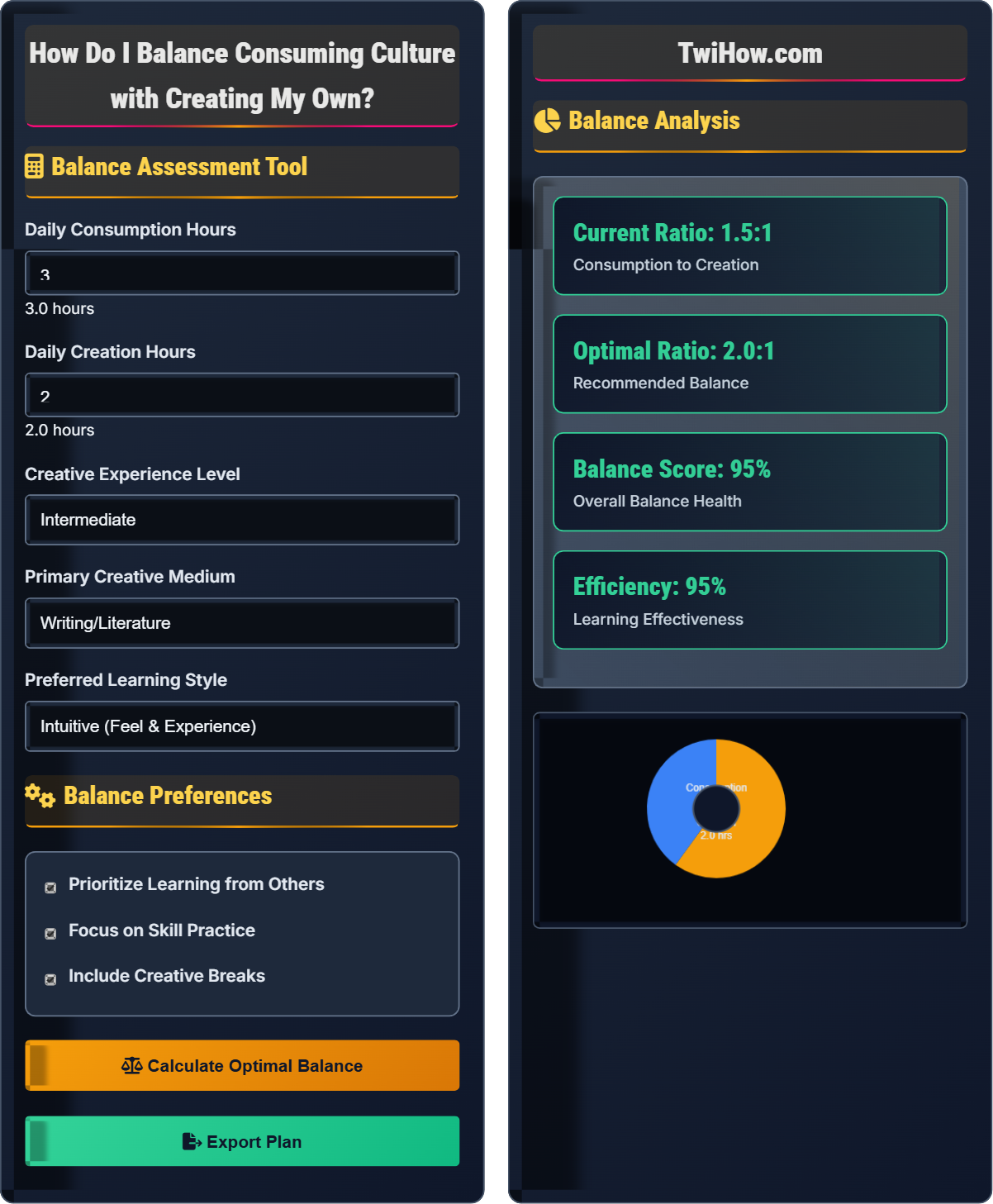
Balance Assessment Tool
Balance Preferences
Balance Analysis
| Activity | Current | Recommended | Gap |
|---|---|---|---|
| Consumption | 3.0 hrs | 4.0 hrs | -1.0 hr |
| Creation | 2.0 hrs | 2.0 hrs | 0.0 hr |
| Analysis | 0.5 hrs | 1.0 hrs | -0.5 hr |
| Rest/Reflection | 0.5 hrs | 1.0 hrs | -0.5 hr |
Recommended daily schedule: 2 hours creation, 3 hours consumption, 1 hour analysis/reflection
Cultural Consumption vs Creation Framework
The relationship between cultural consumption and creation can be expressed as:
Where the optimal balance depends on your experience level, creative goals, and learning style. The goal is to maximize creative growth while maintaining sustainable habits.
Effective cultural engagement follows this ratio:
Where:
- Experience Level: Beginner (0.5), Intermediate (1), Advanced (1.5), Professional (2)
- Goal Factor: Learning-focused (0.8), Practice-focused (1.2), Innovation-focused (1.5)
Effective cultural consumption for creative development:
- Active Analysis: Study techniques, themes, and execution methods
- Pattern Recognition: Identify trends, innovations, and best practices
- Critical Evaluation: Assess strengths and weaknesses of works
- Contextual Understanding: Learn about historical and cultural backgrounds
- Source Diversification: Explore different genres, styles, and cultures
- Quality Over Quantity: Focus on meaningful engagement rather than volume
Effective personal creative practice:
- Regular Practice: Consistent daily or weekly creative sessions
- Incremental Improvement: Focus on gradual skill development
- Experimentation: Try new techniques and approaches
- Feedback Integration: Seek and incorporate constructive criticism
- Portfolio Development: Build a collection of your work
- Goal Setting: Establish specific, measurable creative objectives
Balancing Principles
A proven framework for balancing consumption and creation:
- 70% Practice: Dedicated time for your own creative work
- 20% Learning: Studying others' work and techniques
- 10% Reflection: Analyzing your progress and planning improvements
Alternating between consumption and creation sessions maximizes learning effectiveness:
- Spend 30-60 minutes consuming inspiring content
- Immediately follow with 60-90 minutes of creation
- Use consumed content as direct inspiration for creation
- Repeat the cycle with different focus areas
- Consumption Addiction: Endless consumption without creation
- Creation Isolation: No input from other creators
- Paralysis by Analysis: Too much studying, not enough doing
- Imposter Syndrome: Feeling inadequate after consuming excellent work
- Perfectionism Trap: Creating nothing due to unrealistic standards
Creative Activities Matrix
Activities categorized by their primary focus:
Cultural Balance Quiz
Which scenario indicates an unhealthy balance between cultural consumption and creation?
Spending 5 hours consuming and only 30 minutes creating represents a severe imbalance. This ratio (10:1) far exceeds healthy guidelines and indicates consumption addiction. Such extreme imbalance prevents meaningful creative development and can lead to creative paralysis or burnout.
The answer is B) Spending 5 hours consuming content and 30 minutes creating.
Healthy creative balance typically ranges from 1:1 to 2:1 consumption-to-creation ratio, depending on experience level. When consumption vastly outweighs creation, individuals become passive consumers rather than active creators. The key is maintaining productive tension between input and output that fuels creative growth.
Consumption Addiction: Excessive intake of cultural content without creative output
Creative Paralysis: Inability to create due to overwhelming exposure to others' work
Productive Tension: Healthy balance between input and output that promotes growth
• Maintain 1:1 to 2:1 consumption-to-creation ratio
• Balance passive and active engagement
• Regular creation prevents stagnation
• Set creation time limits to match consumption
• Use consumed content as immediate inspiration
• Schedule creation sessions like appointments
• Binge-consuming without creating
• Comparing yourself to professionals constantly
• Procrastinating on creative work
Explain how to effectively integrate cultural consumption into your creative practice. Provide specific strategies for turning inspiration into action.
Active Consumption Strategies:
1. Take Notes: Document techniques, themes, and elements that inspire you
2. Deconstruct: Analyze how creators achieved specific effects or emotions
3. Immediate Application: Create something directly inspired by what you consumed
4. Compare and Contrast: Study multiple works to understand variations
5. Reverse Engineer: Try to recreate techniques you observed
Integration Techniques: Set aside time immediately after consuming inspiring content to create something related. This prevents inspiration from being lost and reinforces learning through practice.
Effective cultural consumption requires active engagement rather than passive absorption. When we consume mindfully and immediately apply insights, we create stronger neural pathways that enhance learning and retention. This approach transforms consumption from entertainment to education, supporting creative growth.
Active Consumption: Engaged study and analysis of cultural content
Reverse Engineering: Analyzing and recreating techniques from existing works
Immediate Application: Creating shortly after consuming inspiration
• Don't just consume, analyze and learn
• Apply insights immediately
• Document your observations
• Keep a creative journal
• Create mood boards
• Practice daily prompts
• Mindlessly consuming without taking notes
• Not applying learned techniques
• Waiting too long to act on inspiration
You have 2 hours available for creative activities each day. Currently, you spend 1.5 hours consuming content (reading, watching, listening) and 0.5 hours creating. You want to achieve a healthier 1:1 ratio. Calculate the optimal daily allocation and explain how to transition gradually.
Current Allocation: 1.5 hours consumption, 0.5 hours creation (3:1 ratio)
Target Allocation: 1 hour consumption, 1 hour creation (1:1 ratio)
Transition Strategy:
Week 1-2: Reduce consumption to 1.25 hours, increase creation to 0.75 hours
Week 3-4: Further reduce consumption to 1.1 hours, increase creation to 0.9 hours
Week 5+: Achieve 1 hour each for consumption and creation
This gradual approach prevents overwhelm and allows habit formation while maintaining motivation for both activities.
Gradual transitions are more sustainable than sudden changes. When rebalancing creative activities, incremental adjustments allow your brain to adapt to new patterns while maintaining engagement with both consumption and creation. This approach reduces resistance and increases long-term adherence to balanced habits.
Habit Stacking: Adding new behaviors to existing routines
Gradual Transition: Slow, systematic change to prevent resistance
Behavioral Momentum: Building positive habits gradually
• Make gradual changes over weeks
• Maintain both activities during transition
• Track progress consistently
• Use a timer to manage allocation
• Schedule specific times for each activity
• Prepare materials in advance
• Making drastic changes immediately
• Eliminating consumption entirely
• Not tracking progress
You're a beginner artist who feels overwhelmed by the amazing work of professionals online. Every time you consume art, you feel discouraged about your own abilities. Design a consumption strategy that maintains inspiration while protecting your creative confidence.
Strategic Consumption Approach:
1. Follow Beginners: Follow artists at similar experience levels for realistic benchmarks
2. Study Process: Focus on technique learning rather than finished product comparison
3. Limit Exposure: Set time limits for viewing professional work to prevent overwhelm
4. Positive Framing: View others' work as inspiration rather than competition
5. Progress Tracking: Regularly review your own improvement timeline
6. Learning Focus: Ask "How did they achieve this?" rather than "Why can't I do this?"
This approach maintains motivation while building skills and confidence.
Beginner artists often fall into the comparison trap when consuming professional work. The key is reframing consumption from competition to education. By focusing on learning and technique rather than outcome comparison, beginners can maintain inspiration while building confidence in their own developmental journey.
Growth Mindset: Viewing challenges as learning opportunities
Process vs Outcome: Focusing on learning rather than results
Realistic Benchmarking: Comparing to appropriate skill levels
• Compare to your past self, not others
• Focus on learning over achievement
• Set realistic expectations for your level
• Follow artists' progress journeys
• Document your own progress
• Join supportive communities
• Comparing beginners to professionals
• Focusing only on finished products
• Not tracking personal progress
Which scheduling approach is most effective for maintaining balance between cultural consumption and creation?
Alternating between consumption and creation in shorter sessions is most effective. This approach allows immediate application of inspiration, prevents fatigue from single-tasking, and maintains productive tension between input and output. Shorter sessions also accommodate busy schedules while maintaining the beneficial relationship between consumption and creation.
The answer is B) Alternate between consumption and creation in shorter sessions.
Alternating sessions optimize the learning-transfer process. When we consume inspiring content and immediately create, we strengthen neural pathways and reinforce learning. This approach also prevents the mental fatigue associated with single-tasking for extended periods, while maintaining the synergistic relationship between input and output activities.
Alternation Method: Switching between different types of activities
Learning Transfer: Applying knowledge from one context to another
Productive Tension: Beneficial pressure between input and output
• Connect consumption to immediate creation
• Prevent mental fatigue through variety
• Maintain consistent rhythm
• Use 30-60 minute session blocks
• Set timers for each activity
• Keep materials ready for transitions
• Separating consumption and creation too much
• Not having a consistent schedule
• Overloading one activity type
FAQ
Q: How do I avoid getting stuck in "inspiration porn" mode where I just consume content without creating anything?
A: To avoid inspiration porn:
1. Set Creation Triggers: After consuming inspiring content, immediately schedule a creation session
2. Document Insights: Keep a notebook of techniques or ideas you want to try
3. Create Accountability: Share your work with others or join a creative community
4. Time-Box Consumption: Set specific limits on consumption time
5. Focus on Process: Emphasize learning techniques rather than admiring finished products
6. Make It a Habit: Always follow consumption with some form of creation
The key is creating automatic connections between input and output so inspiration naturally flows into action.
Q: Should I stop reading other writers while working on my own projects to avoid unconscious influence?
A: Complete isolation is counterproductive. Instead:
Strategic Reading: Read different genres or styles than your current project
Learning-Focused Reading: Analyze technique rather than just enjoying content
Time Management: Read before starting your work session, not during
Conscious Influence: Acknowledge and embrace influences rather than hiding from them
Original Voice: Remember that your unique experiences and perspective will differentiate your work
Reading as Fuel: Thoughtful consumption energizes rather than hinders your creative voice
The goal is conscious engagement rather than passive absorption, which strengthens rather than weakens your original voice.
Best Practices for Cultural Balance
Proven strategies for maintaining healthy cultural consumption and creation:
- Time Blocking: Schedule specific times for both activities
- Quality Over Quantity: Focus on meaningful engagement
- Active Consumption: Take notes and analyze what you consume
- Immediate Application: Create something inspired by what you consume
- Progress Tracking: Regularly assess your creative development
- Community Engagement: Share and receive feedback on your work
Structure your week for optimal balance:
- Monday: Study and analyze inspiring work
- Tuesday: Apply insights to your own creation
- Wednesday: Review and refine your work
- Thursday: Consume diverse content for inspiration
- Friday: Create based on new inspiration
- Saturday: Community sharing and feedback
- Sunday: Reflection and planning for next week