Curating a Cultural Consumption Practice
Complete curation guide • Step-by-step explanations
Cultural Curation:
Show Cultural Consumption PlannerCurating a cultural consumption practice involves intentionally selecting and engaging with diverse cultural content that enriches your life and broadens your perspective. This practice requires conscious choices about what you consume, how you consume it, and why it matters to your personal growth.
Effective cultural curation balances familiar and unfamiliar, traditional and contemporary, local and global perspectives. It's about developing a mindful approach to cultural engagement that promotes intellectual growth, emotional well-being, and cultural understanding.
Key elements of cultural curation include:
- Intentional Selection: Deliberate choice of cultural content
- Diversity Focus: Exposure to multiple perspectives and traditions
- Quality Emphasis: Prioritizing meaningful content over quantity
- Reflection Practice: Processing and integrating experiences
- Continuous Learning: Evolving your cultural palate over time
Success depends on developing a sustainable practice that aligns with your values and goals.
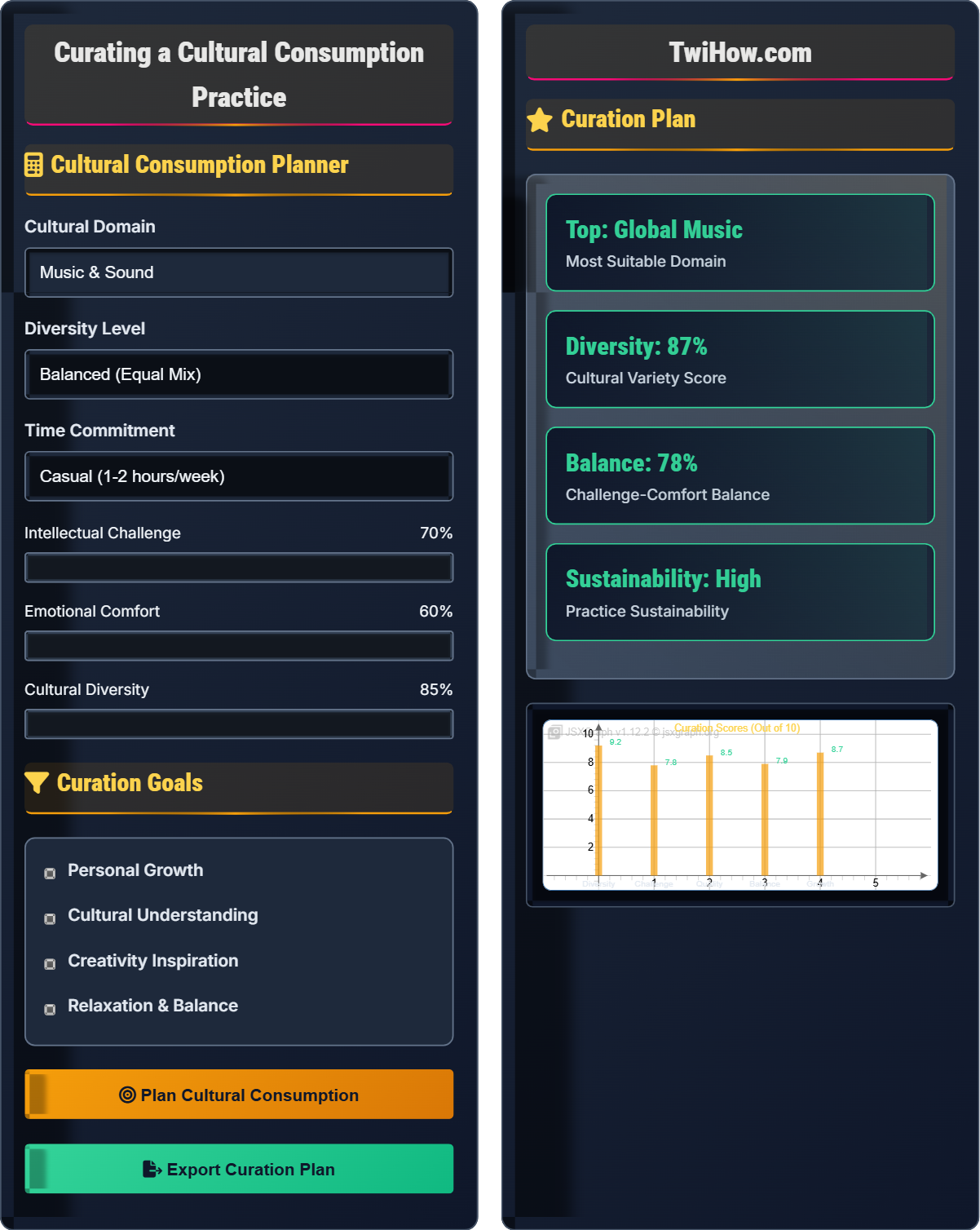
Cultural Consumption Planner
Curation Goals
Curation Plan
Weekly discovery of music from different cultures and time periods to broaden auditory perspectives
Monthly reading of books from different cultural backgrounds and literary traditions
Bi-weekly exploration of different visual art styles and cultural movements
| Day | Activity | Domain | Duration | Focus | Intensity |
|---|---|---|---|---|---|
| Monday | Global Music | Music | 30 min | Diversity | Medium |
| Wednesday | Art Reading | Visual | 45 min | Learning | High |
| Friday | Documentary | Film | 90 min | Culture | High |
Cultural Consumption Framework
Effective cultural consumption requires intentional exposure to diverse perspectives, traditions, and artistic expressions. This includes different cultures, time periods, genres, and artistic movements that challenge your existing preferences and assumptions.
Strategies: Rotate cultural sources, explore different geographic regions, vary time periods, and include marginalized voices in your consumption.
Balance comfort and challenge in your cultural consumption. Include familiar content that provides emotional safety while also incorporating challenging material that promotes growth and learning.
Approach: 70% familiar/30% challenging as a starting point, gradually increasing the challenging portion over time.
Develop criteria for evaluating cultural content quality, including artistic merit, cultural significance, critical acclaim, and personal resonance. Quality doesn't always mean popular or prestigious.
Factors: Critical reception, historical importance, artistic innovation, and personal impact assessment.
Allocate appropriate time for different types of cultural consumption. Some forms require deep engagement while others can be consumed more casually. Balance intensive and light cultural activities.
Guidelines: Dedicated time blocks, flexible scheduling, and realistic expectations for engagement levels.
Regularly reflect on your cultural consumption experiences. Consider how different content affects your thinking, emotions, and perspectives. This reflection deepens the enriching effects of cultural consumption.
Methods: Journaling, discussion with others, and connecting new experiences to existing knowledge.
Monitor how your cultural consumption practice evolves over time. Track changes in preferences, understanding, and perspective. Adjust your approach based on what works and what doesn't.
Metrics: Diversity of exposure, depth of engagement, and personal growth indicators.
Cultural Consumption Journey
Global Music Exploration
Weekly discovery of music from different cultures and time periods to broaden auditory perspectives and cultural understanding.
Literary Diversity
Monthly reading of books from different cultural backgrounds and literary traditions to expand worldview and empathy.
Art Appreciation
Regular exploration of visual art styles and cultural movements to develop aesthetic appreciation and cultural literacy.
Cinematic Discovery
Watching films from different countries, genres, and eras to understand diverse storytelling traditions and cultural perspectives.
Cultural Domains Overview
Cultural Consumption Distribution
| Domain | Recommended Time | Frequency | Diversity Score | Accessibility | Impact Level |
|---|---|---|---|---|---|
| Music | 30-60 min/day | Daily | 95% | High | High |
| Literature | 45-90 min/day | Daily | 90% | Medium | Very High |
| Visual Arts | 20-40 min/day | Weekly | 85% | High | Medium |
| Film | 90-120 min/session | Weekly | 88% | High | High |
| Performance | 60-120 min/session | Monthly | 80% | Medium | Very High |
Curation Resources & Platforms
Platforms for discovering diverse musical traditions and artists from around the world.
Spotify Global Bandcamp International World Music RadioResources for exploring diverse visual art traditions and contemporary expressions.
Google Arts & Culture Artsy Collections Museum Virtual ToursPlatforms for discovering literature from different cultures and time periods.
World Literature Library Databases Translation PublishersCultural Consumption Curation Quiz
What is the most important principle for curating a cultural consumption practice that broadens your perspective?
Actively seeking diverse and unfamiliar cultural experiences is the most important principle. This approach deliberately exposes you to different perspectives, traditions, and ways of thinking that broaden your worldview and challenge your assumptions.
The answer is B) Actively seeking diverse and unfamiliar cultural experiences.
Cultural consumption that broadens perspective requires stepping outside your comfort zone and encountering different worldviews. This doesn't mean abandoning quality or comfort entirely, but rather maintaining a balance that includes challenging new experiences alongside familiar ones.
Cultural Perspective: Different ways of viewing and interpreting the world
Diverse Exposure: Intentional encounter with different cultural traditions
Comfort Zone: Familiar and safe cultural experiences
• Diversity challenges assumptions
• New experiences broaden perspective
• Balance comfort with challenge
• Start with adjacent cultures
• Ask for recommendations from diverse sources
• Keep an open mind
• Staying in comfort zone
• Not diversifying sources
• Judging without understanding
How should you balance familiar and challenging cultural content in your consumption practice?
Balance Strategy:
Comfort Foundation: Maintain a base of familiar content that provides emotional safety and aesthetic pleasure. This serves as a foundation for exploring more challenging material.
Gradual Expansion: Begin with a 70% familiar/30% challenging ratio, gradually increasing the challenging portion as your cultural palate develops.
Contextual Mixing: Combine familiar and challenging content in different ways—sometimes separately, sometimes together to create interesting contrasts.
Reflection Integration: Use familiar content to process and understand challenging experiences, creating bridges between known and unknown.
Flexible Adjustment: Adjust the ratio based on your current needs, stress levels, and growth goals. Some periods may require more comfort, others more challenge.
Quality Integration: Ensure both familiar and challenging content meets quality standards, avoiding low-quality challenging material just for the sake of novelty.
Effective cultural consumption requires a sustainable balance between comfort and challenge. Too much challenge can be overwhelming, while too much familiarity can limit growth. The key is creating a dynamic equilibrium that adapts to your evolving needs and capabilities.
Comfort Content: Familiar material that provides safety
Challenging Content: Unfamiliar material that promotes growth
Cultural Palate: Developed taste for diverse cultural experiences
• Maintain foundational comfort
• Gradually increase challenge
• Adapt to personal needs
• Start with 70/30 ratio
• Use familiar content as bridge
• Adjust based on stress levels
• Jumping straight to challenging content
• Not adjusting for personal stress
• Sacrificing quality for novelty
You want to develop a cultural consumption practice that introduces you to diverse global perspectives while maintaining personal enjoyment. What approach would best achieve this balance?
Strategic Approach:
Domain Rotation: Focus on different cultural domains (music, literature, visual arts) in rotation, allowing deep exploration of each while maintaining variety.
Geographic Mapping: Systematically explore cultural content from different regions, perhaps following a monthly rotation of continents or cultures.
Quality Filtering: Research and select high-quality content from diverse sources, ensuring that exploration doesn't compromise quality.
Community Integration: Join cultural communities or find guides who can recommend quality content from their traditions.
Reflection Practice: Maintain a journal to process and integrate diverse cultural experiences, making connections between different traditions.
Time Management: Allocate specific time slots for different cultural domains, ensuring consistent exposure while maintaining personal enjoyment.
Successful cultural exploration requires both systematic approach and personal enjoyment. The key is creating structures that ensure diversity while maintaining the pleasure that keeps you engaged. This approach builds sustainable habits that grow over time.
Cultural Exploration: Systematic discovery of diverse traditions
Quality Filtering: Selecting high-standard content
Reflection Practice: Processing cultural experiences
• Maintain systematic approach
• Ensure quality over quantity
• Build sustainable habits
• Join cultural communities
• Use structured rotation
• Maintain reflection practice
• Random consumption without structure
• Sacrificing enjoyment for diversity
• Not processing experiences
You're exploring literature from different cultures but struggle to assess the quality and significance of works. What approach would help you make better selections?
Assessment Strategy:
1. Academic Sources: Consult university reading lists, literary criticism, and academic recommendations for different cultural traditions
2. Cultural Experts: Seek recommendations from scholars, translators, and cultural experts in specific traditions
3. Historical Significance: Research the historical and cultural importance of works within their own contexts
4. Translation Quality: Pay attention to translation quality when reading works in translation
5. Contemporary Reception: Look at current critical reception and cultural impact
6. Thematic Relevance: Consider how works relate to universal themes while respecting cultural specificity
7. Authorial Background: Understand the author's place in their cultural tradition and literary movement
Quality assessment in cultural consumption requires understanding both universal literary standards and specific cultural contexts. The goal is to appreciate works on their own terms while recognizing their broader significance. This approach builds cultural literacy and enhances the enriching potential of consumption.
Cultural Context: Understanding works within their traditions
Literary Standards: Universal quality criteria
Cultural Literacy: Knowledge of diverse cultural traditions
• Understand cultural context
• Consider translation quality
• Seek expert recommendations
• Consult academic sources
• Join book clubs
• Research cultural background
• Judging by Western standards only
• Not considering translation quality
• Ignoring cultural context
What is the most effective way to integrate reflection into your cultural consumption practice?
Maintaining a regular journal to process and connect experiences is the most effective reflection practice. This allows you to track your growth, make connections between different cultural experiences, and integrate new perspectives into your worldview.
The answer is B) Maintain a regular journal to process and connect experiences.
Reflection transforms passive consumption into active learning. A regular journal practice helps you internalize cultural experiences, recognize patterns, and track your evolving perspectives. This deepens the enriching effects of cultural consumption and makes the practice more meaningful.
Reflection Practice: Processing and integrating experiences
Active Learning: Engaging deeply with content
Cultural Integration: Incorporating new perspectives
• Reflection deepens impact
• Regular practice is essential
• Connections enhance learning
• Write regularly after experiences
• Connect to personal experiences
• Track your evolving perspectives
• Skipping reflection entirely
• Only sharing surface reactions
• Not tracking personal growth
FAQ
Q: How do I balance consuming diverse content with maintaining personal enjoyment?
A: Balance by maintaining a foundation of enjoyable content while gradually introducing challenging material. Start with a 70% comfort/30% challenge ratio, and use familiar content as a bridge to more diverse experiences. The goal is to expand your definition of enjoyment rather than abandon it.
Look for entry points that connect new experiences to your existing interests. For example, if you enjoy jazz, explore jazz from different cultures or historical periods. This maintains personal enjoyment while expanding your cultural horizons.
Q: What are the signs that my cultural consumption practice is working?
A: Signs of success include: feeling more curious about different cultures, noticing new connections between experiences, having expanded aesthetic preferences, and experiencing greater empathy and understanding. You'll also find yourself seeking out diverse recommendations and feeling more confident exploring unfamiliar content.
Additionally, you'll notice improved ability to appreciate different artistic traditions, better understanding of cultural contexts, and a more nuanced worldview. The practice should feel enriching rather than burdensome.