How to Evaluate the Authenticity and Ethics of Cultural Content I Consume?
Complete evaluation guide • Step-by-step explanations
Cultural Content Evaluation Fundamentals:
Show Evaluation ToolEvaluating the authenticity and ethics of cultural content is essential in today's interconnected world. As consumers, we have a responsibility to critically examine the media, art, music, and cultural products we engage with, ensuring they respect cultural origins, represent communities authentically, and avoid harmful stereotypes or appropriation.
Key evaluation criteria:
- Source Verification: Confirming the origin and credibility of cultural content
- Cultural Sensitivity: Assessing respectful representation of cultural practices
- Authenticity Assessment: Determining genuine cultural expression vs. commercial exploitation
- Ethical Consumption: Supporting creators and communities ethically
Developing critical evaluation skills helps us become more conscious consumers who support authentic cultural expression while avoiding perpetuating harmful stereotypes or exploitation.
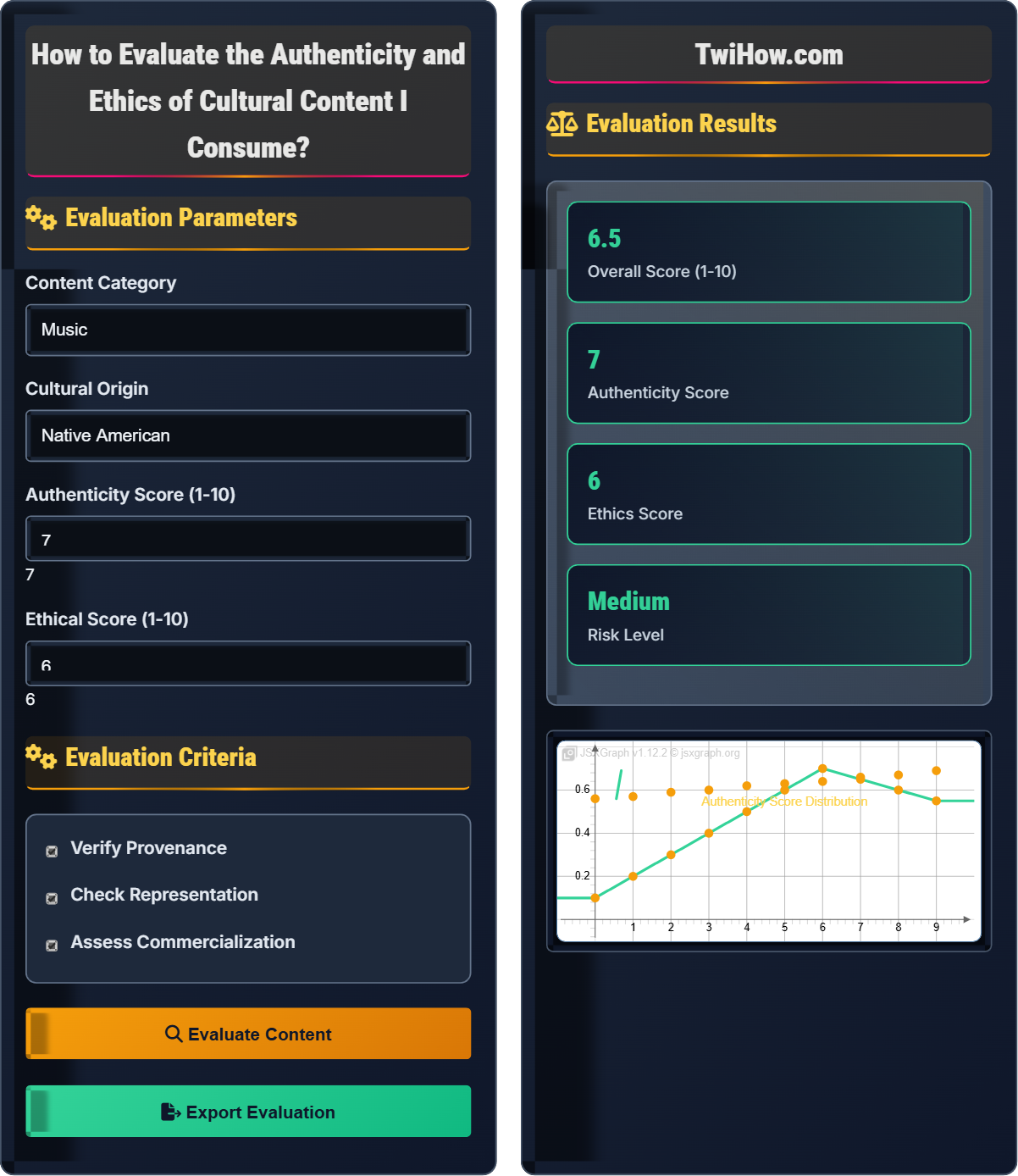
Evaluation Parameters
Evaluation Criteria
Evaluation Results
| Criteria | Score | Status | Details |
|---|---|---|---|
| Source Verification | 8 | Good | Original creators identified |
| Cultural Appropriation | 5 | Concerning | Some elements borrowed without context |
| Representation | 7 | Acceptable | Generally respectful portrayal |
| Commercial Impact | 4 | Poor | Profits not benefiting origin communities |
Personalized Recommendations
Based on your evaluation:
- Seek out original creators and support them directly
- Research cultural context before consuming
- Look for fair trade or ethical alternatives
- Engage with educational resources about the culture
Evaluating Cultural Content Authenticity and Ethics Explained
In our globalized world, cultural content flows rapidly across borders and platforms. Without critical evaluation, we risk perpetuating harmful stereotypes, supporting exploitative practices, or inadvertently participating in cultural appropriation. Ethical consumption respects cultural origins and supports authentic representation.
Ethical consumption score is determined by multiple factors:
Where:
- Authenticity: Degree of genuine cultural representation
- Cultural Respect: Avoidance of stereotypes and appropriation
- Economic Justice: Fair compensation to origin communities
Evaluation applies to various cultural domains:
- Music: Verify cultural origins and artist backgrounds
- Visual Art: Research traditional techniques and contemporary interpretations
- Fashion: Distinguish between inspiration and appropriation
- Food: Understand cultural significance and preparation methods
- Spiritual Practices: Respect sacred elements and proper contexts
- Language: Appreciate linguistic heritage and meanings
- Research Origins: Investigate the cultural roots and original creators
- Consult Communities: Seek perspectives from origin communities
- Check Credentials: Verify expertise and authority of creators
- Assess Context: Understand the cultural and historical background
- Evaluate Intent: Distinguish between appreciation and appropriation
- Monitor Impact: Observe effects on origin communities
Evaluation Criteria
Source verification, cultural sensitivity, economic impact, representation accuracy, community consent, ethical commercialization.
Red Flags to Watch For
Warning Signs
Commercial Exploitation
Products that remove cultural items from their original context and sell them without benefit to origin communities.
Stereotypical Representation
Portrayals that reduce complex cultures to oversimplified or exoticized stereotypes.
Missing Credit
Cultural elements presented without acknowledgment of their origins or creators.
Profit Extraction
Commercial success without economic benefit flowing back to cultural communities.
Green Checks to Look For
Positive Indicators
Community Collaboration
Projects developed in partnership with cultural communities, involving their input and consent.
Cultural Education
Content that provides context and educates about cultural significance.
Direct Support
Commercial ventures that directly benefit origin communities financially.
Respectful Representation
Portrayals that honor complexity and authenticity of cultural practices.
Case Studies
Verification Tools
Source Verification Checklist
Cultural Content Evaluation Learning Quiz
What is the key difference between cultural appropriation and cultural appreciation?
Cultural appropriation involves taking elements from a culture that is not one's own, often without permission, understanding, or compensation. It typically involves power imbalances and can perpetuate stereotypes. Cultural appreciation involves learning about, respecting, and honoring another culture with permission and proper context.
The answer is B) Appropriation involves taking without permission or understanding.
The distinction between appropriation and appreciation lies in the approach and context. Appropriation often involves stripping cultural elements from their original meaning and using them for personal gain without regard for their significance. Appreciation involves learning respectfully, seeking permission when appropriate, and understanding the deeper meanings.
Cultural Appropriation: Taking cultural elements without permission or understanding
Cultural Appreciation: Respectful learning and honoring of other cultures
Power Imbalance: Disparity in social, economic, or political power
• Seek permission when appropriate
• Learn about cultural context
• Consider power dynamics
• Ask yourself who benefits from the exchange
• Research the cultural significance
• Support original creators directly
• Assuming all cultural exchange is appreciation
• Not researching cultural significance
• Ignoring community perspectives
Explain the process of verifying the authenticity of cultural content, including specific steps and reliable sources to consult.
Verification Process Steps:
1. Research Creators: Look up the background of artists, musicians, or creators to understand their cultural connection
2. Trace Origins: Find the earliest known sources of cultural elements, often in academic sources or community records
3. Consult Communities: Reach out to cultural communities or organizations for perspective
4. Check Documentation: Look for proper citations, credits, and acknowledgments
5. Compare Sources: Cross-reference multiple reliable sources to confirm authenticity
Reliable Sources:
- Academic institutions and museums
- Cultural organizations and community leaders
- Peer-reviewed journals and ethnographic studies
- Official cultural heritage databases
Verification requires multiple approaches and sources to build confidence in authenticity claims. The process involves detective work, cross-referencing, and sometimes consulting with cultural experts. Critical thinking and skepticism are essential when evaluating cultural content.
Source Verification: Process of confirming authenticity and origin
Cross-Referencing: Comparing multiple sources for consistency
Cultural Experts: Individuals with deep knowledge of specific cultures
• Consult multiple sources
• Verify creator credentials
• Respect community perspectives
• Look for peer-reviewed academic sources
• Contact cultural organizations directly
• Be skeptical of undocumented claims
• Relying on single sources
• Accepting unverified claims
• Not consulting communities
You find a beautiful handwoven textile online that claims to be made by indigenous artisans. The item is expensive but the seller doesn't provide information about the specific community or how profits are distributed. Using ethical evaluation criteria, analyze the purchase decision and suggest alternatives.
Evaluation:
1. Source Verification: Lacking specific community information and artisan details
2. Economic Justice: Unclear profit distribution to origin communities
3. Transparency: Insufficient documentation of authenticity
Recommendations:
1. Contact Seller: Request detailed information about the community and profit-sharing arrangements
2. Research Alternatives: Look for fair trade certified options with transparent supply chains
3. Direct Purchase: Find cooperatives or cultural centers selling directly
4. Educational Investment: Learn about the cultural significance before purchasing
Without proper verification, consider alternative purchases that support artisans more directly.
Ethical consumerism requires balancing desire for cultural goods with responsibility to origin communities. The absence of transparency is often a red flag. Consumers have the power to demand accountability and support ethical alternatives.
Fair Trade: System ensuring fair compensation to producers
Supply Chain Transparency: Clear documentation of production path
Ethical Consumerism: Conscious purchasing decisions considering impacts
• Demand transparency from sellers
• Verify fair compensation
• Support direct community sales
• Look for fair trade certifications
• Support community cooperatives directly
• Purchasing without verification
• Not questioning marketing claims
• Assuming all ethnic items are ethical
You discover a new genre of music that incorporates traditional instruments and melodies from a specific cultural tradition. The artist is from outside that culture and has gained significant popularity. Analyze the ethical implications and propose guidelines for responsible consumption.
Ethical Analysis:
1. Collaboration: Was the artist in partnership with traditional practitioners?
2. Attribution: Are cultural origins properly credited and acknowledged?
3. Economic Impact: Do profits benefit the origin community?
4. Representation: Is the cultural context preserved and respected?
Consumption Guidelines:
1. Research Background: Learn about the cultural origins and traditional context
2. Support Original Artists: Seek out and support traditional practitioners
3. Educate Others: Share the cultural context with other listeners
4. Advocate for Credit: Encourage proper attribution and collaboration
Responsible consumption involves understanding context and supporting authentic practitioners.
Cultural fusion in music can be positive when done respectfully, but requires careful consideration of attribution, collaboration, and economic impact. Consumers play a role in demanding ethical practices from artists and platforms.
Cultural Fusion: Blending elements from different cultural traditions
Traditional Practitioners: Keepers of cultural knowledge and practices
Proper Attribution: Acknowledging cultural origins and influences
• Seek collaborative approaches
• Demand proper attribution
• Support origin communities
• Research the cultural background
• Support traditional artists directly
• Advocate for fair representation
• Not researching cultural origins
• Supporting only popular versions
• Ignoring community concerns
When evaluating the ethics of cultural content, which factor should be considered most important?
While personal enjoyment, artistic quality, and popularity may influence consumption choices, the economic benefit to origin communities is the most important ethical consideration. This addresses the fundamental issue of exploitation and ensures that cultural communities receive fair compensation for their contributions.
The answer is B) Economic benefit to origin communities.
Ethical evaluation must prioritize the welfare of cultural communities over consumer preferences. Economic justice is central to addressing historical patterns of exploitation and ensuring sustainable cultural practices.
Economic Justice: Fair compensation and benefit distribution
Cultural Exploitation: Taking from communities without fair return
Consumer Ethics: Moral considerations in purchasing decisions
• Prioritize community welfare
• Consider economic impact
• Address power imbalances
• Look for fair trade options
• Support community-owned enterprises
• Research profit distribution
• Prioritizing personal preferences over ethics
• Not considering economic impacts
• Ignoring community voices
FAQ
Q: How can I enjoy cultural content while being respectful and ethical?
A: Ethical cultural consumption involves several key practices:
1. Learn First: Study the cultural context and significance before engaging
2. Support Originators: Directly support creators and communities when possible
3. Give Credit: Acknowledge cultural origins when sharing or discussing
4. Listen to Voices: Pay attention to community feedback and concerns
5. Ask Questions: If unsure about appropriateness, research or ask respectfully
Enjoyment and respect can coexist when approached thoughtfully!
Q: What's the difference between cultural inspiration and cultural appropriation in creative work?
A: The distinction lies in approach and impact:
Cultural Inspiration: Involves learning respectfully, collaborating with community members, crediting sources, and often supporting the origin community. The work honors and preserves cultural elements.
Cultural Appropriation: Involves taking without permission, stripping away context, profiting without benefit to origin communities, and potentially perpetuating stereotypes. It often exploits rather than honors.
Key indicators: Who benefits? Is there consent? Is the cultural significance preserved?