Evaluating Technology's Impact on Traditional Art Forms
Complete evaluation guide • Step-by-step explanations
Impact Assessment:
Show Technology Impact EvaluatorEvaluating technology's impact on traditional art forms requires a nuanced approach that considers multiple dimensions of change. Technology can enhance preservation, accessibility, and innovation while potentially threatening authenticity, craftsmanship, and cultural continuity.
Key evaluation criteria include: preservation vs. transformation, accessibility vs. commodification, authenticity vs. innovation, and tradition vs. evolution. The impact varies significantly across different art forms and cultural contexts.
Evaluation framework includes:
- Preservation Metrics: Digitization quality and cultural integrity
- Accessibility Factors: Expanded reach and democratic access
- Authenticity Indicators: Traditional techniques and cultural meaning
- Innovation Potential: New creative possibilities and hybrid forms
- Sustainability Measures: Long-term cultural preservation
Effective evaluation balances technological benefits with cultural preservation imperatives.
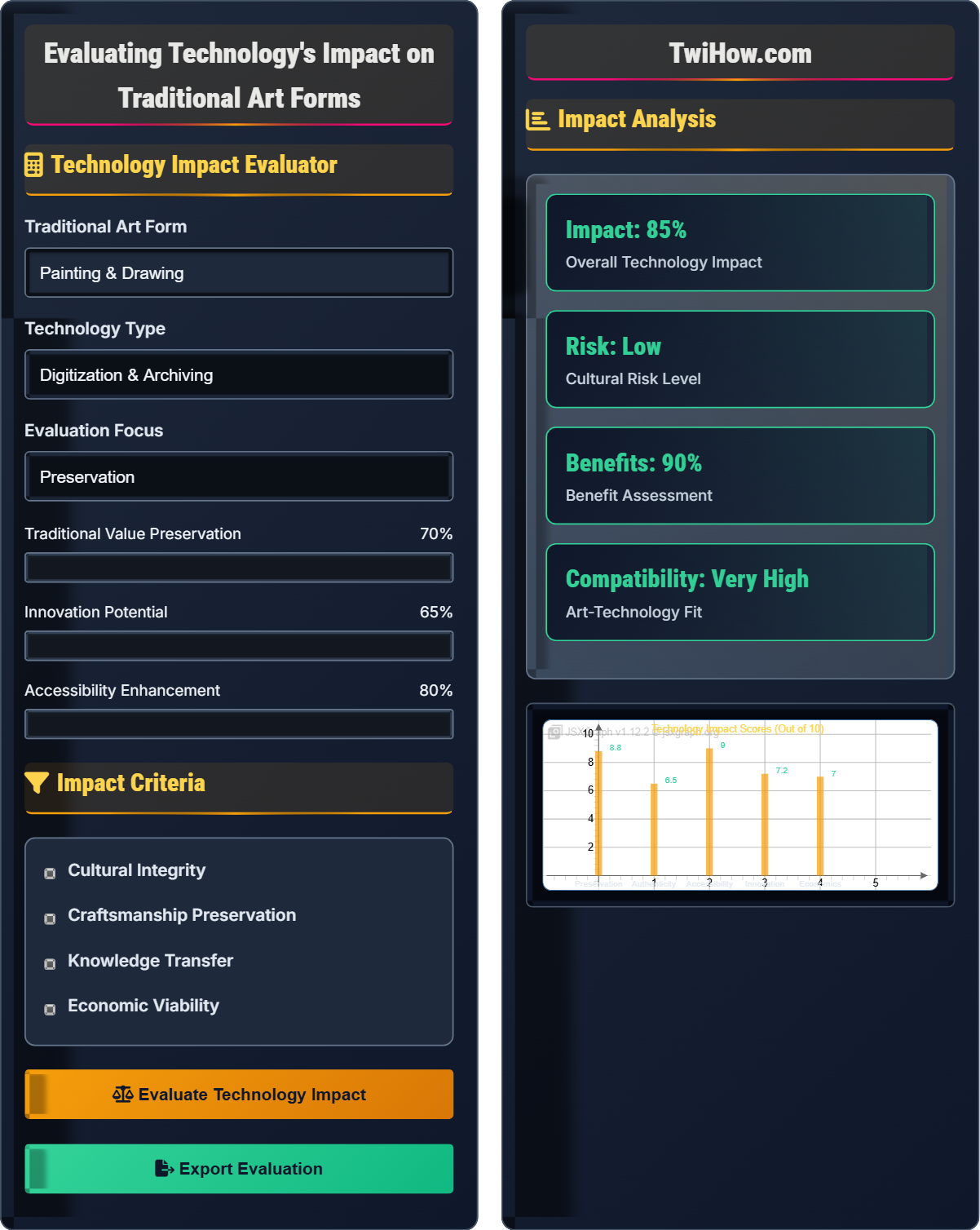
Technology Impact Evaluator
Impact Criteria
Impact Analysis
Technology's impact on preserving traditional art forms and techniques for future generations
Effect on maintaining the authentic character and cultural significance of traditional arts
Improvement in access to traditional art forms for broader audiences
| Criteria | Score | Risk Level | Impact Type | Timeline | Weight |
|---|---|---|---|---|---|
| Preservation | 85% | Low | Positive | Long-term | 25% |
| Authenticity | 65% | Medium | Mixed | Immediate | 20% |
| Accessibility | 90% | Low | Positive | Immediate | 20% |
Technology Impact Evaluation Framework
Technology can digitize, archive, and preserve traditional art forms for future generations. Digital repositories, 3D scanning, and high-resolution imaging capture intricate details that might otherwise be lost. However, the challenge lies in maintaining cultural context and meaning during digitization.
Key considerations: Quality of digital capture, metadata standards, cultural context preservation, and long-term storage sustainability.
Technology can threaten the authentic character of traditional arts by altering techniques, processes, or cultural significance. The line between enhancement and replacement becomes crucial. Authenticity depends on maintaining the spiritual, cultural, and technical elements that define traditional practices.
Factors: Traditional techniques preservation, cultural meaning maintenance, artisan involvement, and community acceptance.
Technology dramatically expands access to traditional art forms through virtual museums, online tutorials, and digital galleries. This democratization can increase appreciation and understanding while potentially diluting the exclusivity and sacred nature of some traditions.
Benefits: Global reach, educational access, cultural exchange, and awareness building.
Technology creates new possibilities for traditional art forms, enabling hybrid expressions and creative evolution. Artists can experiment with digital tools while maintaining traditional elements, leading to innovative cultural expressions that honor the past while embracing the future.
Opportunities: New mediums, creative combinations, global collaboration, and artistic evolution.
Technology can provide new revenue streams for traditional artists while potentially disrupting established markets. Digital sales, online teaching, and virtual experiences offer new economic opportunities, but may also lead to commodification and loss of traditional patronage systems.
Considerations: Market expansion, pricing models, intellectual property, and economic sustainability.
The ultimate test of technology's impact is whether it strengthens or weakens the transmission of cultural knowledge and practices. Successful integration maintains the core values and meanings while adapting to contemporary contexts and needs.
Measures: Knowledge transfer, community engagement, cultural significance, and generational continuity.
Evaluation Criteria Matrix
Digital Archiving Impact
Technology's effect on preserving traditional art forms for future generations through digital means, including quality of capture, accessibility of archives, and long-term sustainability of digital formats.
Cultural Integrity Maintenance
Technology's impact on maintaining the authentic character, cultural significance, and traditional techniques of art forms, including risks of dilution or alteration.
Global Reach Enhancement
Technology's ability to expand access to traditional art forms, reaching broader audiences and enabling global appreciation and understanding of cultural heritage.
Creative Evolution Potential
Technology's capacity to enable new forms of expression while respecting traditional foundations, creating hybrid art forms that honor the past while embracing the future.
Impact Assessment Timeline
Initial Assessment
Identify traditional art form characteristics and baseline conditions
Technology Integration
Implement chosen technology solutions with careful monitoring
Impact Monitoring
Track changes in preservation, accessibility, and authenticity
Adjustment & Refinement
Modify approach based on observed impacts and community feedback
Technology Impact Distribution
| Art Form | Technology | Preservation | Accessibility | Authenticity | Overall Score |
|---|---|---|---|---|---|
| Traditional Painting | Digitization | 92% | 88% | 75% | 85% |
| Traditional Music | Streaming | 85% | 95% | 68% | 83% |
| Traditional Dance | VR Recording | 80% | 90% | 60% | 77% |
| Traditional Crafts | 3D Printing | 70% | 75% | 55% | 67% |
| Traditional Textiles | AI Design | 75% | 80% | 65% | 73% |
Evaluation Resources & Tools
Academic and cultural resources for evaluating technology impact.
UNESCO Cultural Preservation Digital Heritage Studies Cultural Impact AssessmentTools and methodologies for assessing technology impact.
Cultural Impact Metrics Digital Preservation Standards Authenticity AssessmentOrganizations and communities focused on cultural preservation.
Traditional Artisan Networks Cultural Heritage Organizations Digital Humanities ProjectsTechnology Impact on Traditional Arts Quiz
What should be the primary consideration when evaluating technology's impact on traditional art forms?
The primary consideration should be the preservation of cultural authenticity and meaning. Technology should enhance traditional art forms without compromising their essential cultural significance, spiritual elements, and traditional techniques that define their authenticity.
The answer is B) Preservation of cultural authenticity and meaning.
Traditional art forms carry deep cultural meaning, spiritual significance, and historical knowledge that define communities and identities. Any technology evaluation must prioritize preserving these essential elements over economic or technical considerations. The authenticity of traditional arts lies in their connection to cultural heritage and traditional practices.
Cultural Authenticity: Maintaining original cultural meaning and significance
Traditional Techniques: Established methods passed down through generations
Spiritual Significance: Sacred or ceremonial aspects of traditional arts
• Cultural meaning precedes technological capability
• Authenticity preservation is paramount
• Community values guide evaluation
• Consult traditional practitioners
• Understand cultural significance
• Prioritize community involvement
• Focusing on technical capabilities over cultural impact
• Not involving traditional practitioners
• Ignoring spiritual or ceremonial aspects
How can technology enhance traditional art forms while preserving their authenticity and cultural significance?
Enhancement Strategies:
Documentation: Use high-quality digitization to preserve traditional techniques, patterns, and cultural knowledge for future generations while maintaining the original context.
Education: Create digital learning platforms that teach traditional arts alongside their cultural background, ensuring knowledge transfer to new generations.
Accessibility: Enable broader access to traditional arts through virtual museums, online galleries, and digital archives without replacing authentic experiences.
Preservation: Use 3D scanning, high-resolution imaging, and environmental monitoring to protect physical artworks and traditional spaces.
Maintenance: Apply digital tools to monitor and maintain traditional art forms, identifying deterioration early and planning conservation efforts.
Authenticity Preservation:
• Involve traditional practitioners in technology implementation
• Maintain traditional techniques alongside digital tools
• Preserve cultural context and meaning in digital formats
• Ensure community approval of technological interventions
The key to successful technology integration lies in using it as a tool to support and preserve traditional arts rather than replace them. Technology should serve the art form, not the other way around. This approach maintains the core values and meanings while leveraging technological benefits for preservation and accessibility.
Technology Integration: Using tools to support traditional practices
Authenticity Preservation: Maintaining original characteristics
Cultural Context: Historical and spiritual significance
• Technology supports, doesn't replace, traditional arts
• Maintain traditional techniques
• Preserve cultural meaning
• Involve traditional practitioners in planning
• Use high-quality preservation methods
• Maintain traditional elements alongside digital
• Replacing traditional methods entirely
• Not involving traditional practitioners
• Focusing on digital over authentic
A traditional pottery community wants to use 3D printing technology to preserve their ancient vessel designs while continuing traditional hand-building methods. What evaluation approach would best ensure cultural preservation while embracing technological benefits?
Evaluation Framework:
Preservation Assessment: Use 3D scanning to digitally archive traditional vessel designs, measurements, and decorative patterns before any physical deterioration occurs. This creates permanent records of traditional forms.
Authenticity Maintenance: Continue traditional hand-building methods as the primary production process, using 3D printing only for documentation and replication of lost pieces for study purposes.
Knowledge Transfer: Create digital tutorials that document traditional techniques alongside 3D models, ensuring that both the forms and methods are preserved for future generations.
Community Involvement: Ensure that traditional potters are involved in the digitization process and maintain control over how their cultural knowledge is represented and shared.
Educational Integration: Use 3D models to teach traditional pottery techniques, allowing students to study forms and proportions before attempting to create them traditionally.
Revenue Strategy: Focus on maintaining traditional pottery as the primary income source while using digital preservation to enhance cultural tourism and educational programs.
Successful integration of technology with traditional crafts requires a careful balance that prioritizes cultural preservation while leveraging technological benefits. The technology should enhance rather than replace traditional methods, and community involvement ensures that cultural values guide the integration process.
Traditional Methods: Established techniques passed down through generations
Digital Preservation: Using technology to maintain cultural recordsCommunity Involvement: Active participation of cultural practitioners
• Traditional methods remain primary
• Community controls digital representation
• Technology supports preservation goals
• Involve traditional artisans in planning
• Use technology for documentation, not replacement
• Maintain traditional income streams
• Replacing traditional methods with digital production
• Not involving traditional practitioners
• Focusing on commercial over cultural goals
A traditional music academy wants to use AI to transcribe and preserve rare musical compositions while maintaining the cultural context and performance practices. What approach would best serve both preservation and authenticity goals?
Preservation Strategy:
1. High-Quality Recording: Use professional-grade equipment to capture traditional performances with full cultural context, including ceremonial elements and performance practices
2. AI Transcription: Employ AI to create accurate musical notation while maintaining traditional scales, modes, and rhythmic patterns specific to the culture
3. Context Documentation: Record accompanying cultural information, including historical significance, ceremonial uses, and traditional teaching methods
4. Practitioner Involvement: Ensure traditional musicians validate AI transcriptions and provide cultural context for the preserved compositions
5. Hybrid Learning: Use AI-generated notation to support traditional teaching methods rather than replace them
6. Community Access: Create digital archives that traditional communities can access and control, ensuring cultural ownership of preserved materials
Traditional music encompasses more than just notes and rhythms—it includes cultural context, performance practices, and spiritual significance. Successful preservation requires capturing the complete cultural package while using technology to enhance accessibility and longevity. The technology should support traditional teaching methods rather than replace them.
Cultural Context: Historical and spiritual significance of music
Performance Practices: Traditional ways of playing and presenting music
Cultural Ownership: Community control over preserved materials
• Preserve complete cultural context
• Maintain traditional teaching methods
• Ensure community control
• Record full cultural context, not just music
• Validate transcriptions with traditional musicians
• Support rather than replace traditional methods
• Focusing only on musical notation
• Not involving traditional practitioners
• Replacing traditional teaching with digital
Which factor is most critical when determining whether technology positively impacts a traditional art form?
The most critical factor is enhancement of cultural preservation and community engagement. Technology should strengthen the connection between traditional art forms and their cultural communities while ensuring long-term preservation of cultural knowledge and practices.
The answer is B) Enhancement of cultural preservation and community engagement.
Traditional art forms exist within cultural communities and derive their meaning from these contexts. Technology evaluation must prioritize strengthening these cultural connections rather than focusing solely on technical or economic benefits. The success of technological integration depends on community acceptance and cultural preservation.
Cultural Preservation: Maintaining traditional knowledge and practices
Community Engagement: Active participation of cultural groups
Cultural Connection: Link between art and cultural identity
• Community engagement is essential
• Cultural preservation takes priority
• Meaningful connections matter most
• Involve community in planning
• Focus on cultural preservation
• Maintain meaningful connections
• Prioritizing economic over cultural factors
• Not involving cultural communities
• Focusing on technology over purpose
FAQ
Q: How can I use technology to preserve my traditional art form without losing its authenticity?
A: Focus on using technology as a documentation and preservation tool rather than a replacement for traditional methods. Record your techniques, document your processes, and create digital archives while maintaining traditional practices. Involve your cultural community in the digital preservation process and ensure they maintain control over how your cultural knowledge is represented and shared.
Use high-quality recording and scanning equipment to capture the full cultural context of your art form. Remember that technology should serve your traditional practices, not replace them. The goal is to ensure your knowledge and techniques survive for future generations while maintaining their cultural significance.
Q: What are the key metrics for evaluating technology's impact on traditional art forms?
A: Key metrics include: preservation quality (how well traditional techniques and cultural context are maintained), community engagement (level of involvement and approval from cultural practitioners), accessibility improvement (increased access to cultural knowledge), authenticity maintenance (preservation of cultural meaning and significance), and long-term sustainability (viability of digital preservation methods).
Additional metrics include: knowledge transfer effectiveness, cultural continuity indicators, economic impact on traditional practitioners, and community ownership of digital materials. The most important metric is whether the traditional art form maintains its cultural significance and community connection after technological intervention.