How to Find Content That Challenges Your Perspectives Through Arts
Expand your worldview • Discover transformative art • Cultivate empathy
Arts Perspective Challenge:
Explore Arts Discovery ToolFinding artistic content that challenges your perspectives is a transformative journey that expands your understanding of humanity, culture, and creativity. Through exposure to diverse artistic expressions—from literature and music to visual arts and performance—your worldview becomes more nuanced and empathetic.
Key elements of perspective-challenging arts:
- Cultural Diversity: Exposure to different cultural narratives and traditions
- Controversial Themes: Art that addresses difficult social issues
- Experimental Forms: Innovative artistic techniques and mediums
- Historical Context: Understanding art within its original context
- Personal Reflection: Examining your own biases and assumptions
Challenging artistic content helps break down mental barriers, fosters critical thinking, and cultivates emotional intelligence. It encourages you to see the world through different lenses and appreciate the complexity of human experience.
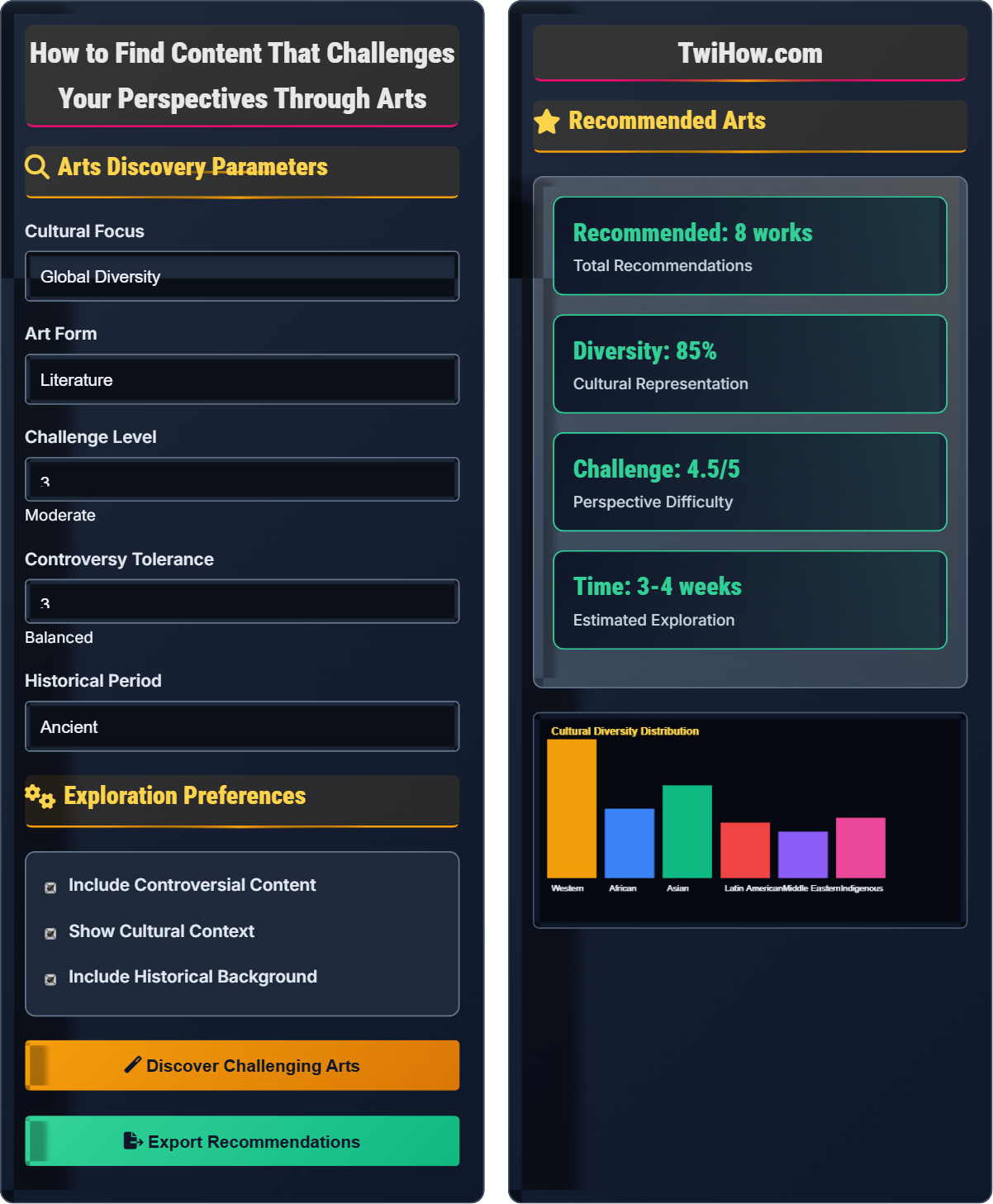
Arts Discovery Parameters
Exploration Preferences
Recommended Arts
Literature • African American Experience • Challenging Race Narratives
Science Fiction • Anarchist Philosophy • Alternative Societies
Visual Art • War Protest • Cubist Expressionism
Television • Urban Sociology • Systemic Issues
| Resource | Type | Challenge Level | Impact |
|---|---|---|---|
| Song of Solomon | Literature | High | Racial Identity |
| The Dispossessed | Literature | Medium | Political Systems |
| Guernica | Visual Art | High | War Impact |
| The Wire | TV | High | Urban Reality |
Arts Perspective Challenge Framework
Perspective-challenging arts are creative works that deliberately confront established viewpoints, question assumptions, and expose viewers/readers/listeners to alternative ways of understanding the world. These works often:
- Present marginalized voices and experiences
- Address uncomfortable social realities
- Use innovative forms to express complex ideas
- Challenge dominant cultural narratives
- Require active engagement and reflection
Effective perspective expansion follows this framework:
Where:
- Cultural Distance: How different the perspective is from your own
- Narrative Complexity: How deeply the work explores themes
- Personal Relevance: How much the work connects to your life
Key areas for perspective expansion:
- Non-Western Literature: Asian, African, Latin American narratives
- Indigenous Voices: Native American, Aboriginal, First Nations perspectives
- LGBTQ+ Art: Queer experiences and identity exploration
- Working Class Narratives: Labor, poverty, and economic inequality
- Disability Perspectives: Neurodiversity and physical differences
- Historical Reinterpretations: Alternative historical viewpoints
- Active Reading: Take notes, research context, discuss with others
- Multiple Viewings: Revisit complex works to deepen understanding
- Contextual Research: Learn about historical and cultural background
- Peer Discussion: Engage with others who have different interpretations
- Personal Journaling: Reflect on how the work affects your views
- Critical Analysis: Examine both strengths and limitations of perspectives
Cultural Perspectives Directory
Explore these major cultural perspectives through arts to challenge your worldview:
Challenging Art Forms
Different art forms offer unique pathways to perspective expansion:
Literature provides intimate access to different worldviews through narrative empathy. Consider exploring:
- Works translated from other languages
- Autobiographical accounts from different cultures
- Science fiction exploring alternative societies
- Historical fiction from marginalized perspectives
Music transcends language barriers to convey emotions and cultural values:
- Traditional folk music from different cultures
- Protest songs addressing social issues
- Experimental compositions challenging musical norms
- Collaborative works crossing cultural boundaries
Visual storytelling offers powerful emotional and intellectual impact:
- International cinema from non-Western countries
- Documentaries addressing global issues
- Animated films exploring complex themes
- Experimental films challenging narrative conventions
- Approach challenging content with open-mindedness
- Respect cultural contexts and sensitivities
- Recognize that discomfort can be part of growth
- Verify information from multiple sources
- Maintain critical thinking while remaining receptive
Arts Perspective Challenge Quiz
Which approach is most effective for finding arts that challenge your perspectives?
Seeking recommendations from people with different backgrounds exposes you to diverse perspectives and introduces you to artistic works you wouldn't discover otherwise. This approach actively challenges your existing cultural frame of reference and provides authentic insights into other worldviews.
The answer is B) Seek recommendations from people with different backgrounds.
Expanding your artistic horizons requires intentional effort to step outside your comfort zone. When we rely only on our own cultural references, we limit our exposure to alternative ways of seeing and interpreting the world. Seeking diverse recommendations creates opportunities for meaningful perspective shifts and cultural understanding.
Cultural Frame of Reference: The set of cultural assumptions and values that shape interpretation
Perspective Shift: A fundamental change in how one views a particular issue or group
Cultural Humility: The practice of maintaining an interpersonal stance that is other-oriented
• Diverse recommendations broaden exposure
• Personal networks offer authentic insights
• Cultural context matters in interpretation
• Join diverse book clubs or film groups
• Follow artists from different cultures on social media
• Visit cultural centers and museums regularly
• Sticking to familiar cultural content
• Assuming all members of a culture think alike
• Approaching new perspectives with judgment
Explain the difference between passive consumption and active engagement with challenging artistic content. Why is active engagement more effective for perspective expansion?
Passive Consumption: Receiving artistic content without critical thought, accepting surface-level meanings, and avoiding deeper analysis.
Active Engagement: Consciously analyzing context, researching background, questioning assumptions, and reflecting on personal reactions.
Active engagement is more effective because it forces you to confront your biases, understand cultural nuances, and integrate new perspectives into your worldview. It transforms consumption from entertainment to education.
Active engagement with challenging arts requires intellectual effort that creates lasting perspective changes. When we passively consume content, we often filter it through existing beliefs without meaningful integration. Active engagement creates cognitive dissonance that, when resolved, leads to expanded understanding and empathy.
Cognitive Dissonance: Mental discomfort experienced when holding conflicting beliefs
Intellectual Humility: Recognition of one's cognitive limitations and willingness to reconsider beliefsEmpathetic Understanding: Ability to comprehend another person's feelings and perspectives
• Research historical and cultural context
• Question your initial reactions
• Seek multiple interpretations
• Keep a reflection journal
• Discuss with others who have different views
• Return to challenging works over time
• Accepting surface-level interpretations
• Avoiding content that causes discomfort
• Judging works by your own cultural standards
You've been reading a novel by a Japanese author that presents a completely different view of family relationships compared to your own cultural background. The portrayal conflicts with your values and makes you uncomfortable. How should you approach continuing engagement with this work to maximize perspective expansion?
Initial Response: Acknowledge your discomfort without dismissing it as wrong.
Research Phase: Investigate Japanese family structures, cultural values, and historical context.
Analysis Stage: Consider how the author's background influences the narrative.
Integration Process: Reflect on what this alternative perspective reveals about your own values and assumptions.
Ongoing Engagement: Continue reading while maintaining curiosity rather than resistance.
This approach transforms discomfort into a learning opportunity, expanding your understanding of human diversity.
Discomfort with unfamiliar perspectives is often a sign of successful challenge to existing beliefs. Rather than avoiding this feeling, we should lean into it as an opportunity for growth. Cultural differences in values don't indicate right or wrong approaches, but rather the diversity of human experience.
Cultural Relativism: Understanding cultural practices within their own context
Universal Values: Beliefs held across different cultures
Cultural Sensitivity: Awareness and respect for cultural differences
• Respect cultural differences while maintaining personal values
• Distinguish between understanding and endorsement
• Seek to understand before forming judgments
• Research the author's cultural background
• Read reviews from people of that culture
• Consider historical and social factors
• Dismissing unfamiliar perspectives immediately
• Assuming your cultural values are universal
• Failing to research cultural context
You want to find films that challenge Western-centric perspectives in storytelling. Describe a systematic approach to identifying and evaluating such films, including criteria for assessing their authenticity and educational value.
Identification Strategy: Research film festivals focused on diverse voices (Toronto, Cannes, Busan), consult international film databases, and seek recommendations from cultural organizations.
Evaluation Criteria: Authentic representation of culture, involvement of local creators, accurate cultural context, and critical acclaim from relevant communities.
Assessment Process: Verify production team composition, research cultural consultants, read reviews from target culture representatives, and examine awards from diverse juries.
Educational Value: Look for films that provide genuine insight into different worldviews rather than exoticizing or stereotyping cultures.
Finding authentic, challenging content requires media literacy skills to distinguish between genuine cultural representation and superficial appropriation. The most impactful perspective-expanding works are created with meaningful participation from the cultures being represented.
Cultural Authenticity: Faithful representation of cultural practices and values
Media Literacy: Ability to critically analyze and evaluate media content
Representation: Accurate portrayal of diverse groups and perspectives
• Verify cultural authenticity of representations
• Research production team backgrounds
• Consult diverse review sources
• Follow international film critics
• Join diverse film discussion groups
• Research director and writer backgrounds
• Accepting stereotypical representations
• Not verifying cultural authenticity
• Relying solely on Western critics
Which factor most commonly prevents people from engaging with perspective-challenging arts?
Psychological resistance to cognitive dissonance is the primary barrier. When artistic content challenges our existing beliefs, it creates mental discomfort that our minds naturally try to avoid. This psychological defense mechanism often prevents us from fully engaging with perspective-expanding content.
The answer is B) Psychological resistance to cognitive dissonance.
Our brains are wired to maintain consistency in our belief systems. When confronted with contradictory information, we experience psychological discomfort. Understanding this natural resistance allows us to consciously push through it for meaningful growth. Embracing this discomfort as a sign of learning can help overcome psychological barriers.
Cognitive Dissonance: Mental stress from holding conflicting beliefs
Confirmation Bias: Tendency to seek information confirming existing beliefs
Psychological Resistance: Unconscious avoidance of challenging information
• Discomfort indicates meaningful challenge
• Conscious effort required to overcome resistance
• Growth comes from pushing through discomfort
• Approach with curiosity rather than defensiveness
• Take breaks when feeling overwhelmed
• Discuss challenging content with others
• Avoiding content that causes discomfort
• Dismissing challenging perspectives immediately
• Not recognizing psychological barriers
FAQ
Q: How do I know if I'm genuinely challenging my perspectives or just looking for content that confirms my existing beliefs about other cultures?
A: Genuine perspective challenge creates cognitive dissonance - you'll feel uncomfortable, confused, or challenged by the content. Signs of authentic challenge include:
1. Emotional Response: Feeling surprised, unsettled, or conflicted by the work
2. Questioning Assumptions: Finding yourself reconsidering previously held beliefs
3. Increased Complexity: Recognizing that issues are more nuanced than you initially thought
4. Behavioral Change: Adjusting your attitudes or actions based on new insights
If you're always nodding in agreement or feeling superior to other perspectives, you're likely in an echo chamber. True perspective expansion requires intellectual humility and the willingness to be wrong.
Q: What's the difference between appreciating art from other cultures and cultural appropriation when seeking perspective expansion?
A: The distinction lies in approach and intent:
Appreciation: Learning with respect, understanding historical context, acknowledging cultural significance, and crediting origins.
Appropriation: Taking elements out of context, profiting without attribution, or misrepresenting cultural practices.
For perspective expansion, focus on:
1. Education: Research the cultural background and significance
2. Respect: Approach with humility and acknowledgment of cultural ownership
3. Attribution: Give credit to cultural sources and creators
4. Intent: Seek to understand rather than exploit or imitate
True appreciation enhances your understanding while honoring the source culture.
Resources for Continued Learning
- World Literature Database - Access to translated works from around the globe
- International Film Festival Archives - Curated collections of global cinema
- Museum Virtual Tours - Online access to diverse cultural institutions
- Ethnic Studies Libraries - Academic resources on minority perspectives
Establish a regular practice of perspective expansion:
- Set monthly goals for exploring new cultural perspectives
- Join diverse reading or viewing groups
- Maintain a reflection journal
- Attend cultural events in your community