How to Find Cultural Content That Educates & Entertains
Complete cultural discovery guide • Step-by-step explanations
Cultural Discovery:
Show Cultural Content FinderFinding cultural content that balances education with entertainment requires strategic approaches to content discovery. Modern audiences seek experiences that inform while engaging, creating demand for content that combines factual accuracy with compelling storytelling.
Cultural content spans multiple formats including documentaries, educational series, podcasts, books, and interactive media. The key to successful discovery lies in understanding content quality indicators, source credibility, and personal learning preferences.
Effective cultural content typically features:
- Expert Curation: Reviewed by subject matter experts
- Engaging Storytelling: Narrative techniques that maintain interest
- Visual Appeal: High production values and aesthetics
- Accessibility: Content for diverse learning styles
- Interactive Elements: Opportunities for deeper engagement
Today's cultural content landscape offers unprecedented access to educational entertainment through streaming platforms, online libraries, and specialized content aggregators.
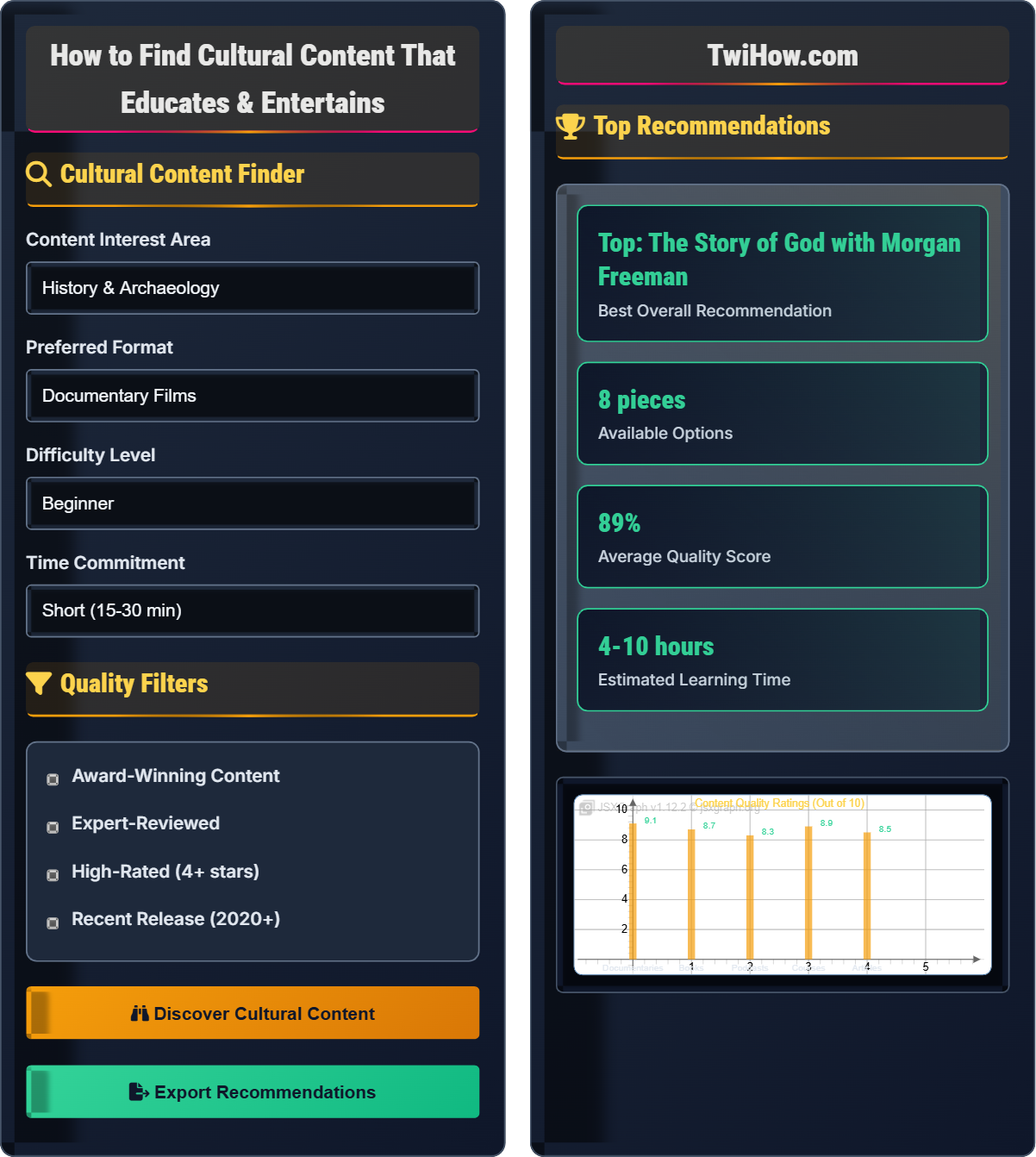
Cultural Content Finder
Quality Filters
Top Recommendations
Science documentary series exploring life in the universe with stunning visuals and expert commentary
Documentary series exploring religious and spiritual concepts across cultures
Stunning nature documentary showcasing wildlife and ecosystems worldwide
| Source | Type | Quality | Specialization | Rating |
|---|---|---|---|---|
| National Geographic | Documentary | High | Nature, History | 4.8/5 |
| BBC Documentaries | Series | Very High | Science, Nature | 4.7/5 |
| Crash Course | YouTube | High | Various Topics | 4.6/5 |
Cultural Content Discovery Methods
High-quality documentaries combine factual information with compelling storytelling. Platforms like Netflix, National Geographic, and BBC offer premium educational content. Look for films with expert interviews, archival footage, and scientific accuracy.
Quality indicators: Awards recognition, expert endorsements, peer-reviewed research, and production company reputation.
Well-researched books provide deep insights into cultural topics. Look for works by established authors, academic presses, and books with extensive bibliographies. Popular science books make complex topics accessible to general audiences.
Characteristics: Peer review, citations, index, and publisher reputation. Best sellers often indicate public interest and accessibility.
Podcasts offer convenient learning during commutes or chores. Series like Radiolab, TED Talks Daily, and Stuff You Should Know explore diverse cultural topics with engaging hosts and production.
Features: Regular episodes, expert guests, narrative structure, and high production values. Subscribe to series that match your interests and learning pace.
Structured learning experiences through platforms like Coursera, edX, and Khan Academy. These courses offer certificates, assignments, and community interaction for comprehensive learning.
Benefits: Progressive difficulty, assessments, discussion forums, and expert instruction. Choose courses with high completion rates and positive reviews.
Museums, libraries, and cultural centers offer curated content through exhibitions, lectures, and workshops. Many institutions provide virtual experiences and online collections.
Resources: Expert curation, historical context, interactive elements, and educational materials. Virtual tours and online archives expand access to global cultural treasures.
Peer-reviewed publications provide authoritative information on cultural topics. Popular science magazines translate complex research for general audiences while maintaining accuracy.
Examples: Scientific American, National Geographic Magazine, Smithsonian, and Archaeology Magazine. Look for articles with expert authors and institutional affiliations.
Quality Indicators for Cultural Content
Subject Matter Expertise
High-quality cultural content is created or reviewed by recognized experts in the field. Look for credentials, institutional affiliations, and peer recognition. Expert involvement ensures accuracy and depth of information.
Visual and Audio Quality
Professional production enhances the learning experience. High-quality visuals, clear audio, and thoughtful editing contribute to engagement and retention. Poor production can distract from valuable content.
Engaging Storytelling
Effective cultural content uses narrative techniques to maintain interest while conveying information. Good pacing, character development, and thematic coherence make complex topics accessible and memorable.
Credibility and Attribution
Trustworthy content clearly cites sources, acknowledges limitations, and presents multiple perspectives when appropriate. Transparency builds trust and allows verification of claims made in the content.
Content Discovery Strategies
Cultural Content Engagement Metrics
| Content | Category | Format | Quality | Duration | Rating |
|---|---|---|---|---|---|
| Cosmos: Possible Worlds | Science | Documentary | Excellent | 4 episodes | 4.7/5 |
| Sapiens by Yuval Noah Harari | History | Book | Excellent | Full-length | 4.6/5 |
| Radiolab Podcast | Science | Podcast | Excellent | Ongoing | 4.8/5 |
| Introduction to Psychology (Yale) | Psychology | Course | Excellent | 20+ lectures | 4.9/5 |
| The Story of God | Religion | Series | Very Good | 6 episodes | 4.5/5 |
Trusted Sources & Platforms
Curated collections of high-quality educational documentaries.
Netflix Documentaries National Geographic BBC DocumentariesStructured learning experiences with expert instruction.
Coursera edX Khan AcademyReputable publishers and platforms for educational books.
Academic Presses Library Systems Book ReviewsCultural Content Discovery Quiz
Which combination of factors most reliably indicates high-quality cultural content?
Expert credentials and peer review ensure factual accuracy and scholarly rigor. While popularity, production quality, and emotional impact contribute to engagement, they don't guarantee educational value. Peer review is the gold standard for validating academic and cultural content.
The answer is B) Expert credentials and peer review.
Evaluating cultural content requires distinguishing between entertainment value and educational merit. Expert credentials indicate the creator's authority on the subject, while peer review ensures the content meets academic standards. Together, these factors provide the strongest indicators of reliable, accurate information.
Peer Review: Evaluation by experts in the same field before publication
Expert Credentials: Academic degrees, professional experience, or recognition in field
Academic Rigor: Systematic methodology and evidence-based conclusions
• Expertise matters more than popularity
• Peer review validates accuracy
• Credentials indicate authority
• Check author's institutional affiliation
• Look for citation sources
• Equating popularity with quality
• Accepting unverified claims
• Ignoring source credentials
How can you evaluate whether cultural content successfully balances education with entertainment? What specific indicators should you look for?
Indicators of Successful Balance:
Educational Indicators: Accurate information, expert sources, comprehensive coverage of topic, and clear learning objectives.
Entertainment Indicators: Engaging narrative, high production values, emotional resonance, and sustained attention throughout.
Balance Indicators: Information presented in accessible ways, complex concepts simplified without dumbing down, and educational moments seamlessly integrated with engaging content.
Specific Signs: Multiple viewings provide new insights (educational depth), content holds attention without relying on sensationalism (balanced presentation), and audience learns facts while enjoying the experience (effective integration).
Evaluation Method: Watch/listen twice—first for entertainment, second for educational content—to assess both elements objectively.
The best cultural content doesn't sacrifice educational value for entertainment or vice versa. Instead, it uses entertainment techniques to enhance learning. Storytelling, visual metaphors, and emotional connections make complex information more memorable and accessible. The key is finding content where both elements support rather than compete with each other.
Educational Entertainment: Content designed to inform while engaging
Information Accessibility: Making complex ideas understandable
Learning Retention: Ability to remember and apply information
• Educational content should remain accurate
• Entertainment shouldn't overshadow facts
• Both elements should reinforce each other
• Take notes during viewing to test learning
• Research unfamiliar concepts afterward
• Discuss content with others for deeper understanding
• Accepting entertainment as education without verification
• Dismissing engaging content as superficial
• Not evaluating the balance between elements
You're interested in learning about ancient civilizations but want content that's both informative and engaging. You prefer shorter content (under 45 minutes) and have noticed that some documentaries feel too academic while others seem overly dramatized. What search strategy would you use to find the best cultural content for your preferences?
Search Strategy:
Platform Selection: Start with reputable educational platforms like National Geographic, BBC, or PBS, which typically maintain high educational standards while using engaging production techniques.
Keyword Strategy: Search for "ancient civilizations documentary" combined with terms like "popular science," "accessible," or "beginner-friendly" to find content that balances education with engagement.
Filtering Criteria: Look for content under 45 minutes, read reviews mentioning "educational yet entertaining," and check if the narrator/host is a respected academic or educator.
Evaluation Process: Watch the first 10 minutes to assess the tone—is it conversational rather than lecture-like? Does it use visual aids effectively? Does it spark curiosity about the topic?
Verification: Cross-reference key facts with academic sources to ensure accuracy while enjoying the engaging presentation.
Effective cultural content discovery requires strategic searching that considers both content quality and presentation style. Reputable platforms provide a foundation of quality, while specific search terms help find content matching your engagement preferences. The key is finding the sweet spot between academic rigor and accessible presentation.
Content Tone: The approach and style of information delivery
Academic Rigor: Systematic methodology and evidence-based conclusions
Accessible Presentation: Complex ideas communicated clearly
• Start with reputable platforms
• Use specific search terms
• Evaluate both content and presentation
• Read reviews from educators and general audiences
• Check if content is part of a series
• Look for bonus materials or follow-up resources
• Settling for either entertainment or education alone
• Not verifying content accuracy
• Ignoring production quality
You've found a documentary about a historical event that seems both educational and entertaining, but you notice it presents only one perspective on controversial aspects of the event. How should you evaluate this content while still benefiting from its educational value?
Evaluation Approach:
1. Acknowledge Strengths: Recognize the documentary's valid points and educational content that is well-supported by evidence
2. Identify Gaps: Note which perspectives or interpretations are missing or underrepresented
3. Seek Additional Sources: Find complementary documentaries, books, or academic articles that present alternative viewpoints
4. Contextualize: Understand that all content creators have perspectives and biases, which is normal
5. Form Balanced View: Synthesize information from multiple sources to form your own informed opinion
Learning Strategy: Use the documentary as a starting point for deeper investigation rather than the final word on the topic. The fact that it raises questions about multiple perspectives is itself educational.
Critical evaluation of cultural content involves understanding that all sources have inherent perspectives. Rather than rejecting content that doesn't present every viewpoint, learn to identify the creator's perspective while extracting valuable information. This approach develops critical thinking skills essential for navigating all forms of media.
Critical Evaluation: Assessing content while recognizing its limitations
Multiple Perspectives: Different viewpoints on the same topic
Source Verification: Confirming information through other sources
• No source is completely neutral
• Seek multiple perspectives
• Separate facts from interpretations
• Keep a list of questions raised by content
• Research the filmmaker's background
• Look for official reviews from historians
• Accepting single perspective as complete truth
• Dismissing content due to bias
• Not seeking additional sources
For learning about a complex cultural topic, which format typically provides the best balance of depth and engagement for most learners?
A popular science book typically provides the best balance of depth and engagement. It offers comprehensive coverage of complex topics while using narrative techniques and accessible language. Unlike academic articles (too dense), social media (too brief), or documentaries (limited by runtime), books provide sufficient space for thorough exploration while maintaining reader engagement.
The answer is C) Popular science book - Accessible yet comprehensive.
Different formats serve different learning purposes. Academic journals provide depth but require expertise to navigate. Documentaries engage through visuals but are limited by time constraints. Social media delivers quick information but lacks context. Popular science books strike the ideal balance by providing comprehensive coverage in accessible formats with narrative structures that maintain engagement.
Popular Science Book: Academic content presented for general audiences
Format Appropriateness: Matching content type to learning objectives
Comprehensive Coverage: Thorough exploration of topics
• Match format to learning goals
• Consider time availability
• Evaluate depth requirements
• Start with overview formats, then dive deeper
• Combine multiple formats for comprehensive learning
• Choose formats that match your attention span
• Using inappropriate format for learning goals
• Not varying content formats
• Assuming one format fits all needs
FAQ
Q: How do I know if a documentary is presenting balanced information?
A: Look for several indicators of balanced information: multiple expert voices from different institutions, acknowledgment of controversies or debates in the field, presentation of opposing viewpoints, and disclosure of funding sources that might influence the narrative. A balanced documentary will often say "some researchers believe..." rather than presenting claims as absolute fact.
Check if the documentary includes primary sources, archival materials from multiple perspectives, and if controversial topics are presented with appropriate context. Also, verify key claims through independent sources and look for reviews from academic experts in the field.
Q: What's the difference between educational entertainment and just entertainment?
A: Educational entertainment has clear learning objectives and provides factual information that viewers can retain and apply. It uses entertainment techniques to enhance learning rather than replace substance with spectacle. Just entertainment prioritizes emotional engagement and enjoyment without necessarily imparting lasting knowledge.
Educational entertainment includes: expert consultation, fact-checking, citation of sources, and measurable learning outcomes. It often leaves viewers with new knowledge, skills, or perspectives they can discuss or apply. Pure entertainment may be enjoyable but doesn't necessarily expand understanding of the world.