How Do I Find Resources for Learning About Art History or Music Theory?
Online Courses • Books • Museums • Universities • Practice Tools
Learning Resources:
Resource Finder ToolFinding quality resources for learning art history and music theory requires navigating a vast landscape of educational options. From prestigious universities to online platforms, from classical textbooks to interactive tools, there are numerous pathways to explore these rich cultural disciplines. The key is matching resources to your learning style, experience level, and specific interests.
Available learning paths:
- Formal Education: University courses, degree programs, certification
- Online Platforms: MOOCs, video lectures, interactive courses
- Books & Publications: Textbooks, reference materials, scholarly works
- Physical Spaces: Museums, libraries, concert halls, studios
- Practice Tools: Apps, software, instruments, exercises
- Community Learning: Workshops, study groups, mentorship
Success comes from combining multiple resource types and maintaining consistent practice and study habits.
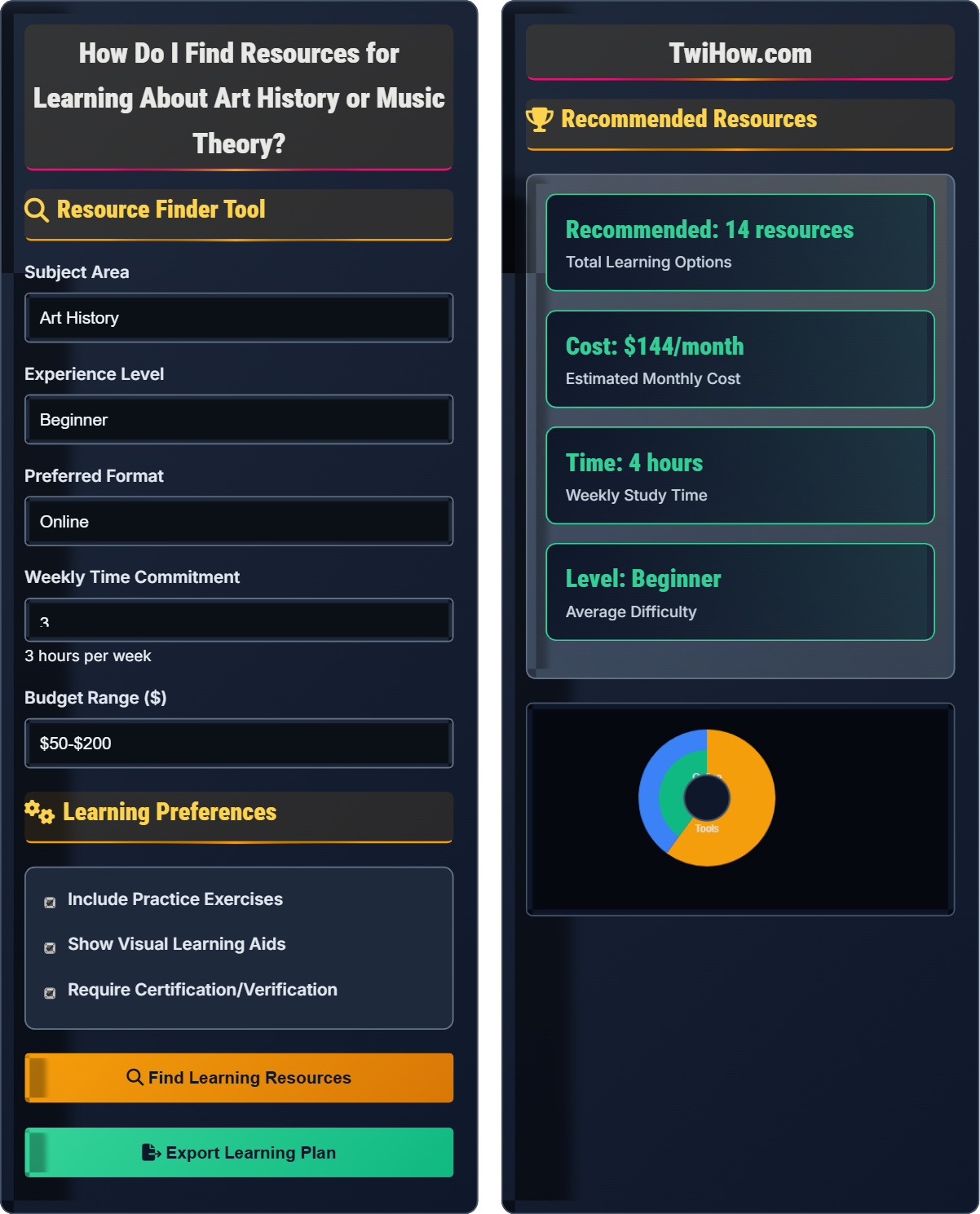
Resource Finder Tool
Learning Preferences
Recommended Resources
Learning Resources Framework
Effective learning in art history and music theory requires a combination of different resource types. The most successful learners utilize multiple formats and approaches to build comprehensive understanding and practical skills.
- Theoretical Knowledge: Books, lectures, and articles for foundational understanding
- Visual Learning: Images, diagrams, and multimedia for conceptual comprehension
- Aural Learning: Audio examples, recordings, and listening exercises
- Practical Application: Exercises, practice tools, and hands-on activities
- Interactive Elements: Quizzes, games, and engagement tools
- Community Support: Forums, study groups, and expert guidance
The effectiveness of learning resources can be optimized using this framework:
Where:
- Quality: Accuracy, depth, and credibility of content
- Relevance: Alignment with your learning goals and interests
- Accessibility: Ease of access and use based on your circumstances
- Engagement: How well the format matches your learning style
Key categories for art history and music theory learning:
- Textbooks: Comprehensive coverage of fundamentals and advanced topics
- Online Courses: Structured learning with guided progression
- Museum Resources: Direct engagement with artworks and historical artifacts
- Practice Software: Interactive tools for skill development
- Academic Journals: Cutting-edge research and analysis
- Community Resources: Peer learning and expert guidance
Match your learning style to appropriate resource types:
- Visual Learners: Image-rich books, videos, museum visits, diagrams
- Auditory Learners: Audio lectures, music examples, podcasts, discussions
- Kinesthetic Learners: Hands-on practice, interactive tools, writing exercises
- Reading/Writing: Textbooks, articles, note-taking, written exercises
- Social Learners: Study groups, classes, community forums, collaboration
- Solitary Learners: Self-paced courses, independent study, quiet practice
Top Learning Resources
High-quality online learning platforms:
Essential Books & Publications
Foundational texts for art history study:
- Gardner's Art Through the Ages: Comprehensive survey of world art
- Janson's History of Art: Authoritative overview with excellent illustrations
- The Story of Art by Gombrich: Accessible introduction to art history
- Ways of Seeing by Berger: Critical examination of visual culture
- Art History by Stokstad: Global perspective with cultural context
Essential texts for music theory study:
- Harmony and Theory by Aldwell & Schachter: Comprehensive textbook
- Tonal Harmony by Kostka & Payne: Standard academic text
- The Complete Musician by Laitz: Integrated approach to theory and analysis
- Music Theory for Dummies: Accessible introduction for beginners
- Harmonic Experience by W.A. Mathieu: Practical and experiential approach
Practice Tools & Software
Ear training and music theory practice
Free music theory exercises
Art history content and context
Music ear training app
Art database and learning resource
Interactive lessons and exercises
Learning Resources Quiz
Which type of resource is most effective for a beginner learning music theory?
Interactive online exercises with audio feedback are most effective for beginners because they provide immediate feedback, visual aids, and hands-on practice with the fundamental concepts of music theory. This approach allows learners to hear the concepts they're studying, making abstract theoretical concepts concrete and memorable.
The answer is B) Interactive online exercises with audio feedback.
Beginning learners benefit most from resources that combine multiple learning modalities. Music theory involves both visual (notation) and auditory (sound) elements, so effective resources must address both. Interactive exercises provide immediate feedback and allow for repetitive practice, which is essential for building foundational skills.
Interactive Learning: Learning through active participation and immediate feedback
Aural Skills: Ability to recognize and reproduce musical elements by ear
Foundational Concepts: Basic principles that support advanced learning
• Beginners need concrete examples
• Multiple sensory inputs enhance learning
• Immediate feedback accelerates progress
• Start with basic intervals and scales
• Use apps that provide audio examples
• Practice regularly in short sessions
• Starting with advanced materials
• Not practicing aural skills
• Skipping foundational concepts
Explain the advantages of combining visual museum experiences with online art history resources. How do these different approaches complement each other?
Advantages of Museum Experiences:
1. Scale and Detail: Seeing artworks in person reveals details and scale that photographs cannot capture
2. Material Properties: Understanding texture, brushwork, and material choices through direct observation
3. Emotional Impact: Physical presence creates different emotional responses than digital viewing
4. Contextual Understanding: Spatial relationships and curatorial decisions provide additional context
Advantages of Online Resources:
1. Accessibility: Access to artworks from around the world regardless of location
2. Research Depth: Extensive scholarly articles and historical context
3. Comparative Analysis: Easy side-by-side comparison of different works
4. Interactive Features: Zoom features, virtual tours, and multimedia content
Complementary Benefits: The combination allows for initial emotional engagement and detail observation at museums, followed by deeper research and comparative study online, creating a comprehensive learning experience.
Effective art history learning requires both sensory engagement and intellectual analysis. Museums provide the former through direct visual experience, while online resources excel at providing the latter through extensive contextual information. The combination creates a more complete understanding than either approach alone.
Visual Literacy: Ability to interpret and analyze visual information
Material Analysis: Understanding of physical properties of artworks
Contextual Learning: Understanding artworks within historical and cultural frameworks
• Direct observation provides unique insights
• Digital resources offer extensive context
• Combined approaches create deeper understanding
• Research artworks before visiting museums
• Take notes during museum visits
• Use online resources to deepen understanding
• Relying only on digital images
• Not researching before museum visits
• Failing to connect visual and intellectual learning
You want to learn music theory but have a budget of $100 per month. You need a textbook ($40), online course access ($30/month), practice software ($25), and occasional private lessons ($50). Calculate how to allocate your budget effectively and suggest strategies for managing costs.
Budget Analysis:
Monthly total needed: $30 (course) + $50 (lessons) = $80
One-time costs: $40 (textbook) + $25 (software) = $65
Allocation Strategy:
Month 1: Purchase textbook and software ($65), enroll in course ($30) - Total: $95
Months 2-3: Course access ($30) + lessons ($50) = $80 per month
Cost Management Strategies:
1. Free Trials: Use free trials for online courses before committing
2. Library Resources: Borrow textbooks when possible
3. Group Lessons: Share lesson costs with other students
4. Free Software: Use free alternatives like MusicTheory.net
5. Community Resources: Join study groups for peer learning
Learning music theory requires both theoretical knowledge (textbooks) and practical application (software, lessons). The most cost-effective approach prioritizes essential resources first and seeks alternatives for expensive items. Free and low-cost resources can provide substantial learning value when combined strategically.
Opportunity Cost: What you give up when choosing one option over another
Cost-Benefit Analysis: Evaluating value relative to expense
Resource Allocation: Distributing limited resources effectively
• Prioritize essential resources first
• Seek free alternatives when possible
• Balance cost with learning effectiveness
• Start with free resources
• Invest in essential tools first
• Look for bundled discounts
• Buying everything at once
• Not considering free alternatives
• Overspending on non-essential items
You're a complete beginner wanting to learn both art history and music theory. Design a 6-month learning plan that incorporates different resource types and accounts for your busy schedule (2 hours per day, 5 days per week). Include specific resources and milestones.
6-Month Learning Plan:
Months 1-2: Foundation Building
• 1 hour daily: Khan Academy Art History (basic movements, terminology)
• 1 hour daily: MusicTheory.net (notes, scales, intervals)
Months 3-4: Intermediate Concepts
• 1 hour daily: Coursera Art History course (specific periods)
• 1 hour daily: Teoria exercises (chords, progressions)
Months 5-6: Integration & Application
• 1 hour daily: Art history textbook reading (Janson's History of Art)
• 1 hour daily: Practical music theory application (composition exercises)
Weekly Milestones: Complete one module per subject, practice 2 hours independently, attend one virtual museum tour or concert.
Resources: Khan Academy, MusicTheory.net, Coursera, local museum websites, library books.
Effective learning requires gradual progression from basic to advanced concepts, with sufficient practice time between new material. Alternating between subjects can prevent cognitive overload while maintaining engagement. Regular milestones provide motivation and track progress.
Scaffolding: Building knowledge progressively from simple to complex
Cognitive Load: Amount of mental effort required for learning
Milestone Tracking: Marking progress points for motivation
• Progress from basic to advanced concepts
• Balance new learning with practice
• Set achievable milestones
• Alternate subjects daily
• Use weekends for review
• Join online study groups
• Trying to learn everything at once
• Not allowing for practice time
• Skipping foundational concepts
Which combination of resources would be most effective for a kinesthetic learner studying art history?
Virtual museum tours and interactive timeline activities are most effective for kinesthetic learners because they involve active participation and manipulation of content. These resources allow learners to move through virtual spaces, click and explore, and engage physically with the learning material, which matches the kinesthetic learning style that benefits from hands-on activity.
The answer is B) Virtual museum tours and interactive timeline activities.
Kinesthetic learners retain information best when they can engage physically with the material. In art history, this might mean virtually walking through galleries, manipulating digital reproductions, or participating in interactive activities that involve clicking, dragging, or exploring. Static visual or auditory content is less effective for this learning style.
Kinesthetic Learning: Learning through physical activity and manipulation
Learning Style: Preferred method of receiving and processing information
Interactive Learning: Learning through active participation
• Match resources to learning style
• Kinesthetic learners need active engagement
• Different styles require different approaches
• Use interactive museum websites
• Try art reproduction activities
• Participate in virtual studio tours
• Using only passive learning methods
• Not considering individual learning styles
• Assuming all learners are the same
FAQ
Q: What are the best free resources for learning art history as a complete beginner?
A: Excellent free resources for beginners:
Khan Academy Art History: High-quality, comprehensive content with beautiful imagery
SmartHistory: Contextual art history with expert explanations
Metropolitan Museum of Art: Extensive online collection with educational resources
Google Arts & Culture: Virtual museum tours and high-resolution artwork viewing
YouTube Channels: The Art Assignment, Crash Course Art History, and museum channels
Library Books: Many foundational texts are available through public libraries
Start with these to build a solid foundation before moving to more specialized resources.
Q: How can I practice music theory without an instrument at home?
A: Many effective practice methods don't require an instrument:
Vocal Practice: Sing scales, intervals, and chord progressions
Clapping Rhythms: Practice rhythmic patterns and subdivisions
Written Exercises: Complete harmony and analysis exercises on paper
Software Tools: Use apps like Teoria, MusicTheory.net, or EarMaster
Mental Visualization: Imagine fingerings, voicings, and harmonic movements
Listening Practice: Identify chords, keys, and forms in recorded music
Body Percussion: Use clapping, snapping, and stomping to feel rhythm
These methods can be highly effective and complement instrumental practice.
Best Practices for Learning
Proven strategies for successful art history and music theory learning:
- Consistent Practice: Regular, short sessions are more effective than infrequent marathons
- Multimodal Learning: Combine visual, auditory, and kinesthetic approaches
- Active Engagement: Take notes, ask questions, and apply concepts
- Connect Concepts: Relate new information to existing knowledge
- Regular Review: Space out learning sessions to improve retention
- Seek Feedback: Get input from teachers, peers, or online communities
Sample weekly routine for balanced learning:
- Monday: Art history reading and analysis
- Tuesday: Music theory exercises and practice
- Wednesday: Museum visit or virtual tour
- Thursday: Music listening and analysis
- Friday: Review and synthesis of week's learning
- Saturday: Creative application (artistic or musical)
- Sunday: Rest and reflection