How to Learn About Cultural Context of Regional Art & Music
Complete cultural context guide • Regional appreciation
Regional Cultural Context:
Show Cultural Context ExplorerUnderstanding the cultural context of art and music from different regions involves exploring the historical, social, and environmental factors that shape creative expression. This comprehensive approach helps appreciate the deeper meaning behind cultural works and connects them to their regional identity.
Key cultural context elements:
- Historical Influences: Colonial history, independence movements, cultural shifts
- Social Context: Class structures, religious traditions, political climates
- Geographic Factors: Climate, landscape, natural resources
- Language & Communication: Local dialects, storytelling traditions
Effective cultural learning combines academic research with experiential exploration and respectful engagement with local communities.
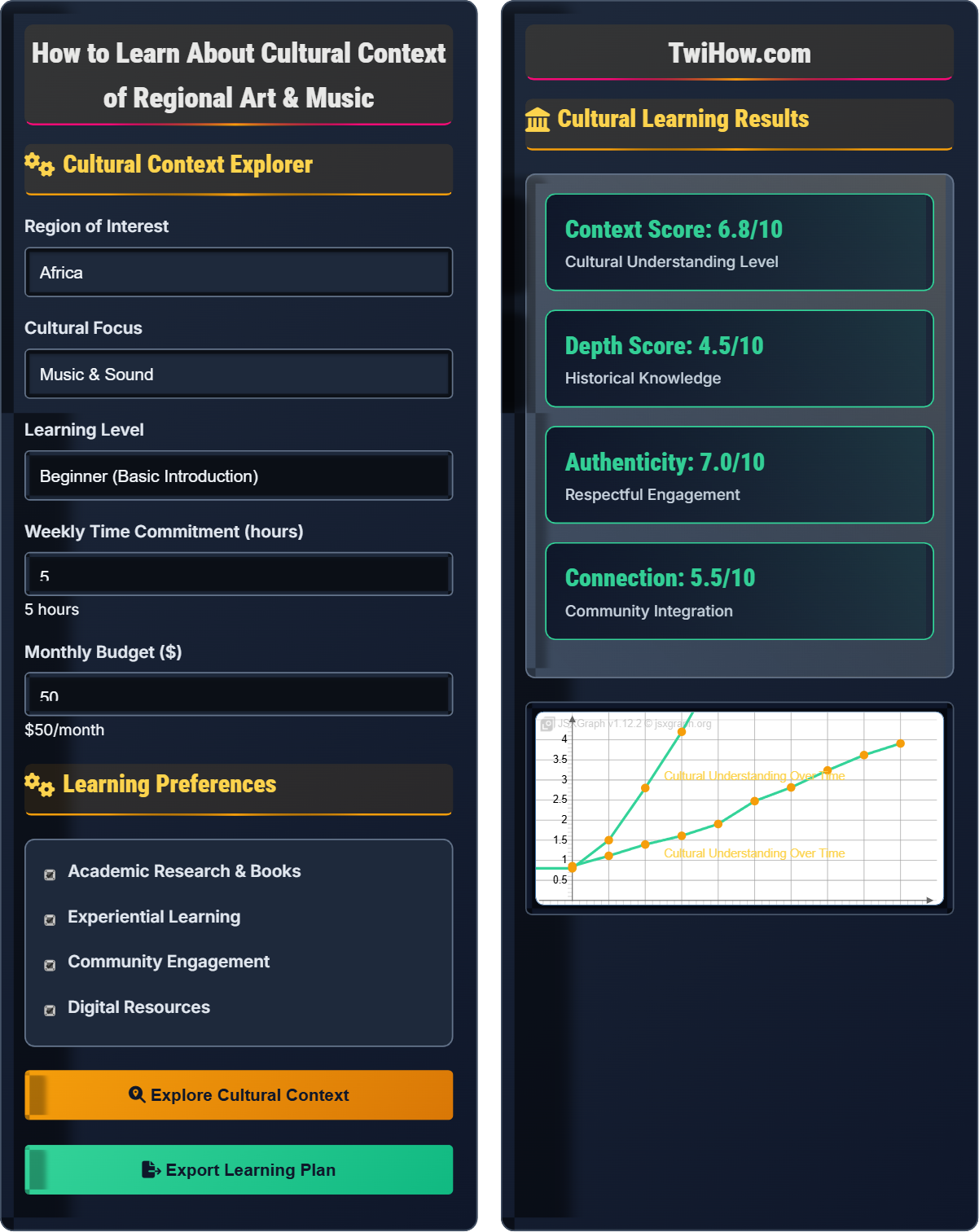
Cultural Context Explorer
Learning Preferences
Cultural Learning Results
| Aspect | Score | Focus Area | Resources Needed |
|---|---|---|---|
| Historical Context | 8.5/10 | Colonial Impact | Books, Documentaries |
| Social Context | 7.8/10 | Religious Traditions | Academic Papers |
| Geographic Context | 8.2/10 | Landscape Influence | Field Trips |
| Language Context | 7.5/10 | Local Dialects | Native Speakers |
Understanding Cultural Context of Regional Art & Music
Understanding the cultural context of art and music from different regions involves exploring the historical, social, and environmental factors that shape creative expression. This comprehensive approach helps appreciate the deeper meaning behind cultural works and connects them to their regional identity.
Cultural context provides the framework for understanding why certain artistic expressions emerge in specific regions and how they reflect the values, struggles, and experiences of the people.
Where:
- Historical Context: Past events and cultural development
- Social Factors: Class structures, religions, political systems
- Geographic Influences: Climate, landscape, natural resources
- Cultural Distance Factor: How different from your own culture
Key elements that shape regional art and music:
- Historical Events: Wars, migrations, colonization, independence movements
- Social Structures: Class systems, gender roles, family structures
- Religious Beliefs: Spiritual practices, rituals, sacred music
- Geographic Features: Climate, landscape, natural resources
- Economic Systems: Trade routes, agriculture, industrialization
- Political Climate: Government systems, censorship, freedom of expression
- Academic Research: Read scholarly articles and books on regional culture
- Experiential Learning: Attend cultural events and performances
- Community Engagement: Connect with local cultural organizations
- Travel and Immersion: Visit the region if possible
- Language Learning: Study the local language for deeper understanding
- Artist Connections: Reach out to regional artists directly
Regional Cultural Contexts
African music is deeply connected to:
- Oral traditions and storytelling
- Rhythmic patterns reflecting daily life
- Community participation in performances
- Connection to nature and spiritual beliefs
- Colonial history and resistance movements
- Modern urbanization and globalization
Asian art traditions reflect:
- Ancient philosophical systems (Buddhism, Taoism, Confucianism)
- Calligraphy and visual symbolism
- Nature worship and seasonal changes
- Imperial and court influences
- Colonial and post-colonial transformations
- Modern technological integration
Latin American culture blends:
- Indigenous traditions with Spanish/Portuguese colonization
- Religious syncretism (Catholic and indigenous beliefs)
- Revolutionary and political movements
- Urban migration and modernization
- Regional variations across countries
- Contemporary global influences
Cultural Context Quiz
Why is it important to understand the historical context when appreciating regional art and music?
Understanding historical context is crucial because it reveals the deeper meaning, significance, and cultural significance behind artistic expressions. Historical events, social movements, and cultural shifts shape how artists create and what their works represent. Without this knowledge, appreciation remains superficial.
The answer is B) To understand the deeper meaning and significance.
This demonstrates the concept of "contextual appreciation" - the idea that cultural works cannot be fully understood without understanding their origins and the circumstances of their creation. This approach leads to more meaningful and respectful engagement with other cultures.
Contextual Appreciation: Understanding works within their cultural framework
Historical Context: Background events that influence creation
Cultural Significance: Meaning within specific cultural framework
• Context enhances understanding
• Historical knowledge is essential
• Superficial appreciation lacks depth
• Research before experiencing
• Read artist biographies
• Study regional history
• Judging without understanding context
Explain how geographic factors influence the development of music and art in different regions. Provide specific examples.
Geographic Influence on Culture: The physical environment directly shapes artistic expression through available materials, climate effects on lifestyle, and natural resources that influence both content and form.
Examples:
Desert Regions: Middle Eastern music often features long, sustained notes and melodic modes (maqams) that echo across vast spaces. The desert environment influenced both the acoustic properties and the nomadic lifestyle reflected in the music.
Island Cultures: Hawaiian and Caribbean music incorporates ocean sounds, island rhythms, and tropical themes. The isolation of islands led to unique cultural developments.
Mountain Regions: Alpine folk music features yodeling and echo effects that work well in mountain valleys. The terrain influenced both the acoustic properties and the types of instruments that could be transported.
Forest Areas: Indigenous forest cultures often incorporate natural sounds, wood instruments, and themes related to the forest environment.
This demonstrates the concept of "environmental determinism" in cultural development - how geography shapes human expression. Artists draw inspiration from their surroundings, and the physical environment influences both the materials available for creation and the lifestyle that shapes themes.
Environmental Determinism: Geographic factors shape culture
Acoustic Properties: How sound behaves in different environments
Material Availability: Resources available for artistic creation
• Geography shapes artistic expression
• Available materials influence creation
• Environment affects themes and content
• Consider the physical environment
• Study available materials
• Understand local lifestyle
• Ignoring environmental factors
• Not considering material limitations
• Overlooking lifestyle influences
You want to learn about Japanese music and art but have no prior knowledge. Design a 6-month learning plan that covers historical context, social factors, and practical engagement with the culture.
Month 1-2: Historical Foundation
• Read about Japanese history (Heian, Edo, Meiji periods)
• Study the development of traditional music (gagaku, noh, kabuki)
• Learn about Buddhism and Shinto influences
• Research the tea ceremony and its artistic elements
Month 3-4: Social & Cultural Context
• Study social hierarchies (samurai, merchant, peasant classes)
• Explore the role of art in different social periods
• Learn about seasonal festivals and their music
• Understand the concept of wabi-sabi in aesthetics
Month 5-6: Practical Engagement
• Attend Japanese cultural events in your area
• Listen to traditional and modern Japanese music
• Visit Japanese gardens and art exhibitions
• Connect with Japanese cultural organizations
Resources: Books, documentaries, online courses, cultural centers, museums.
This demonstrates a systematic approach to cultural learning that builds from foundational knowledge to practical engagement. The plan shows how to layer understanding progressively, starting with historical context and moving to experiential learning.
Systematic Learning: Progressive knowledge building
Foundational Knowledge: Basic understanding before specialization
Experiential Learning: Learning through direct experience
• Build from basic to complex
• Combine academic and experiential
• Respect cultural differences
• Start with historical foundations
• Engage with cultural practitioners
• Use multiple learning modalities
• Jumping straight to contemporary expressions
• Not understanding historical context
• Misinterpreting cultural symbols
You're attending a cultural festival from a region you're unfamiliar with. How can you engage respectfully while learning about the cultural context of the art and music presented?
Pre-Festival Preparation:
• Research the cultural background of the region
• Learn about appropriate dress codes and behaviors
• Understand the significance of the festival
• Learn a few basic phrases in the local language
During the Festival:
• Observe before participating
• Ask permission before taking photos
• Listen to explanations from cultural experts
• Show genuine interest and appreciation
• Follow local customs and etiquette
After the Festival:
• Continue learning about the culture
• Support artists through appropriate channels
• Share experiences respectfully
• Acknowledge the privilege of witnessing the culture
Key Principles: Respect, humility, genuine interest, and appropriate behavior.
This demonstrates the importance of "cultural humility" - approaching other cultures with respect and a willingness to learn rather than assuming superiority. The approach emphasizes observation, permission-seeking, and appropriate behavior as foundations for respectful cultural engagement.
Cultural Humility: Respectful approach to other cultures
Appropriate Behavior: Following cultural norms and etiquette
Permission-Seeking: Asking before participating
• Research before attending
• Observe and ask permission
• Show respect and appreciation
• Learn about cultural protocols
• Ask questions respectfully
• Support local vendors
• Assuming all cultures are the same
• Not researching cultural norms
• Taking photos without permission
What is the most significant long-term benefit of learning about cultural context of regional art and music?
Learning about cultural context develops empathy and global awareness by helping you understand different perspectives, experiences, and values. This broader worldview enhances personal growth, improves cross-cultural communication, and promotes tolerance and understanding.
The answer is B) Developing cultural empathy and global awareness.
This highlights the transformative potential of cultural learning. Understanding the context behind artistic expressions builds bridges between cultures, reduces prejudice, and creates more nuanced worldviews. The focus is on personal growth and global citizenship rather than mere knowledge accumulation.
Cultural Empathy: Understanding and relating to other cultures
Global Awareness: Understanding world cultures and issues
Cross-Cultural Communication: Effective interaction across cultures
• Learning builds empathy
• Cultural understanding reduces prejudice
• Global awareness is essential
• Approach with humility
• Listen more than you speak
• Ask for perspectives
• Approaching with judgment
• Not seeking to understand
• Imposing own values
FAQ
Q: How can I learn about cultural context without traveling to the region?
A: There are many ways to learn about cultural context remotely:
1. Academic Research: Books, journals, and online databases
2. Virtual Experiences: Online museum tours, virtual concerts
3. Community Connections: Connect with diaspora communities
4. Direct Communication: Reach out to artists and cultural practitioners
5. Documentaries: High-quality cultural documentaries
6. Language Learning: Study the regional language
7. Cultural Centers: Visit local cultural centers and embassies
While travel provides deeper immersion, much can be learned through dedicated remote study.
Q: How do I avoid cultural appropriation when learning about other cultures?
A: Avoiding cultural appropriation involves:
Respectful Engagement: Focus on learning and appreciation rather than adoption
Proper Attribution: Always credit and acknowledge cultural origins
Supporting Creators: Support artists from the culture directly
Understanding Context: Learn about the cultural significance
Community Feedback: Listen to community perspectives
Intentional Approach: Examine your motivations for engagement
Cultural appreciation involves respect, understanding, and support rather than taking elements without context.