How to Navigate Cultural Appropriation vs Appreciation?
Complete cultural ethics guide • Step-by-step explanations
Cultural Navigation Fundamentals:
Show Navigation ToolUnderstanding the difference between cultural appropriation and appreciation is essential in our interconnected world. Cultural appropriation involves taking elements from a culture that is not your own, often without permission, understanding, or compensation, and especially when there are power imbalances. Cultural appreciation involves learning about, respecting, and honoring another culture with permission and proper context.
Key principles include:
- Permission: Seeking consent when appropriate
- Context: Understanding the significance and meaning
- Compensation: Supporting origin communities
- Respect: Honoring the culture appropriately
Navigating this distinction requires empathy, education, and a commitment to ethical engagement with diverse cultures.
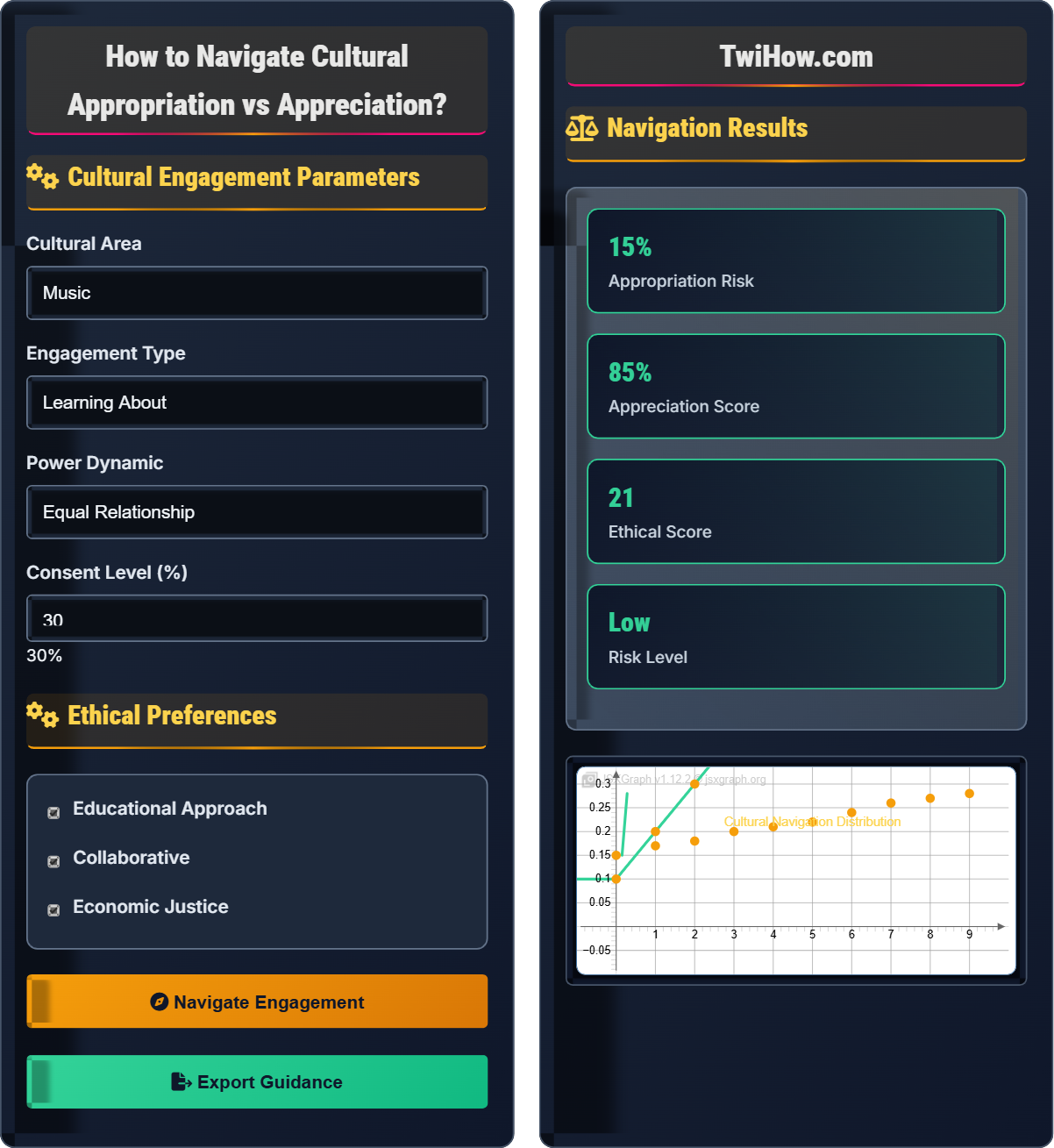
Cultural Engagement Parameters
Ethical Preferences
Navigation Results
| Factor | Risk Level | Score | Guidance |
|---|---|---|---|
| Consent | High Risk | 30 | Seek explicit permission |
| Context | Medium Risk | 50 | Learn cultural significance |
| Compensation | High Risk | 20 | Support origin communities |
| Power Dynamic | High Risk | 25 | Address imbalances |
Personalized Recommendations
Based on your analysis:
- Seek explicit consent from cultural communities
- Invest time in understanding cultural context
- Ensure economic benefits flow to origin communities
- Address power imbalances through collaboration
Cultural Appropriation vs Appreciation Explained
Understanding the difference between cultural appropriation and appreciation is crucial for ethical engagement with diverse cultures. Cultural appropriation can perpetuate harm, disrespect, and exploitation, while cultural appreciation fosters respect, understanding, and positive cultural exchange.
The likelihood of appropriation vs appreciation can be assessed using multiple factors:
Where:
- Power Imbalance: Disparities in social, economic, or political power
- Lack of Consent: Absence of permission from cultural communities
- Exploitation: Taking without benefit to origin communities
- Respect Factor: Consideration for cultural significance and context
Cultural navigation applies to various domains:
- Music: Sampling, fusion, and cultural borrowing
- Fashion: Traditional patterns, designs, and styles
- Food: Cuisine, cooking methods, and ingredients
- Art: Visual motifs, techniques, and symbolism
- Spiritual Practices: Ceremonies, beliefs, and sacred elements
- Language: Terms, phrases, and linguistic elements
- Education First: Learn about cultural context before engagement
- Community Consultation: Seek input from cultural communities
- Collaborative Approach: Work together rather than taking independently
- Proper Attribution: Credit cultural origins and creators
- Economic Justice: Ensure fair compensation to origin communities
- Respect Boundaries: Honor sacred or restricted elements
Appropriation vs Appreciation
Permission, context, compensation, respect, power dynamics, collaboration.
Decision Tree
Navigation Framework
Real-World Scenarios
Ethical Guidelines
Best Practices
Cultural Appropriation vs Appreciation Learning Quiz
What is the primary difference between cultural appropriation and cultural appreciation?
The primary difference between cultural appropriation and appreciation lies in permission, understanding, and respect. Cultural appropriation involves taking from a culture without permission, understanding, or compensation, especially when there are power imbalances. Cultural appreciation involves learning about, respecting, and honoring another culture with permission and proper context.
The answer is B) The level of permission and understanding.
The distinction between appropriation and appreciation centers on the approach and context of engagement. Appropriation involves taking without consent or understanding, often perpetuating harm or exploitation. Appreciation involves respectful learning, collaboration, and acknowledgment of cultural significance.
Cultural Appropriation: Taking cultural elements without permission or understanding
Cultural Appreciation: Respectful learning and honoring of other cultures
Power Imbalance: Disparities in social, economic, or political power
• Permission is key to respectful engagement
• Understanding cultural context matters
• Power dynamics influence impact
• Always research cultural significance
• Seek guidance from cultural communities
• Consider who benefits from the exchange
• Assuming all cultural exchange is appreciation
• Not researching cultural significance
• Ignoring power dynamics
Explain the role of power dynamics in distinguishing between cultural appropriation and appreciation, and provide examples of how power imbalances affect cultural exchange.
Power Dynamics Role:
Power dynamics are crucial in determining whether cultural exchange is appropriation or appreciation. When there are disparities in social, economic, or political power, cultural exchange becomes more likely to be exploitative.
Examples of Power Imbalances:
Historical Oppression: When a dominant culture takes from a historically oppressed culture, especially if that oppression continues today. For example, wearing Native American headdresses as costumes while Indigenous communities face ongoing discrimination.
Economic Disparities: When wealthy, privileged individuals profit from cultural elements without benefiting the origin communities. For example, selling "ethnic" jewelry made in sweatshops while claiming cultural authenticity.
Media Representation: When dominant cultures control media narratives about minority cultures, often misrepresenting or stereotyping them. For example, Hollywood's portrayal of Asian cultures.
Colonial Legacy: When former colonizers continue to exploit cultural elements from colonized nations without recognition or compensation.
Understanding and addressing these power dynamics is essential for ethical cultural engagement.
Power dynamics create the context in which cultural exchange occurs. When examining cultural engagement, it's important to consider the historical and contemporary relationship between cultures. Simply taking elements from another culture without considering these power relationships can perpetuate harm and exploitation.
Power Dynamics: Relationships of influence and control between groups
Historical Oppression: Past injustices that continue to affect communities
Economic Disparities: Differences in wealth and opportunity
• Consider historical context
• Address economic disparities
• Recognize ongoing oppression
• Research historical relationships
• Consider economic impact
• Listen to community perspectives
• Ignoring historical context
• Not considering economic impact
• Assuming equal power relationships
A fashion company wants to use traditional African patterns in their new clothing line. They plan to hire a famous designer to recreate these patterns without involving African designers or communities. Analyze this situation using the appropriation vs appreciation framework and suggest an alternative approach.
Analysis Using Framework:
• Permission: None sought from African communities
• Context: Patterns stripped of cultural significance
• Compensation: Profits go to company, not origin communities
• Power Dynamic: Western company exploiting African cultural heritage
• Collaboration: No partnership with African designers
This clearly constitutes cultural appropriation.
Alternative Approach:
1. Partner with African Designers: Collaborate with established African fashion designers
2. Proper Attribution: Credit the cultural origins of the patterns
3. Profit Sharing: Ensure a percentage of profits goes to origin communities
4. Cultural Education: Educate customers about the cultural significance
5. Capacity Building: Invest in African fashion industry development
This approach transforms appropriation into appreciation while creating mutual benefit.
The fashion industry has a history of cultural appropriation, particularly with traditional patterns and designs. The key to ethical engagement is shifting from extraction to collaboration, ensuring that cultural communities benefit from their contributions rather than being exploited.
Cultural Extraction: Taking without benefit to origin communities
Collaborative Partnership: Working together for mutual benefit
Profit Sharing: Distributing economic benefits fairly
• Partner with origin communities
• Ensure fair compensation
• Maintain cultural context
• Find and partner with cultural representatives
• Share profits and recognition
• Invest in cultural development
• Not involving origin communities
• Stripping away cultural context
• Focusing only on profit
A pop artist wants to incorporate traditional indigenous instruments and melodies into their new album. They want to ensure they're showing appreciation rather than appropriation. Develop a framework for ethical engagement that addresses all aspects of cultural respect.
Framework for Ethical Engagement:
1. Research Phase: Learn about the cultural significance of the instruments and melodies
2. Community Connection: Reach out to indigenous communities and musicians
3. Collaboration Proposal: Invite indigenous artists to collaborate on the project
4. Permission Process: Obtain explicit consent for using specific elements
5. Compensation Agreement: Ensure indigenous collaborators receive fair payment
6. Context Preservation: Include cultural context in album liner notes
7. Benefit Sharing: Allocate a portion of profits to indigenous cultural programs
8. Ongoing Relationship: Maintain connections with the communities
9. Education Component: Educate audiences about the cultural elements
10. Respectful Representation: Avoid stereotyping or misrepresentation
This comprehensive approach ensures ethical engagement while creating meaningful cultural exchange.
Music presents unique challenges for ethical cultural engagement because it involves both sonic elements and cultural meaning. The key is to approach cultural elements with respect for their significance and to ensure that cultural communities benefit from their contributions.
Cultural Significance: Meaning and importance to origin communities
Collaborative Engagement: Working together rather than taking independently
Benefit Sharing: Ensuring communities benefit from their contributions
• Collaborate with cultural representatives
• Obtain explicit consent
• Ensure fair compensation
• Learn about cultural context first
• Build genuine relationships
• Share benefits and recognition
• Using cultural elements as mere decoration
• Not involving cultural communities
• Failing to share benefits
What should you do if you encounter sacred or restricted cultural elements while learning about another culture?
If you encounter sacred or restricted cultural elements, you should always respect boundaries and avoid using them. Sacred elements often carry deep spiritual significance and are meant to be accessed only by those who have earned the right through ceremony, study, or birth. Respecting these boundaries is fundamental to ethical cultural engagement.
The answer is B) Respect boundaries and avoid using them.
Many cultures have sacred elements that are restricted to certain individuals or contexts. These restrictions are not arbitrary but reflect deep cultural values and spiritual beliefs. Respecting these boundaries demonstrates genuine appreciation rather than appropriation.
Sacred Elements: Spiritual or ceremonial cultural components
Cultural Boundaries: Restrictions on cultural access or use
Spiritual Significance: Religious or ceremonial meaning
• Respect cultural boundaries
• Honor sacred elements
• Follow community guidelines
• Learn about cultural restrictions
• Ask respectfully about boundaries
• Accept "no" as an answer
• Dismissing cultural boundaries
• Assuming everything is accessible
• Pressuring for exceptions
FAQ
Q: How can I enjoy cultural foods or music without appropriating them?
A: Enjoying cultural foods and music respectfully involves several key principles:
Education: Learn about the cultural significance and history of what you're enjoying
Support: Patronize authentic establishments owned by people from those cultures
Respect: Avoid mocking accents, stereotyping, or treating cultures as exotic
Attribution: Acknowledge the origins when sharing or discussing
Humility: Recognize that you're experiencing someone else's cultural heritage
Consuming cultural products ethically is possible when done with respect and understanding.
Q: What if I grew up in a multicultural environment and my art reflects multiple cultural influences?
A: Growing up in multicultural environments creates complex cultural identities:
Authentic Influence: If you genuinely experienced and learned about these cultures growing up, that's different from taking from cultures you've never been part of
Intentionality: Be mindful of how you present your work and its cultural influences
Community Recognition: Acknowledge the communities that influenced your development
Context Matters: Your background and how you acquired cultural knowledge affects the equation
Ongoing Dialogue: Continue learning and engaging with the communities whose cultures you represent
The key is honest self-reflection and ongoing engagement with cultural communities.