How to Support Arts Education and Access in My Community
Complete community action guide • Step-by-step explanations
Community Action:
Show Support Impact CalculatorSupporting arts education and access in your community requires strategic action across multiple dimensions. Effective community support combines financial contributions, volunteer efforts, advocacy, and long-term commitment to sustainable programs.
Arts education provides essential benefits including enhanced creativity, critical thinking, cultural awareness, and emotional development. Access to arts programs helps bridge socioeconomic gaps and provides opportunities for personal expression and community building.
Key support strategies include:
- Financial Contributions: Direct funding and fundraising
- Volunteer Engagement: Hands-on participation and mentorship
- Advocacy Efforts: Policy support and awareness raising
- Partnership Building: Collaborating with schools and organizations
- Resource Sharing: Materials, space, and expertise
Successful community support requires understanding local needs, leveraging available resources, and maintaining consistent involvement over time.
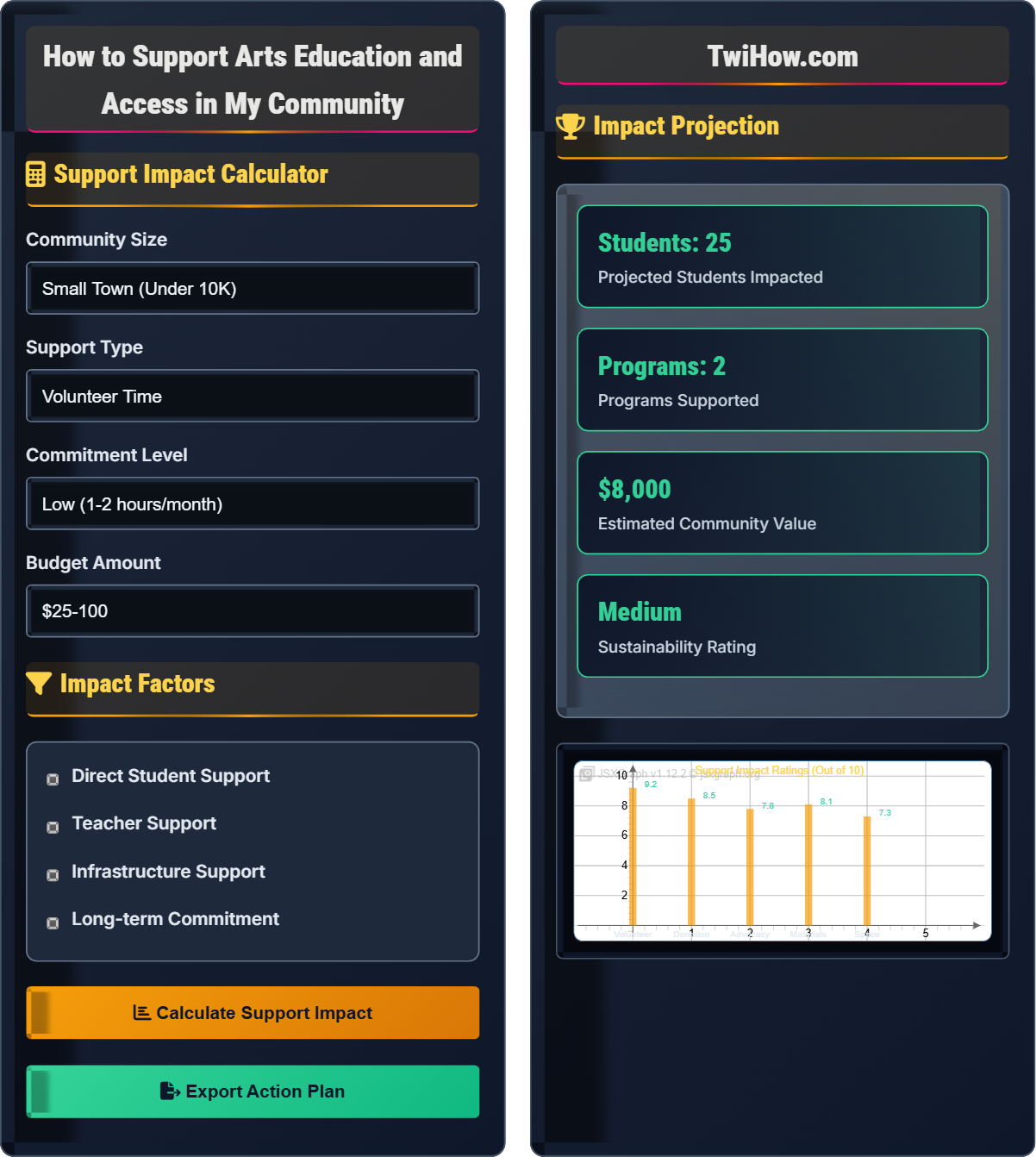
Support Impact Calculator
Impact Factors
Impact Projection
Support local arts teachers by assisting with classroom activities and providing one-on-one student support
Coordinate community event to raise funds for arts supplies and equipment
Attend school board meetings and advocate for increased arts education funding
| Resource | Type | Availability | Impact | Access | Rating |
|---|---|---|---|---|---|
| Local Arts Organizations | Partnership | High | High | Easy | 4.8/5 |
| Volunteer Programs | Engagement | Medium | Medium | Easy | 4.6/5 |
| Funding Opportunities | Financial | Variable | High | Moderate | 4.4/5 |
Ways to Support Arts Education
Direct financial contributions fund essential programs, supplies, and equipment. Donations can be made to schools, community organizations, or specific arts programs. Corporate sponsorships and grant writing also provide substantial support.
Financial impact: Supplies, equipment, teacher salaries, program expansion, and scholarship opportunities for underserved students.
Volunteers assist teachers, mentor students, chaperone events, and provide administrative support. Skills-based volunteering allows professionals to share expertise in marketing, accounting, or technical areas.
Volunteer benefits: Direct student interaction, skill development, community building, and hands-on program support.
Advocacy efforts include attending school board meetings, contacting elected officials, and raising awareness about arts education benefits. Public speaking and community organizing amplify support.
Advocacy impact: Policy changes, increased funding, public awareness, and long-term program sustainability.
Donating materials, equipment, or space provides direct support. Professionals can offer expertise through workshops, masterclasses, or mentoring programs. Technology donations expand digital arts access.
Resource categories: Instruments, art supplies, performance spaces, technology, and professional expertise.
Building partnerships between schools, businesses, cultural institutions, and community organizations creates sustainable support networks. Collaborative efforts maximize impact and resources.
Partnership opportunities: Business sponsorships, cultural institution collaborations, and cross-sector initiatives.
Attending performances, exhibitions, and events demonstrates community support. Family involvement encourages student participation and creates broader community investment in arts programs.
Engagement activities: Show attendance, parent volunteering, community celebrations, and family workshops.
Support Strategies by Impact Level
Quick Impact Actions
Simple actions that can be taken immediately to support arts education: attending events, volunteering for specific activities, donating basic supplies, or spreading awareness through social media.
Organized Support Efforts
More structured approaches requiring planning: organizing fundraising events, establishing volunteer programs, coordinating with multiple stakeholders, or advocating for policy changes.
Sustainable Partnerships
Systematic approaches for lasting impact: creating endowments, establishing permanent programs, developing curriculum partnerships, or building institutional support systems.
Policy and Infrastructure
Addressing root causes through advocacy, policy change, and systemic improvements to ensure equitable access to arts education for all community members.
Community Support Timeline
Assessment & Research
Identify local needs, existing programs, and key stakeholders
Initial Contact
Reach out to schools, organizations, and community leaders
First Actions
Begin volunteering, donate supplies, attend events
Organized Efforts
Organize events, establish partnerships, advocate for programs
Expansion & Growth
Scale successful initiatives, recruit more supporters
Sustainability
Establish long-term programs and institutional support
Support Impact Distribution
| Action | Type | Time Required | Impact Level | Community Reach | Difficulty |
|---|---|---|---|---|---|
| Volunteer Teaching Assistant | Direct Support | 2-4 hours/week | High | 15-30 students | Medium |
| Fundraising Event | Financial | Monthly | High | Multiple programs | High |
| School Board Advocacy | Policy | Quarterly | Very High | All students | Medium |
| Supply Donations | Material | As needed | Medium | Classroom | Low |
| Performance Attendance | Engagement | Event-based | Medium | 100+ attendees | Low |
Resources and Partnerships
Organizations and resources for arts education support.
National Endowment for the Arts Americans for the Arts Local Arts CouncilsGroups focused on community arts education support.
Local Volunteer Centers School Volunteer Programs Arts Education NonprofitsGrants and funding opportunities for arts education.
Federal Grant Programs Corporate Sponsorships Foundation GrantsArts Education Support Quiz
What is the most effective way to support arts education in your community?
Consistent, smaller contributions over time provide sustainable support that allows programs to plan effectively and maintain operations. While large donations are valuable, steady support enables long-term program development and stability.
The answer is B) Provide consistent, smaller contributions over time.
Effective community support requires understanding the difference between transactional and relational approaches. Sustainable support comes from consistent engagement rather than sporadic large gestures. This approach builds trust, enables planning, and creates lasting impact for both programs and students.
Sustainable Support: Consistent contributions over time
Program Planning: Long-term organizational strategy
Community Investment: Ongoing stakeholder engagement
• Consistency beats size for sustainability
• Long-term commitment enables planning
• Small actions compound over time
• Start with manageable commitments
• Build relationships with program staff
• Coordinate with other supporters
• Expecting immediate results from single actions
• Not following through on commitments
• Working in isolation from others
How should you approach advocating for arts education funding at a school board meeting?
Preparation:
Research: Understand current budget allocations, specific program needs, and district priorities.
Build Coalition: Connect with other parents, teachers, and community members who support arts education.
Gather Evidence: Collect data on arts education benefits, student achievement, and community support.
Meeting Strategy:
Be Specific: Request specific funding amounts for particular programs rather than general support.
Focus on Outcomes: Emphasize academic benefits, student engagement, and long-term community value.
Offer Solutions: Present concrete proposals rather than just identifying problems.
Follow Up: Maintain engagement after the meeting through continued communication and monitoring.
Effective advocacy requires strategic preparation and professional presentation. School boards make decisions based on evidence, feasibility, and community priorities. By presenting well-researched arguments that align with district goals, advocates can significantly increase their impact on funding decisions.
Advocacy: Speaking in favor of a cause or policy
Coalition Building: Forming alliances with supporters
Stakeholder Engagement: Involving all interested parties
• Prepare thoroughly before meetings
• Focus on outcomes and benefits
• Maintain respectful dialogue
• Bring supporting documentation
• Practice your presentation
• Follow up with board members
• Appearing unprepared or emotional
• Focusing on personal grievances
• Not offering concrete solutions
Your community has $10,000 available for arts education support. You have identified four equally important needs: instrument repairs ($4,000), art supplies ($3,000), teacher professional development ($5,000), and field trip transportation ($2,000). How should you allocate these funds to maximize impact?
Priority Assessment:
Immediate Needs: Instrument repairs and art supplies address urgent classroom needs that directly impact daily instruction.
Long-term Investment: Teacher professional development enhances program quality for years to come.
Equitable Approach: Field trips provide access opportunities for students who might not otherwise experience cultural venues.
Recommended Allocation:
Instrument repairs: $4,000 (immediate impact, enables program continuation)
Art supplies: $3,000 (essential for creative activities)
Teacher PD: $2,000 (partial funding for sustainable improvement)
Field trip transportation: $1,000 (partial funding for access opportunity)
Rationale: This allocation addresses immediate needs while beginning to invest in long-term improvement. The remaining needs can be pursued through additional fundraising efforts.
Resource allocation in community support requires balancing immediate needs with long-term goals. Effective allocation considers urgency, impact scope, sustainability, and equity. The best approaches often combine addressing critical needs with strategic investments in future capacity.
Resource Allocation: Distributing limited resources effectively
Immediate Needs: Urgent requirements for program operation
Long-term Investment: Improvements with sustained benefits
• Address urgent needs first
• Consider long-term impact
• Balance multiple priorities
• Consult with program directors
• Consider seasonal timing
• Plan for future fundraising
• Allocating based on personal preferences
• Not consulting program staff
• Focusing only on visible needs
You want to establish a partnership between your local business and the elementary school's art program. What steps should you take to create a mutually beneficial relationship that supports the program sustainably?
Initial Steps:
1. Identify Needs: Meet with school administration and art teachers to understand specific program needs and goals
2. Assess Capabilities: Determine what resources your business can realistically provide (time, money, expertise, space)
3. Find Alignment: Identify how the partnership supports both the school's mission and your business objectives
4. Propose Structure: Develop a formal agreement outlining mutual responsibilities, expectations, and timelines
5. Implement Gradually: Start with small initiatives and expand based on success and mutual satisfaction
Sustainability Measures:
• Regular communication between partners
• Clear metrics for measuring success
• Flexible arrangements that adapt to changing needs
• Recognition of mutual benefits to maintain enthusiasm
Successful partnerships require careful planning and mutual benefit consideration. The most effective community-business partnerships align organizational missions, leverage complementary strengths, and create sustainable value for all parties. This approach ensures long-term commitment and measurable impact.
Mutual Benefit: Advantages for all partnership parties
Stakeholder Alignment: Shared goals and objectives
Sustainable Partnership: Long-term collaborative relationship
• Understand partner needs and goals
• Establish clear agreements
• Measure and communicate impact
• Start with small pilot projects
• Celebrate joint successes publicly
• Maintain regular communication
• Assuming all parties have same priorities
• Not documenting partnership agreements
• Failing to measure partnership success
Which type of volunteer activity typically has the greatest impact on student learning in arts education?
Direct one-on-one student support provides the greatest impact on learning because it offers personalized attention, immediate feedback, and tailored instruction that can address individual student needs. While other volunteer activities are valuable, direct student interaction most directly influences learning outcomes.
The answer is B) Direct one-on-one student support.
Educational research consistently shows that individualized attention and feedback significantly enhance learning outcomes. In arts education, where creativity and skill development are personal journeys, one-on-one support allows volunteers to encourage experimentation, provide constructive feedback, and help students overcome specific challenges.
Individualized Attention: Personalized focus on student needs
Learning Outcomes: Measurable improvements in student ability
Personalized Feedback: Specific guidance for improvement
• Direct student interaction maximizes learning impact
• Individualized attention enhances outcomes
• All volunteer roles contribute to success
• Train volunteers in effective teaching techniques
• Pair volunteers with students appropriately
• Provide ongoing support to volunteers
• Undervaluing indirect support activities
• Not training volunteers properly
• Failing to match volunteers to appropriate tasks
FAQ
Q: I don't have much money to donate. How else can I support arts education in my child's school?
A: Time and skills are incredibly valuable! You can volunteer as a classroom helper, chaperone field trips, assist with performances, or help organize events. Even driving students to competitions or helping with costume/prop preparation makes a huge difference. You can also donate gently used supplies, promote events on social media, or simply attend student performances to show support.
Many parents underestimate the impact of simply showing up to student events. Your presence and encouragement mean everything to young artists. Volunteering even 1-2 hours per month can significantly support teachers and enhance your child's educational experience.
Q: What are the benefits of supporting arts education for my business?
A: Supporting arts education provides multiple business benefits: enhanced community reputation, positive employee engagement, potential tax deductions, and access to a more creative workforce in the future. Students who participate in arts programs develop creativity, problem-solving, and collaboration skills that are highly valued in today's economy.
Additionally, your support demonstrates corporate social responsibility, which resonates with customers and employees. Many businesses find that arts education partnerships create meaningful community connections that extend beyond simple advertising benefits.