How to Support Museums, Galleries, and Cultural Institutions
Complete support guide • Step-by-step explanations
Cultural Support Fundamentals:
Show Support CalculatorSupporting museums, galleries, and cultural institutions is crucial for preserving history, promoting education, and fostering creativity in our communities. These institutions rely on various forms of support to maintain operations, acquire new collections, and offer educational programs.
There are multiple ways to support cultural institutions:
- Financial Contributions: Donations, memberships, and sponsorships
- Volunteer Services: Time and expertise sharing
- Advocacy: Promoting awareness and policy support
- Community Engagement: Attendance and participation
Effective support combines financial backing with active participation and community outreach to ensure these institutions remain vibrant and accessible to all.
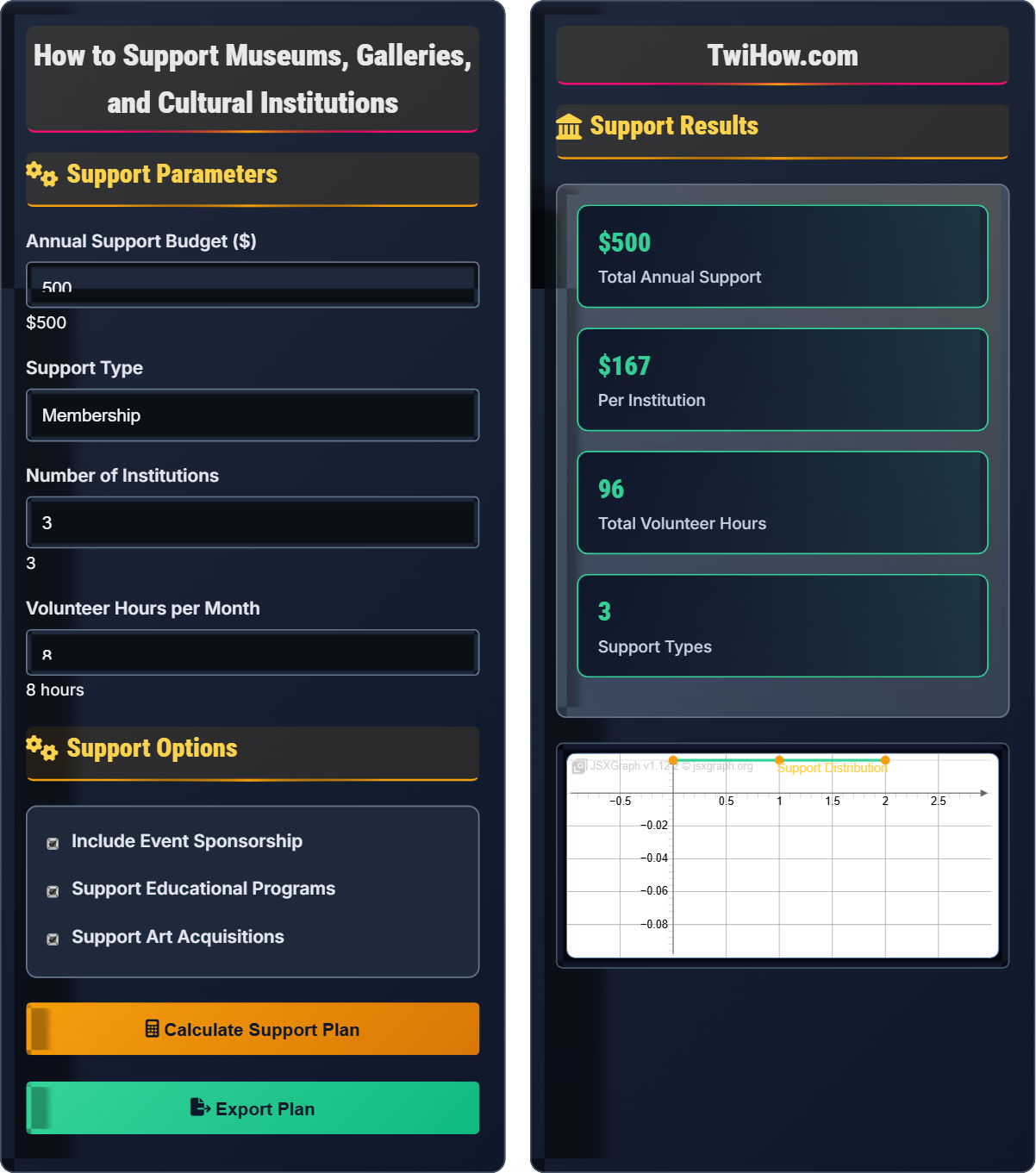
Support Parameters
Support Options
Support Results
| Type | Amount | Frequency | Impact |
|---|---|---|---|
| Membership | $300 | Annual | Access + Operations |
| Donation | $600 | Annual | Programs + Collections |
| Volunteer | 96 hrs | Monthly | Direct Support |
Personalized Recommendations
Based on your budget and preferences:
- Consider joining the Friends program for deeper engagement
- Look into corporate matching gift programs
- Explore planned giving options for long-term impact
- Attend member-only events and previews
How to Support Cultural Institutions Explained
Museums, galleries, and cultural institutions serve as repositories of human knowledge, creativity, and heritage. They provide educational opportunities, preserve cultural artifacts, and inspire future generations. Supporting these institutions ensures that art, history, and culture remain accessible to everyone.
Financial contributions are among the most direct ways to support cultural institutions:
Where:
- Membership Fees: Recurring support providing access benefits
- Donations: One-time or recurring gifts for specific purposes
- Sponsorships: Funding for exhibitions, events, or programs
Support goes toward various critical areas:
- Collection Care: Preservation and conservation of artworks and artifacts
- Education: School programs, workshops, and public lectures
- Exhibitions: New shows, installations, and special events
- Operations: Daily maintenance, staffing, and utilities
- Community Outreach: Programs for underserved populations
- Research: Academic studies and scholarly publications
- Annual Membership: Provides ongoing operational support
- Planned Giving: Bequests and endowments for long-term sustainability
- Corporate Partnerships: Business sponsorships and employee volunteer programs
- Event Participation: Gala dinners, fundraising events, and auctions
- Advocacy: Supporting public policies that fund cultural institutions
Support Methods
Membership, donations, volunteering, advocacy, corporate partnerships, planned giving.
Total Support = Membership Fees + Donations + Volunteer Hours + Advocacy Efforts
Where each component contributes differently to institutional sustainability.
- Consistent support is more valuable than sporadic large gifts
- Volunteer time often matches monetary contributions in value
- Corporate matching can double your donation impact
Local Cultural Institutions
Discover nearby museums, galleries, and cultural centers worth supporting.
Membership Programs
Membership Tiers Comparison
- Free admission year-round
- Member-only previews
- Discounted event tickets
- Free admission for 4 people
- Member-only previews
- Discounted event tickets
- Newsletter subscription
- All previous benefits
- Behind-the-scenes tours
- Curator-led discussions
- Recognition in annual report
Volunteer Opportunities
Volunteer Roles
Upcoming Events
Cultural Support Learning Quiz
Which of the following is NOT typically included in a basic museum membership?
While basic memberships typically include free admission, discounts, and newsletters, behind-the-scenes curator tours are usually reserved for higher-tier memberships or special donor events. These exclusive experiences are offered to members who contribute more significantly to the institution.
The answer is C) Behind-the-scenes curator tours.
Understanding membership tiers helps supporters maximize their benefits while institutions maintain sustainable revenue streams. Basic memberships provide core benefits that encourage regular attendance, while premium memberships offer exclusive experiences that reward larger contributions. This tiered approach ensures accessibility while generating additional funds for special programs.
Membership Tier: Different levels of membership with varying benefits
Exclusive Access: Privileges offered only to certain supporter levels
Revenue Diversification: Multiple income sources for institutional sustainability
• Higher membership tiers offer greater benefits
• Exclusive access rewards significant contributors
• Tiered systems promote institutional sustainability
• Compare membership benefits across institutions
• Consider family memberships for broader access
• Look for corporate matching programs
• Assuming all members get exclusive access
• Not understanding membership differences
• Missing out on group discounts
Explain how corporate partnerships benefit both businesses and cultural institutions. Provide specific examples of mutual advantages.
Benefits for Cultural Institutions: Corporate partnerships provide substantial funding for operations, special exhibitions, educational programs, and capital improvements. Businesses also contribute expertise in marketing, technology, and management that institutions may lack.
Benefits for Corporations: Companies gain positive brand association with culture and education, tax deductions for charitable contributions, and opportunities for employee engagement and team building. They also reach educated, culturally aware audiences.
Examples: Bank of America sponsors free museum days nationwide, gaining positive publicity while increasing museum attendance. Tech companies partner with science museums for STEM education programs, enhancing their reputation while supporting education.
Corporate partnerships represent a win-win relationship where businesses fulfill social responsibility goals while institutions receive critical resources. These partnerships often involve multi-year commitments that provide stable funding for long-term projects. Success depends on aligning corporate values with institutional missions.
Corporate Social Responsibility: Business commitment to ethical practices and community support
Partnership Synergy: Combined effect greater than individual contributions
Stakeholder Alignment: Shared values between partners
• Partnerships should align with institutional mission
• Clear agreements protect both parties
• Transparency maintains public trust
• Research corporate CSR programs
• Prepare compelling partnership proposals
• Measure and report partnership impact
• Accepting partnerships misaligned with values
• Poor documentation of agreements
• Not measuring partnership success
A local history museum has an annual operating budget of $2 million and receives 60% from government funding, 25% from admissions and memberships, and needs to raise 15% through private support. If the museum wants to increase its private support by 20% next year to fund a new exhibit, calculate how much additional private support is needed and suggest three strategies to achieve this goal.
Current Private Support: 15% of $2,000,000 = $300,000
Target Increase: 20% of $300,000 = $60,000
New Target: $300,000 + $60,000 = $360,000
Three Strategies:
1. Major Donor Campaign: Identify and cultivate 10 major donors contributing $3,000-$5,000 each
2. Corporate Sponsorship Drive: Secure 3 corporate sponsors contributing $10,000-$15,000 each
3. Community Fundraising Events: Organize 2-3 events raising $15,000-$20,000 each
These combined efforts would generate approximately $360,000 in private support.
Diversifying funding sources is crucial for institutional sustainability. Calculating precise funding needs helps set realistic goals and allocate resources effectively. Successful fundraising requires multiple approaches targeting different donor segments to minimize risk and maximize reach.
Revenue Diversification: Multiple funding sources reducing dependency risk
Major Donors: High-contributing individuals with capacity for significant gifts
Fundraising Strategy: Coordinated approach to secure financial support
• Calculate precise funding needs
• Diversify funding sources
• Maintain donor relationships
• Start planning fundraisers well in advance
• Track donor engagement metrics
• Express gratitude promptly
• Setting unrealistic fundraising goals
• Not diversifying funding sources
• Failing to acknowledge donors properly
A medium-sized art gallery currently has 15 volunteers contributing an average of 4 hours per week. The director wants to increase volunteer engagement by 50% to support expanded programming. Design a volunteer program that achieves this goal while maintaining volunteer satisfaction and retention.
Current Volunteer Hours: 15 volunteers × 4 hours = 60 hours/week
Target Increase: 50% of 60 = 30 additional hours/week
New Target: 90 hours/week total
Optimized Volunteer Program:
1. Role Diversification: Expand from front desk duties to education assistance, docent training, and special event support
2. Flexible Scheduling: Offer various shift lengths (2, 4, 6 hours) and days to accommodate different schedules
3. Recognition System: Monthly appreciation events, volunteer newsletters, and achievement certificates
4. Professional Development: Training in art history, museum studies, and customer service
These changes would increase engagement while providing meaningful experiences for volunteers.
Effective volunteer programs balance institutional needs with volunteer satisfaction. Engagement increases when volunteers feel valued, learn new skills, and see the impact of their contributions. Successful programs match volunteer interests with institutional needs while providing growth opportunities.
Volunteer Engagement: Level of involvement and commitment of volunteers
Retention Rate: Percentage of volunteers who continue their service
Skills-Based Volunteering: Matching volunteer expertise with institutional needs
• Match volunteer interests with assignments
• Provide adequate training and support
• Recognize volunteer contributions regularly
• Conduct volunteer interest surveys
• Create buddy systems for new volunteers
• Offer flexible scheduling options
• Overworking volunteers without recognition
• Not providing adequate training
• Assigning volunteers to mismatched roles
Which of the following represents the most effective way to support cultural institutions digitally?
All digital support methods contribute meaningfully to cultural institutions. While online donations provide direct financial support, social media sharing increases visibility and attracts new visitors. Virtual participation demonstrates ongoing interest and supports digital programming initiatives. The combination of all methods creates comprehensive digital support.
The answer is D) All of the above contribute meaningfully.
Digital engagement has become increasingly important for cultural institutions, especially post-pandemic. Institutions now offer hybrid experiences combining physical and digital access. Digital support methods expand reach beyond geographic limitations and engage younger demographics. A comprehensive digital strategy maximizes impact across multiple dimensions.
Digital Engagement: Interaction with cultural content through online platforms
Virtual Programming: Online events, tours, and educational content
Hybrid Experience: Combination of physical and digital access
• Digital support complements physical visits
• Online engagement expands audience reach
• Consistent digital presence builds loyalty
• Follow institutions on multiple platforms
• Engage with online content regularly
• Share experiences with your network
• Viewing digital engagement as less valuable
• Not participating in virtual offerings
• Focusing only on one support method
FAQ
Q: How can I support museums if I have limited financial resources?
A: There are many ways to support museums without significant financial contributions:
1. Volunteer: Many museums need help with visitor services, special events, and educational programs
2. Share: Promote exhibitions and events on social media to increase awareness
3. Visit Regularly: Frequent attendance demonstrates community interest and supports operational statistics
4. Join Friends Groups: Often have minimal fees but provide networking and special access
5. Attend Free Events: Shows community engagement and helps justify funding requests
Time and advocacy can be as valuable as financial support!
Q: What's the difference between donating money and donating artwork to a museum?
A: Monetary donations and artwork donations serve different institutional needs:
Monetary Donations: Provide immediate operational flexibility. Funds can be used for conservation, education programs, acquisitions, or facility maintenance. The museum has complete discretion over how to allocate the money.
Artwork Donations: Add to the permanent collection but come with responsibilities. The museum must assess whether the piece fits their collecting mission, has proper provenance, and can be properly cared for. The institution may decline donations that don't meet their criteria.
Both are valuable, but monetary gifts offer more flexibility for institutional priorities.