How Do I Support Sustainable Practices in Arts and Cultural Production?
Green Venues • Eco-Friendly Materials • Ethical Sourcing • Environmental Responsibility
Sustainable Arts:
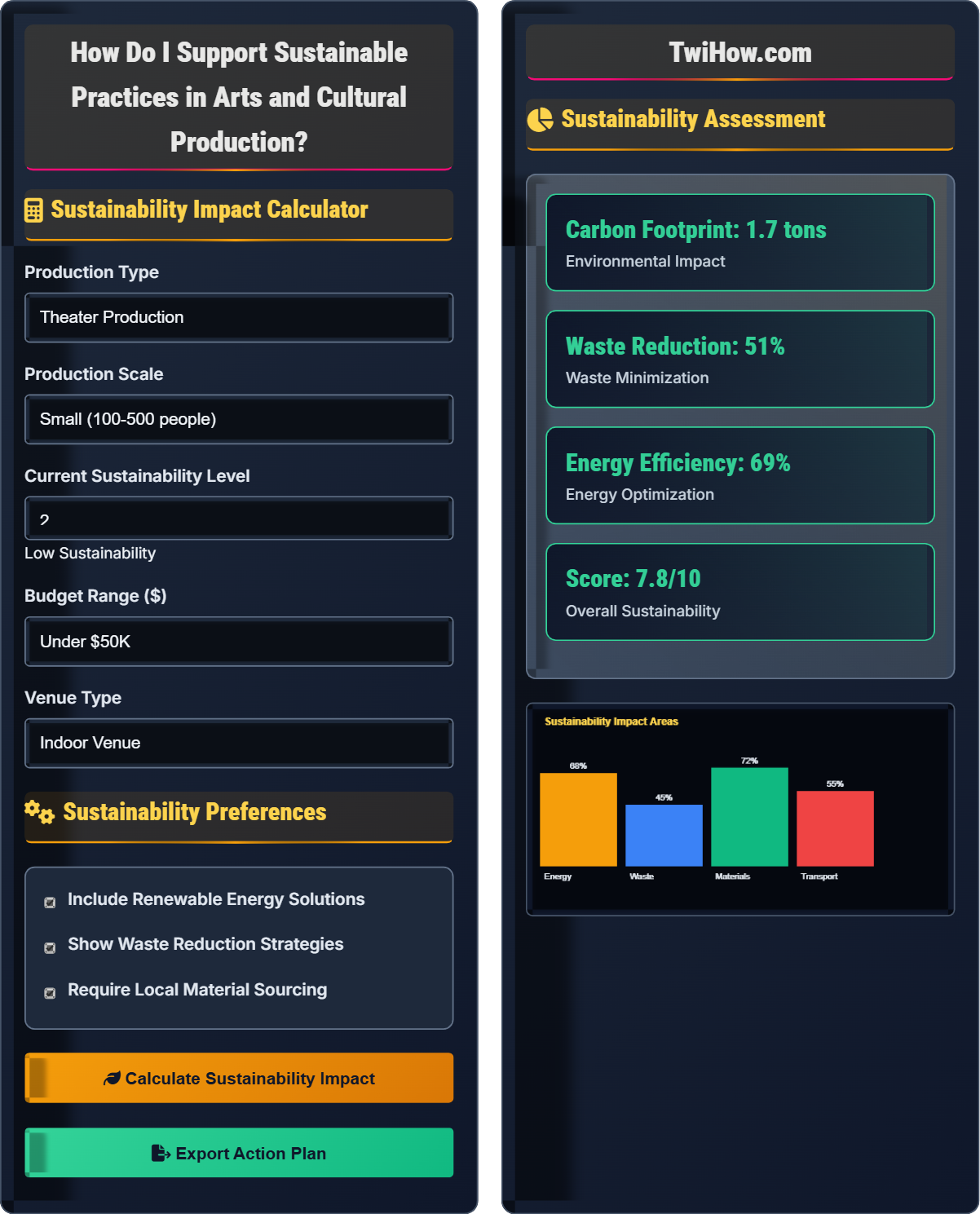
Sustainability Impact CalculatorSupporting sustainable practices in arts and cultural production involves implementing environmentally responsible approaches throughout the creative process. This includes using eco-friendly materials, reducing waste, minimizing carbon footprints, and promoting ethical practices that protect both the environment and cultural workers.
Key sustainability areas:
- Material Sourcing: Using recycled, renewable, and non-toxic materials
- Energy Efficiency: Green venues and sustainable power sources
- Waste Reduction: Minimizing waste through reuse and recycling
- Ethical Labor: Fair wages and safe working conditions
- Community Impact: Supporting local economies and communities
- Long-term Planning: Ensuring cultural sustainability for future generations
Sustainable practices benefit both the environment and the cultural sector by reducing costs, improving reputation, and ensuring long-term viability.
Sustainability Impact Calculator
Sustainability Preferences
Sustainability Assessment
| Category | Current Impact | Potential Reduction | Feasibility |
|---|---|---|---|
| Energy Usage | High | 40% | Medium |
| Material Waste | High | 60% | High |
| Transportation | Medium | 25% | Low |
| Water Usage | Low | 15% | Medium |
Sustainable Arts Production Framework
Sustainable practices in arts and cultural production encompass environmental, social, and economic considerations that ensure long-term viability while minimizing negative impacts. The approach involves:
- Environmental Stewardship: Minimizing ecological footprint through responsible resource use
- Social Responsibility: Ensuring fair labor practices and community benefits
- Economic Viability: Maintaining financial sustainability while supporting ethical practices
- Material Innovation: Exploring eco-friendly alternatives and circular economy principles
- Energy Efficiency: Implementing renewable energy and conservation measures
- Community Engagement: Building local partnerships and supporting cultural diversity
The overall sustainability impact can be measured using this framework:
Where:
- Environmental Impact: Carbon footprint, waste generation, resource consumption
- Social Impact: Labor practices, community engagement, accessibility
- Economic Impact: Local economic benefits, cost efficiency, long-term viability
- Innovation Factor: Adoption of new sustainable technologies and practices
Essential practices for sustainable arts production:
- Material Selection: Choose renewable, recyclable, and non-toxic materials
- Energy Management: Use renewable energy sources and efficient equipment
- Waste Reduction: Implement circular economy principles and zero-waste goals
- Transportation: Minimize travel and use sustainable transport options
- Water Conservation: Efficient water use and recycling systems
- Local Partnerships: Support local suppliers and communities
Sustainable arts production balances three key dimensions:
- People: Social responsibility, fair labor practices, community engagement
- Planet: Environmental protection, resource conservation, ecological stewardship
- Profit: Economic viability, cost efficiency, long-term financial sustainability
Sustainable Practices Implementation
Effective material management strategies:
Energy-saving strategies for arts venues:
Comprehensive waste reduction strategies:
- Recycling Stations: Set up clearly marked recycling points throughout venues
- Composting Programs: Process organic waste from catering and events
- Digital Ticketing: Eliminate paper tickets and printed programs
- Reusable Items: Provide reusable cups, plates, and utensils
- Material Recovery: Establish systems for recovering and repurposing set materials
- Vendor Requirements: Mandate sustainable practices from all suppliers
Green Venues & Facilities
Sustainable Arts Practices Quiz
Which of the following is the most environmentally sustainable approach to costume production?
Creating costumes from recycled and sustainable materials is the most environmentally sustainable approach. This method minimizes waste, reduces the need for new resources, and supports circular economy principles. While rental costumes are also sustainable, using recycled materials creates new items without contributing to overconsumption.
The answer is C) Creating costumes from recycled and sustainable materials.
Sustainable costume production involves considering the entire lifecycle of materials. Recycled and sustainable materials reduce environmental impact while still allowing for creative expression. This approach supports both environmental goals and artistic innovation.
Circular Economy: Economic system aimed at eliminating waste and continual use of resources
Sustainable Materials: Resources that can be used without depleting natural reserves
Life Cycle Assessment: Analysis of environmental impacts throughout a product's life
• Minimize resource consumption
• Prioritize recycled materials
• Consider full lifecycle impact
• Partner with textile recyclers
• Use organic and natural fibers
• Design for disassembly and reuse
• Not considering material origins
• Ignoring disposal methods
• Focusing only on aesthetics
Explain how renewable energy systems can be integrated into arts venues and the benefits of doing so. Include specific technologies and implementation strategies.
Solar Power Systems: Photovoltaic panels can be installed on rooftops, parking structures, or adjacent land to generate electricity. Modern systems can offset 50-100% of venue energy needs depending on size and location.
Wind Power: Small wind turbines can supplement energy needs in areas with consistent wind patterns, particularly for outdoor venues.
Geothermal Systems: Ground-source heat pumps can efficiently manage heating and cooling needs while reducing energy consumption by 30-60%.
Implementation Strategies:
1. Energy Audit: Assess current energy consumption patterns and peak demands
2. System Sizing: Calculate appropriate renewable energy capacity based on usage
3. Financing Options: Explore grants, tax incentives, and green financing programs
4. Phased Implementation: Install systems gradually to spread costs and minimize disruption
5. Monitoring Systems: Track energy production and consumption for optimization
Benefits: Reduced operational costs, lower carbon footprint, energy independence, and positive public relations.
Renewable energy integration requires careful planning that considers venue-specific factors like location, energy needs, and budget constraints. The most effective approach combines multiple technologies and includes comprehensive monitoring to ensure optimal performance. Long-term benefits often outweigh initial investment costs.
Photovoltaic: Technology that converts light into electrical energy
Net Zero Energy: Building that produces as much energy as it consumes
Energy Independence: Reduced reliance on external energy sources
• Conduct thorough energy assessments
• Consider local climate conditions
• Plan for long-term maintenance
• Research available incentives and rebates
• Partner with renewable energy specialists
• Consider battery storage systems
• Incorrect system sizing
• Not considering maintenance costs
• Ignoring local regulations and permits
Your theater company produces 10 shows per year, generating approximately 500 pounds of waste per show. Calculate the total annual waste and design a waste reduction strategy that could reduce this by 60%. Include specific methods and expected outcomes.
Current Annual Waste: 10 shows × 500 pounds = 5,000 pounds per year
Target Reduction: 5,000 × 0.60 = 3,000 pounds reduction
New Target: 2,000 pounds per year
Waste Reduction Strategy:
1. Digital Programs: Eliminate paper programs (saves ~500 lbs/year)
2. Reusable Materials: Use reusable set pieces and props (saves ~1,000 lbs/year)
3. Recycling Program: Sort and recycle paper, plastic, and metal waste (saves ~800 lbs/year)
4. Composting: Process organic waste from catering (saves ~300 lbs/year)
5. Donation System: Donate reusable materials to schools and community groups (saves ~400 lbs/year)
Total Expected Reduction: 3,000 pounds (60% reduction)
Additional Benefits: Cost savings, improved public image, educational opportunities.
Effective waste reduction requires a systematic approach that addresses different types of waste streams. The key is to focus on prevention rather than just disposal, implementing strategies that reduce waste generation at the source. This approach creates long-term sustainability benefits.
Waste Stream: Specific category of waste materials requiring different handling
Zero Waste: Goal of eliminating waste through reuse, recycling, and prevention
Waste Hierarchy: Priority order for waste management: reduce, reuse, recycle
• Focus on waste prevention first
• Implement comprehensive sorting systems
• Track and measure reduction progress
• Conduct regular waste audits
• Educate staff and volunteers
• Partner with local recycling programs
• Not tracking waste types separately
• Assuming all recycling is equal
• Not involving all stakeholders
You're planning a large outdoor music festival that expects 20,000 attendees. Design a sustainable transportation plan that reduces the carbon footprint while ensuring accessibility and convenience for all attendees.
Sustainable Transportation Plan:
1. Public Transit Partnership: Coordinate with local transit authorities to provide frequent shuttle services and expanded bus routes to the venue
2. Carpooling Platform: Create an app or system to connect attendees traveling from similar locations
3. Bicycle Infrastructure: Provide secure bike parking, bike-sharing partnerships, and cycling routes
4. Electric Vehicle Charging: Install EV charging stations for attendees with electric vehicles
5. Local Accommodation: Partner with nearby hotels and campgrounds to reduce travel distances
6. Remote Parking: Offer shuttle services from distant parking areas to reduce congestion
Accessibility Considerations:
• Ensure all transportation options are accessible to people with disabilities
• Provide wheelchair-accessible shuttles and seating
• Offer reserved parking for mobility-impaired attendees
Expected Impact: 40-50% reduction in individual vehicle trips, significant carbon footprint reduction.
Sustainable transportation planning requires balancing environmental goals with practical accessibility needs. The most effective approach provides multiple options that accommodate different mobility needs, economic situations, and geographic locations while maintaining convenience for all attendees.
Carbon Footprint: Total greenhouse gas emissions caused by an individual, event, or organization
Modal Shift: Change in transportation mode from higher to lower carbon options
Transportation Demand Management: Strategies to reduce vehicle travel
• Ensure accessibility for all attendees
• Provide multiple transportation options
• Start planning transportation early
• Partner with local transit authorities
• Incentivize sustainable choices
• Not considering accessibility needs
• Assuming all attendees have similar options
• Not coordinating with local authorities
Which of the following is the most effective long-term strategy for ensuring economic sustainability of sustainable practices in arts production?
Integrating sustainable practices into the core business model is the most effective long-term strategy. This approach ensures that sustainability becomes a fundamental part of operations rather than an add-on program. It creates accountability, generates cost savings through efficiency, and builds sustainable competitive advantages that support long-term financial health.
The answer is B) Integrating sustainable practices into core business model.
Economic sustainability requires that sustainable practices generate value that justifies their costs. When sustainability is integrated into the business model, it creates synergies that improve both environmental performance and financial results. This approach ensures that sustainable practices are maintained even when external funding is unavailable.
Triple Bottom Line: Accounting framework that includes social, environmental, and financial performance
Economic Sustainability: Ability to maintain financial viability while supporting environmental and social goals
Business Model Integration: Embedding sustainability into core operations and value creation
• Align sustainability with business goals
• Measure both costs and benefits
• Create sustainable competitive advantages
• Develop sustainability metrics tied to performance
• Create revenue streams from sustainable practices
• Build sustainability into organizational culture
• Treating sustainability as a separate program
• Not measuring financial returns
• Assuming sustainability always costs more
FAQ
Q: How can small theaters implement sustainable practices with limited budgets?
A: Small theaters can implement sustainable practices through:
Low-Cost Initiatives: Digital ticketing, LED lighting upgrades, recycling programs, and energy-efficient equipment
Partnerships: Collaborate with local environmental groups, universities, and green businesses
Volunteer Programs: Engage community volunteers for sustainability initiatives
Grant Funding: Apply for environmental and arts grants that support sustainable practices
Reuse and Repurpose: Maximize use of existing sets, costumes, and props
Community Education: Use sustainability efforts as educational opportunities that enhance community engagement
Many sustainable practices actually reduce costs over time while building positive community relationships.
Q: What are the most effective ways to measure the success of sustainability initiatives at cultural events?
A: Effective measurement approaches include:
Quantitative Metrics: Carbon footprint, waste diversion rates, energy consumption, water usage
Qualitative Indicators: Audience satisfaction, community engagement, brand perception
Financial Measures: Cost savings from efficiency improvements, revenue from green initiatives
Baseline Comparisons: Compare current performance to previous years or similar events
Third-Party Certifications: Pursue recognized sustainability certifications like ISO 20121
Stakeholder Feedback: Surveys from attendees, staff, and vendors about sustainability efforts
Combining multiple measurement approaches provides a comprehensive view of sustainability performance and impact.
Best Practices for Implementation
Proven approaches for successful sustainable practices implementation:
- Leadership Commitment: Ensure executive buy-in and dedicated resources
- Staff Training: Educate all team members about sustainable practices
- Stakeholder Engagement: Involve artists, vendors, and community members
- Progressive Implementation: Start with easy wins and expand gradually
- Continuous Monitoring: Track metrics and adjust strategies regularly
- Transparent Reporting: Communicate efforts and achievements to audiences
Recommended timeline for sustainable practices adoption:
- Month 1-2: Assessment and planning phase
- Month 3-4: Staff training and vendor communication
- Month 5-6: Pilot program implementation
- Month 7-8: Evaluation and refinement
- Month 9-12: Full implementation and expansion
- Year 2+: Continuous improvement and innovation