What Are the Benefits of Cultural Literacy and How Do I Develop It?
Enhanced Communication • Cultural Awareness • Global Competency • Personal Growth
Cultural Literacy:
Literacy Assessment ToolCultural literacy encompasses the knowledge, understanding, and appreciation of diverse cultural expressions, traditions, and perspectives. In today's interconnected world, cultural literacy is essential for effective communication, collaboration, and personal growth. It enables individuals to navigate diverse environments with confidence and respect.
Key components of cultural literacy:
- Historical Knowledge: Understanding cultural origins and evolution
- Artistic Traditions: Appreciation of music, visual arts, literature, and performance
- Communication Styles: Recognizing different cultural communication patterns
- Values & Beliefs: Understanding cultural frameworks and worldviews
- Contemporary Expressions: Awareness of modern cultural developments
- Global Perspectives: Appreciation of diverse cultural viewpoints
Developing cultural literacy enhances empathy, communication skills, and global awareness while enriching personal and professional relationships.
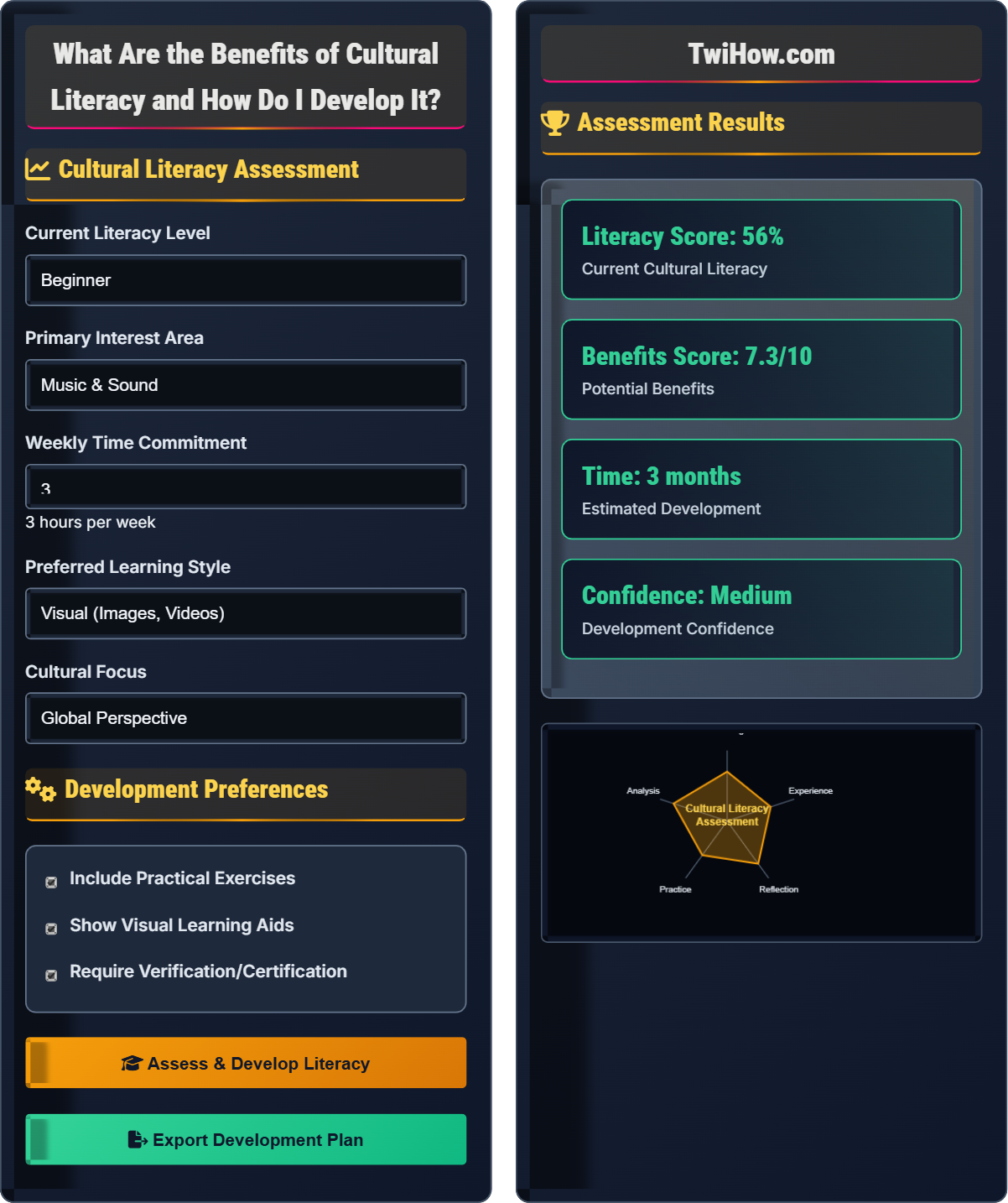
Cultural Literacy Assessment
Development Preferences
Assessment Results
Cultural Literacy Framework
Cultural literacy encompasses the knowledge, skills, and understanding required to navigate and appreciate diverse cultural contexts. It involves:
- Knowledge Acquisition: Learning about cultural histories, traditions, and expressions
- Skill Development: Building abilities to interpret and engage with cultural content
- Attitude Formation: Developing respect, openness, and empathy for diversity
- Application: Using cultural understanding in real-world contexts
- Critical Analysis: Evaluating cultural expressions and their meanings
- Continuous Learning: Maintaining curiosity and growth mindset
Cultural literacy development can be understood through this framework:
Where:
- Knowledge: Factual understanding of cultural elements
- Experience: Direct engagement with cultural expressions
- Reflection: Critical thinking about cultural significance
- Practice: Active application of cultural understanding
Key areas for cultural literacy development:
- Historical Context: Understanding cultural evolution and historical influences
- Artistic Expression: Appreciating various forms of creative expression
- Communication Patterns: Recognizing different cultural communication styles
- Social Structures: Understanding cultural organization and social norms
- Belief Systems: Exploring diverse worldviews and value systems
- Contemporary Issues: Staying informed about current cultural developments
Match your learning style to appropriate cultural literacy approaches:
- Visual Learners: Art museums, documentaries, visual cultural analysis
- Auditory Learners: Music, podcasts, storytelling, spoken word
- Kinesthetic Learners: Cultural workshops, dance, hands-on activities
- Reading/Writing: Literature, cultural texts, journaling
- Social Learners: Cultural events, group discussions, travel
- Solitary Learners: Independent study, reflection, personal exploration
Benefits of Cultural Literacy
Enhanced cultural literacy provides significant personal advantages:
Professional Benefits
Cultural literacy enhances professional opportunities and performance:
- Global Communication: Effective interaction with international colleagues and clients
- Cross-Cultural Teams: Improved collaboration and team dynamics
- Market Understanding: Better insight into diverse consumer needs and preferences
- Leadership Skills: Enhanced ability to lead diverse teams and organizations
- Problem-Solving: Diverse perspectives lead to innovative solutions
- Career Mobility: Increased opportunities in global markets and organizations
Essential skills for the modern workplace:
- Intercultural Communication: Effective dialogue across cultural boundaries
- Cultural Sensitivity: Awareness of cultural differences and appropriate responses
- Adaptability: Flexibility in diverse cultural environments
- Conflict Resolution: Understanding cultural roots of disagreements
- Negotiation Skills: Cultural awareness in business dealings
- Global Mindset: Thinking beyond local cultural constraints
Development Strategies
Proven strategies for building cultural literacy:
- Immersive Learning: Direct engagement with cultural content and experiences
- Active Participation: Engaging in cultural activities rather than passive consumption
- Reflective Practice: Regular analysis and synthesis of cultural learning
- Community Engagement: Connecting with cultural communities and practitioners
- Continuous Learning: Maintaining ongoing curiosity and growth
- Interdisciplinary Approach: Connecting cultural knowledge across domains
Cultural Literacy Quiz
Which of the following best defines cultural literacy?
Cultural literacy encompasses understanding, appreciation, and effective engagement with diverse cultural expressions and perspectives. It goes beyond mere factual knowledge to include the ability to interpret, analyze, and respectfully participate in cultural exchanges. Cultural literacy involves both knowledge acquisition and practical application.
The answer is B) Understanding, appreciating, and effectively engaging with diverse cultural expressions and perspectives.
Cultural literacy is not just about accumulating information about different cultures. It involves developing the capacity to navigate cultural differences, appreciate diverse perspectives, and communicate effectively across cultural boundaries. This requires both cognitive understanding and practical skills.
Cultural Literacy: Knowledge and understanding of cultural expressions and perspectives
Cultural Competency: Practical ability to interact effectively across cultures
Cultural Awareness: Recognition of cultural differences and similarities
• Cultural literacy requires both knowledge and application
• It involves understanding and appreciation
• Effective engagement is a key component
• Focus on understanding rather than memorization
• Practice engaging with diverse cultural content
• Seek out authentic cultural experiences
• Confusing cultural knowledge with cultural literacy
• Not practicing cultural engagement
• Assuming all members of a culture are identical
Explain how cultural literacy enhances professional effectiveness and career advancement in today's global economy.
Enhanced Communication: Cultural literacy enables more effective communication with diverse colleagues, clients, and stakeholders by understanding different communication styles, non-verbal cues, and cultural contexts.
Global Market Understanding: Professionals with cultural literacy can better understand consumer preferences, market trends, and business practices in different regions.
Cross-Cultural Team Leadership: Leaders with cultural literacy can more effectively manage diverse teams, resolve conflicts, and leverage different perspectives for innovation.
Competitive Advantage: Organizations value employees who can navigate cultural complexities and build relationships across different markets.
Problem-Solving Enhancement: Exposure to diverse cultural approaches to problem-solving expands creative and analytical thinking capabilities.
Career Mobility: Cultural literacy opens doors to international assignments and global career opportunities.
These benefits make culturally literate professionals invaluable in the modern workplace.
Cultural literacy in professional contexts goes beyond simple awareness to include practical application. It enables individuals to navigate cultural complexities that are increasingly common in global business environments. The ability to understand and respect cultural differences while finding common ground is a critical professional skill.
Global Competency: Ability to work effectively in international contexts
Cultural Intelligence: Capability to function in culturally diverse situations
Cross-Cultural Communication: Effective interaction across cultural boundaries
• Cultural literacy is increasingly valuable in global markets
• It enhances team collaboration and leadership
• It provides competitive professional advantages
• Develop cultural awareness early in your career
• Seek diverse cultural experiences
• Practice cross-cultural communication skills
• Underestimating the importance of cultural skills
• Assuming cultural literacy isn't relevant to your field
You're a college student who grew up in a homogeneous cultural environment. You want to develop cultural literacy to prepare for a career in international business. You have 5 hours per week to dedicate to cultural learning. Design a weekly plan that maximizes your cultural literacy development.
Weekly Plan (5 hours):
Monday (1 hour): Listen to international news podcasts or cultural documentaries
Tuesday (1 hour): Read literature or articles from different cultural perspectives
Wednesday (1 hour): Explore music or visual arts from diverse cultures
Thursday (1 hour): Participate in cultural events or join international student groups
Friday (1 hour): Reflect and journal about weekly cultural learning experiences
Additional Strategies:
1. Online Engagement: Follow cultural institutions and artists on social media
2. Local Exploration: Visit cultural centers and ethnic restaurants
3. Language Learning: Study basic phrases in different languages
4. Academic Integration: Choose courses with international perspectives
5. Travel Opportunities: Participate in study abroad or cultural exchange programs
Effective cultural literacy development requires consistent, varied exposure to different cultural expressions. The plan should include multiple learning modalities (visual, auditory, experiential) and regular reflection to consolidate learning. Starting with manageable time commitments ensures sustainable long-term development.
Cultural Immersion: Deep engagement with different cultural contexts
Experiential Learning: Learning through direct experience and practice
Reflective Practice: Regular analysis of learning experiences
• Consistency is more important than intensity
• Multiple exposure methods accelerate learning
• Reflection consolidates cultural understanding
• Start with cultures related to your career goals
• Use free online resources for maximum exposure
• Join cultural organizations and communities
• Trying to learn about too many cultures at once
• Not reflecting on learning experiences
• Focusing only on entertainment rather than education
You're managing a project team with members from different cultural backgrounds. You notice communication conflicts arising from different cultural approaches to directness, time management, and decision-making. How would you use cultural literacy to resolve these conflicts?
Understanding Cultural Differences:
• Directness: Some cultures value direct communication, others prefer indirect approaches
• Time Management: Cultures differ in punctuality expectations and time orientation
• Decision-Making: Some cultures favor consensus, others hierarchical decisions
Resolution Strategies:
1. Facilitate Cultural Awareness: Help team members understand different cultural approaches
2. Establish Common Ground: Identify shared goals and values
3. Adapt Communication Styles: Use approaches that work for all team members
4. Set Clear Expectations: Define project norms that accommodate cultural differences
5. Provide Cultural Mediation: Help translate cultural misunderstandings
6. Encourage Patience: Allow time for cultural adjustment and understanding
Cultural literacy enables leaders to transform cultural differences into strengths rather than obstacles.
Cultural literacy in professional settings involves recognizing that apparent conflicts may stem from different cultural approaches rather than personal issues. Effective resolution requires understanding the cultural roots of behaviors and finding ways to honor different approaches while achieving common goals. This transforms diversity from a challenge into an asset.
Cultural Mediation: Helping parties understand cultural differences in conflicts
Cross-Cultural Leadership: Managing diverse teams effectively
Cultural Competency: Practical application of cultural knowledge
• Cultural differences are not personal issues
• Understanding precedes resolution
• Different approaches can be complementary
• Learn about team members' cultural backgrounds
• Establish clear communication protocols
• Encourage cultural sharing and learning
• Assuming all conflicts are personal
• Not addressing cultural differences directly
• Forcing one cultural approach on all members
Which approach is most effective for developing cultural literacy?
Active engagement with cultural content and communities is most effective for developing cultural literacy. This approach involves not just consuming cultural expressions but also participating in cultural activities, engaging with practitioners, asking questions, and reflecting on experiences. Active engagement creates deeper understanding and personal connection to cultural content.
The answer is B) Active engagement with cultural content and communities.
Cultural literacy develops through active participation rather than passive consumption. When we actively engage with cultural content—by attending events, asking questions, trying cultural practices, and reflecting on experiences—we build deeper understanding and appreciation. This hands-on approach creates lasting learning and genuine cultural competence.
Active Engagement: Participating directly in cultural experiences
Passive Consumption: Merely observing cultural content
Cultural Participation: Involving oneself in cultural activities
• Active engagement creates deeper understanding
• Participation enhances cultural literacy
• Reflection consolidates learning
• Attend cultural events and festivals
• Join cultural organizations
• Practice cultural activities personally
• Limiting exposure to media representations
• Not engaging with actual cultural communities
• Assuming all cultural content is equal
FAQ
Q: How can I develop cultural literacy when I live in a culturally homogeneous area?
A: Even in homogeneous areas, you can develop cultural literacy:
Online Resources: Virtual museum tours, cultural documentaries, international news
Academic Materials: Books, scholarly articles, and online courses
Community Connections: Seek out cultural groups and international students
Technology: Video calls with cultural practitioners, virtual exchanges
Travel: Plan visits to diverse cities and cultural centers
Local Diversity: Look for underrepresented communities in your area
Media Consumption: International films, music, and literature
Geography doesn't limit cultural learning when you're proactive and resourceful.
Q: How much time should I invest in cultural literacy development for professional benefits?
A: For professional benefits, invest 3-5 hours per week:
Beginner Level: 2-3 hours for foundational knowledge
Intermediate Level: 3-4 hours for deeper understanding
Advanced Level: 4-5 hours for expertise and application
Strategic Approach:
• Focus on cultures relevant to your industry and markets
• Combine learning with professional networking
• Apply cultural knowledge in workplace situations
• Join professional associations with international focus
• Attend international conferences and events
Consistent investment pays dividends in career advancement and global opportunities.
Best Practices for Development
Proven strategies for successful cultural literacy development:
- Consistent Practice: Regular, short sessions are more effective than infrequent marathons
- Multimodal Learning: Combine visual, auditory, and experiential approaches
- Active Engagement: Participate rather than just observe
- Connect Concepts: Relate new cultural knowledge to existing understanding
- Regular Reflection: Journal about cultural learning experiences
- Seek Feedback: Get input from cultural experts and practitioners
Sample weekly routine for balanced cultural literacy:
- Monday: Cultural reading and research
- Tuesday: Music or audio cultural content
- Wednesday: Visual arts or film exploration
- Thursday: Community engagement or cultural events
- Friday: Reflection and journaling
- Saturday: Hands-on cultural practice
- Sunday: Review and plan for upcoming week