Latest Trends in Music Production & Technology
Complete music production guide • Tech trends
Music Production Trends:
Show Tech Trend AnalyzerThe music production landscape is rapidly evolving with new technologies revolutionizing how music is created, distributed, and experienced. From AI-powered tools to virtual reality studios, these trends are reshaping the industry for artists, producers, and consumers.
Key technological trends:
- AI Music Generation: Automated composition and arrangement tools
- Cloud-Based Collaboration: Real-time remote production workflows
- Immersive Audio: Spatial and 3D audio experiences
- Blockchain Distribution: Decentralized music rights and payments
These innovations are democratizing music production and creating new creative possibilities.
Tech Trend Analyzer
Technology Preferences
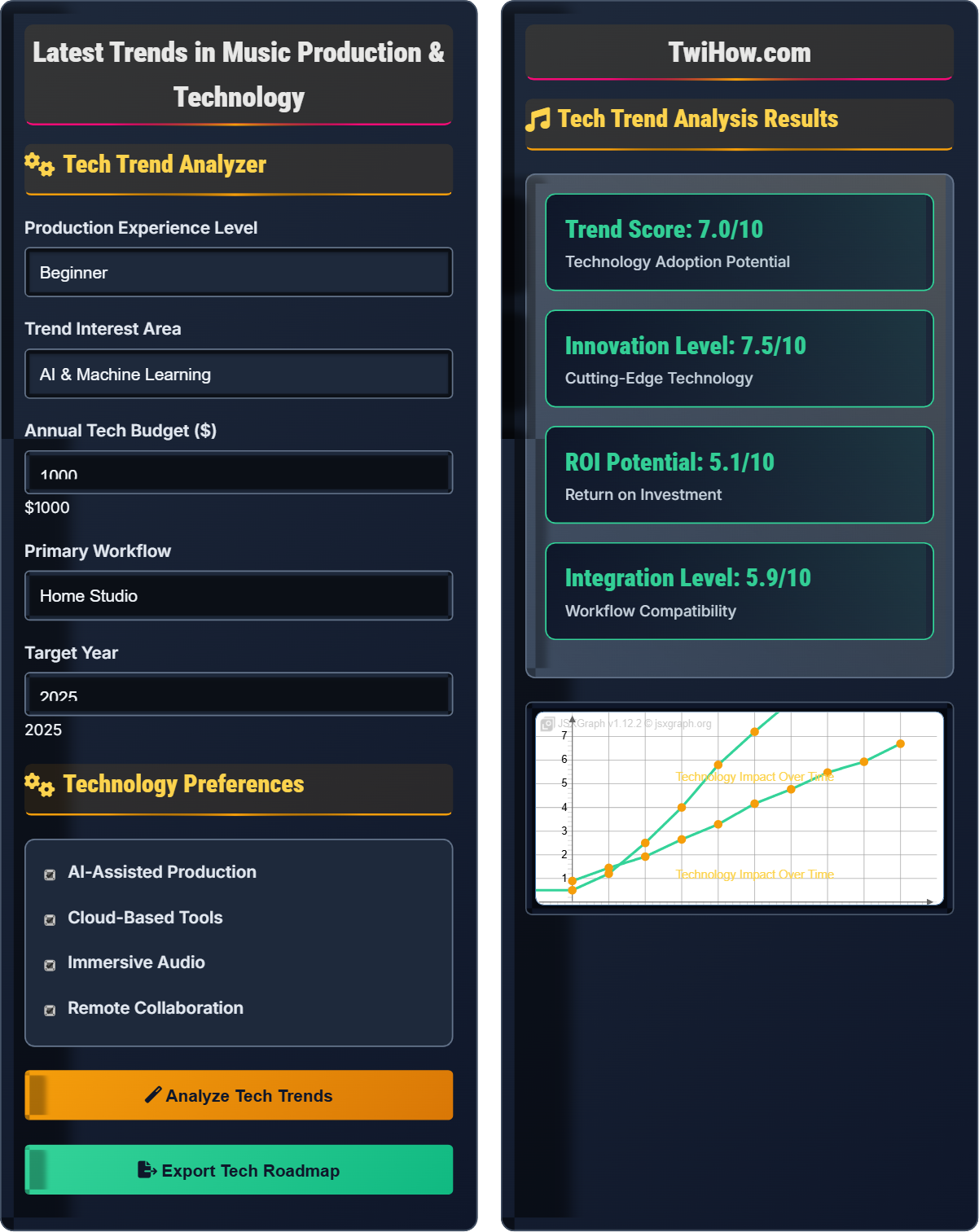
Tech Trend Analysis Results
| Trend | Impact | Adoption | Readiness |
|---|---|---|---|
| AI Music Generation | High | 85% | Ready |
| Cloud Collaboration | Very High | 70% | Ready |
| Spatial Audio | Medium | 45% | Soon |
| Blockchain Rights | Medium | 30% | Future |
Latest Trends in Music Production & Technology
The music production industry is experiencing unprecedented technological advancement. AI-powered tools are revolutionizing composition, cloud-based collaboration is eliminating geographical barriers, and immersive audio technologies are creating new creative possibilities.
These innovations are democratizing music production while simultaneously pushing the boundaries of what's creatively possible.
Where:
- Creative Potential: New possibilities enabled by technology
- Accessibility: Ease of use and availability
- Market Adoption: Industry acceptance rate
- Learning Curve: Skill requirements for adoption
- Cost Factor: Financial investment required
Key technological trends shaping music production:
- AI Music Generation: Automated composition and arrangement tools
- Cloud-Based Collaboration: Real-time remote production workflows
- Immersive Audio: Spatial and 3D audio experiences
- Blockchain Distribution: Decentralized music rights and payments
- Virtual Reality Studios: Immersive production environments
- Quantum Audio Processing: Advanced signal processing capabilities
- Phased Integration: Introduce technologies gradually to minimize disruption
- Hybrid Workflows: Combine traditional and new technologies
- Continuous Learning: Stay updated with training and certifications
- Community Engagement: Participate in technology-focused communities
- Cost-Benefit Analysis: Evaluate ROI before major investments
- Backup Systems: Maintain redundancy for critical workflows
Technology Trends Guide
AI is transforming music production through:
- Automated composition and arrangement
- Intelligent audio restoration and cleaning
- Smart mixing and mastering algorithms
- Generative music for background scoring
- Real-time performance enhancement
- Predictive analytics for hit potential
Cloud technologies enable:
- Real-time collaboration across continents
- Massive sample libraries accessible anywhere
- Remote mixing and mastering services
- Version control for project files
- Scalable processing power on demand
- Seamless backup and recovery systems
Spatial audio innovations include:
- 360-degree sound field recording
- Object-based audio mixing
- Dynamic binaural rendering
- Interactive audio experiences
- Virtual acoustic environments
- Personalized audio optimization
Technology Analysis
Music technology, AI music, cloud production, immersive audio, blockchain rights, virtual studios.
Technology Impact = (Creative Potential × Accessibility × Market Adoption) ÷ (Learning Curve × Cost Factor)
Where Technology Impact = overall trend significance, Creative Potential = new possibilities enabled.
- Adopt technology gradually
- Consider workflow integration
- Evaluate cost-benefit ratios
Music Technology Quiz
Which area of music production is AI most likely to impact first and most significantly?
Background music and jingles are most likely to be impacted first by AI. These applications have predictable structures, commercial requirements, and lower emotional investment compared to main artistic works. AI can efficiently generate royalty-free music for videos, advertisements, and games at scale.
The answer is B) Background music and jingles.
This demonstrates how AI adoption follows a pattern of impacting more structured, commercial applications before artistic ones. Background music has clear parameters (length, mood, genre) that can be algorithmically generated, making it a natural first application for AI music technology.
AI Music Generation: Computer algorithms creating musical content
Background Music: Functional music for commercial applications
Algorithmic Composition: Music created through computational rules
• AI impacts structured applications first
• Commercial applications adopt faster
• Start with AI for background elements
• Use AI for idea generation
• Combine AI with human creativity
• Expecting AI to replace human creativity
• Not understanding AI capabilities
• Over-relying on automation
Explain the benefits and challenges of cloud-based music production collaboration. How does this technology change the traditional studio model?
Benefits: Cloud collaboration eliminates geographical barriers, enables real-time collaboration, provides scalable storage and processing power, and allows for asynchronous work. Artists can work with producers worldwide, share large files seamlessly, and access projects from any device.
Challenges: Internet dependency, latency issues, version control complexity, security concerns, and the need for standardized file formats. Bandwidth limitations can affect real-time collaboration quality.
Studio Model Changes: The traditional centralized studio model shifts to a distributed network of contributors. Studios become more flexible and cost-effective, with reduced overhead and increased global reach.
Impact: Democratizes music production by reducing barriers to high-quality tools and global collaboration opportunities.
This represents a fundamental shift from scarcity-based to abundance-based resource access. Instead of needing expensive hardware and physical proximity, producers can access world-class tools and talent through cloud platforms, fundamentally changing how music is made and distributed.
Cloud Collaboration: Real-time remote music production
Version Control: Managing different project iterations
Distributed Model: Non-centralized production approach
• Reliable internet is essential
• Security protocols are critical
• Standardized workflows improve efficiency
• Use redundant internet connections
• Establish clear version control systems
• Test latency with collaborators
• Not planning for internet outages
• Poor file organization
• Inadequate security measures
You're a home studio producer with a $2000 budget for new technology. You want to upgrade your setup to include modern production trends. Design a technology roadmap that incorporates AI tools, cloud services, and immersive audio capabilities while maximizing creative potential.
Budget Allocation: $800 for AI tools/subscriptions, $600 for cloud storage/subscription, $400 for spatial audio plugins, $200 for additional hardware.
AI Integration: Subscribe to AI music generation tools (AIVA, Amper Music), AI mastering services (LANDR), and audio restoration tools (iZotope RX).
Cloud Setup: Subscribe to collaboration platforms (Splice, BandLab), cloud sample libraries, and backup services.
Immersive Audio: Invest in spatial audio plugins (DearVR, Waves Nx) and monitor setup for 3D mixing.
Hardware: Upgrade to a powerful audio interface and VR-compatible headphones for spatial monitoring.
Learning Plan: Allocate time for training and certification in new technologies.
This demonstrates strategic technology adoption planning. The approach balances immediate usability with future-proofing, ensuring the investment provides both current benefits and prepares for emerging trends. The emphasis on training highlights the importance of human adaptation alongside technology.
Technology Roadmap: Strategic plan for tech adoption
Future-Proofing: Preparing for emerging technologies
Strategic Allocation: Purposeful resource distribution
• Balance immediate and future needs
• Consider learning curve
• Plan for ongoing costs
• Start with free trials before purchasing
• Join beta testing programs
• Invest in training resources
• Buying too much too fast
• Not planning for learning curve
• Ignoring compatibility issues
A music producer wants to incorporate virtual reality into their mixing workflow. What are the technical requirements, creative possibilities, and practical considerations for VR-based music production?
Technical Requirements: High-end PC with VR-ready GPU, VR headset (Oculus, HTC Vive), room-scale tracking, powerful audio interface, and VR-compatible DAW plugins.
Creative Possibilities: Spatial arrangement of instruments in 3D space, immersive mixing environments, gesture-based controls, and visual feedback for audio elements.
Practical Considerations: Extended use may cause fatigue, calibration requirements, hardware costs, and the need for specialized VR audio plugins.
Workflow Integration: Use VR for spatial mixing and creative visualization while maintaining traditional mixing for detailed work. VR excels at conceptual stages and spatial arrangement.
Market Reality: Still emerging technology with limited adoption, but growing rapidly in film scoring and immersive content production.
This demonstrates how emerging technologies require careful evaluation of practical utility versus novelty. VR offers unique creative possibilities but also presents ergonomic and technical challenges that require balanced integration with traditional workflows.
Virtual Reality Production: 3D immersive music creation
Spatial Mixing: Positioning audio in 3D space
Gesture Controls: Hand-tracking for audio manipulation
• Evaluate practical utility
• Consider ergonomics
• Plan for high hardware costs
• Start with VR-compatible plugins
• Use for spatial content creation
• Maintain traditional backup workflows
• Over-investing in unproven technology
• Not considering ergonomics
• Abandoning proven workflows
Which technology trend is most likely to become standard in music production within the next 3 years?
AI-assisted mixing and mastering is most likely to become standard within 3 years. This technology is already commercially available (LANDR, iZotope Neutron), provides clear value propositions, and is being adopted by both independent and professional producers. The technology addresses real workflow inefficiencies with proven results.
The answer is B) AI-assisted mixing and mastering.
This demonstrates the difference between hype and practical adoption. Technologies that solve immediate problems with proven results tend to gain traction faster than revolutionary but unproven concepts. The timeline for adoption depends on practical utility, cost-effectiveness, and integration with existing workflows.
Technology Adoption: Rate of industry acceptance
Practical Utility: Real-world problem-solving capabilityWorkflow Integration: Compatibility with existing processes
• Practical solutions adopt faster
• Integration with existing workflows
• Clear value proposition required
• Focus on proven technologies
• Consider adoption timelines
• Evaluate practical applications
• Chasing hype over utility
• Not evaluating practicality
• Ignoring adoption timelines
FAQ
Q: How can I integrate AI tools into my existing production workflow without losing creative control?
A: Integrate AI tools strategically:
1. Use AI for idea generation: Generate chord progressions, drum patterns, or melodic ideas
2. Automate repetitive tasks: Audio cleanup, noise reduction, tuning
3. Experiment with AI: Create variations and alternatives to your ideas
4. Use as starting point: AI output as a foundation for human creativity
5. Maintain human oversight: Always review and refine AI-generated content
6. Combine with traditional tools: AI as one of many creative tools
The key is using AI as a creative partner, not replacement, for human artistic vision.
Q: What's the most important technology trend for beginner producers to understand?
A: Cloud-based collaboration is the most important trend for beginners:
Why: It removes barriers to working with others, accessing professional tools, and learning from other producers.
Benefits: Access to professional-grade tools without expensive hardware, ability to collaborate with artists worldwide, automatic backups and version control.
Recommended: Start with cloud-based DAWs like Soundtrap or BandLab, then graduate to cloud storage for samples and projects.
Skills: Learn to work with shared projects, understand file compatibility, and maintain organized cloud workflows.
This trend democratizes music production and accelerates learning through collaboration.