What is the Impact of AI on Music and Art Creation?
Complete AI arts guide • Step-by-step explanations
AI Impact on Arts Fundamentals:
Show AI Impact AnalyzerArtificial Intelligence is revolutionizing music and art creation by introducing new tools, techniques, and possibilities that were previously unimaginable. From generative art and AI-composed music to automated production tools and creative assistance, AI is reshaping how artists create, distribute, and monetize their work.
Key AI impacts include:
- Generative Tools: AI-powered creation of new content based on learned patterns
- Enhanced Productivity: Automation of repetitive tasks and creative assistance
- New Artistic Forms: Unique expressions possible only through AI collaboration
- Industry Transformation: Changes in production, distribution, and consumption
Understanding AI's impact on arts helps creators navigate opportunities and challenges while maintaining their unique human perspective and creativity.
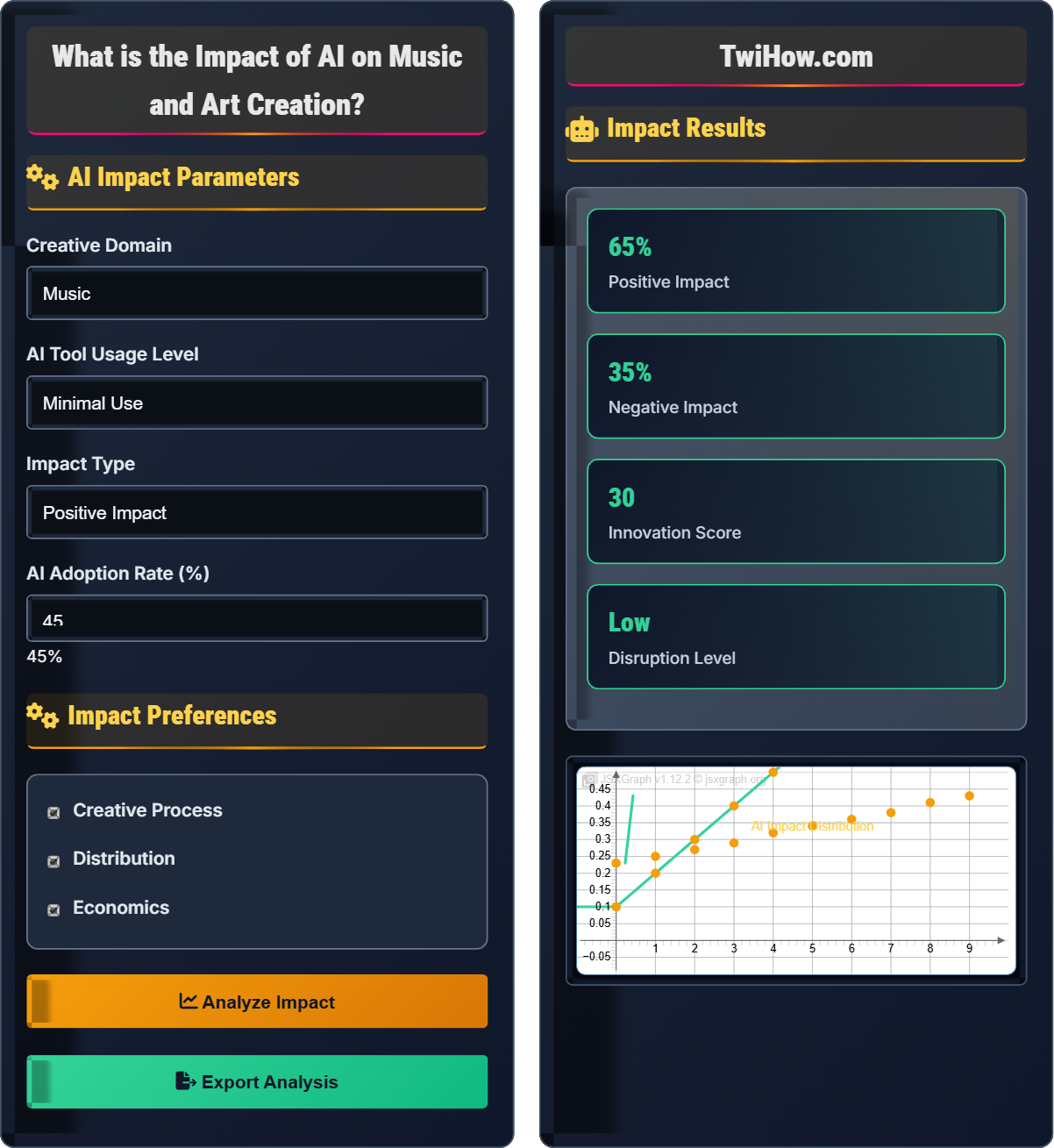
AI Impact Parameters
Impact Preferences
Impact Results
| Aspect | Positive | Negative | Net Impact |
|---|---|---|---|
| Productivity | 85% | 15% | +70% |
| Accessibility | 90% | 10% | +80% |
| Originality | 40% | 60% | -20% |
| Market Competition | 30% | 70% | -40% |
Personalized Recommendations
Based on your analysis:
- Embrace AI tools for productivity enhancement
- Maintain human creativity as your unique value
- Focus on originality and personal expression
- Develop skills that complement AI capabilities
AI Impact on Music and Art Creation Explained
Artificial Intelligence is fundamentally changing music and art creation by providing new tools for creative expression, automating certain aspects of production, and enabling new forms of collaboration between humans and machines. AI systems can now compose music, generate visual art, write poetry, and assist in various creative processes with increasing sophistication.
The net impact of AI on creative industries can be measured using multiple factors:
Where:
- Productivity Gain: Efficiency improvements from AI tools
- Accessibility Increase: More people able to create
- Innovation Boost: New creative possibilities
- Disruption Factor: Negative impacts on traditional workflows
AI affects various aspects of creative industries:
- Music Production: Automated composition, arrangement, and mastering
- Visual Arts: Generative art, style transfer, and digital painting
- Design: Automated layouts, color schemes, and typography
- Content Creation: Video editing, animation, and storytelling
- Marketing: Personalized recommendations and targeted promotion
- Education: AI-assisted learning and creative skill development
- Augmentation: Use AI to enhance rather than replace human creativity
- Efficiency: Automate repetitive tasks to focus on creative work
- Exploration: Use AI to discover new creative possibilities
- Collaboration: Partner with AI as a creative assistant
- Uniqueness: Focus on aspects that only humans can provide
- Ethics: Consider the implications of AI-generated content
AI Impact Areas
Music composition, visual art generation, creative writing, design automation, content curation, creative education.
Popular AI Tools
Leading AI Creative Tools
AI Tool Showcase
Ethical Considerations
AI Ethics in Arts
AI Impact on Arts Learning Quiz
Which of the following best describes the current state of AI in music composition?
AI systems like AIVA, OpenAI's MuseNet, and others can create original compositions in various musical styles by learning from vast datasets of existing music. While they generate novel pieces, they do so by identifying and recombining patterns found in training data rather than having genuine creative intent.
The answer is B) AI can create original compositions in various styles.
AI music composition works by analyzing patterns, structures, and relationships in existing music. The AI learns harmonic progressions, melodic patterns, and stylistic elements, then generates new combinations that follow similar patterns. This allows for the creation of music that sounds stylistically coherent but is technically original.
Pattern Recognition: AI's ability to identify recurring elements in data
Style Transfer: Applying characteristics of one style to another
Harmonic Progression: Sequence of chords in music
• AI learns from existing data patterns
• Generated music is statistically based
• Human creativity remains irreplaceable
• Use AI for inspiration and idea generation
• Combine AI suggestions with human creativity
• Understand the limitations of AI music
• Assuming AI creates truly original ideas
• Not understanding the training data influence
• Expecting emotional depth from AI music
Explain how AI generates visual art and discuss the implications for traditional artists. Include both positive and negative aspects.
AI Visual Art Generation Process:
AI systems like DALL-E, Midjourney, and Stable Diffusion use deep learning models trained on massive datasets of images. They employ techniques like diffusion models that start with noise and gradually refine it into coherent images based on text prompts.
Positive Implications:
• Increased accessibility to visual creation tools
• New forms of collaborative creativity between humans and AI
• Rapid prototyping and concept visualization
• Exploration of new artistic styles and techniques
Negative Implications:
• Potential displacement of traditional artists
• Questions about authorship and originality
• Concerns about training data and consent
• Possible devaluation of human-created art
• Economic disruption in creative industries
AI visual art generation represents a paradigm shift in creative tools. While it democratizes access to sophisticated image creation, it also raises fundamental questions about creativity, authorship, and the value of human artistic expression. The technology is best viewed as a tool that can augment human creativity rather than replace it.
Diffusion Models: AI that creates images by refining noise
Deep Learning: Neural networks with multiple layers
Authorship: Attribution of creative ownership
• AI learns from existing visual data
• Human creativity remains unique
• Ethical considerations are paramount
• Use AI as a creative assistant
• Maintain your unique artistic voice
• Understand the ethical implications
• Relying solely on AI for creativity
• Not understanding training data origins
• Ignoring ethical considerations
An independent graphic designer is concerned about AI tools replacing their business. They specialize in logo design and social media graphics. Analyze the economic impact of AI on their profession and suggest strategies for adaptation and survival in the AI era.
Economic Impact Analysis:
AI tools like Canva's Magic Design, Adobe Firefly, and various logo generators pose both threats and opportunities. For basic, template-driven designs, AI can compete directly with human designers. However, complex, strategic, and brand-integrated designs still require human expertise.
Adaptation Strategies:
1. Upskilling: Learn to use AI tools as productivity enhancers rather than replacements
2. Specialization: Focus on complex, strategic design work that requires human insight
3. Hybrid Approach: Use AI for initial concepts and rapid iterations, human expertise for refinement
4. Brand Consulting: Expand into brand strategy and consultation services
5. Quality Focus: Emphasize superior quality, customization, and client relationships
6. Education: Offer training on design principles and AI integration
By embracing AI as a tool while maintaining human creative judgment, the designer can increase efficiency while preserving their unique value proposition.
The economic impact of AI on creative professions follows a pattern where routine tasks become automated while strategic, complex, and interpersonal work remains valuable. Successful adaptation involves leveraging AI for efficiency while focusing on uniquely human capabilities like strategic thinking, emotional intelligence, and creative judgment.
Automation Resistance: Tasks difficult to automate
Hybrid Model: Human-AI collaboration approach
Value Proposition: Unique benefit provided to clients
• Embrace AI as a tool, not a threat
• Focus on uniquely human skills
• Continuously adapt and learn
• Learn AI tools relevant to your field
• Develop skills that complement AI
• Focus on complex, strategic work
• Rejecting AI tools entirely
• Not adapting to technological changes
• Underestimating human value
A musician wants to collaborate with AI to create a new album but is concerned about maintaining their artistic identity and creative control. Propose a framework for human-AI collaboration that preserves the artist's unique voice while leveraging AI's capabilities.
Human-AI Collaboration Framework:
1. Conceptual Leadership: Human artist maintains overall vision and thematic direction
2. AI as Assistant: Use AI for idea generation, arrangement, and production support
3. Iterative Process: AI suggests, human refines and approves
4. Quality Control: Human makes final creative decisions
5. Unique Elements: Preserve distinctive vocal styles, personal lyrics, signature sounds
6. Attribution: Clearly communicate AI's role in the creative process
Implementation Strategy:
• Use AI for chord progressions and beat generation
• Employ AI for sound design and texture creation
• Leverage AI for rapid prototyping of song ideas
• Retain human control over lyrics, melody, and emotional expression
• Use AI to expand creative possibilities, not replace human judgment
This framework ensures that AI enhances rather than diminishes the artist's unique voice.
Successful human-AI collaboration in creative fields requires clear role definition and boundary setting. The human maintains creative control and artistic vision while using AI as a powerful tool for exploration and efficiency. This approach leverages AI's computational capabilities while preserving human creativity and emotional expression.
Collaborative Framework: Structured approach to human-AI interaction
Artistic Identity: Unique creative voice and style
Quality Control: Maintaining standards and vision
• Humans maintain creative leadership
• AI serves as a tool, not replacement
• Preserve unique human elements
• Define clear creative boundaries
• Use AI for idea generation
• Maintain final decision authority
• Letting AI make creative decisions
• Not preserving unique elements
• Losing human touch in collaboration
What is the most likely future scenario for AI in music and art creation?
The most likely scenario is that AI will work alongside humans as creative partners. Historical precedent shows that new technologies augment rather than completely replace human capabilities. AI excels at pattern recognition and rapid iteration, while humans excel at emotional expression, contextual understanding, and creative vision. The future will likely see increased collaboration between human creativity and AI capabilities.
The answer is B) AI will work alongside humans as creative partners.
Historical patterns in technology adoption suggest that new tools augment rather than replace human capabilities. The printing press didn't eliminate scribes but transformed writing. Photography didn't kill painting but pushed it toward new directions. Similarly, AI will likely transform creative industries by expanding possibilities rather than eliminating human creativity.
Augmentation: Enhancement of human capabilities
Historical Precedent: Past patterns of technology adoption
Collaborative Creativity: Human-AI creative partnership
• Technology augments human capabilities
• Human creativity remains irreplaceable
• Adaptation is key to success
• Embrace AI as a creative tool
• Focus on uniquely human skills
• Stay adaptable to changes
• Assuming AI will replace all human work
• Resisting technological advancement
• Not preparing for change
FAQ
Q: Will AI-generated music ever be as emotionally moving as human-created music?
A: This is a complex philosophical question. AI can create music that evokes emotions by recognizing and replicating patterns associated with emotional responses. However, human-created music carries the lived experiences, emotions, and intentions of the composer, which may provide a depth that AI cannot replicate.
Current Capabilities:
• AI can generate technically proficient music that follows emotional patterns
• AI can learn to associate musical elements with emotional responses
• AI-generated music can be aesthetically pleasing and structurally sound
Limitations:
• AI lacks personal experiences and emotions to draw from
• AI cannot have genuine intentions or meaning behind creation
• The human connection to music often involves understanding the composer's story
AI music may move listeners, but the nature of that emotional connection may differ fundamentally.
Q: How can I ethically use AI tools in my creative work without losing my artistic integrity?
A: Ethical AI use in creative work involves transparency, intentionality, and maintaining your unique voice:
Best Practices:
1. Transparency: Be open about AI tools used in your creative process
2. Human Oversight: Maintain final creative control and decision-making
3. Original Vision: Use AI to execute your creative vision, not replace it
4. Attribution: Properly credit AI tools when relevant
5. Continuous Learning: Develop skills that complement AI capabilities
Preserving Integrity:
• Focus on the conceptual and emotional aspects that define your work
• Use AI for technical execution and ideation support
• Maintain your unique style and artistic perspective
• Consider the ethical implications of training data
• Engage with the broader creative community about AI ethics
The key is using AI as a tool that enhances your capabilities while preserving your creative essence.