What is the Impact of Globalization on Local Cultures and Arts?
Homogenization • Cultural Exchange • Preservation • Adaptive Strategies
Globalization & Culture:
Cultural Impact CalculatorGlobalization profoundly impacts local cultures and arts through complex processes of homogenization, hybridization, and resistance. This multifaceted phenomenon creates both opportunities for cultural exchange and challenges for cultural preservation, reshaping artistic expressions, traditions, and identity formation worldwide.
Key impact areas:
- Cultural Homogenization: Spread of dominant cultural forms and values
- Hybridization: Fusion of local and global cultural elements
- Resistance & Revival: Efforts to preserve and revitalize local traditions
- Commercialization: Market-driven transformation of cultural practices
- Access & Reach: Expanded global exposure for local arts
- Identity Negotiation: Balancing local and global identities
Understanding these impacts requires recognizing both the challenges and opportunities that globalization presents for cultural diversity and artistic expression.
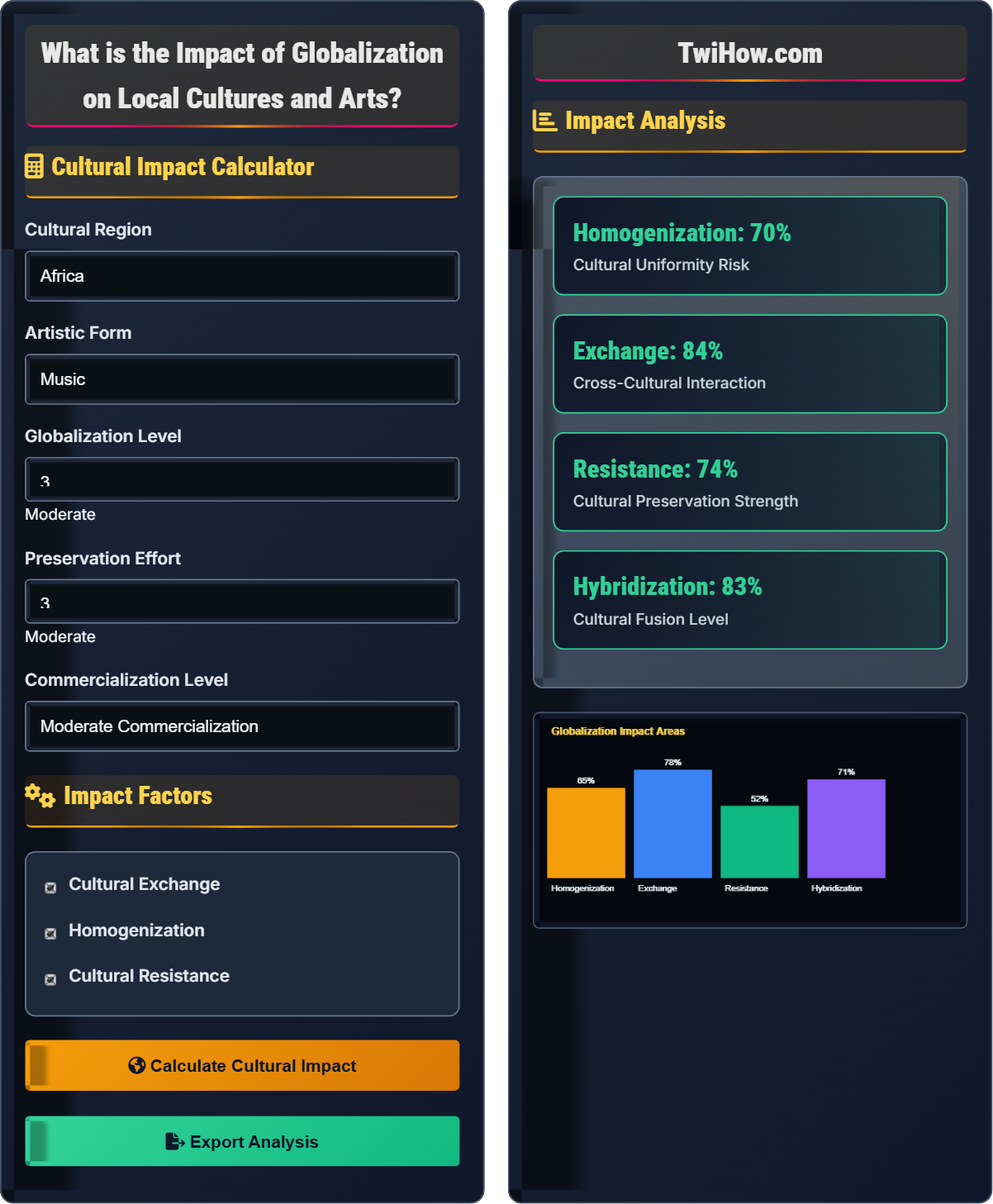
Cultural Impact Calculator
Impact Factors
Impact Analysis
| Strategy | Implementation | Effectiveness | Examples |
|---|---|---|---|
| Documentation | Recording and archiving | High | Museums, digital archives |
| Education | Teaching in schools | Medium | Cultural curricula |
| Policy | Legal protection | High | UNESCO recognition |
| Community | Local initiatives | High | Festivals, workshops |
Globalization Impact Framework
Globalization impacts local cultures and arts through multiple interconnected processes that can be both destructive and constructive. The effects vary significantly based on regional context, cultural resilience, and adaptive strategies employed by local communities.
- Homogenization: Standardization of cultural practices and values
- Hybridization: Fusion of local and global elements creating new forms
- Resistance: Deliberate efforts to preserve and revitalize local traditions
- Commodification: Transformation of culture into marketable products
- Diffusion: Spread of cultural elements across geographical boundaries
- Acculturation: Cultural change through contact with other cultures
The overall impact of globalization on local cultures can be analyzed using this framework:
Where:
- Exposure: Degree of contact with global influences
- Vulnerability: Susceptibility to cultural change
- Adaptability: Capacity to selectively adopt global elements
- Resistance: Strength of preservation efforts
Globalization can enhance local cultures through:
- Increased Visibility: Global platforms for local cultural expression
- Resource Access: Funding and support for cultural projects
- Collaboration Opportunities: Cross-cultural artistic partnerships
- Technological Innovation: New tools for cultural preservation and creation
- Market Expansion: Broader audiences for local arts
- Cultural Exchange: Learning from other traditions and practices
Globalization can threaten local cultures through:
- Homogenization Pressure: Dominance of global cultural forms
- Commercialization: Loss of cultural authenticity
- Language Erosion: Decline of local languages and dialects
- Traditional Knowledge Loss: Disruption of knowledge transmission
- Identity Crisis: Confusion between local and global identities
- Market Dependency: Vulnerability to global market fluctuations
Global-Local Cultural Dynamics
The interaction between global and local cultures follows several patterns:
Regional Case Studies
| Region | Artistic Form | Globalization Impact | Preservation Response |
|---|---|---|---|
| Africa | Traditional Music | Hybridization with global genres | Documentation projects, cultural festivals |
| Asia | Classical Dance | Commercialization and fusion | Academic institutions, government support |
| Latin America | Indigenous Arts | Market commodification | Community cooperatives, cultural centers |
| Middle East | Calligraphy & Poetry | Digital preservation efforts | UNESCO recognition, cultural diplomacy |
Preservation Strategies
Strategies for maintaining cultural vitality amid globalization:
- Documentation: Recording and archiving traditional practices
- Education: Teaching cultural practices in schools and communities
- Policy Support: Legal frameworks protecting cultural heritage
- Community Engagement: Grassroots preservation initiatives
- Technology Integration: Using digital tools for preservation and dissemination
- Market Development: Creating sustainable economic models for cultural practices
Globalization & Culture Quiz
Which of the following best describes the process of "glocalization" in the context of cultural globalization?
Glocalization refers to the process where global cultural elements are adapted, modified, or transformed to fit local contexts, needs, and preferences. This creates hybrid forms that maintain local relevance while incorporating global influences, rather than simply replacing local culture with global culture.
The answer is B) Global elements adapted to local contexts and needs.
Glocalization represents one of the most important adaptive responses to globalization. Rather than wholesale adoption or complete rejection of global influences, glocalization allows local cultures to selectively incorporate global elements while maintaining their distinct identity. This process demonstrates the agency of local communities in shaping how globalization affects them.
Glocalization: Adaptation of global elements to local contexts
Hybridization: Blending of global and local cultural elements
Cultural Homogenization: Standardization of cultural practices
• Glocalization maintains local relevance
• Adaptation creates new hybrid forms
• Local agency shapes global influences
• Look for local adaptations of global practices
• Identify hybrid cultural forms
• Consider local agency in cultural change
• Confusing glocalization with homogenization
• Assuming globalization is always uniform
• Not recognizing local agency in adaptation
Explain how local communities resist the homogenizing effects of globalization on their cultural practices. Provide specific strategies and examples of successful resistance movements.
Strategies for Cultural Resistance:
1. Documentation and Archiving: Recording traditional practices, languages, and knowledge systems to preserve them for future generations.
2. Education and Transmission: Teaching cultural practices in schools, community centers, and family settings to ensure continuity.
3. Policy Advocacy: Working with governments to create protective legislation and UNESCO recognition for cultural heritage.
4. Community Festivals: Organizing cultural events that celebrate and showcase local traditions to both insiders and outsiders.
5. Alternative Markets: Creating local economic systems that support traditional crafts and practices.
Successful Examples:
• The revival of Hawaiian language and cultural practices after near extinction
• Indigenous peoples' movements to protect traditional territories and practices
• Traditional craft cooperatives in Latin America that maintain authentic techniques
• Cultural preservation initiatives among Native American tribes
Cultural resistance is not merely opposition to change but active preservation and revitalization of cultural practices. Successful resistance movements combine documentation, education, policy advocacy, and community engagement to create sustainable systems for cultural continuity. These efforts demonstrate that globalization does not inevitably lead to cultural loss.
Cultural Resistance: Deliberate efforts to preserve and revitalize local traditions
Cultural Revival: Restoration of declining cultural practices
Heritage Preservation: Protection of cultural traditions and knowledge
• Resistance requires sustained effort
• Multiple strategies work best
• Community involvement is crucial
• Combine documentation with practice
• Engage younger generations
• Create economic incentives
• Assuming resistance is impossible
• Not recognizing the complexity of preservation
• Focusing only on documentation without practice
A traditional weaving community in Peru faces pressure to modernize their techniques to compete in global markets. Their traditional hand-woven textiles take 2 weeks to produce and sell for $200, while machine-made copies sell for $50. However, their traditional methods employ 15 community members, while machine production would employ only 3. Calculate the economic trade-offs and discuss the cultural implications of each approach.
Economic Trade-offs:
Traditional Methods:
• Revenue per item: $200
• Employment: 15 people
• Production time: 2 weeks
• Cultural value: Preserves traditional techniques
Machine Production:
• Revenue per item: $50
• Employment: 3 people
• Production time: Significantly reduced
• Cultural value: Loss of traditional skills
Trade-offs: Higher individual prices vs. market volume, more employment vs. efficiency, cultural preservation vs. competitive pricing. The traditional approach maintains cultural integrity and provides broader community benefits, while machine production increases market competitiveness but threatens cultural continuity.
This example illustrates the complex economic decisions facing traditional communities. The choice between traditional and modern methods involves trade-offs between economic efficiency and cultural preservation. Successful strategies often involve finding ways to maintain traditional techniques while accessing broader markets through premium positioning and cultural authenticity marketing.
Cultural Commodification: Transformation of culture into marketable products
Traditional Knowledge: Indigenous and local knowledge systems
Community-Based Tourism: Economic models that support local cultures
• Economic decisions affect cultural continuity
• Traditional methods often provide broader benefits
• Cultural authenticity can command premium prices
• Develop premium market positioning
• Emphasize cultural authenticity
• Create cooperative economic models
• Focusing only on short-term economic gains
• Not considering community employment impacts
• Underestimating cultural value of authenticity
You're documenting a fusion music genre that combines traditional Indian ragas with electronic music elements. The genre has gained international popularity but some traditional musicians argue it compromises the authenticity of classical Indian music. Design a research framework to evaluate whether this hybrid form represents cultural enrichment or degradation.
Research Framework:
1. Authenticity Assessment: Evaluate how traditional elements are incorporated and whether core principles are maintained
2. Community Reception: Survey both traditional musicians and younger audiences about their perceptions
3. Skills Transfer: Assess whether the fusion promotes learning of traditional techniques
4. Cultural Context: Examine whether the fusion respects the cultural significance of original elements
5. Artistic Innovation: Evaluate whether the fusion creates meaningful new artistic expressions
6. Market Impact: Analyze whether the fusion increases interest in traditional forms
Evaluation Criteria: The fusion represents enrichment if it maintains respect for traditional elements while creating innovative expressions that attract new audiences to the cultural tradition.
Hybridization represents one of the most complex aspects of globalization's cultural impact. The key question is whether fusion maintains respect for traditional elements while creating meaningful innovation. Successful hybridization often serves as a bridge that introduces new audiences to traditional forms while demonstrating the living, evolving nature of cultural expression.
Hybridization: Blending of cultural elements from different traditions
Cultural Appropriation: Taking cultural elements without permission or understanding
Cultural Appreciation: Respectful engagement with other cultures
• Respect for traditional elements is crucial
• Community consent matters
• Innovation should enhance rather than replace
• Engage with traditional practitioners
• Maintain cultural context
• Promote traditional forms alongside fusion
• Not consulting traditional communities
• Misrepresenting cultural significance
• Focusing only on commercial potential
Which outcome of globalization on local cultures is most likely to occur in regions with strong cultural institutions and government support?
Regions with strong cultural institutions and government support are most likely to engage in selective adaptation and hybridization. These regions have the infrastructure and political will to choose which global influences to accept while maintaining core cultural elements. They can engage with globalization strategically rather than being overwhelmed by it.
The answer is B) Selective adaptation and hybridization.
Strong cultural institutions and government support provide the capacity for strategic engagement with globalization. Rather than being passive recipients of global influences, these regions can actively choose which elements to adopt, adapt, or reject. This agency leads to more sophisticated outcomes like hybridization rather than simple homogenization.
Selective Adaptation: Choosing which global elements to incorporate
Cultural Agency: The ability to make choices about cultural change
Strategic Engagement: Purposeful interaction with global forces
• Institutional support enables strategic choices
• Cultural agency affects outcomes
• Strong foundations allow selective adaptation
• Build strong cultural institutions
• Develop government support
• Create strategic engagement plans
• Assuming globalization affects all regions equally
• Not recognizing the role of cultural capacity
• Overlooking institutional factors
FAQ
Q: How can we distinguish between beneficial cultural exchange and harmful cultural appropriation in the context of globalization?
A: The key distinctions include:
Cultural Exchange: Mutual respect, community consent, fair compensation, and preservation of cultural context
Cultural Appropriation: Taking without permission, profiting without benefit to source communities, and removing cultural elements from their original context
Other factors to consider:
1. Power Dynamics: Who benefits from the exchange?
2. Consent: Have source communities given permission?
3. Compensation: Are originators fairly compensated?
4. Context: Is cultural significance respected?
5. Representation: Are communities accurately represented?
Beneficial exchange strengthens both cultures involved, while appropriation exploits and diminishes the source culture.
Q: As a local artist, how can I leverage global platforms to showcase my work while maintaining cultural authenticity?
A: Strategies for authentic global engagement:
Storytelling: Share the cultural context and meaning behind your work
Education: Use your platform to educate audiences about your culture
Community Connection: Maintain ties with your cultural community
Collaboration: Partner with other artists from your tradition
Transparency: Be open about your cultural background and influences
Control: Retain ownership of your work and its cultural narrative
Reinvestment: Use success to support your local cultural community
Success comes from being authentically yourself while making your culture accessible to global audiences.