What is the Role of Festivals and Events in Cultural Engagement?
Community building • Heritage preservation • Economic impact • Cultural exchange
Festival & Event Roles:
Festival Impact CalculatorFestivals and events serve as vital catalysts for cultural engagement, creating spaces where communities come together to celebrate, preserve, and share their heritage. These gatherings play multiple crucial roles in society, from strengthening community bonds to preserving cultural traditions and driving economic development.
Key roles of festivals and events:
- Community Building: Strengthening social connections and collective identity
- Heritage Preservation: Maintaining and transmitting cultural traditions
- Economic Development: Generating revenue and employment opportunities
- Cultural Exchange: Facilitating cross-cultural understanding
- Education: Providing learning opportunities about history and traditions
- Innovation: Encouraging creative expression and adaptation
These multi-faceted roles make festivals and events essential components of vibrant, engaged communities that celebrate diversity and promote cultural understanding.
Festival Impact Parameters
Engagement Factors
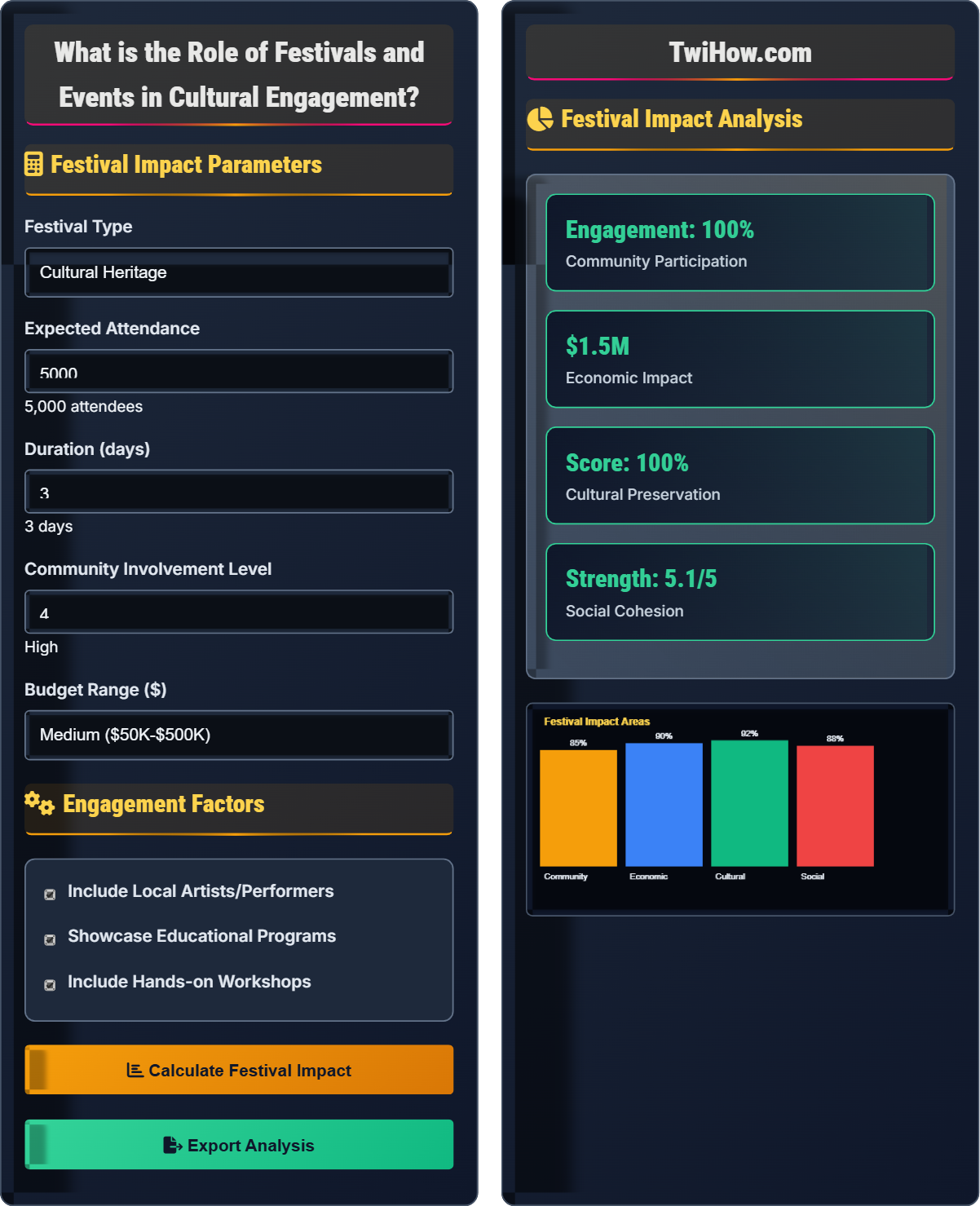
Festival Impact Analysis
| Role | Impact Level | Contribution | Examples |
|---|---|---|---|
| Community Building | High | 85% | Local participation, networking |
| Heritage Preservation | Very High | 92% | Traditional practices, stories |
| Economic Development | High | $2.4M | Tourism, jobs, spending |
| Cultural Exchange | Medium | 78% | Visitor interactions |
Festival & Event Cultural Engagement Framework
Festivals and events serve as dynamic platforms for cultural engagement, playing multiple interconnected roles that strengthen communities and preserve heritage. These roles include:
- Community Building: Creating shared experiences that strengthen social bonds
- Heritage Preservation: Maintaining and transmitting cultural traditions
- Economic Development: Generating revenue and employment opportunities
- Cultural Exchange: Facilitating cross-cultural understanding
- Education: Providing learning opportunities about history and traditions
- Innovation: Encouraging creative expression and adaptation
The effectiveness of festivals in promoting cultural engagement can be measured by this framework:
Where:
- Participation: Level of community involvement and attendance
- Authenticity: Degree of genuine cultural representation
- Accessibility: Inclusivity and availability to diverse populations
- Sustainability: Long-term viability and environmental impact
Key areas of cultural engagement through festivals:
- Heritage Transmission: Passing down traditions to younger generations
- Identity Formation: Strengthening cultural identity and belonging
- Intergenerational Dialogue: Connecting different age groups through shared experiences
- Cross-Cultural Learning: Promoting understanding between different cultural groups
- Artistic Expression: Providing platforms for creative cultural expression
- Community Empowerment: Strengthening local capacity and leadership
- Participatory Activities: Hands-on workshops, interactive demonstrations
- Storytelling Sessions: Oral histories and traditional narratives
- Traditional Performances: Music, dance, theater, and ritual presentations
- Artisan Demonstrations: Craft-making and traditional skills
- Food Experiences: Traditional cuisine and cooking methods
- Community Projects: Collaborative cultural initiatives
Primary Roles of Festivals in Cultural Engagement
Festivals serve as powerful catalysts for community building by bringing people together across demographic boundaries. They create shared experiences that strengthen social bonds, foster mutual understanding, and build collective identity. Through participation in common activities, community members develop stronger connections and a greater sense of belonging.
Key aspects include:
- Creating opportunities for social interaction
- Building trust and cooperation among neighbors
- Encouraging civic participation and engagement
- Strengthening community resilience
Festivals play a crucial role in preserving cultural heritage by providing platforms for the practice and demonstration of traditional customs, rituals, and artistic expressions. They serve as living repositories of cultural knowledge, ensuring that traditional practices remain alive and accessible to future generations.
Preservation mechanisms include:
- Documentation of traditional practices
- Transmission of cultural knowledge
- Revitalization of endangered traditions
- Archiving of cultural materials
Festivals contribute significantly to local economies by attracting visitors, creating employment opportunities, and stimulating business activity. They serve as cultural tourism attractions that bring external revenue into communities while showcasing local products, services, and traditions.
Economic impacts include:
- Direct spending by visitors
- Job creation in hospitality and retail
- Marketing opportunities for local businesses
- Infrastructure development
Festivals facilitate cultural exchange by bringing together diverse communities and promoting cross-cultural understanding. They provide safe spaces for people to learn about different traditions, customs, and worldviews, fostering tolerance and appreciation for diversity.
Exchange opportunities include:
- Inter-cultural dialogue and sharing
- Collaborative artistic projects
- Educational programs and workshops
- Networking between cultural practitioners
Types of Cultural Festivals
Various types of festivals serve different cultural engagement purposes:
Festival & Cultural Engagement Quiz
Which of the following is NOT a primary role of festivals in cultural engagement?
While festivals may occasionally involve political elements, political campaign promotion is not a primary role of festivals in cultural engagement. The main roles are community building, heritage preservation, and cultural exchange. Festivals are primarily cultural rather than political events.
The answer is C) Political campaign promotion.
Understanding the primary roles of festivals helps distinguish between their core cultural functions and potential secondary uses. Cultural festivals focus on preserving and celebrating heritage, strengthening community bonds, and facilitating cross-cultural understanding. While political messaging may sometimes appear, it's not the central purpose of cultural engagement.
Cultural Engagement: Active participation in cultural activities that promote understanding and appreciation
Heritage Preservation: Maintaining and transmitting cultural traditions to future generations
Community Building: Strengthening social bonds and collective identity within a group
• Festivals primarily serve cultural functions
• Community engagement is central to success
• Cultural authenticity should be preserved
• Focus on cultural rather than commercial aspects
• Prioritize community involvement
• Ensure authentic representation
• Confusing festivals with purely commercial events
• Over-commercializing cultural content
• Neglecting community input in planning
Explain how festivals contribute to community building and social cohesion. Provide specific examples of how these events strengthen social bonds.
Community Building Mechanisms: Festivals create shared experiences that transcend individual differences, bringing together people from various backgrounds to participate in common activities.
Specific Examples:
1. Collaborative Preparation: Community members work together organizing and setting up, building relationships and trust.
2. Shared Participation: People engage in common activities like dancing, eating, or watching performances together.
3. Intergenerational Interaction: Older and younger generations share cultural knowledge and experiences.
4. Collective Pride: Success of the event creates shared accomplishment and community pride.
These interactions break down social barriers and create lasting connections that extend beyond the festival itself.
Festivals create what sociologists call "communitas" - temporary communities based on shared experiences rather than traditional social hierarchies. These events provide neutral ground where people can interact as equals, fostering genuine connections and mutual understanding that strengthens the broader community fabric.
Social Cohesion: The degree of connectedness and solidarity within a community
Communitas: A feeling of close-knit community spirit and unity
Social Capital: Networks of relationships that enable cooperation within a community
• Shared experiences create lasting bonds
• Inclusive participation strengthens communities
• Trust develops through collaborative efforts
• Encourage diverse participation
• Create opportunities for interaction
• Foster collaborative activities
• Excluding certain community groups
• Focusing only on entertainment
• Not facilitating interaction between strangers
A small town with a population of 10,000 residents hosts an annual cultural festival that attracts 5,000 visitors over three days. Visitors spend an average of $150 per day on accommodation, food, and shopping. Local vendors sell $25,000 worth of traditional crafts during the festival. Calculate the direct economic impact and explain how this contributes to cultural preservation.
Direct Economic Impact Calculation:
Visitor spending: 5,000 visitors × 3 days × $150/day = $2,250,000
Local craft sales: $25,000
Total direct economic impact: $2,250,000 + $25,000 = $2,275,000
Cultural Preservation Connection: Economic benefits provide incentives for artisans to continue traditional crafts, fund cultural programs, and support heritage preservation activities. The financial success demonstrates the value of cultural traditions, encouraging their continuation and transmission to future generations.
The economic dimension of cultural festivals creates a sustainable model for heritage preservation. When cultural practices generate income, they become self-reinforcing, providing economic incentives for their continuation. This economic argument strengthens support for cultural preservation efforts and helps secure funding for related programs.
Direct Economic Impact: Immediate spending by visitors and participants
Cultural Economics: Study of economic aspects of cultural activities
Heritage Tourism: Tourism focused on cultural and historical sites
• Economic benefits support cultural sustainability
• Market demand can preserve traditions
• Balance commercial and cultural goals
• Develop local artisan markets
• Promote authentic cultural products
• Create sustainable economic models
• Prioritizing profit over cultural integrity
• Not reinvesting in cultural programs
• Over-commercializing authentic practices
You're organizing a cultural festival to help preserve traditional crafts in a community where young people are losing interest in ancestral practices. Design a festival program that effectively engages youth while maintaining cultural authenticity. Include specific activities and strategies.
Engagement Strategy: Create hands-on learning experiences that connect traditional crafts to contemporary interests:
1. Interactive Workshops: Young people learn from master artisans through step-by-step guidance
2. Modern Applications: Show how traditional techniques apply to contemporary design and art
3. Technology Integration: Use digital tools to document and share traditional methods
4. Competitive Elements: Friendly competitions to encourage participation and excellence
5. Mentorship Programs: Pair young learners with experienced practitioners
Authenticity Maintenance: Ensure traditional masters lead sessions and that core techniques remain unchanged while allowing creative expression.
Successful cultural transmission to youth requires respecting both traditional knowledge and contemporary learning preferences. By making connections between ancestral practices and modern interests, festivals can bridge generational gaps while preserving the integrity of cultural traditions. The key is to maintain core elements while adapting presentation methods.
Heritage Transmission: Passing cultural knowledge from one generation to another
Cultural Authenticity: Maintaining genuine characteristics of cultural practices
Intergenerational Learning: Knowledge transfer between different age groups
• Preserve core cultural elements
• Adapt presentation methods for youth
• Involve traditional practitioners as leaders
• Use social media to document processes
• Connect crafts to contemporary design
• Create mentor-apprentice relationships
• Compromising authenticity for popularity
• Not involving traditional practitioners
• Focusing only on entertainment value
Which factor is most critical for the long-term sustainability of cultural festivals?
Strong community ownership and participation is essential for long-term sustainability. When local community members feel ownership of the festival and actively participate in its organization and execution, the event becomes embedded in community life rather than dependent on external factors. This ensures continuity even when external funding or support fluctuates.
The answer is B) Strong community ownership and participation.
Sustainable cultural festivals require grassroots support that transcends temporary funding or external interest. Community ownership creates intrinsic motivation for continuation, ensures cultural authenticity, and builds the social capital necessary for long-term success. External factors like celebrity endorsements or corporate sponsorships may provide short-term benefits but cannot sustain festivals over the long term without community commitment.
Community Ownership: Local community's sense of responsibility and investment in an initiative
Sustainability: Ability to maintain activities over the long term
Grassroots Support: Bottom-up community engagement and participation
• Community involvement drives sustainability
• External support supplements, doesn't replace
• Ownership creates intrinsic motivation
• Involve community in planning
• Rotate leadership responsibilities
• Build local capacity
• Relying too heavily on external support
• Not developing local leadership
• Failing to build community capacity
FAQ
Q: How can we measure the cultural impact of our community festival beyond economic metrics?
A: Cultural impact measurement requires different approaches than economic metrics:
1. Participation Tracking: Document who participates and their engagement levels
2. Knowledge Transfer: Assess learning outcomes and skill acquisition
3. Community Connections: Measure new relationships formed and social network changes
4. Cultural Pride: Survey community members about cultural identity and pride
5. Behavioral Changes: Track ongoing cultural participation after the event
6. Heritage Documentation: Record traditional knowledge preserved through the festival
Combine quantitative surveys with qualitative interviews and ethnographic observation for comprehensive assessment.
Q: What's the difference between cultural festivals and tourist attractions, and why does this matter for cultural engagement?
A: The key differences are:
Cultural Festivals: Rooted in authentic community traditions, organized by and for community members, focus on cultural transmission and celebration.
Tourist Attractions: Often designed primarily for visitor consumption, may be staged or modified for tourist appeal, focus on entertainment value.
The distinction matters because authentic cultural festivals maintain integrity of traditions and strengthen community bonds, while staged attractions may dilute cultural meaning and create superficial engagement. For meaningful cultural engagement, festivals should prioritize community needs and cultural authenticity over tourist expectations.
Best Practices for Cultural Festivals
Key elements that ensure effective cultural engagement:
- Community Leadership: Local community members drive planning and implementation
- Cultural Authenticity: Genuine representation of traditions and practices
- Inclusive Participation: Opportunities for diverse community members to participate
- Educational Components: Learning opportunities about cultural significance
- Sustainable Practices: Environmental and economic sustainability considerations
- Long-term Planning: Strategies for continuation and evolution
Effective festival planning follows these steps:
- Community consultation and needs assessment
- Cultural significance evaluation
- Stakeholder identification and engagement
- Resource assessment and budgeting
- Program design and scheduling
- Marketing and outreach strategy
- Implementation and evaluation