Role of Music in Mental Health & Emotional Well-being
Complete mental health guide • Therapeutic benefits
Music & Mental Health:
Show Music Therapy CalculatorMusic plays a profound role in mental health and emotional well-being, with scientific research demonstrating measurable benefits. From reducing stress and anxiety to enhancing mood and cognitive function, music therapy is increasingly recognized as a legitimate therapeutic intervention.
Key mental health benefits:
- Stress Reduction: Music lowers cortisol levels and activates relaxation responses
- Emotional Regulation: Helps process and express complex emotions
- Mood Enhancement: Triggers dopamine release and positive emotions
- Cognitive Benefits: Improves memory, attention, and executive function
Music therapy combines neurological and psychological mechanisms to promote healing and well-being.
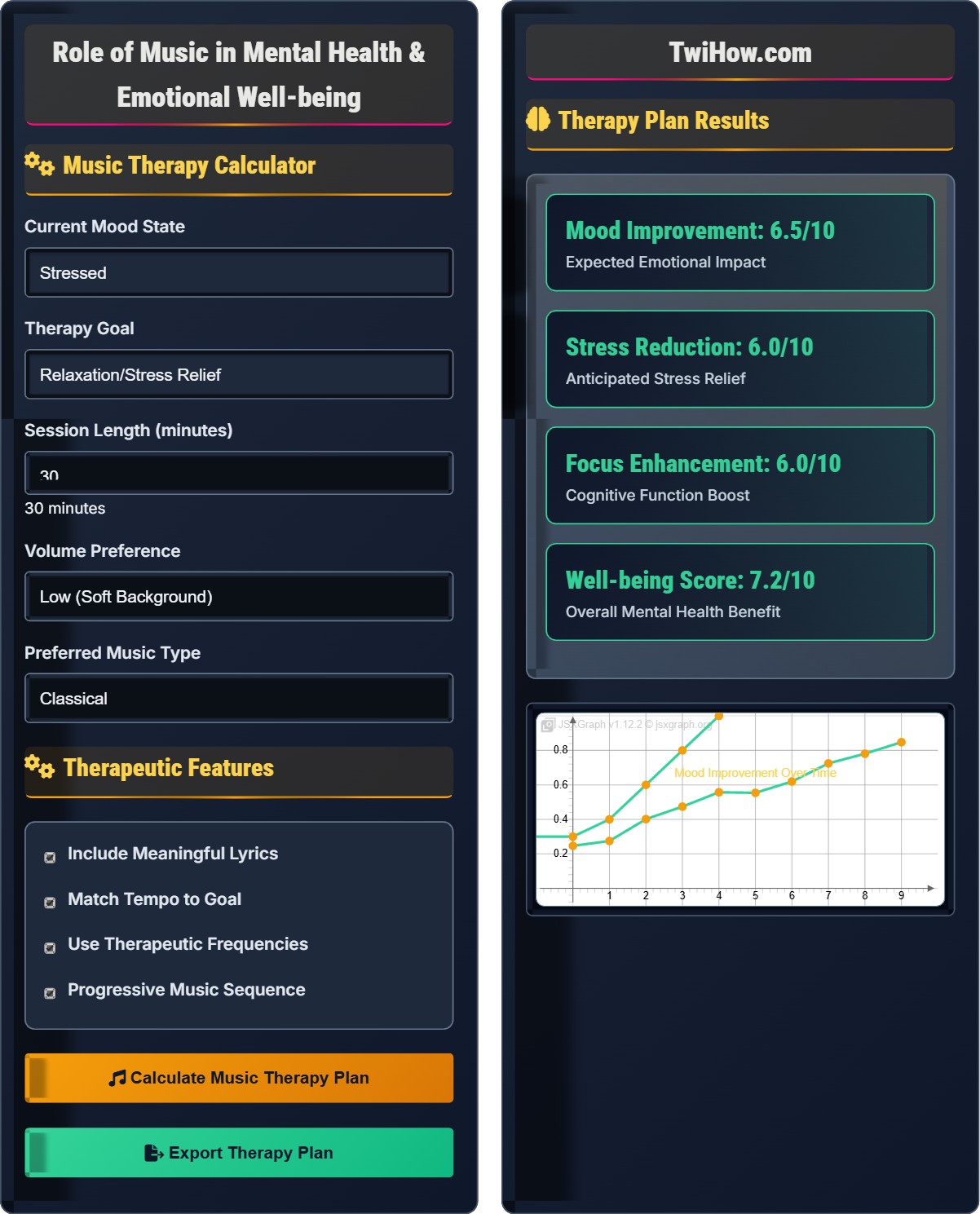
Music Therapy Calculator
Therapeutic Features
Therapy Plan Results
| Element | Recommendation | Duration | Intensity |
|---|---|---|---|
| Warm-up | Slow tempo, calming music | 5 min | Low |
| Main Session | Target therapy music | 20 min | Medium |
| Cooldown | Gradual silence | 5 min | Decreasing |
Music in Mental Health & Emotional Well-being
Music affects the brain through multiple pathways, triggering neurochemical responses that directly impact mental health. The auditory cortex processes sound, while limbic structures regulate emotion and memory. Music activates the reward system, releasing dopamine and endorphins that promote well-being.
Scientific studies show that music therapy can be as effective as traditional interventions for certain conditions.
Where:
- Emotional Resonance: How deeply music connects with emotions
- Neurological Response: Brain activation and neurochemical release
- Personal Relevance: Connection to personal experiences and preferences
- Resistance Factor: Psychological barriers to music acceptance
Music therapy applications for mental health:
- Depression: Mood enhancement through uplifting melodies
- Anxiety: Stress reduction via calming rhythms
- PTSD: Trauma processing through guided listening
- Dementia: Memory recall and cognitive stimulation
- Autism: Social communication and emotional expression
- Addiction: Coping skills and emotional regulation
- Personal Playlists: Curate music for specific emotional needs
- Guided Meditation: Use music for mindfulness and relaxation
- Active Participation: Sing, play instruments, or move to music
- Emotional Processing: Discuss feelings evoked by music
- Memory Association: Connect music to positive experiences
- Group Therapy: Share musical experiences with others
Music Therapy Fundamentals
Music therapy works through several neurological pathways:
- Dopamine Release: Reward system activation
- Stress Hormone Reduction: Cortisol decrease
- Neural Connectivity: Enhanced brain network communication
- Memory Consolidation: Strengthened recall pathways
- Emotional Regulation: Limbic system modulation
Emotional well-being improvements through music:
- Mood Enhancement: Positive emotion induction
- Stress Relief: Relaxation and tension reduction
- Emotional Expression: Safe outlet for feelings
- Self-Reflection: Internal processing facilitation
- Social Connection: Shared experiences and bonding
Music therapy methods and applications:
- Receptive Listening: Passive music consumption
- Active Participation: Singing, playing, moving
- Improvisation: Spontaneous musical creation
- Composition: Writing and arranging music
- Lyric Analysis: Discussing song meanings
- Music and Imagery: Guided visualization
Scientific Research
Music therapy, neuroplasticity, dopamine release, stress hormones, emotional regulation, therapeutic intervention.
Therapeutic Impact = (Emotional Resonance × Neurological Response × Personal Relevance) ÷ Resistance Factor
Where Therapeutic Impact = overall mental health benefit, Emotional Resonance = emotional connection strength.
- Personalization increases effectiveness
- Consistent practice yields better results
- Combination with other therapies enhances outcomes
Music Therapy Quiz
Which neurotransmitter is primarily responsible for the mood-enhancing effects of music?
Dopamine is the primary neurotransmitter responsible for music's mood-enhancing effects. Music activates the brain's reward system, triggering dopamine release in areas associated with pleasure and motivation. This neurochemical response explains why music can be so emotionally powerful and mood-improving.
The answer is B) Dopamine.
Understanding the neurological basis of music therapy helps explain its effectiveness. The dopaminergic reward pathway is crucial for motivation, pleasure, and reinforcement learning. Music's ability to activate this system underlies its therapeutic potential for mood disorders and addiction recovery.
Dopamine: Neurotransmitter associated with reward and pleasure
Neurotransmitter: Chemical messenger between nerve cells
Reward System: Brain circuitry for motivation and pleasure
• Music activates reward pathways
• Dopamine mediates pleasure responses
• Neurochemical basis explains effectiveness
• Choose music that triggers positive emotions
• Pay attention to mood changes during listening
• Use music as a mood regulation tool
• Underestimating neurological impact
Explain how music reduces stress and anxiety. What are the specific physiological mechanisms involved?
Stress Reduction Mechanisms:
1. Cortisol Reduction: Calming music decreases cortisol production, lowering stress hormone levels.
2. Heart Rate Variability: Slow-tempo music can slow heart rate and reduce blood pressure.
3. Parasympathetic Activation: Relaxing music triggers the parasympathetic nervous system, promoting rest and digestion.
4. Endorphin Release: Pleasant music releases endorphins, natural painkillers that promote well-being.
5. Amygdala Regulation: Music can dampen amygdala activity, reducing fear and anxiety responses.
6. Cognitive Distraction: Music redirects attention away from stressors, providing mental relief.
Research shows that 30 minutes of relaxing music can significantly reduce stress markers.
Music's stress-reducing effects involve multiple physiological systems working together. The combination of hormonal, neurological, and cardiovascular responses creates a comprehensive stress-relief mechanism. This multi-system approach explains why music therapy is effective for anxiety management.
Cortisol: Primary stress hormone
Parasympathetic Nervous System: Rest and digest response
Amygdala: Brain region controlling fear responses
• Slow tempo reduces stress
• Familiar music is more effective
• Consistent practice enhances benefits
• Use 60-80 BPM for relaxation
• Create stress-reduction playlists
• Practice deep breathing with music
• Using stimulating music for relaxation
• Not practicing regularly
• Expecting immediate results
A person with mild depression wants to use music therapy as part of their recovery. Design a music therapy plan that addresses mood enhancement, emotional processing, and motivation. Include specific recommendations for music selection, timing, and techniques.
Therapy Plan:
1. Morning Motivation: Start with uplifting, energetic music (80-120 BPM) to stimulate motivation and positive mood.
2. Midday Processing: Use emotionally resonant music with meaningful lyrics for emotional expression and processing.
3. Evening Reflection: Listen to calming music for relaxation and positive reflection on the day.
Techniques: Combine receptive listening with active participation (singing, humming, gentle movement).
Selection: Include personally meaningful songs, nature sounds, and instrumental pieces that evoke positive memories.
Duration: 20-30 minutes per session, 3-4 times daily.
Monitoring: Track mood changes before and after sessions to assess effectiveness.
This structured approach demonstrates how music therapy can be systematically applied to address specific mental health conditions. The timing and selection considerations reflect the circadian rhythms and emotional needs of people with depression, showing how therapy can be tailored to individual needs.
Receptive Listening: Passive music consumption
Active Participation: Engaging with music through singing/playing
Emotional Processing: Working through feelings with music
• Match music to time of day
• Include emotional expression
• Maintain consistent schedule
• Create mood-specific playlists
• Use music journaling
• Combine with other activities
• Using only sad music during depression
• Not maintaining consistency
• Ignoring personal preferences
Someone experiences severe anxiety before public speaking. How can they use music therapy techniques to manage their anxiety in the 30 minutes before a presentation?
Pre-Presentation Protocol:
1. Initial Phase (10 min): Listen to familiar, calming music to activate relaxation response.
2. Breathing Coordination (10 min): Synchronize breathing with slow, rhythmic music (60-70 BPM).
3. Confidence Building (5 min): Listen to empowering, upbeat music to boost confidence.
4. Visualization (5 min): Use music-assisted mental rehearsal of successful presentation.
Techniques: Focus on instrumental music to avoid cognitive distraction from lyrics. Use binaural beats or nature sounds if available.
Environment: Find quiet space, use quality headphones, maintain comfortable posture.
This targeted approach shows how music therapy can be adapted for specific anxiety-inducing situations. The timed protocol addresses the physiological arousal of anxiety while building confidence through positive emotional states. This demonstrates the versatility of music therapy applications.
Performance Anxiety: Fear related to public performance
Physiological Arousal: Bodily activation during stress
Binaural Beats: Audio illusion for brainwave entrainment
• Use familiar music
• Match tempo to desired state
• Combine with breathing techniques
• Practice routine beforehand
• Prepare multiple music options
• Use music as ritual/cue
• Using unfamiliar music
• Not practicing the routine
• Choosing stimulating music
Which type of music has been shown to be most effective for improving cognitive function and memory in older adults?
Classical music, particularly Mozart's compositions, has been shown to be most effective for improving cognitive function and memory in older adults. The "Mozart Effect" refers to temporary improvements in spatial-temporal reasoning after listening to Mozart's music. The complex yet structured nature of classical music appears to enhance neural connectivity and cognitive processing.
The answer is B) Classical music, particularly Mozart.
This demonstrates how specific musical characteristics can influence cognitive function. The structured, complex nature of classical music provides optimal stimulation for neural networks involved in spatial reasoning and memory. However, individual preferences and personal relevance also play important roles in therapeutic effectiveness.
Mozart Effect: Temporary cognitive enhancement from classical music
Spatial-Temporal Reasoning: Mental manipulation of objects
Neural Connectivity: Communication between brain regions
• Structured music enhances cognition
• Individual preferences matter
• Personal relevance increases effectiveness
• Try classical during study sessions
• Use familiar music for best results
• Experiment with different composers
• Using distracting music during cognitive tasks
• Not considering personal preferences
• Ignoring volume levels
FAQ
Q: Can music therapy replace traditional mental health treatments?
A: Music therapy should complement, not replace, traditional mental health treatments:
1. Adjunctive Treatment: Works best alongside conventional therapy
2. Individual Conditions: Some conditions require medication or intensive therapy
3. Severity Matters: Severe mental illness needs comprehensive care
4. Professional Supervision: Trained therapists provide safe guidance
5. Personalized Approach: Combined treatments address multiple needs
Music therapy is a powerful tool that can enhance traditional treatments but should be integrated into a comprehensive care plan.
Q: How can I use music therapy techniques to help a loved one with depression?
A: Supportive music therapy approaches:
Active Listening: Create playlists together, respecting their preferences
Shared Experiences: Listen together, discuss emotions and memories
Encouragement: Support their musical interests and participation
Environmental Music: Play calming music in shared spaces
Non-Judgmental Space: Allow them to choose their own music
Professional Referral: Connect them with certified music therapists
Remember that depression affects musical preferences differently for each person.