Resources for Deepening Arts & Culture Appreciation
Complete resource guide • Step-by-step explanations
Resource Explorer:
Show Resource FinderDeepening your appreciation and understanding of arts and culture requires access to diverse, high-quality resources that provide context, analysis, and immersive experiences. Effective cultural education combines formal learning with experiential engagement.
Key resource categories include: academic institutions, cultural institutions, digital platforms, community organizations, and professional networks. The most effective approach combines multiple resource types for comprehensive cultural understanding.
Essential resource types include:
- Academic Resources: Courses, books, scholarly articles
- Cultural Institutions: Museums, theaters, galleries
- Digital Platforms: Online courses, virtual tours, streaming
- Community Resources: Local organizations, workshops
- Professional Networks: Artist communities, cultural professionals
Success depends on selecting resources that match your learning style and interests.
Cultural Resource Finder
Resource Priorities
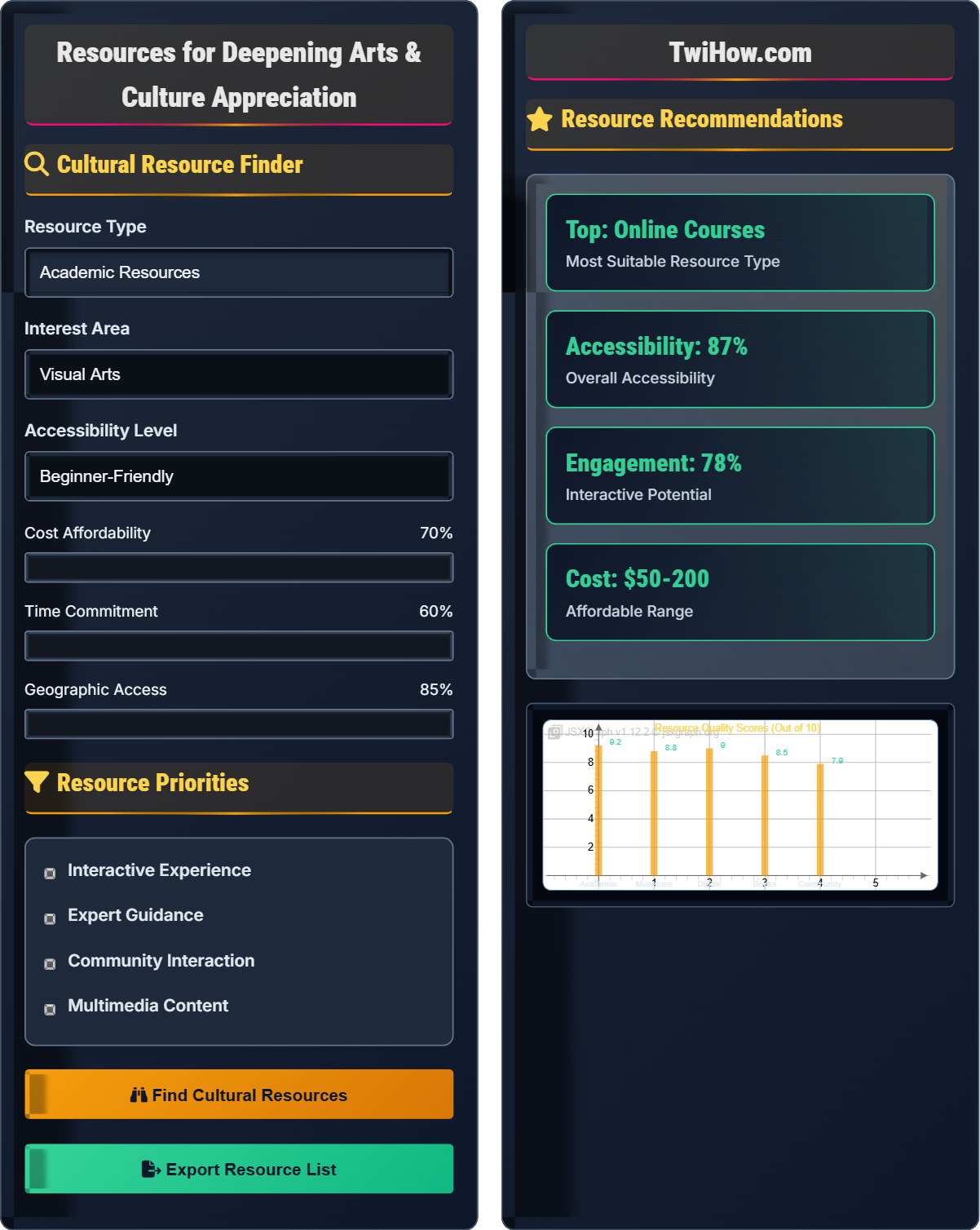
Resource Recommendations
Comprehensive courses covering various art movements and cultural contexts with expert instruction
High-quality virtual experiences of world-class museums with detailed guided tours
Expert-hosted podcasts exploring various cultural topics with deep analysis
| Resource | Type | Cost | Time | Accessibility | Expertise |
|---|---|---|---|---|---|
| Online Courses | Academic | Low-Medium | Flexible | High | Expert |
| Virtual Tours | Digital | Free | Flexible | Very High | Curated |
| Books | Medium | Flexible | High | Expert |
Cultural Resource Categories
Formal educational resources including university courses, academic books, scholarly articles, and research publications. These provide rigorous analysis and historical context for cultural understanding.
Benefits: Expert knowledge, comprehensive coverage, academic rigor, and scholarly validation.
Museums, galleries, theaters, and cultural centers offer immersive experiences with authentic artifacts and expert curation. These institutions provide context and professional interpretation.
Advantages: Authentic objects, expert interpretation, immersive experiences, and cultural preservation.
Online resources including virtual tours, streaming services, digital libraries, and educational websites. These offer unprecedented access to global cultural content.
Features: Global access, convenience, multimedia content, and interactive experiences.
Local organizations, cultural groups, workshops, and community centers provide hands-on experiences and social learning opportunities.
Benefits: Personal interaction, local context, practical experience, and community engagement.
Books, magazines, journals, and periodicals offer in-depth analysis and diverse perspectives on cultural topics. These provide comprehensive coverage of subjects.
Advantages: Comprehensive coverage, diverse perspectives, detailed analysis, and permanent reference.
Podcasts, documentaries, videos, and audio content provide engaging, accessible ways to learn about cultural topics through storytelling and expert interviews.
Features: Engaging format, expert interviews, accessible content, and flexible consumption.
Cultural Learning Journey
Online Art History Courses
Comprehensive courses covering various art movements and cultural contexts with expert instruction from renowned institutions.
Virtual Museum Tours
High-quality virtual experiences of world-class museums with detailed guided tours and expert commentary.
Cultural Workshops
Hands-on workshops and classes offered by local cultural organizations and community centers.
Cultural Magazines
Specialized publications offering in-depth analysis and current perspectives on arts and culture.
Resource Categories Overview
Resource Accessibility Distribution
| Resource | Category | Cost | Accessibility | Expertise | Engagement |
|---|---|---|---|---|---|
| Online Courses | Academic | Low-Medium | High | Expert | High |
| Virtual Tours | Digital | Free | Very High | Curated | Medium |
| Books | Medium | High | Expert | Medium | |
| Workshops | Community | Medium | Low | Practical | Very High |
| Podcasts | Audio | Free | Very High | Expert | Medium |
Recommended Resources & Platforms
University courses and academic resources for deep cultural understanding.
Coursera Art History edX Cultural Studies Khan Academy ArtVirtual and physical museum experiences for authentic cultural encounters.
Google Arts & Culture Metropolitan Museum British MuseumMagazines, journals, and books for in-depth cultural analysis.
Artforum Smithsonian Magazine New York Review of BooksCultural Resource Knowledge Quiz
Which type of resource typically provides the most comprehensive and academically rigorous analysis of cultural topics?
Academic books and scholarly articles provide the most comprehensive and rigorous analysis of cultural topics. These resources undergo peer review, cite extensive sources, and offer detailed contextual analysis that builds upon established scholarship.
The answer is B) Academic books and scholarly articles.
Academic resources are characterized by scholarly rigor, extensive research, and peer review processes. They provide comprehensive coverage of topics, citing primary sources and engaging with existing scholarship. This level of analysis is essential for developing deep understanding of cultural topics.
Academic Rigor: Strict standards of research and analysis
Peer Review: Evaluation by expert scholars in the field
Scholarly Analysis: In-depth examination of topics
• Academic sources provide depth
• Peer review ensures quality
• Scholarly analysis builds understanding
• Start with introductory texts
• Follow up with scholarly sources
• Check bibliography for further reading
• Relying solely on casual sources
• Not verifying information
• Ignoring academic resources
How should you evaluate the quality and reliability of cultural resources?
Evaluation Criteria:
Author Credentials: Research the author's expertise, institutional affiliation, and academic background in the relevant field.
Publication Source: Consider the reputation of the publisher, journal, or institution providing the resource.
Citation Practice: Check whether the resource cites credible sources and engages with existing scholarship.
Editorial Process: Determine if the resource underwent peer review, editorial oversight, or quality control.
Objectivity and Balance: Assess whether the resource presents multiple perspectives and avoids obvious bias.
Methodology: For research-based resources, examine the methods used to gather and analyze information.
Current Relevance: Consider the publication date and whether the resource reflects current understanding of the topic.
Evaluating cultural resources requires critical thinking skills that consider the source's credibility, methodology, and scholarly rigor. Quality resources demonstrate expertise, engage with established knowledge, and follow appropriate academic standards. This evaluation process helps distinguish reliable information from speculation or bias.
Author Credentials: Qualifications and expertise of the creator
Peer Review: Evaluation by expert colleagues
Academic Rigor: Strict standards of research and analysis
• Verify author credentials
• Check publication source
• Look for citations
• Cross-reference multiple sources
• Check for peer review
• Look for institutional backing
• Not verifying author credentials
• Accepting uncited claims
• Ignoring publication quality
You want to deepen your understanding of Renaissance art but have limited background knowledge. What learning path would best help you develop comprehensive appreciation and understanding?
Structured Learning Path:
Beginner Foundation: Start with accessible resources like museum virtual tours, introductory books, and documentary films to gain visual familiarity and basic concepts.
Contextual Learning: Explore historical context through books about Renaissance history, politics, and culture to understand art within its broader framework.
Academic Deepening: Progress to scholarly books and articles that analyze specific artists, techniques, and cultural significance.
Practical Engagement: Participate in museum visits, gallery talks, or workshops to experience art firsthand.
Community Discussion: Join art appreciation groups or online forums to discuss and analyze your learning with others.
Ongoing Practice: Regularly visit museums, read art criticism, and continue exploring related cultural topics to maintain and deepen your understanding.
Effective cultural learning follows a progressive path from basic exposure to deep analysis. Starting with accessible resources builds foundational knowledge and visual literacy, while gradually introducing more complex academic analysis deepens understanding. This approach maintains engagement while building expertise.
Visual Literacy: Ability to interpret and understand visual information
Progressive Learning: Building knowledge systematically
Cultural Context: Understanding within historical framework
• Start with accessible resources
• Build progressively
• Engage practically
• Visit museums regularly
• Read artist biographies
• Join appreciation groups
• Jumping to advanced sources too quickly
• Not understanding historical context
• Learning in isolation
You want to explore world music but live in a remote area with limited cultural institutions. What digital resources would provide the best cultural education and appreciation experience?
Comprehensive Digital Approach:
1. Streaming Services: Use platforms like Spotify, Apple Music, or Bandcamp to explore world music categories and curated playlists
2. Educational Websites: Visit sites like Smithsonian Folkways, UNESCO's music database, or cultural institution websites
3. Documentary Films: Watch music documentaries on platforms like Netflix, Kanopy, or YouTube
4. Online Courses: Enroll in world music courses on Coursera, edX, or music institutions' online programs
5. Podcasts: Listen to music-focused podcasts that explore cultural contexts and artist interviews
6. Virtual Concerts: Attend live-streamed performances from world-class musicians and cultural institutions
7. Academic Resources: Access music history books and articles through digital libraries and databases
Digital resources can provide comprehensive cultural education when physical access is limited. The key is combining audio experience with contextual learning through educational content, historical analysis, and expert commentary. This approach creates a well-rounded learning experience despite geographic limitations.
Digital Access: Online availability of cultural content
Contextual Learning: Understanding within cultural framework
Virtual Experience: Digital representation of cultural events
• Combine audio with education
• Use multiple platforms
• Seek expert content
• Create cultural playlists
• Follow cultural institutions online
• Join online music communities
• Only listening without learning context
• Not exploring cultural backgrounds
• Missing educational opportunities
What is the primary advantage of community-based cultural resources compared to other types of resources?
The primary advantage of community-based cultural resources is personal interaction and hands-on experience. These resources provide opportunities for direct engagement with cultural practitioners, group discussions, and practical learning experiences that cannot be replicated through other resource types.
The answer is B) Personal interaction and hands-on experience.
Community resources offer unique value through social learning and practical engagement. The personal interaction aspect allows for questions, discussions, and immediate feedback that deepen understanding. Hands-on experiences provide tactile and sensory learning that enhances cultural appreciation and creates lasting memories.
Community Resources: Locally-based cultural offerings
Hands-on Experience: Direct participation in activities
Social Learning: Learning through interaction
• Social interaction enhances learning
• Practical experience deepens understanding
• Community connections matter
• Attend local cultural events
• Join appreciation groups
• Participate in workshops
• Only learning individually
• Missing social aspects
• Not trying hands-on experiences
FAQ
Q: How do I balance different types of cultural resources for comprehensive learning?
A: Balance different resource types by combining visual experiences (museums, virtual tours) with analytical content (books, articles), interactive experiences (workshops, courses) with passive consumption (documentaries, podcasts), and solitary learning with community engagement. This multi-modal approach reinforces learning through different pathways.
Start with accessible resources to build foundational knowledge, then deepen understanding through academic sources. Combine theoretical learning with practical experiences, and engage with cultural content both individually and in groups for comprehensive understanding.
Q: What are the most cost-effective resources for cultural education?
A: Most cost-effective resources include public library books and audiobooks, free museum days, online courses with audit options, public cultural events, and digital resources like Google Arts & Culture. Many institutions offer free access days or discounted memberships for students.
Take advantage of free resources like podcasts, YouTube channels from cultural institutions, public lectures, and community cultural events. These provide high-quality content at little or no cost while building cultural knowledge and appreciation.