How do I avoid decision fatigue when choosing what to watch?
Complete streaming decision guide • Step-by-step strategies
Streaming Decision Fatigue:
Show Decision HelperDecision fatigue when choosing what to watch occurs when the overwhelming abundance of streaming options leads to mental exhaustion, indecision, and ultimately poor content choices. This phenomenon, also known as "Netflix paralysis," affects millions of users daily as they face thousands of titles with limited information to guide their selection.
Modern streaming platforms present users with an abundance of choices—Netflix alone offers over 13,000 titles. This excess of options triggers cognitive overload, where the brain struggles to process and compare numerous alternatives. The result is often abandoning the decision entirely or settling for suboptimal content.
Effective strategies include:
- Pre-selection: Creating watchlists and collections in advance
- Time Limits: Setting decision windows to prevent endless browsing
- Category Filters: Using genres, moods, and preferences to narrow choices
- Decision Rules: Establishing simple criteria for selection
- Batch Planning: Choosing multiple items at once
- Trusted Sources: Relying on curated recommendations
These approaches help transform the overwhelming array of options into manageable, satisfying choices that lead to better viewing experiences.
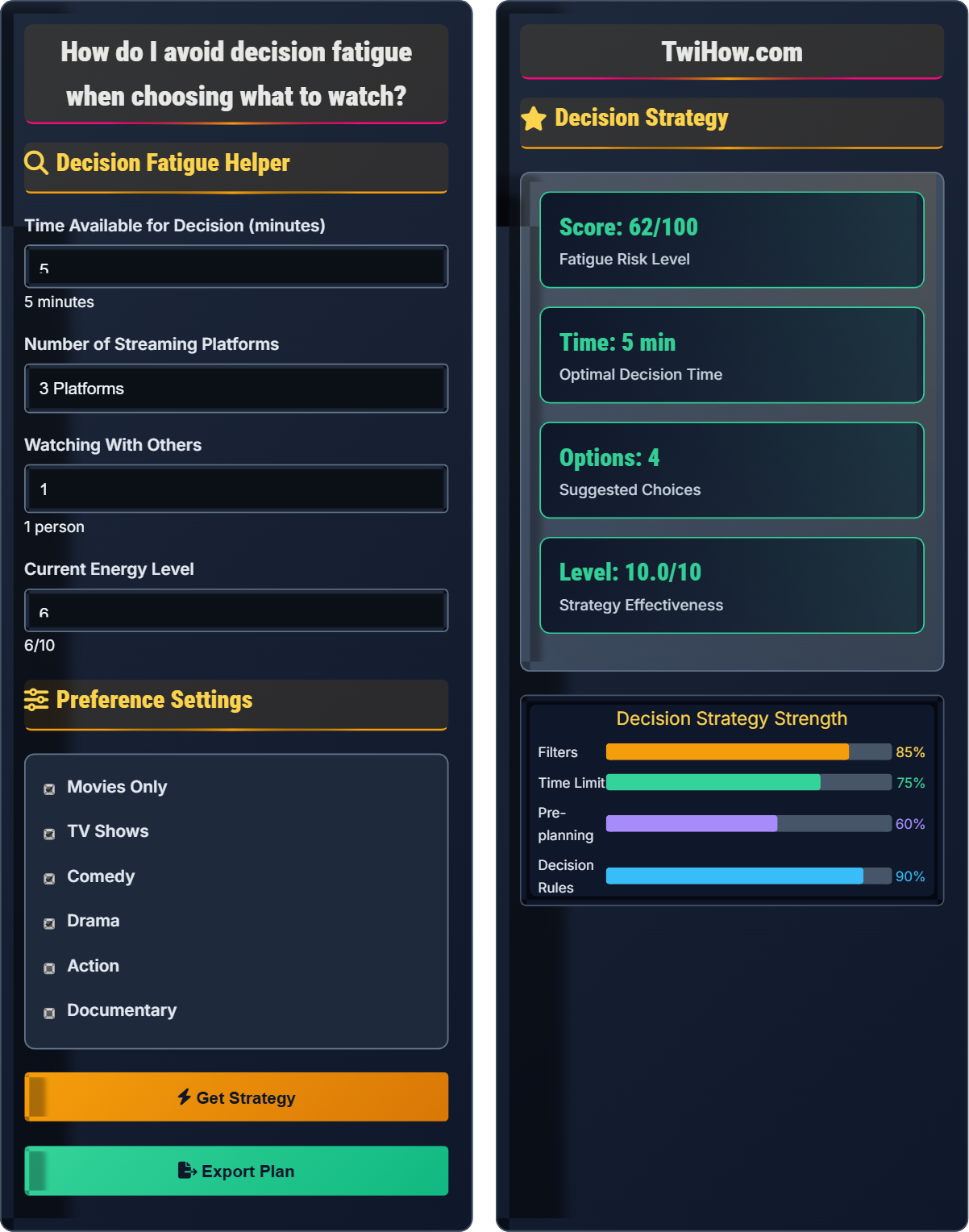
Decision Fatigue Helper
Preference Settings
Decision Strategy
| Strategy | Priority | Effectiveness | Implementation |
|---|---|---|---|
| Genre Filtering | 1 | High | Apply genre preferences |
| Time Limit | 2 | High | Set 3-minute timer |
| Quick Preview | 3 | Medium | Watch 30-second previews |
| Trusted Sources | 4 | Medium | Use favorite recommendations |
Recommended Options
Quick Selection
Choose from 5 pre-filtered options
Time Boxing
3-minute decision window
Pre-planning
Build watchlist in advance
Rule-Based
Simple yes/no criteria
Decision Fatigue in Streaming Explained
Decision fatigue occurs when the mental energy required to make choices becomes depleted after prolonged decision-making. In streaming contexts, users face hundreds or thousands of options with limited information, creating cognitive overload. As fatigue accumulates, decision quality decreases, leading to suboptimal choices or decision avoidance. This psychological phenomenon affects everyone but is particularly pronounced when tired, stressed, or facing complex choices.
Where:
- Choice Complexity: Difficulty of comparing options
- Time Pressure: Urgency to make a decision
- Options Count: Number of available choices
- Energy Level: Mental and physical energy available
- Decision Rules: Established criteria for selection
Effective strategies for reducing decision fatigue include:
- Pre-selection: Build watchlists during low-energy times
- Automated Filtering: Use platform recommendations and personal filters
- Decision Rules: Establish simple criteria (e.g., "if it's longer than 2 hours, skip it")
- Batch Processing: Plan multiple viewing sessions at once
- Trusted Sources: Rely on recommendations from trusted friends or critics
- Time Boxing: Set strict limits on decision-making time
- Two-Option Rule: Quickly eliminate all but two choices
- Stop-After-One: Choose the first acceptable option
- Random Selection: Use dice or randomizer for similar options
- Mood-Based Sorting: Match content to current mood
- Energy Matching: Choose complexity based on energy level
- Group Decision: Use consensus-building techniques
Decision Fundamentals
Decision fatigue, cognitive load, choice paralysis, streaming overload, mental energy, decision-making process, option evaluation.
Fatigue Level = (Choice Complexity × Time Pressure × Options Count) / (Energy Level × Decision Rules)
Where Level = measure of mental exhaustion from decision-making.
- More choices increase decision fatigue exponentially
- Time pressure compounds fatigue effects
- Established rules reduce cognitive load significantly
Strategy Implementation
Pre-planning, filtering, time management, evaluation criteria, rule establishment, acceptance techniques.
- Assess current decision-making patterns
- Identify specific fatigue triggers
- Implement filtering and pre-planning
- Set time limits and decision rules
- Practice acceptance of good-enough choices
- Reduced time spent browsing
- Higher satisfaction with choices
- Less frustration during selection
- More consistent viewing habits
Decision Fatigue Learning Quiz
What is the primary cause of decision fatigue when choosing what to watch?
Decision fatigue primarily results from having too many options with insufficient information to distinguish between them. Streaming platforms offer thousands of titles, but users only see brief summaries and ratings. This creates cognitive overload as the brain attempts to process and compare numerous alternatives without adequate information to make informed distinctions. The abundance of choices without clear differentiators exhausts mental energy, leading to poor decision-making or decision avoidance.
The answer is B) Excessive choice with limited information.
Understanding the root cause of decision fatigue reveals why common solutions like "just pick something" don't work. The problem isn't that people are indecisive or lazy—it's that the human brain has limited capacity for processing complex comparisons. When faced with too many options that appear similar based on available information, cognitive resources become depleted. This demonstrates why strategies that reduce the number of options to consider (through filtering and pre-planning) are more effective than trying to improve decision-making skills when overwhelmed.
Decision Fatigue: Mental exhaustion from prolonged decision-making
Cognitive Load: Mental effort required for processing information
Choice Paralysis: Inability to make decisions due to too many options
• More choices don't necessarily mean better decisions
• Limited information compounds choice complexity
• Mental energy is finite and gets depleted
• Pre-select options when energy is high
• Use platform filtering features extensively
• Set time limits for decision-making
• Assuming more options lead to better choices
Explain how to implement an effective pre-planning strategy to avoid decision fatigue, including specific techniques and timing considerations.
Pre-Planning Strategy: Schedule decision-making during high-energy periods, typically earlier in the day or after rest. Create multiple watchlists organized by mood, genre, and viewing situation (alone, with family, with friends).
Specific Techniques: Build a "Tonight's Queue" list during afternoon lulls, create "Rainy Day Favorites" for low-energy evenings, maintain "Group Viewing" selections for social occasions, and prepare "Quick Picks" for time-constrained situations.
Timing Considerations: Plan during weekdays for weekend viewing, schedule during commutes or lunch breaks, and update lists based on seasonal content availability. The key is separating the planning phase from the decision phase, allowing for thoughtful selection when energy is high and deferring quick decisions when fatigued.
Effective pre-planning works by leveraging the principle that decision quality varies with mental energy levels. By making thoughtful choices when alert and energetic, we create a reservoir of pre-approved options for times when energy is low. This strategy transforms the evening decision from "what do I want to watch?" to "which of my pre-selected options feels right tonight?" This reduces cognitive load while maintaining personal agency. The key insight is that good decision-making requires both time and energy, so we must be strategic about when we deploy these resources.
Pre-Planning: Making decisions in advance during high-energy periods
Watchlist: Pre-selected content for future viewing
Energy Matching: Aligning decision complexity with available mental energy
• Plan when energy is high, decide when tired
• Match content to viewing context
• Update plans regularly to stay current
• Create multiple themed watchlists
• Use platform bookmark features
• Share watchlists with household members
• Planning during low-energy decision times
• Creating overly rigid, inflexible plans
• Failing to update lists based on new releases
You're part of a household with different viewing preferences: you prefer documentaries, your partner likes comedies, and your teenager enjoys action shows. How would you implement a system that reduces decision fatigue for everyone while ensuring fair viewing opportunities? Include specific strategies and scheduling considerations.
Rotating Schedule: Implement a weekly rotation system where each person gets designated viewing nights. Create individual watchlists for each person during their respective planning times.
Compromise Options: Maintain a "Household List" with content that appeals to multiple preferences (comedy documentaries, action comedies). Use collaborative filtering tools to identify mutually acceptable content.
Flexible Rules: Establish guidelines like "no veto for the scheduled viewer" but allow "one compromise per week." Create themed nights (documentary Sunday, comedy Monday) to provide variety while maintaining structure.
Decision Efficiency: Set 2-minute timers for household decisions, use voting systems for compromise nights, and maintain separate personal viewing schedules for solo sessions.
Multi-person decision-making compounds the challenges of decision fatigue by introducing conflicting preferences and negotiation complexities. The solution involves creating structure that removes the need for repeated negotiations while ensuring fairness. This approach recognizes that household harmony often trumps individual preference optimization. The key is establishing systems that preserve personal autonomy while creating predictable, fair sharing arrangements. This demonstrates how decision fatigue strategies must adapt to social contexts while maintaining their core principles of reducing cognitive load.
Rotating Schedule: Systematic alternation of decision authority
Compromise Content: Options that satisfy multiple preferences
Household Coordination: Structured approach to shared decisions
• Structure reduces negotiation fatigue
• Fairness requires explicit systems
• Compromise should be balanced over time
• Use calendar tools to track rotations
• Maintain personal viewing allowances
• Create shared lists for neutral options
• Attempting consensus for every decision
• Failing to establish clear scheduling rules
• Not accounting for changing preferences over time
You have only 10 minutes to choose something to watch before guests arrive, but you want to make a good selection. How would you structure your decision-making process to maximize satisfaction within this tight timeframe? Include specific techniques and time allocations.
Time Allocation: Spend 2 minutes reviewing pre-made lists, 3 minutes quick preview scanning, 3 minutes applying simple decision rules, and 2 minutes finalizing the choice.
Decision Rules: Apply immediate elimination criteria (genre, length, guest appropriateness). Use the "first acceptable option" rule rather than comparative evaluation. Focus on content that matches the group's known preferences.
Efficiency Techniques: Use platform's "Quick Pick" features, rely on trusted recommendations, skip detailed reading in favor of visual cues (posters, thumbnails). Prepare a "Party List" of universally appealing content in advance.
Acceptance Strategy: Commit to the choice made within the timeframe rather than second-guessing. Remember that good enough is often better than perfect, especially with time constraints.
Time-constrained decision-making requires different strategies than unconstrained choices. The key is recognizing that perfect decisions are impossible under time pressure, so we must optimize for "good enough" rather than "best possible." This approach prioritizes decision completion over optimization, which is often more practical and leads to higher satisfaction than attempting to make the perfect choice under pressure. The preparation component (pre-made lists) becomes crucial when time is limited, demonstrating how effective decision-making involves both reactive and proactive strategies.
Time-Constrained Decision: Choice made under temporal pressure
Good Enough Principle: Accepting satisfactory rather than optimal outcomes
Decision Completion: Prioritizing finishing the choice over optimizing it
• Preparation enables rapid decision-making
• Time pressure requires different strategies
• Satisfaction comes from completion, not perfection
• Maintain emergency backup options
• Use visual scanning for quick evaluation
• Apply strict elimination criteria
• Attempting thorough evaluation under time pressure
• Second-guessing decisions made under time constraints
• Not preparing for time-sensitive situations
How should your decision-making approach change based on your current energy level?
The most effective approach is to match decision complexity to available mental energy. When energy is high, you can handle complex decisions requiring careful evaluation of multiple options. When energy is low, use simple decision rules, pre-made lists, or random selection. This approach optimizes both decision quality and energy conservation. It recognizes that mental energy fluctuates throughout the day and adjusts strategies accordingly rather than applying a one-size-fits-all approach.
The answer is C) Match decision complexity to available mental energy.
Energy matching represents a sophisticated understanding of decision-making that accounts for human limitations and rhythms. Rather than treating decision-making as a constant process, this approach recognizes that our capacity varies and adapts strategies accordingly. This demonstrates the principle that effective systems accommodate human variability rather than fighting against it. The key insight is that good decision-making isn't about making the same choices in the same way—it's about using the right approach for the current context and available resources.
Energy Matching: Aligning decision complexity with available mental resources
Mental Energy: Cognitive resources available for decision-making
Adaptive Strategy: Approaches that adjust to current conditions
• Adjust approach based on current energy levels
• Complex decisions require high energy
• Simple strategies work for low-energy periods
• Plan complex decisions for high-energy times
• Prepare simple options for low-energy periods
• Recognize your personal energy patterns
• Attempting complex decisions when exhausted
• Using energy-intensive strategies during low-energy periods
• Not recognizing personal energy fluctuations
FAQ
Q: How long should I spend deciding what to watch?
A: The optimal decision time depends on your energy level and viewing context:
1. Pre-planned Viewing: 30 seconds to 1 minute to select from your prepared list
2. Spontaneous Choice: 2-5 minutes maximum with clear criteria
3. Group Decision: 3-7 minutes with established rules
4. High Energy Periods: Up to 10 minutes for careful selection
The key is setting time limits before starting the decision process. Once you exceed your predetermined time, use a simple selection method (first acceptable option, random selection, or default choice) rather than continuing to browse indefinitely.
Q: How do I avoid decision fatigue with kids who want to watch different things?
A: Managing children's viewing decisions requires structured approaches:
Rotation System: Each child gets designated viewing days or times
Pre-approved Lists: Maintain separate lists for each child's age-appropriate favorites
Quick Decision Rules: "First person to suggest an option gets to choose" or "parent picks if kids can't agree"
Compromise Content: Keep a list of shows that appeal to multiple age groups
Time Limits: Set strict browsing time (2-3 minutes max) before making a choice
Remember that consistency and predictability help children know what to expect, reducing decision anxiety for everyone.
Q: Are there any apps or tools that can help automate this process?
A: Several tools can assist with decision automation:
Platform Features: Netflix's "Skip Intro" and "My List" features, Hulu's "Continue Watching"
Third-party Apps: JustWatch for cross-platform search, Reelgood for recommendations
Browser Extensions: Netflix Roulette for random selection, streaming helper extensions
Custom Solutions: Spreadsheets with personal ratings, simple scripts for random selection
However, the most effective tools are often simple: maintaining personal watchlists, using platform bookmarks, and creating calendar reminders for new releases in your preferred genres.