How to Balance Entertainment with Other Life Priorities
Complete balance guide • Step-by-step explanations
Entertainment Balance:
Show Balance CalculatorBalancing entertainment with other life priorities requires intentional time management and conscious decision-making. Modern streaming platforms and content abundance create unique challenges for maintaining equilibrium between leisure, work, family, health, and personal growth. Effective balance involves setting boundaries, creating schedules, and establishing priorities that support overall well-being.
Key balance factors include:
- Time Allocation: Distributing hours among different life areas
- Priority Setting: Identifying what matters most in different contexts
- Boundary Management: Creating limits around entertainment consumption
- Quality vs. Quantity: Focusing on meaningful engagement over passive consumption
- Life Integration: Finding ways to enjoy entertainment while maintaining responsibilities
Developing these skills helps maintain a fulfilling life while avoiding the negative effects of excessive entertainment consumption.
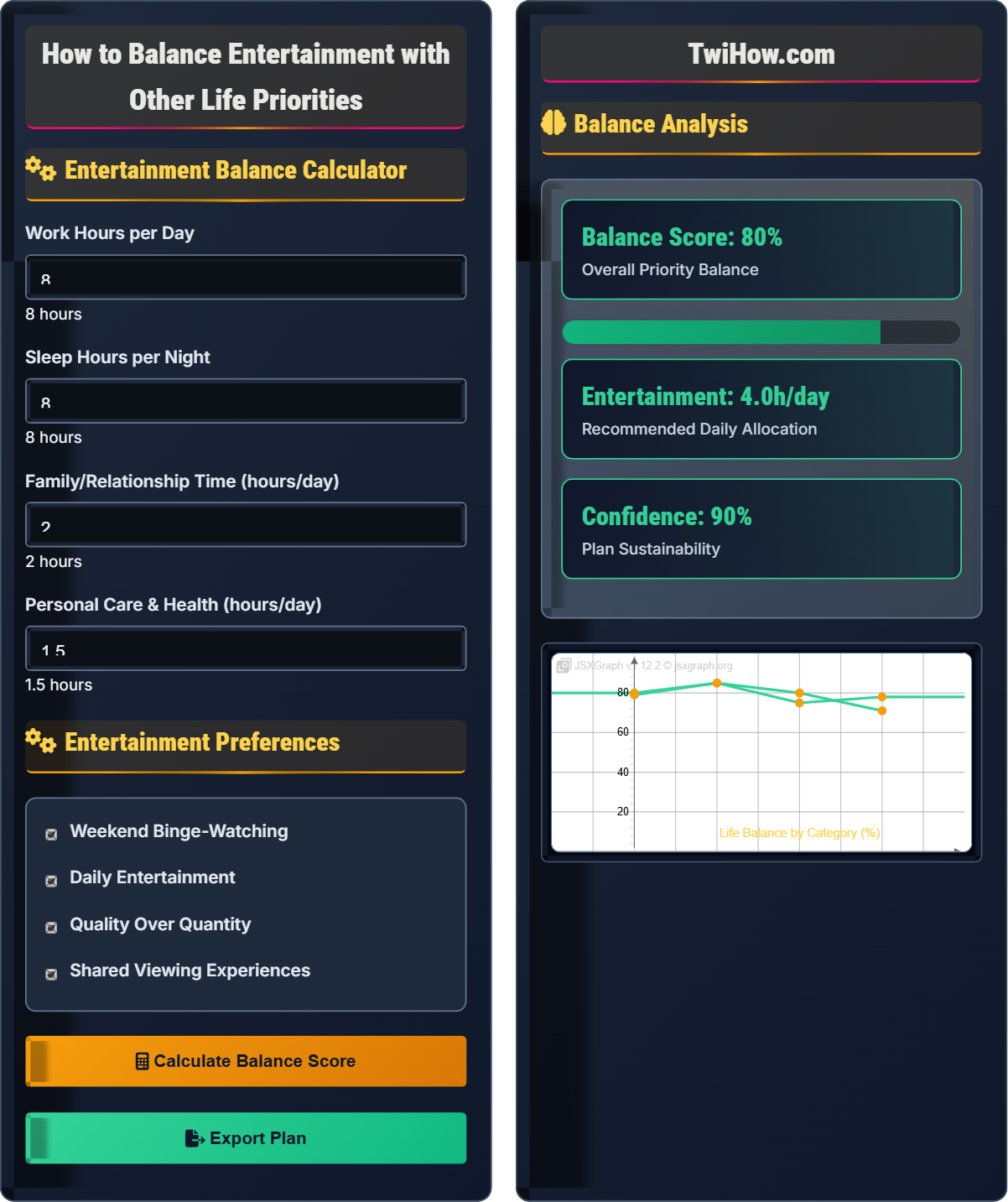
Entertainment Balance Calculator
Entertainment Preferences
Balance Analysis
| Life Area | Allocated | Recommended | Status |
|---|---|---|---|
| Work | 8h | 8h | Optimal |
| Sleep | 8h | 8h | Optimal |
| Family | 2h | 2.5h | Good |
| Entertainment | 2.5h | 2h | Acceptable |
Set specific entertainment windows to avoid overconsumption
Establish weekly priorities and protect important time blocks
Use streaming platform features to limit binge-watching
Combine entertainment with relationship time when possible
Entertainment Balance Formula
Entertainment balance is achieved when all life priorities receive adequate attention:
Where:
- Available Time: 24 hours per day
- Essential Needs: Sleep, nutrition, hygiene (6-8 hours)
- Productive Activities: Work, education, chores (8-12 hours)
- Relationships: Family, friends, social connections (2-4 hours)
- Personal Growth: Exercise, hobbies, relaxation (2-4 hours)
- Entertainment: Remaining time for leisure (2-4 hours)
Key factors that improve entertainment-life balance:
- Flexible Scheduling: Adapting to changing daily needs and opportunities
- Quality Content: Choosing entertainment that provides genuine value
- Conscious Consumption: Being intentional about what and when you watch
- Shared Experiences: Combining entertainment with relationship building
- Boundary Setting: Creating clear limits to prevent overconsumption
- Time Blocking: Schedule specific times for entertainment
- Episode Limits: Set maximum episodes per session
- Device Boundaries: Keep screens out of bedrooms and dining areas
- Weekend Planning: Plan entertainment activities in advance
- Alternative Activities: Develop non-screen hobbies and interests
Core Balance Principles
Time management, priority setting, boundary management, quality focus, life integration.
Balance = (Work + Sleep + Family + Personal Care + Entertainment) ≤ Available Time
Where Available Time = 24 hours, Essential Needs = Sleep/Nutrition/Hygiene.
- Essential needs take priority over entertainment
- Entertainment should enhance rather than detract from life
- Boundaries prevent overconsumption and neglect of responsibilities
- Balance is personal and varies by individual circumstances
Real-World Applications
Work-life balance, family time, personal health, social relationships, productivity maintenance.
- Track current time allocation for one week
- Identify priorities and values alignment
- Create a realistic weekly schedule
- Set boundaries and accountability measures
- Review and adjust regularly based on outcomes
- Individual needs and circumstances vary
- Seasonal adjustments may be necessary
- Family and work demands fluctuate
- Personal preferences evolve over time
Interactive Priority Planner
Example: Weekly Balance Plan
Work: 8h | Sleep: 8h | Family: 2h | Exercise: 1h | Entertainment: 1.5h
Flexible time allocation with 3-4h entertainment, extended family time, and personal projects
No entertainment during meals, 1 hour before bed, and during work hours. Maximum 2 episodes per session.
Entertainment Balance Quiz
Which of the following is the most effective strategy for balancing entertainment with work responsibilities?
Setting specific entertainment windows after work hours is the most effective strategy. This approach maintains clear boundaries between work and leisure time, prevents entertainment from interfering with productivity, and allows for intentional rest and recovery. It also prevents the accumulation of unfinished content that can create stress or guilt.
The answer is B) Setting specific entertainment windows after work hours.
Effective time management involves creating clear boundaries between different life areas. When entertainment has designated time slots, it becomes easier to manage and less likely to interfere with other responsibilities. This approach supports both work productivity and personal enjoyment without creating conflicts or guilt.
Time Boundaries: Specific periods allocated for different activities
Work-Life Balance: Equilibrium between professional and personal time
Intentional Rest: Deliberate downtime for recovery and rejuvenation
• Separate work and entertainment time to maintain focus
• Designated time slots prevent overconsumption
• Clear boundaries support both productivity and relaxation
• Use calendar blocking for entertainment time
• Set device notifications to remind you of time limits
• Prepare entertainment in advance to avoid decision fatigue
• Allowing entertainment to bleed into work time
• Not setting any boundaries on consumption
• Using entertainment as a distraction from responsibilities
Explain how to integrate entertainment with family time in a way that strengthens relationships rather than creating competition for attention. Include specific strategies and potential challenges.
Shared Viewing: Choose content that appeals to multiple family members and schedule regular family movie nights. This creates bonding experiences and shared cultural references.
Discussion Opportunities: Use entertainment as a springboard for meaningful conversations about values, relationships, and life experiences.
Activity Alternatives: Balance screen time with other shared activities like games, outdoor activities, or cooking together.
Respect Individual Preferences: Allow family members to choose their own entertainment sometimes, while ensuring quality time together.
Challenges: Different age groups may have conflicting preferences, screen time limits need enforcement, and some family members may become isolated in their own viewing habits.
Entertainment can strengthen family bonds when approached intentionally. The key is to view entertainment as a tool for connection rather than a substitute for interaction. By choosing content thoughtfully and creating opportunities for discussion, families can use entertainment to enhance their relationships.
Family Integration: Incorporating entertainment into family time constructively
Shared Experience: Common activity that brings family members together
Quality Time: Focused attention and meaningful interaction
• Entertainment should complement rather than replace family interaction
• Respect individual preferences while promoting togetherness
• Balance screen time with other family activities
• Rotate who chooses the entertainment for family time
• Create traditions around shared viewing experiences
• Use entertainment as conversation starters
• Forcing everyone to watch the same content
• Not setting any screen time limits
• Using entertainment to avoid family interaction
If someone works 8 hours a day, sleeps 8 hours a night, spends 2 hours on family time, and 1.5 hours on personal care and exercise, how many hours remain for entertainment and other activities? If they want to dedicate 2 hours daily to entertainment, what percentage of their remaining time does this represent?
Calculation:
Total committed time: 8 (work) + 8 (sleep) + 2 (family) + 1.5 (personal care) = 19.5 hours
Remaining time: 24 - 19.5 = 4.5 hours
Entertainment allocation: 2 hours
Percentage: (2 ÷ 4.5) × 100 = 44.4%
Entertainment represents 44.4% of the remaining time, which is a reasonable allocation for maintaining balance while leaving time for other activities.
This calculation demonstrates the importance of understanding how our time commitments add up. When we account for essential activities, we see that entertainment competes with other discretionary activities for the limited remaining time. Allocating 44% of free time to entertainment represents a balanced approach that leaves room for other important activities.
Time Allocation: Distribution of hours across different activities
Remaining Time: Hours left after essential commitments
Discretionary Time: Free time available for personal choices
• Essential needs (sleep, work) take priority
• Entertainment should fit within remaining time
• Balance requires accounting for all time commitments
• Track your time for one week to see actual allocation
• Consider seasonal adjustments to time allocation
• Build flexibility into your schedule for unexpected events
• Underestimating time needed for essential activities
• Not accounting for commute and transition time
• Overallocating time to entertainment at expense of other areas
You find yourself frequently watching "just one more episode" and ending up staying up late, which affects your next day's productivity. Design a comprehensive plan to set effective boundaries around your streaming habits that addresses the psychological triggers for continuing to watch.
Physical Boundaries: Keep remote controls in a different room after reaching your limit. Use streaming platform settings to disable autoplay. Place devices away from sleeping areas.
Temporal Boundaries: Set a firm bedtime alarm that turns off all screens. Schedule entertainment during specific time blocks rather than open-ended sessions.
Psychological Strategies: Prepare alternative activities for when you feel the urge to continue watching. Use the "two-minute rule" - if you really want to watch more, wait two minutes to see if the impulse passes.
Accountability Measures: Share your goals with family members who can help enforce boundaries. Use apps that track and limit screen time.
Replacement Activities: Have a list of non-screen activities ready for when entertainment time ends (reading, meditation, gentle stretching).
Effective boundary setting requires addressing both external triggers and internal psychological patterns. The "just one more episode" phenomenon exploits our brain's reward system and our desire for closure. By creating environmental barriers and having prepared alternatives, we can interrupt these patterns and maintain control over our choices.
Boundary Setting: Creating limits around behavior and time allocation
Behavioral Triggers: Environmental cues that prompt automatic responses
Psychological Patterns: Mental habits that drive repetitive behaviors
• Make boundaries automatic rather than dependent on willpower
• Address both external triggers and internal impulses
• Have alternative activities ready for transition
• Use streaming platform parental controls to set limits
• Create a "shutdown routine" that includes turning off devices
• Keep a log of when you exceed your boundaries to identify patterns
• Relying solely on willpower instead of environmental changes
• Not having a plan for when boundaries are challenged
• Setting unrealistic boundaries that are difficult to maintain
What is the most important factor to consider when determining how much time to allocate to entertainment?
Your personal values and life goals are the most important factor when determining entertainment time allocation. Time is finite, and how we spend it should align with what matters most to us. Entertainment should serve our overall well-being and life objectives, not compete with them. While cost, social connection, and content availability are relevant considerations, they should be evaluated within the framework of our personal values and goals.
The answer is B) Your personal values and life goals.
Personal values provide the compass for all life decisions, including how we spend our time. When entertainment time aligns with our values and supports our goals, it becomes a meaningful part of our lives rather than a distraction. This alignment creates sustainable balance because our choices are guided by deeper purpose rather than temporary impulses or external pressures.
Personal Values: Fundamental beliefs that guide behavior and decision-making
Life Goals: Desired outcomes that provide direction and purpose
Value Alignment: Consistency between actions and core beliefs
• Time allocation should reflect personal priorities
• Entertainment should support overall well-being
• Balance is subjective and varies by individual values
• Regularly assess whether your time allocation aligns with your values
• Consider how entertainment contributes to your life goals
• Adjust time allocation as your values and goals evolve
• Letting external pressures override personal values
• Not regularly reassessing time allocation
• Failing to consider long-term consequences of time choices
FAQ
Q: How can I enjoy entertainment while still being fully present for my family?
A: The key to enjoying entertainment while being present for family is intentional boundary-setting:
Designated Entertainment Time: Set specific times for personal entertainment and communicate these boundaries to family members. During these times, they know you're unavailable and can plan accordingly.
Shared Entertainment: Choose times when you can enjoy entertainment together, such as family movie nights or watching shows that interest your partner.
Quality Over Quantity: Focus on being fully present during family time rather than multitasking with entertainment. Give your full attention during meals, conversations, and activities.
Device-Free Zones: Establish areas like bedrooms and dining rooms as entertainment-free zones to ensure family time remains uninterrupted.
Flexible Scheduling: Be willing to pause your entertainment when family needs arise, but also ensure you get your needed downtime.
Q: How do I balance streaming with academic responsibilities without feeling guilty?
A: Guilt about entertainment often stems from feeling like you're not being productive enough. Here's how to maintain balance without guilt:
Reframe Entertainment: View entertainment as necessary rest and recovery that supports your academic performance. Your brain needs downtime to consolidate learning and maintain focus.
Strategic Timing: Use entertainment as a reward after completing study sessions or as a break between intensive academic work.
Efficient Consumption: Choose shorter content (movies, mini-series) during busy academic periods and save longer series for breaks.
Academic Integration: Sometimes choose educational or thought-provoking content that relates to your studies.
Accountability Systems: Set timers, use streaming platform limits, and track your time to ensure entertainment doesn't exceed your planned allocation.
Remember, sustainable academic success requires balance, not constant work.