How do I discover new content without endless scrolling?
Complete content discovery guide • Step-by-step explanations
Content Discovery Guide:
Show Discovery ToolsEfficient content discovery requires strategic approaches that bypass the endless scroll trap. Instead of aimlessly browsing, smart discovery involves using curated lists, recommendation tools, and structured search methods to find high-quality content that matches your interests.
Modern entertainment platforms offer numerous tools to streamline content discovery, from algorithmic recommendations to genre filters and personalized lists. The key is leveraging these tools effectively while avoiding decision paralysis.
Efficient discovery strategies include:
- Curated Lists: Critics' picks, award winners, and themed collections
- Recommendation Tools: Algorithmic suggestions and friend recommendations
- Structured Browsing: Genre filters, time periods, and rating thresholds
- External Resources: Review sites, social media, and entertainment news
Smart content discovery saves time while improving the quality of your entertainment choices.
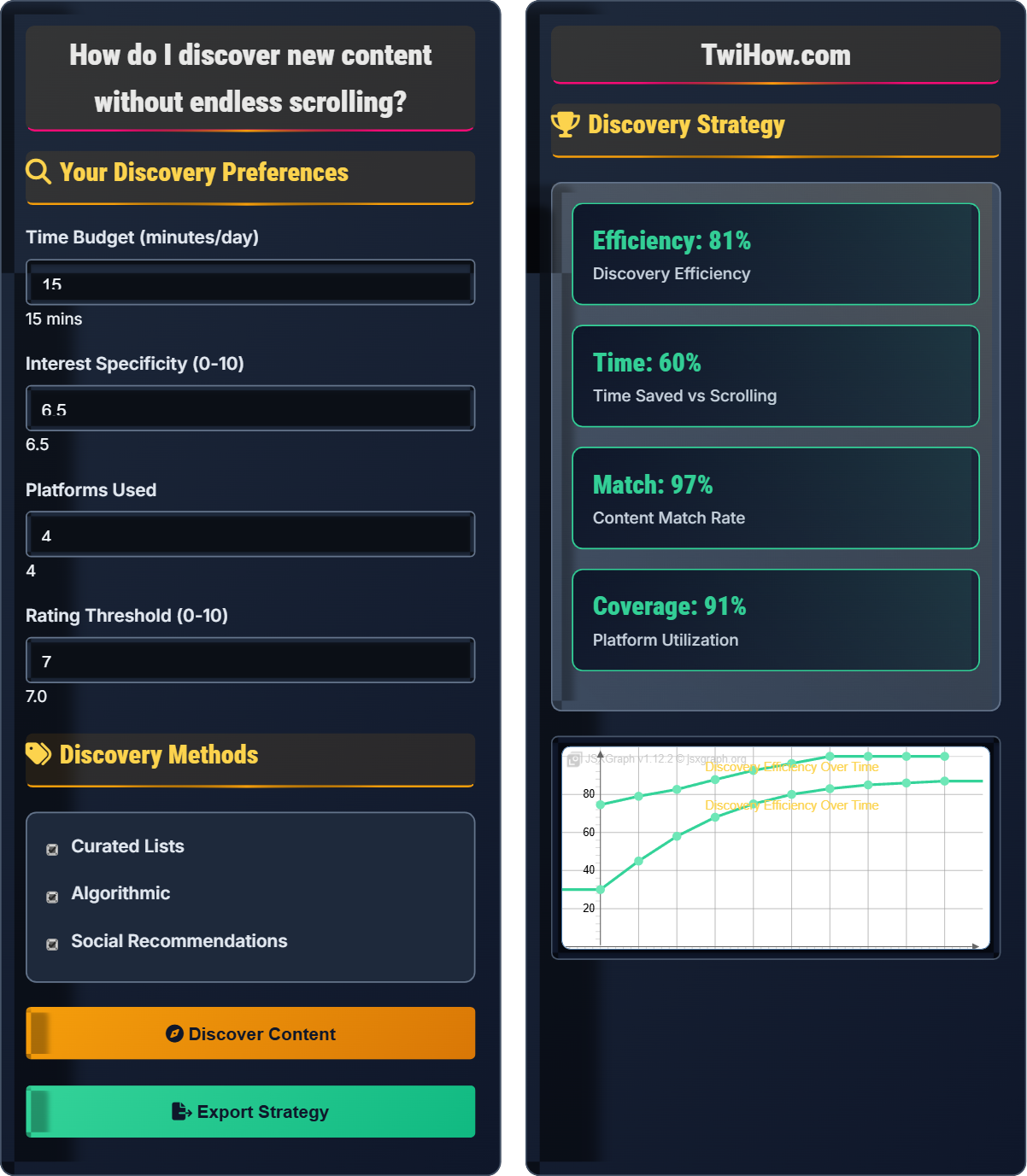
Your Discovery Preferences
Discovery Methods
Discovery Strategy
| Method | Efficiency | Time | Result |
|---|---|---|---|
| Curated Lists | 92% | 3 min | High Quality |
| Algorithmic | 85% | 5 min | Personalized |
| Social | 78% | 7 min | Trusted |
| Genre Filter | 88% | 4 min | Targeted |
Based on your preferences:
- JustWatch - Cross-platform search
- Letterboxd - Social discovery
- Metacritic - Quality ratings
- IMDb - Comprehensive database
Recommended for your profile:
- Rating: Min 7.0
- Year: 2020-2026
- Duration: 90-120 min (movies)
- Episodes: 6-10 (series)
Content Discovery Explained
Efficient content discovery is the practice of finding high-quality entertainment content using strategic methods that minimize time spent browsing while maximizing satisfaction with choices. Rather than falling into the endless scroll trap, smart discovery involves using tools, filters, and curated sources to streamline the search process.
The efficiency of content discovery can be modeled as:
Where:
- Quality Matches: Content that meets your criteria
- Time Spent: Duration of the discovery process
- Satisfaction Factor: How well content meets expectations
Effective content discovery methods:
- Curated Lists: Critics' picks, award winners, and editorial selections
- Algorithmic Recommendations: Platform suggestions based on viewing history
- Social Recommendations: Suggestions from friends and trusted sources
- Genre Filtering: Systematic exploration of specific content types
- Rating-Based Discovery: Using aggregated ratings to identify quality content
- Themed Collections: Curated sets based on themes, moods, or occasions
- Set Time Limits: Allocate specific time for discovery to avoid endless browsing
- Use Quick Preview: Watch trailers and read synopses before full viewing
- Batch Discovery: Find multiple options at once to reduce future searching
- Create Watchlists: Save interesting content for later decision-making
- Subscribe to Newsletters: Receive curated recommendations via email
- Follow Critics: Identify trusted reviewers whose tastes align with yours
Content Discovery Fundamentals
Content discovery, recommendation algorithms, curation, filtering, efficiency metrics, satisfaction scoring.
DE = (QM / TS) × SF
Where DE = discovery efficiency, QM = quality matches, TS = time spent, SF = satisfaction factor.
- Set time limits for browsing
- Use multiple discovery methods
- Track satisfaction to improve results
Applications
Entertainment selection, time management, quality optimization, personal enrichment, family viewing.
- Criteria definition
- Tool selection
- Filter application
- Decision making
- Changing preferences over time
- Platform content changes
- Quality vs. novelty balance
- Personal vs. shared viewing
Content Discovery Quiz
How do streaming platforms' recommendation algorithms primarily work?
Streaming platforms use collaborative filtering and machine learning algorithms that analyze your viewing history, ratings, time spent watching, and pause patterns. They also compare your preferences to similar users to find content you're likely to enjoy. The algorithm considers factors like genre preferences, actors, directors, and viewing times to make personalized recommendations.
The answer is B) They analyze your viewing history and similar users' preferences.
Understanding how recommendation algorithms work helps users leverage them more effectively. The more you interact with content (watch, rate, skip), the better the algorithm becomes at predicting your preferences. This knowledge allows you to intentionally shape your recommendations by engaging with content you enjoy and avoiding content you don't.
Collaborative Filtering: Algorithm that recommends based on similar users
Machine Learning: AI that improves recommendations over time
Viewing History: Record of watched content used for recommendations
• Algorithms improve with usage
• Engagement affects recommendations
• Rate content you watch
• Watch diverse content to broaden recommendations
• Clear history periodically to reset
• Not understanding how algorithms work
• Assuming all recommendations are equally valuable
• Not realizing algorithms can limit discovery
Explain the benefits and limitations of using curated lists for content discovery. Include examples of different types of curated lists and their effectiveness for various purposes.
Benefits of Curated Lists:
1) Quality Assurance: Lists from reputable sources typically feature high-quality content vetted by experts
2) Time Savings: Eliminates the need to individually evaluate numerous options
3) Discovery of Hidden Gems: Exposes viewers to content they might not find otherwise
4) Thematic Cohesion: Provides contextually related content based on themes, moods, or genres
Types of Curated Lists:
• Critics' year-end lists (NY Times, Rolling Stone)
• Streaming platform collections (Netflix's "Popular Now")
• Genre-specific compilations (Sci-fi essentials, horror classics)
• Award winner aggregations (Oscar nominees, Emmy winners)
Limitations: May not align with personal taste, can be influenced by marketing, and may become outdated quickly.
Curated lists represent the expertise of others who have evaluated content. They serve as shortcuts to quality, but require some trust in the curator's judgment. The most effective approach combines multiple curated sources with personal evaluation to find content that matches your specific preferences.
Curated List: Content selected by experts or editors
Quality Assurance: Confidence in content excellence
Thematic Cohesion: Related content grouped by theme
• Curators have their own biases
• Combine multiple sources for best results
• Personal taste may differ from curators
• Follow curators whose taste aligns with yours
• Check multiple lists for diverse perspectives
• Verify with trailers and reviews
• Assuming all curated lists are equally valuable
• Not verifying recommendations
• Relying on a single source only
You typically spend 45 minutes scrolling through streaming platforms each evening but only end up watching content for 30 minutes. You decide to implement an efficient discovery strategy that reduces browsing time to 10 minutes while maintaining the same quality of content selection. Calculate your time savings per week and determine how this could be used for additional entertainment or other activities.
Current Daily Time: 45 minutes browsing + 30 minutes watching = 75 minutes
New Daily Time: 10 minutes discovery + 30 minutes watching = 40 minutes
Daily Time Saved: 75 - 40 = 35 minutes
Weekly Time Saved: 35 minutes × 7 days = 245 minutes (4 hours 5 minutes)
Alternative Uses: This time could be used for watching additional content (about 2-3 extra episodes or 1-2 movies), reading, exercising, or pursuing hobbies. The time saved equals nearly half a workday's worth of productive time each week.
Implementing efficient discovery saves significant time while maintaining entertainment quality.
This problem demonstrates the significant time savings possible through efficient content discovery. The 35-minute daily reduction may seem modest, but it accumulates to substantial weekly savings. This illustrates how small behavioral changes can have significant cumulative effects over time.
Time Management: Efficient allocation of available time
Opportunity Cost: What else could be done with saved time
Cumulative Effect: Small changes leading to large results
• Small time savings multiply over time
• Efficient discovery maintains quality
• Saved time has alternative uses
• Set timers for discovery sessions
• Batch discovery sessions
• Track time spent browsing
• Not tracking time spent browsing
• Assuming longer browsing improves selection
• Underestimating cumulative time waste
You subscribe to 4 streaming platforms but struggle to find content efficiently across all of them. Design a systematic approach to discover content across multiple platforms without constantly switching between apps and losing time to platform-specific interfaces.
Systematic Multi-Platform Strategy:
1) Cross-Platform Tools: Use JustWatch or Trakt.tv to search across all platforms simultaneously and see where content is available
2) Platform Rotation: Dedicate specific days to different platforms (e.g., Netflix Sundays, Hulu Mondays)
3) Consolidated Lists: Create a master watchlist using apps like Letterboxd that aggregates content from multiple platforms
4) Release Calendar: Track upcoming releases across platforms in a unified calendar
5) Platform-Specific Sessions: Batch your viewing by platform to minimize context switching
6) Quality Filtering: Apply consistent rating thresholds across all platforms to quickly eliminate low-quality options
This approach reduces platform-switching overhead while maintaining efficient discovery.
Managing multiple platforms requires systematic approaches to avoid the inefficiencies of constant switching. The key is creating centralized systems that work across platforms while maintaining the benefits of diverse content libraries. This demonstrates how organizational strategies can improve efficiency in digital environments.
Cross-Platform: Working across multiple services
Context Switching: Time lost transitioning between different systems
Batch Processing: Grouping similar tasks together
• Minimize platform switching
• Use centralized tools
• Apply consistent criteria
• Use browser extensions for cross-platform search
• Schedule platform-specific viewing times
• Maintain a single watchlist
• Constantly switching between platforms
• Not using cross-platform tools
• Applying inconsistent quality standards
What is the primary advantage of using social recommendations for content discovery?
The primary advantage of social recommendations is that they come from people whose tastes are likely similar to yours. Friends, family, and trusted social media contacts have demonstrated preferences that align with yours based on shared experiences, personalities, and interests. This personal connection increases the likelihood that recommended content will be enjoyable.
The answer is B) They come from people with similar tastes to yours.
Social recommendations leverage the similarity-attraction principle, where people tend to like what similar people like. This form of discovery is particularly effective because it comes with personal context and reasoning that algorithmic recommendations lack. The social element adds trust and personalization that other methods cannot replicate.
Social Recommendations: Content suggestions from personal contacts
Similarity-Attraction: Tendency to prefer what similar people prefer
Personal Context: Background information about recommendations
• Social recommendations are highly personalized
• Trust in recommender matters
• Shared experiences improve recommendations
• Follow people with similar taste
• Ask for recommendations from trusted sources
• Share your own discoveries
• Assuming all social recommendations are valuable
• Not considering taste differences
• Over-relying on social sources
FAQ
Q: How can I find content that's genuinely good without spending hours browsing?
A: Here are efficient strategies for finding quality content:
Curated Sources: Subscribe to newsletters like The Ringer's TV newsletter, or follow reputable critics on social media who share thoughtful recommendations.
Rating Aggregation: Use platforms like Metacritic or Rotten Tomatoes to quickly assess critical consensus.
Trailer Evaluation: Watch 2-3 minute trailers to quickly gauge production quality and tone.
Short-Form Reviews: Read brief reviews from critics whose taste aligns with yours.
Themed Lists: Explore "best of" lists organized by genre, year, or theme.
Friend Networks: Create a group chat where friends share 1-2 recommendations weekly.
Focus on sources that provide context and reasoning rather than just random suggestions.
Q: How do we discover content that works for the whole family efficiently?
A: Efficient family content discovery includes:
Age-Appropriate Filters: Use parental controls and rating systems to pre-screen content.
Preview Sessions: Parents can preview content first to ensure appropriateness and quality.
Rotating Selection: Let each family member choose content for designated nights.
Common Interest Lists: Focus on genres that appeal to multiple age groups (animated films, adventure series).
Interactive Platforms: Use platforms with built-in family profiles and recommendations.
Community Input: Ask other families for recommendations and read family-focused reviews.
Combine efficiency with family harmony by involving everyone in the discovery process.